


 |
市场调查报告书
商品编码
1939100
亚太地区医药包装:市场占有率分析、产业趋势与统计、成长预测(2026-2031)Asia Pacific Pharmaceutical Packaging - Market Share Analysis, Industry Trends & Statistics, Growth Forecasts (2026 - 2031) |
||||||

※ 本网页内容可能与最新版本有所差异。详细情况请与我们联繫。
亚太地区药品包装市场在 2025 年的价值为 445.7 亿美元,预计到 2031 年将达到 654.8 亿美元,而 2026 年为 475.2 亿美元。
预计在预测期(2026-2031 年)内,复合年增长率将达到 6.62%。
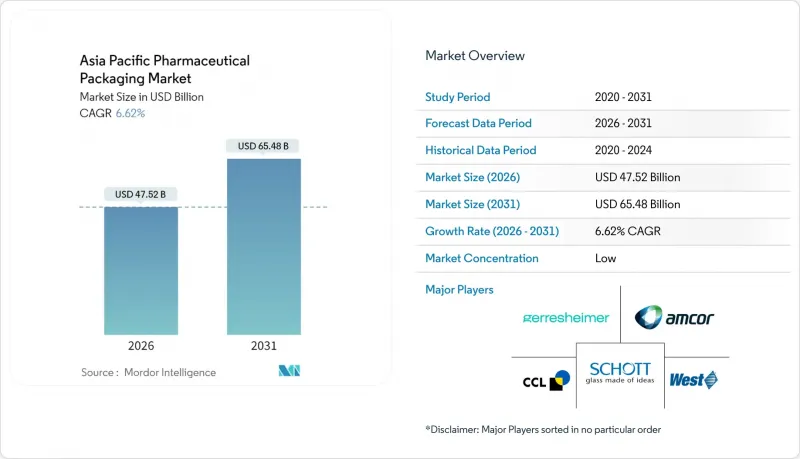
这一稳步增长反映了该地区从低成本生产中心向高价值生物製药、复杂灌装密封服务和序列化包装生产线的全球中心转型。随着中国实施电子代码序列化,以及印度扩大药品认证和检验应用(DAVA)的覆盖范围,需求不断增长,推动供应链各环节向可追溯、防篡改包装形式转变。材料创新也在加速发展,加工商正从一般塑胶转向能够承受细胞和基因疗法低温物流的环烯烃和生质塑胶。同时,製药品牌所有者正在采用单剂量包装和整合数位标识符,亚太地区药品包装市场正处于以永续性和合规性为重点的多年投资週期中。
亚太地区医药包装市场趋势与洞察
不断增长的生物製药产品线需要可靠的初级包装
2024年,生物製剂占肖特製药生物製药销售额的34%,推动总销售额达10.5亿美元。这标誌着其包装结构向预灭菌硼硼硅酸玻璃容器转变,从而最大限度地降低污染风险。 Stevanato集团也呈现类似的趋势,2024财年销售额达到12.1亿美元,其中38%来自即用型管瓶和药筒。 2024年9月,Schotta与Gerresheimer共同创立了「即用型包装联盟」(Alliance for RTU),旨在推动亚太地区药品包装市场即用型容器规格的标准化。如今,契约製造生产商在竞标阶段就明确要求使用无热原管瓶和预组装瓶盖,从而缩短疫苗和单株抗体上市的验证时间。随着生物製药产品线的成熟,对高价值容器的需求正在超越顶级製造地,这促使区域玻璃製造商对熔炉进行改造,以实现更严格的尺寸公差和可见的无颗粒生产。
将灌装和表面处理工程外包给亚洲的趋势正在推动合约包装量的成长。
Lotus Pharmaceutical 获得 FDA、EMA 和 PMDA 认证的网路在 2025 财年上半年实现了创纪录的收入,凸显了印度吸收从西方工厂转移过来的复杂灌装和表面处理工程的能力。新加坡和韩国在生物製药专业技术方面竞争,而中国经济高效的灭菌设施则缩短了季节性疫苗的生产前置作业时间。因此,亚太地区的药品包装市场对嵌套注射器、双腔药筒和序列化二级包装盒的需求量正在增加。技术转移协议越来越多地将包装合格测试与药品生产相结合,使本地加工商从单纯的商品供应商转变为解决方案合作伙伴。这种趋势正在加速符合 ISO 标准的无尘室基础设施的普及,并对标籤、测试和聚合服务产生连锁反应。
树脂和氧化铝价格的波动对加工商的利润率带来压力。
Winpack发布的2024年公布财报显示,尼龙和铝箔价格较上月下降9%至13%。这标誌着价格从先前的飙升中回落,凸显了包装材料生产商面临的商品价格快速波动问题。包装製造商正将财务资源投入到避险策略和灵活的定价条款中,而规模较小的公司则缺乏足够的信贷额度来应对价格飙升。库存控制更加严格,如果供应商限製配额,生产线停产的风险也会增加。成本吸收能力的不平衡使一体化跨国公司占据优势,导致亚太地区医药包装市场的竞争格局向那些透过谈判获得年度原料合约的大型企业倾斜。
细分市场分析
到2025年,塑胶仍将占据亚太地区医药包装市场46.78%的主导地位,这主要得益于主要製药製造群附近成熟的挤出和射出成型能力。然而,该细分市场的中个位数成长率与先进材料8.22%的复合年增长率形成鲜明对比,预示着市场正在向环烯烃、生物基聚合物和特种玻璃转型,这些材料具有更优异的耐低温储存和耐高活性药物性能。随着生物製药研发管线的扩展及Annex 1无尘室标准的加强,环烯烃共聚物可望推动亚太地区医药包装市场规模达到两位数成长。
三井化学的APEL™环烯烃创新技术已证明其能够在满足防潮要求的同时保持与伽马射线灭菌的兼容性,从而得以广泛应用于预填充式注射器筒体。玻璃製造商也在对其I型硼硅酸玻璃熔炉维修,以充分利用不断增长的注射剂填充和封装市场,同时避免传统管瓶的分层风险。从永续性的角度来看,薄膜加工商正在试验PLA-奈米纤维素复合材料,该材料预计将在满足《药品法典》规定的可萃取物限量的同时,确保可堆肥性。区域监管机构透过发布指南,优先考虑可回收性和碳足迹揭露,并将环境指标纳入材料选择清单,从而支持这项转型。
其他福利:
- Excel格式的市场预测(ME)表
- 3个月的分析师支持
目录
第一章 引言
- 研究假设和市场定义
- 调查范围
第二章调查方法
第三章执行摘要
第四章 市场情势
- 市场概览
- 市场驱动因素
- 不断增长的生物製药产品线需要可靠的初级包装
- 灌装和表面处理工程加速外包至亚洲,推动了合约包装业务量的成长。
- 政府批量采购计画倾向于采用成本效益高的泡壳包装形式。
- 序列化法规(中国的E-Code、印度的Dava)促进了可追溯包装的实施。
- 低剂量、高活性口服固体製剂(OSD)的激增将推动阻隔性PTP箔片的应用(被低估了)。
- 温度敏感型细胞和基因疗法的成长将创造对耐冷冻保存管瓶的需求(被低估了)。
- 市场限制
- 树脂和氧化铝价格的波动对加工商的利润率带来压力。
- 日本和韩国都采取了严格的PVC淘汰政策。
- 由于港口拥堵和低温运输瓶颈导致出口货物延误(未充分报告)
- 区域内药用级硼硅酸玻璃管供不应求(未充分通报)
- 产业价值链分析
- 监管环境
- 技术展望
- 波特五力分析
- 供应商的议价能力
- 消费者议价能力
- 新进入者的威胁
- 替代品的威胁
- 竞争对手之间的竞争
- 产业伙伴关係与合作
第五章 市场规模与成长预测
- 材料
- 塑胶
- 纸和纸板
- 玻璃
- 铝箔
- 其他材质(生质塑胶、环状烯烃)
- 按类型
- 安瓿
- 泡壳包装
- 塑胶瓶
- 注射器
- 管瓶
- 点滴
- 棒状包装
- 小袋和小袋
- 瓶盖和封装
- 透过药物输送方法
- 口服
- 注射
- 肺
- 经皮/经皮吸收型
- 其他给药途径
- 按国家/地区
- 中国
- 印度
- 日本
- 韩国
- 澳洲
- 亚太其他地区
第六章 竞争情势
- 市场集中度
- 策略趋势
- 市占率分析
- 公司简介
- Amcor plc
- Gerresheimer AG
- Schott AG
- West Pharmaceutical Services Inc
- CCL Industries Inc
- NIPRO Corporation
- Wihuri Group
- Klockner Pentaplast Group
- Catalent Pharma Solutions Inc
- Berry Global Group Inc
- SGD Pharma
- AptarGroup Inc
- Stevanato Group
- Huhtamaki Oyj
- Daikyo Seiko Ltd
- Shandong Pharmaceutical Glass Co
- Tekni-Plex Inc
- Alpla Werke
- Chongqing Zhengchuan Glass
- Essel Propack Ltd
第七章 市场机会与未来展望
The Asia Pacific pharmaceutical packaging market was valued at USD 44.57 billion in 2025 and estimated to grow from USD 47.52 billion in 2026 to reach USD 65.48 billion by 2031, at a CAGR of 6.62% during the forecast period (2026-2031).
This steady climb reflects the region's transition from a low-cost production base into a global center for high-value biologics, complex fill-finish services, and serialization-ready packaging lines. Demand intensifies as China enforces e-code serialization and India scales its Drug Authentication and Verification Application, pushing every tier of the supply chain toward traceable, tamper-evident formats. Material innovation also quickens: converters move from commodity plastics toward cyclic olefins and bioplastics that withstand deep-cold logistics for cell-and-gene therapies. In parallel, pharmaceutical brand owners favor single-dose formats and integrated digital identifiers, locking the Asia Pacific pharmaceutical packaging market into a multi-year investment cycle focused on sustainability and compliance.
Asia Pacific Pharmaceutical Packaging Market Trends and Insights
Rising Biologics Pipeline Demanding High-Integrity Primary Packaging
Biologics represented 34% of SCHOTT Pharma's biopharmaceutical revenue in 2024, lifting total sales to USD 1.05 billion and signaling a structural pivot toward pre-sterilized borosilicate formats that minimize contamination risk.Stevanato Group echoed this trend, generating USD 1.21 billion in fiscal 2024 with 38% of revenue from ready-to-use vials and cartridges. The two firms, together with Gerresheimer, formed the Alliance for RTU in September 2024 to standardize ready-to-use container formats across the Asia Pacific pharmaceutical packaging market. Contract manufacturers now specify depyrogenated vials and pre-assembled closures at bid stage, compressing validation timelines for vaccine and monoclonal antibody launches. As biologics pipelines mature, high-value container demand expands beyond top-tier sites, encouraging regional glass makers to retrofit furnaces for tighter dimensional tolerances and visible-particle-free output.
Accelerated Fill-Finish Outsourcing to Asia Driving Contract Packaging Volumes
Lotus Pharmaceutical's FDA-, EMA- and PMDA-certified network earned a record first-half 2025 revenue, reinforcing India's ability to absorb complex fill-finish work relocated from Western plants. Singapore and South Korea compete on biologics expertise, while cost-efficient sterilization suites in China shorten lead times for seasonal vaccine production. The Asia Pacific pharmaceutical packaging market consequently records higher throughput for nested syringes, dual-chamber cartridges, and serialized secondary cartons. Technology transfer contracts increasingly bundle packaging qualification with drug-product manufacture, elevating local converters into solution partners rather than commodity suppliers. This momentum accelerates adoption of ISO -compliant clean-room infrastructure and creates a ripple effect on labelling, inspection, and aggregation services.
Volatile Resin and Alumina Prices Squeezing Converter Margins
Winpak's 2024 earnings call revealed a 9-13% quarter-over-quarter drop in nylon and aluminum foil prices after earlier spikes, underscoring the commodity whiplash confronting converters. Packaging producers devote treasury resources to hedging strategies and flexible pricing clauses, yet smaller firms lack the credit lines to buffer sudden surges. Inventory runs leaner, raising the risk of line stoppages when suppliers ration allocations. Uneven cost absorption places integrated multinationals at an advantage, tilting competitive balance within the Asia Pacific pharmaceutical packaging market toward scale players that negotiate annual raw-material contracts.
Other drivers and restraints analyzed in the detailed report include:
- Government Bulk-Procurement Schemes Favouring Cost-Efficient Blister Formats
- Serialization Regulations Boosting Track-and-Trace Packaging
- Stringent PVC Phase-Out Policies in Japan and South Korea
For complete list of drivers and restraints, kindly check the Table Of Contents.
Segment Analysis
Plastic maintained a commanding 46.78% share of the Asia Pacific pharmaceutical packaging market in 2025 thanks to established extrusion and injection-molding capacity close to major drug-manufacturing clusters. Yet the segment's mid-single-digit growth contrasts with the 8.22% CAGR logged by advanced materials, underscoring a pivot toward cyclic olefins, bio-based polymers, and specialty glass that better withstand cryogenic storage and high-potency drugs. The Asia Pacific pharmaceutical packaging market size attributable to cyclic-olefin copolymers is projected to climb in double digits as biologics pipelines deepen and Annex 1 clean-room standards tighten.
Mitsui Chemicals' APEL(TM) demonstrates how cyclic-olefin innovation satisfies moisture-barrier demands while remaining compatible with gamma sterilization, enabling wider adoption in pre-filled syringe barrels. Glass producers also renovate furnaces for Type I borosilicate, aiming to capture injectable fill-finish growth without the delamination risks of legacy vials. On the sustainability front, film converters experiment with PLA-nanocellulose blends that promise compostability yet meet extractables limits required by pharmacopeias. Regional regulators support this shift by issuing guidance prioritizing recyclability and carbon-footprint disclosure, embedding environmental metrics into material-selection checklists.
The Asia Pacific Pharmaceutical Packaging Market Report is Segmented by Material (Plastic, Paper and Paperboard, Glass, Aluminum Foil, Other Advanced Materials), Type (Ampoules, Blister Packs, Plastic Bottles, Syringes, Vials, IV Fluids, Stick Packs, Pouches and Sachets, Caps and Closures), Drug Delivery Mode (Oral, Injectable, Pulmonary, and More), and Country. The Market Forecasts are Provided in Terms of Value (USD).
List of Companies Covered in this Report:
- Amcor plc
- Gerresheimer AG
- Schott AG
- West Pharmaceutical Services Inc
- CCL Industries Inc
- NIPRO Corporation
- Wihuri Group
- Klockner Pentaplast Group
- Catalent Pharma Solutions Inc
- Berry Global Group Inc
- SGD Pharma
- AptarGroup Inc
- Stevanato Group
- Huhtamaki Oyj
- Daikyo Seiko Ltd
- Shandong Pharmaceutical Glass Co
- Tekni-Plex Inc
- Alpla Werke
- Chongqing Zhengchuan Glass
- Essel Propack Ltd
Additional Benefits:
- The market estimate (ME) sheet in Excel format
- 3 months of analyst support
TABLE OF CONTENTS
1 INTRODUCTION
- 1.1 Study Assumptions and Market Definition
- 1.2 Scope of the Study
2 RESEARCH METHODOLOGY
3 EXECUTIVE SUMMARY
4 MARKET LANDSCAPE
- 4.1 Market Overview
- 4.2 Market Drivers
- 4.2.1 Rising Biologics Pipeline Demanding High-Integrity Primary Packaging
- 4.2.2 Accelerated Fill-Finish Outsourcing to Asia Driving Contract Packaging Volumes
- 4.2.3 Government Bulk-Procurement Schemes Favouring Cost-Efficient Blister Formats
- 4.2.4 Serialization Regulations (China E-Codes, India Dava) Boosting Track-and-Trace Packaging
- 4.2.5 Surge in Low-Dose, High-Potency OSD Drugs Spurring Adoption of High-Barrier PTP Foils (Under-Reported)
- 4.2.6 Growth of Temperature-Sensitive Cell-and-Gene Therapies Creating Demand for Cryo-Compatible Vials (Under-Reported)
- 4.3 Market Restraints
- 4.3.1 Volatile Resin and Alumina Prices Squeezing Converter Margins
- 4.3.2 Stringent PVC Phase-Out Policies In Japan and South Korea
- 4.3.3 Port Congestion and Cold-Chain Bottlenecks Slowing Export Shipments (Under-Reported)
- 4.3.4 Limited Regional Supply of Pharma-Grade Borosilicate Tubing (Under-Reported)
- 4.4 Industry Value Chain Analysis
- 4.5 Regulatory Landscape
- 4.6 Technological Outlook
- 4.7 Porter's Five Forces Analysis
- 4.7.1 Bargaining Power of Supplier
- 4.7.2 Bargaining Power of Consumers
- 4.7.3 Threat of New Entrants
- 4.7.4 Threat of Substitute Products
- 4.7.5 Intensity of Competitive Rivalry
- 4.8 Industry Partnerships and Collaborations
5 MARKET SIZE AND GROWTH FORECASTS (VALUE)
- 5.1 By Material
- 5.1.1 Plastic
- 5.1.2 Paper and Paperboard
- 5.1.3 Glass
- 5.1.4 Aluminum Foil
- 5.1.5 Other Materials (Bioplastics, Cyclic Olefins)
- 5.2 By Type
- 5.2.1 Ampoules
- 5.2.2 Blister Packs
- 5.2.3 Plastic Bottles
- 5.2.4 Syringes
- 5.2.5 Vials
- 5.2.6 IV Fluids
- 5.2.7 Stick Packs
- 5.2.8 Pouches and Sachets
- 5.2.9 Caps and Closures
- 5.3 By Drug Delivery Mode
- 5.3.1 Oral
- 5.3.2 Injectable
- 5.3.3 Pulmonary
- 5.3.4 Topical and Transdermal
- 5.3.5 Other Modes
- 5.4 By Country
- 5.4.1 China
- 5.4.2 India
- 5.4.3 Japan
- 5.4.4 South Korea
- 5.4.5 Australia
- 5.4.6 Rest of Asia Pacific
6 COMPETITIVE LANDSCAPE
- 6.1 Market Concentration
- 6.2 Strategic Moves
- 6.3 Market Share Analysis
- 6.4 Company Profiles {(includes Global level Overview, Market level overview, Core Segments, Financials as available, Strategic Information, Market Rank/Share for key companies, Products and Services, and Recent Developments)}
- 6.4.1 Amcor plc
- 6.4.2 Gerresheimer AG
- 6.4.3 Schott AG
- 6.4.4 West Pharmaceutical Services Inc
- 6.4.5 CCL Industries Inc
- 6.4.6 NIPRO Corporation
- 6.4.7 Wihuri Group
- 6.4.8 Klockner Pentaplast Group
- 6.4.9 Catalent Pharma Solutions Inc
- 6.4.10 Berry Global Group Inc
- 6.4.11 SGD Pharma
- 6.4.12 AptarGroup Inc
- 6.4.13 Stevanato Group
- 6.4.14 Huhtamaki Oyj
- 6.4.15 Daikyo Seiko Ltd
- 6.4.16 Shandong Pharmaceutical Glass Co
- 6.4.17 Tekni-Plex Inc
- 6.4.18 Alpla Werke
- 6.4.19 Chongqing Zhengchuan Glass
- 6.4.20 Essel Propack Ltd
7 MARKET OPPORTUNITIES AND FUTURE OUTLOOK
- 7.1 White-space and Unmet-Need Assessment

 药品包装市场:依材料、产品类型、包装等级、药品类型、剂型、最终用户及通路划分-2026-2032年全球市场预测实验室耗材初级包装市场:依产品类型、材料、应用和形式划分-2026年至2032年全球市场预测
 全球药品包装袋检测系统市场规模、份额、趋势和成长分析报告(2026-2034年)医药瓶装盒机市场:按应用、最终用户、机器类型、包装材料和包装速度划分 - 全球预测 2026-2032
 2026年全球药品单剂量包装市场报告
 医药包装市场分析及预测(至2035年):依类型、产品类型、材质、技术、应用、组件、最终用户、功能、製程及解决方案划分容器密封完整性测试市场分析及预测(至2035年):类型、产品、服务、技术、应用、材质类型、设备、製程、最终用户、设施全球疫苗包装市场规模、份额、趋势和成长分析报告(2026-2034年)全球药品包装市场规模、份额、趋势和成长分析报告(2026-2034年)
 日本生物製药包装市场规模、份额、趋势及预测(依材料、包装类型、应用及地区划分),2026-2034年