


 |
市场调查报告书
商品编码
1939148
合成钻石:市场占有率分析、产业趋势与统计、成长预测(2026-2031)Synthetic Diamond - Market Share Analysis, Industry Trends & Statistics, Growth Forecasts (2026 - 2031) |
||||||

※ 本网页内容可能与最新版本有所差异。详细情况请与我们联繫。
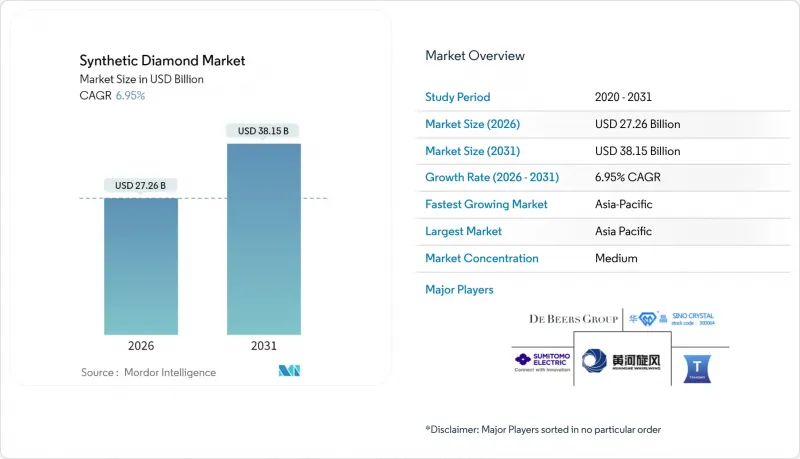
预计合成钻石市场将从 2025 年的 254.9 亿美元成长到 2026 年的 272.6 亿美元,到 2031 年达到 381.5 亿美元,2026 年至 2031 年的复合年增长率为 6.95%。
电讯、电动车、航太和精密製造等产业需求的成长推动了收入的持续成长,而对永续性的呼吁正促使消费者从开采钻石转向实验室培育钻石。亚太地区已占据钻石晶片和超磨粒工具市场的大部分份额,这得益于政府的激励措施和电子产品出口的激增。随着专注于技术的新兴参与企业扩大化学气相沉积(CVD)产能,能够生产出装置级纯度的钻石,竞争日益激烈,对现有的高温高压(HPHT)模式构成了直接挑战。同时,波湾合作理事会(GCC)的奢侈品牌正利用彩色实验室培育钻石来满足具有环保意识的消费者的需求,并将市场拓展到传统婚礼珠宝之外。监管的不确定性和认证标准的不一致仍然是主要的阻力,尤其是在固定零售价格侵蚀终端用户对钻石转售价值的认知的情况下,但以业绩为导向的高科技行业仍在努力维持利润率。
全球合成钻石市场趋势及展望
亚洲5G/6G射频滤波器中CVD钻石的应用日益增多
CVD单晶硅片的散热能力高达22 W/cm*K,这使得製造更小巧、更可靠的高频滤波器成为可能,从而支援高密度5G和未来的6G网路。 DARPA支援的大面积基板研究正在向商业晶圆代工厂转移,尤其是在中国、韩国和台湾地区,这些地区的垂直整合型OEM厂商正在将钻石晶片黏接层整合到大规模多输入多输出(mMIMO)天线中。当地供应商报告称,功耗降低,基地台寿命延长,为营运商节省了可观的总体拥有成本(TCO)。
电动车电池超级工厂推动工业用钻石需求激增
多晶钻石涂层精密研磨对于切割富硅负极材料、雷射划线隔膜以及铝製机壳的表面精加工至关重要。美国和欧洲的超大型电池工厂目前在超过70%的高速加工工位中指定使用钻石工具,这推高了每个汽车平臺的单位耗材量。 Diamond Foundry的晶圆逆变器尺寸仅为现有设计的六分之一,却能提供更高的高功率,显示改进的热性能和电气性能可以提高动力传动系统的效率。
监管和认证方面的挑战
印度中央消费者保护局要求零售商在发票和促销资料上註明钻石的产地和培育方式,这增加了合规成本,并促使供应链更加透明。在美国,JVC 指南也提出了类似的审核要求,迫使企业投资光谱分析和自动化筛检设备。各地法规的差异使跨境贸易更加复杂,并使经销商面临法律风险。
细分市场分析
2025年,毛坯钻石占合成钻石市场的65.30%,这主要得益于建筑、石油天然气钻探和精密切割工具等领域对毛坯钻石日益增长的需求,这些领域都受益于毛坯钻石卓越的硬度和导热性。根据美国地质调查局(USGS)统计,美国国内毛坯钻石产量为1.6亿克拉(价值5,300万美元),较上年成长5%。
儘管产量较低,但抛光原石却是成长最快的品类,年复合成长率高达9.35%。消费者的广泛接受、设计柔软性的提升以及等离子体后处理技术(可增强色彩饱和度)的进步,都推动了中阶珠宝连锁店交易量的成长。据美国宝石学院(GIA)称,化学气相沉积(CVD)产品的鑑定需求已超过高温高压(HPHT)产品,其中彩色宝石和3克拉以上的原石的鑑定需求同比增长显着。即使批发价格在预测期内保持稳定,抛光宝石预计仍将在全通路零售中继续扩大销售份额。
区域分析
亚太地区预计到2025年将占全球钻石收入的55.40%,并将继续保持成长最快的地区地位,到2031年平均年增长率将达到8.05%。河南、山东和古吉拉突邦的生产群集提供从晶种合成到成品珠宝的垂直整合营运模式。中国在实验室反应器领域的领先地位带来了成本优势,而印度取消5%的毛坯钻石进口关税也吸引了许多外国合资企业。
北美仍然是高性能应用领域的关键参与者,尤其是在量子感测和宽能带隙功率电子领域。 AdamasOne 位于南卡罗来纳州的工厂(目前运作12 个反应堆,每月生产 3000 克拉原石)专注于专有的生长通讯协定,以确保获得航太和医疗合约。
欧洲保持稳定,同时创新型。德国工具製造商和法国光电新兴企业正在将钻石嵌件应用于轻量化汽车领域。英国的学术生态系统,特别是国家量子计算中心,正在推进氮空位(NV)缺陷工程技术在安全通讯领域的应用。在欧洲以外,中东正将杜拜打造成为贸易和生产中心。
其他福利:
- Excel格式的市场预测(ME)表
- 3个月的分析师支持
目录
第一章 引言
- 研究假设和市场定义
- 调查范围
第二章调查方法
第三章执行摘要
第四章 市场情势
- 市场概览
- 市场驱动因素
- CVD钻石在5G/6G射频滤波器的应用日益广泛(亚洲地区)
- 电动车电池超级工厂推动工业用钻石需求激增
- 对超磨粒的需求不断增长
- 超磨粒在航太复合材料自动化数控加工的应用
- 海湾合作委员会地区奢侈品牌的永续性转型:转向实验室培育彩色宝石
- 市场限制
- 监管和认证方面的挑战
- 复杂的製造过程
- 实验室培育钻石价格下跌以及消费者对实验室培育钻石与天然钻石比较的困惑
- 价值链分析
- 波特五力模型
- 供应商的议价能力
- 买方的议价能力
- 新进入者的威胁
- 替代品的威胁
- 竞争对手之间的竞争
第五章 市场规模与成长预测
- 依产品类型
- 抛光
- 珠宝
- 电子设备
- 卫生保健
- 其他抛光类型
- 粗糙的石头
- 建造
- 矿业
- 石油和天然气
- 其他宝石类型
- 抛光
- 透过製造工艺
- 高压高温(HPHT)
- 化学气相沉积(CVD)
- 按地区
- 亚太地区
- 中国
- 印度
- 日本
- 韩国
- ASEAN
- 亚太其他地区
- 北美洲
- 我们
- 加拿大
- 墨西哥
- 欧洲
- 德国
- 英国
- 法国
- 义大利
- 西班牙
- 北欧国家
- 其他欧洲地区
- 南美洲
- 巴西
- 阿根廷
- 南美洲其他地区
- 中东和非洲
- 沙乌地阿拉伯
- 南非
- 其他中东和非洲地区
- 亚太地区
第六章 竞争情势
- 市场集中度
- 策略趋势
- 市占率分析
- 公司简介
- ADAMAS ONE
- Applied Diamond Inc.
- Coherent Corp.
- De Beers Group(Element Six)
- Diamond Foundry
- Henan Huanghe Whirlwind CO.,Ltd.
- Heyaru Group
- ILJIN DIAMOND CO., LTD.
- John Crane(Advanced Diamond Technologies, Inc.)
- NEW DIAMOND TECHNOLOGY LLC
- PURE LAB DIAMONDS
- Sandvik AB
- Sumitomo Electric Industries, Ltd.
- Swarovski AG
- Tecdia, Inc.
- Washington Diamond
- Zhengzhou Sino-Crystal Diamond Co.,Ltd.
- Zhuhai Zhong Na Diamond Co.,Ltd Inc.
第七章 市场机会与未来展望
The Synthetic Diamond market is expected to grow from USD 25.49 billion in 2025 to USD 27.26 billion in 2026 and is forecast to reach USD 38.15 billion by 2031 at 6.95% CAGR over 2026-2031.
Escalating demand from telecommunications, electric vehicles, aerospace, and high-precision manufacturing is accelerating revenue streams, while persistent sustainability mandates are steering customers away from mined stones toward engineered alternatives. Asia Pacific, already supplying most diamond wafers and super-abrasive tools, benefits from generous state incentives and surging electronics exports. Competition is intensifying because technology-focused entrants are scaling Chemical Vapor Deposition (CVD) capacity that can achieve device-grade purity, posing a direct challenge to the incumbent High Pressure High Temperature (HPHT) model. Meanwhile, luxury brands in the Gulf Cooperation Council are leveraging fancy-color lab-grown stones to satisfy environmentally conscious consumers, widening the addressable base beyond traditional bridal jewelry. Regulatory uncertainty and uneven certification standards remain the chief headwinds, especially as retail price corrections undermine perceived resale value among end users, but the performance-driven high-tech arena continues to shield margins.
Global Synthetic Diamond Market Trends and Insights
Rising Adoption of CVD Diamonds for 5G/6G RF Filters in Asia
CVD single-crystal wafers dissipate heat at 22 W/cm*K, enabling smaller and more reliable radio-frequency filters that underpin dense 5G and future 6G networks. Large-area substrate work sponsored by DARPA is migrating into commercial foundries, particularly in China, South Korea, and Taiwan, where vertically integrated OEMs are embedding diamond die-attach layers inside massive multiple-input multiple-output (mMIMO) antennas. Local equipment vendors report lower power consumption and longer base-station lifetimes, giving operators measurable total-cost-of-ownership gains.
Industrial Diamond Demand Surge from EV Battery Gigafactories
Precision grinding wheels with polycrystalline diamond coatings are indispensable for cutting silicon-rich anodes, laser-scribing separator films, and surfacing aluminum casings. Giga-scale battery plants in the United States and Europe now specify diamond tooling in over 70% of high-speed machining stations, elevating unit consumption per vehicle platform. Diamond Foundry's wafer-based inverter, six times smaller than the incumbent design yet more powerful, underscores how thermal and electrical properties improve drivetrain efficiency.
Regulatory and Certification Challenges
The Central Consumer Protection Authority in India requires retailers to specify production origin and growth method on invoices and marketing collateral, adding compliance costs and compelling supply-chain transparency. In the United States, Jewelers Vigilance Committee guidelines similarly tighten audit obligations, prompting firms to invest in spectroscopy and automated screening equipment. Divergent rules by region complicate cross-border trading and create legal exposure for distributors.
Other drivers and restraints analyzed in the detailed report include:
- Growing Demand for Super-Abrasives
- Luxury Brands' Sustainability Pivot to Lab-Grown Fancy-Color Stones in the GCC
- Consumer Confusion Over Lab-Grown Diamond Price Depreciation
For complete list of drivers and restraints, kindly check the Table Of Contents.
Segment Analysis
Rough stones captured 65.30% of the synthetic diamond market share in 2025, owing to heavy uptake in construction, oil-and-gas drilling, and precision cutting tools, all of which leverage unmatched hardness and thermal conductivity. The U.S. Geological Survey recorded domestic output of 160 million carats valued at USD 53 million, a 5% rise on the prior year.
Polished stones, though smaller in tonnage, are the fastest-expanding category at a projected 9.35% CAGR. Wider consumer acceptance, heightened design flexibility, and advances in plasma post-processing that enhance color saturation are boosting volumes across mid-tier jewelry chains. The Gemological Institute of America notes that CVD submissions now exceed HPHT samples, with fancy colors and 3-carat-plus stones up sharply year over year. Over the forecast horizon, polished gems are expected to secure incremental shelf space in omnichannel retail, even as wholesale prices stabilize.
The Synthetic Diamond Market Report Segments the Industry by Product Type (Polished and Rough), Manufacturing Process (High Pressure, High Temperature (HPHT) and Chemical Vapor Deposition (CVD)), and Geography (Asia-Pacific, North America, Europe, South America, and Middle-East and Africa). The Market Forecasts are Provided in Terms of Value (USD).
Geography Analysis
Asia Pacific anchored 55.40% of global revenue in 2025 and continues to post the fastest regional growth at an 8.05% CAGR through 2031. Production clusters in Henan, Shandong, and Gujarat host vertically integrated operations that span seed synthesis to finished jewelry. China's dominance in lab reactors provides cost advantages, while India's abolition of a 5% import duty on diamond seeds attracts overseas joint ventures.
North America remains pivotal for high-performance applications, particularly in quantum sensing and wide-band-gap power electronics. Adamas One Corp's South Carolina facility, which currently runs 12 reactors producing 3,000 rough carats monthly, emphasizes IP-protected growth protocols to secure aerospace and medical contracts.
Europe maintains a stable but innovation-oriented stance. German toolmakers and French photonics startups incorporate diamond inserts to meet automotive lightweighting mandates. The United Kingdom's academic ecosystem, notably the National Quantum Computing Centre, advances Nitrogen-Vacancy (NV) defect engineering for secure communications. Outside Europe, the Middle East positions Dubai as a trading and production hub.
- ADAMAS ONE
- Applied Diamond Inc.
- Coherent Corp.
- De Beers Group (Element Six)
- Diamond Foundry
- Henan Huanghe Whirlwind CO.,Ltd.
- Heyaru Group
- ILJIN DIAMOND CO., LTD.
- John Crane (Advanced Diamond Technologies, Inc.)
- NEW DIAMOND TECHNOLOGY LLC
- PURE LAB DIAMONDS
- Sandvik AB
- Sumitomo Electric Industries, Ltd.
- Swarovski AG
- Tecdia, Inc.
- Washington Diamond
- Zhengzhou Sino-Crystal Diamond Co.,Ltd.
- Zhuhai Zhong Na Diamond Co.,Ltd Inc.
Additional Benefits:
- The market estimate (ME) sheet in Excel format
- 3 months of analyst support
TABLE OF CONTENTS
1 Introduction
- 1.1 Study Assumptions and Market Definition
- 1.2 Scope of the Study
2 Research Methodology
3 Executive Summary
4 Market Landscape
- 4.1 Market Overview
- 4.2 Market Drivers
- 4.2.1 Rising Adoption of CVD Diamonds for 5G/6G RF Filters Asia
- 4.2.2 Industrial Diamond Demand Surge from EV Battery Gigafactories
- 4.2.3 Growing Demand for Super Abrasives
- 4.2.4 Super-abrasive Usage in Automated CNC Machining for Aerospace Composites
- 4.2.5 Luxury Brands' Sustainability Pivot to Lab-Grown Fancy-Color Stones in the GCC
- 4.3 Market Restraints
- 4.3.1 Regulatory and Certification Challenges
- 4.3.2 Complex Manufacturing Process
- 4.3.3 Consumer Confusion Over LGD Price Depreciation vs. Natural Diamonds
- 4.4 Value Chain Analysis
- 4.5 Porter's Five Forces
- 4.5.1 Bargaining Power of Suppliers
- 4.5.2 Bargaining Power of Buyers
- 4.5.3 Threat of New Entrants
- 4.5.4 Threat of Substitutes
- 4.5.5 Competitive Rivalry
5 Market Size and Growth Forecasts (Value and Volume)
- 5.1 By Product Type
- 5.1.1 Polished
- 5.1.1.1 Jewelry
- 5.1.1.2 Electronics
- 5.1.1.3 Healthcare
- 5.1.1.4 Other Polished Types
- 5.1.2 Rough
- 5.1.2.1 Construction
- 5.1.2.2 Mining
- 5.1.2.3 Oil and Gas
- 5.1.2.4 Other Rough Types
- 5.1.1 Polished
- 5.2 By Manufacturing Process
- 5.2.1 High Pressure High Temperature (HPHT)
- 5.2.2 Chemical Vapor Deposition (CVD)
- 5.3 By Geography
- 5.3.1 Asia-Pacific
- 5.3.1.1 China
- 5.3.1.2 India
- 5.3.1.3 Japan
- 5.3.1.4 South Korea
- 5.3.1.5 ASEAN
- 5.3.1.6 Rest of Asia-Pacific
- 5.3.2 North America
- 5.3.2.1 United States
- 5.3.2.2 Canada
- 5.3.2.3 Mexico
- 5.3.3 Europe
- 5.3.3.1 Germany
- 5.3.3.2 United Kingdom
- 5.3.3.3 France
- 5.3.3.4 Italy
- 5.3.3.5 Spain
- 5.3.3.6 Nordics
- 5.3.3.7 Rest of Europe
- 5.3.4 South America
- 5.3.4.1 Brazil
- 5.3.4.2 Argentina
- 5.3.4.3 Rest of South America
- 5.3.5 Middle-East and Africa
- 5.3.5.1 Saudi Arabia
- 5.3.5.2 South Africa
- 5.3.5.3 Rest of Middle-East and Africa
- 5.3.1 Asia-Pacific
6 Competitive Landscape
- 6.1 Market Concentration
- 6.2 Strategic Moves
- 6.3 Market Share Analysis
- 6.4 Company Profiles (includes Global level Overview, Market level overview, Core Segments, Financials as available, Strategic Information, Market Rank/Share for key companies, Products and Services, and Recent Developments)
- 6.4.1 ADAMAS ONE
- 6.4.2 Applied Diamond Inc.
- 6.4.3 Coherent Corp.
- 6.4.4 De Beers Group (Element Six)
- 6.4.5 Diamond Foundry
- 6.4.6 Henan Huanghe Whirlwind CO.,Ltd.
- 6.4.7 Heyaru Group
- 6.4.8 ILJIN DIAMOND CO., LTD.
- 6.4.9 John Crane (Advanced Diamond Technologies, Inc.)
- 6.4.10 NEW DIAMOND TECHNOLOGY LLC
- 6.4.11 PURE LAB DIAMONDS
- 6.4.12 Sandvik AB
- 6.4.13 Sumitomo Electric Industries, Ltd.
- 6.4.14 Swarovski AG
- 6.4.15 Tecdia, Inc.
- 6.4.16 Washington Diamond
- 6.4.17 Zhengzhou Sino-Crystal Diamond Co.,Ltd.
- 6.4.18 Zhuhai Zhong Na Diamond Co.,Ltd Inc.
7 Market Opportunities and Future Outlook
- 7.1 White-space and Unmet-Need Assessment
- 7.2 Applications in Orthopedic Medical Devices

 2026年全球实验室培育钻石市场报告2026年全球化学气相沉积法(CVD)实验室培育钻石市场报告2026年全球合成钻石市场报告
 CVD钻石市场(按形状、克拉重量范围、分销管道和应用划分)—全球预测,2026-2032年彩色CVD钻石市场按形状、颜色、克拉重量、切割等级、销售管道和应用划分-全球预测,2026-2032年
 合成钻石市场规模、份额和成长分析(按类型、产品类型、製造流程和地区划分)-2026-2033年产业预测
 实验室培育钻石市场预测至2032年:按产品类型、生产方法、特性、尺寸、应用、通路和地区分類的全球分析
 全球化学气相沉积 (CVD) 实验室培育钻石市场
 人造钻石市场(按类型、製造工艺和地区划分)
 全球合成钻石市场规模(按产品类型、製造流程、应用、地区和预测)