


 |
市场调查报告书
商品编码
1939598
汽车轮胎压力监测系统(TPMS):市场份额分析、产业趋势与统计、成长预测(2026-2031)Automotive TPMS - Market Share Analysis, Industry Trends & Statistics, Growth Forecasts (2026 - 2031) |
||||||

※ 本网页内容可能与最新版本有所差异。详细情况请与我们联繫。
汽车轮胎压力监测系统 (TPMS) 市场预计将从 2025 年的 71.2 亿美元成长到 2026 年的 76.9 亿美元,预计到 2031 年将达到 113.1 亿美元,2026 年至 2031 年的复合年增长率为 8.02%。
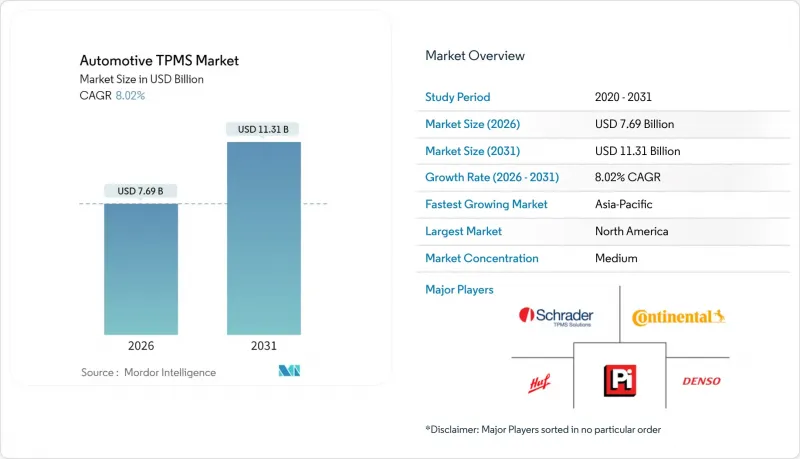
这项成长的驱动力来自日益严格的安全法规、向电动动力传动系统的转型,以及轮胎数据与高级驾驶辅助系统和联网汽车基础设施的深度整合。即时轮胎健康分析正在取代传统的仅提供胎压警报,使汽车製造商能够将预测性维护与空中软体更新相结合,同时保障对重量敏感的电动车车型的续航里程。感测器、网关和云端平台的整合也降低了系统成本,加速了其在摩托车和商用车车队的应用。同时,压电能源采集技术的创新和安全的2.4GHz连接正在重新定义感测器的自供电方式以及轮胎、网关和云端之间的数据传输方式,为汽车轮胎压力监测系统(TPMS)市场在多个细分领域的持续增长奠定了基础。
全球汽车轮胎压力监测系统(TPMS)市场趋势及洞察
根据新的汽车安全法规,胎压监测系统(TPMS)的安装现已成为强制性要求。
法规的适用范围已不再局限于乘用车。欧盟通用安全法规(将于2024年7月生效)将强制要求扩展至卡车、巴士和拖车。美国相应的法规FMVSS 138涵盖所有重量低于10,000磅的轻型车辆,每辆车的安装成本在48.44美元至69.89美元之间。韩国的早期应用以及印度的框架草案为新兴市场提供了蓝图,确保汽车轮胎压力监测系统(TPMS)市场在中期内保持监管需求。先前应用较为缓慢的商用车也在快速更新换代,推动了替换需求,并促进了感测器生产的规模经济。
加强与ADAS和联网汽车远端资讯处理平台的集成
将胎压监测系统 (TPMS) 的直接数据与车辆稳定性控制、自动煞车和云端分析结合,可提升整体安全性能。 Melexis 为汽车製造商推出了业界首款支援蓝牙功能的 TPMS,支援无线软体更新,并可与行动应用程式无缝整合。在电动车领域,TPMS 数据是高级驾驶辅助系统 (ADAS) 的重要组成部分,因为优化的胎压可以延长电池续航里程并减少能量回收煞车波动。随着 2025 年车型强製配备自动紧急煞车系统,轮胎状况预计将成为决策演算法中更关键的输入参数。
入门级产品中感测器和校准高成本
对于价格敏感的A级轿车和通勤自行车而言,12-15美元的额外硬体成本加上经销商的校准费用阻碍了其全面普及。大陆集团的多重通讯协定可编程感测器虽然减少了维修厂的库存单位数量,但独立维修人员仍需要扫描工具和培训,以避免保固问题。电池续航力的限制也进一步阻碍了预算有限的车主采用这项技术,因为他们觉得更换灯泡很麻烦。
细分市场分析
到2025年,直接式架构将占据汽车轮胎压力监测系统(TPMS)市场62.35%的份额,预计到2031年将以8.01%的复合年增长率增长,这主要得益于其能够提供符合联合国R141精度标准的即时压力和温度数据。间接式解决方案利用ABS车轮速度讯号,为车队改造提供了经济高效的方案,但无法提供ADAS感测器融合所需的高解析度资料流。随着汽车製造商向集中式网域控制器转型,直接式TPMS节点可以轻鬆整合到CAN-FD和汽车乙太网路骨干网路中,从而简化诊断和空中韧体更新。
除了硬体之外,软体分析平台还能将原始轮胎资料转化为可操作的维护週期、预测性胎面磨损警报和动态负载平衡提示。车队管理入口网站整合了胎压监测系统 (TPMS) 控制面板,使维修经理能够在路边爆胎之前及早发现微小洩漏。这种预测价值正推动汽车胎压监测系统 (TPMS) 市场从零件到服务的模式转型,即使晶片成本下降,也能维持较高的定价。
到2025年,MEMS电容元件将占据汽车轮胎压力监测系统(TPMS)51.05%的市场份额,这主要得益于前端製造技术的日趋成熟以及原始设备製造商(OEM)的广泛检验。然而,压电能源采集正迅速普及,预计年复合成长率(CAGR)将达到8.11%,这主要归功于供应商将锆钛酸铅条整合到TPMS中,该铅条能够将汽车胎体形变转化为有效电荷。佩鲁贾大学的概念验证原型在2MPa的径向负载下产生了768V的电压,完全满足了微控制器的占空比要求,且无需纽扣电池。省去电池不仅便于报废回收,延长了维护週期,也使得TPMS能够应用于无轮毂摩托车等感测器安装困难的车款上。
同时,诸如NXP FXTH87E之类的双轴加速感应器可实现车轮自动定位,将轮胎换位时间缩短五分钟,并支援租赁车队的现场部署。应变计和光学感测器在小众高性能车辆领域仍需求旺盛,因为低于0.1 psi的解析度能够提升赛道性能,但高昂的组件成本限制了其产量。
区域分析
根据FMVSS 138标准,北美地区在2025年仍是汽车轮胎压力监测系统(TPMS)市场收入的最大区域贡献者,市占率高达36.12%,这主要得益于其在轻型车辆中的高搭载率和强大的售后市场供应链。各州对网路安全的持续关注正促使供应商转向符合即将到来的ISO 21434审核要求的加密BLE和UWB协定堆迭。加拿大正朝着美国标准部署方向发展,而墨西哥的OEM工厂则越来越多地为出口市场预装TPMS,从而加强了德克萨斯州和新莱昂州物流中心的供应链集群。为了提高合规性、安全性和责任评估(CSA)评分,商务传输者正在大规模改装8级牵引车,预计到2025年,该地区的改装渗透率将达到约40%。
欧洲通用安全法规将要求从2024年中期起,所有新商用车都必须安装胎压监测系统(TPMS)。戴姆勒卡车和曼恩等德国汽车製造商已开始将感测器直接整合到重型卡车平台中。同时,英国售后市场经销商报告称,改装厢型车的销量较去年同期成长超过50%。该地区的脱碳目标正促使车队营运商将TPMS与低滚动阻力轮胎配合使用,TÜV Nord的实地测试表明,这样可以节省2-3%的燃油。 UN R141标准在欧洲的统一化进一步降低了型式认证门槛,使得从鹿特丹到华沙的拖车零件编号能够在跨境车队中实现标准化。
亚太地区在轮胎胎压监测系统(TPMS)出货量方面保持领先地位,预计到2031年将以8.19%的复合年增长率增长,超过全球平均水平。这主要得益于印度、中国和东南亚国家不断扩大的摩托车和轻型卡车TPMS法规。中国电动车的快速成长迫使对续航里程要求较高的汽车製造商在其A级掀背车标配TPMS,比亚迪每年从当地二级供应商采购数百万个感测器。韩国的售后感测器市场自2013年初强制实施TPMS以来已日趋成熟,而印度修订后的汽车工业标准149(AISI)提案提案从2026年起强制M类和N类车辆安装TPMS。越南摩托车製造商正在为售价低于1500美元的150cc车型标配直通式感测器,这表明在东协地区,由于具备大规模生产的能力,TPMS成本有快速降低的潜力。
其他福利:
- Excel格式的市场预测(ME)表
- 3个月的分析师支持
目录
第一章 引言
- 研究假设和市场定义
- 调查范围
第二章调查方法
第3章执行摘要
第四章 市场情势
- 市场概览
- 市场驱动因素
- 根据新的汽车安全法规,胎压监测系统(TPMS)的安装现已成为强制性要求。
- 加强与ADAS和联网汽车远端资讯处理平台的集成
- 低成本MEMS感测器在摩托车领域的普及
- 迈向智慧轮胎健康分析生态系统
- 电气化带来的重量增加和续航里程问题
- 保险公司利用远端资讯处理技术激励轮胎压力合规性
- 市场限制
- 入门级感测器校准高成本
- 售后市场安装的复杂性与维修挑战
- 无线胎压监测系统的网路安全漏洞
- 无气轮胎和防爆轮胎技术的出现
- 价值/供应链分析
- 监管环境
- 技术展望
- ポーターの五力分析
- 供应商的议价能力
- 买方和消费者的议价能力
- 新进入者的威胁
- 替代品的威胁
- 竞争对手之间的竞争
第五章 市场规模及成长预测(金额)
- 依系统类型
- 直接的
- 间接
- 杂交种
- センサー技术别
- MEMS静电容量式
- 应变计
- 压电
- 其他(光学、表面声波等)
- 透过安装方法
- 阀桿(卡入式/夹紧式)
- バンド/リムマウント式
- 组み込みタイヤモジュール
- 按频段
- 315 MHz
- 433 MHz
- 2.4 GHz 以上频段及超宽频
- 按车辆类型
- 搭乘用车
- 商用车辆
- 摩托车
- 按销售管道
- 原厂配套
- 售后改装
- 按地区
- 北美洲
- 我们
- 加拿大
- 北美其他地区
- 南美洲
- 巴西
- 阿根廷
- 南美洲其他地区
- 欧洲
- 德国
- 英国
- 法国
- 义大利
- 西班牙
- 俄罗斯
- 其他欧洲地区
- 亚太地区
- 中国
- 日本
- 印度
- 韩国
- 澳洲
- 亚太其他地区
- 中东和非洲
- 阿拉伯聯合大公国
- 沙乌地阿拉伯
- 土耳其
- 埃及
- 南非
- 其他中东和非洲地区
- 北美洲
第6章 竞合情势
- 市场集中度
- 策略趋势
- 市占率分析
- 公司简介
- Continental AG
- Sensata Technologies/Schrader
- Pacific Industrial Co. Ltd.
- Huf Hulsbeck & Furst
- DENSO Corporation
- ZF Friedrichshafen AG(incl. TRW)
- Valeo SA
- ALLIGATOR Ventilfabrik GmbH
- Alps Alpine Co. Ltd.
- Delphi/Aptiv plc
- Continental-Vitesco JV
- PressurePro Enterprises Inc.
- Steelmate Co. Ltd.
- Orange Electronic Co. Ltd.
- Bartec USA LLC
第七章 市场机会与未来展望
The Automotive TPMS market is expected to grow from USD 7.12 billion in 2025 to USD 7.69 billion in 2026 and is forecast to reach USD 11.31 billion by 2031 at 8.02% CAGR over 2026-2031.
The expansion stems from tightly enforced safety rules, the shift toward electrified powertrains, and deeper integration of tire data into advanced driver-assistance and connected-car stacks. Real-time tire health analytics are replacing legacy pressure-only alerts, allowing automakers to align predictive maintenance with over-the-air software capabilities while protecting driving range in weight-sensitive electric models. Consolidation of sensor, gateway, and cloud platforms is also lowering system costs, accelerating adoption in two-wheelers and commercial fleets. In parallel, innovation in piezoelectric energy harvesting and secure 2.4 GHz connectivity is redefining how sensors power themselves and how data move between tires, gateways, and the cloud, positioning the Automotive TPMS market for resilient multi-segment growth.
Global Automotive TPMS Market Trends and Insights
Mandated TPMS Fitment In New-Vehicle Safety Regulations
Regulatory expansion is widening beyond passenger cars into trucks, buses, and trailers now mandated by the EU's General Safety Regulation from July 2024. Comparable rules in the United States under FMVSS 138 keep all light vehicles under 10,000 lb within scope and have demonstrated fitment costs of USD 48.44-69.89 per unit. Early adoption in South Korea and draft frameworks in India offer blueprints for emerging markets, ensuring the Automotive TPMS market sustains regulatory pull into the medium term. Commercial fleets that previously lagged adoption are rapidly upgrading, swelling replacement volumes and driving economies of scale in sensor production.
Rising Integration With ADAS & Connected-Car Telematics Platforms
Merging direct TPMS data with vehicle stability, automated braking, and cloud analytics amplifies overall safety value. Melexis launched the first Bluetooth-enabled OEM TPMS, unlocking over-the-air software support and frictionless pairing to mobile apps. For electric vehicles, optimized tire pressure elevates battery range and mitigates regenerative-braking variability, making TPMS data indispensable within the ADAS stack. Upcoming mandates for automatic emergency braking in 2025 vehicles further embed tire status as a critical input to decision algorithms.
High Sensor & Calibration Cost In Entry-Level Segments
In price-sensitive A-segment cars and commuter bikes, the extra USD 12-15 hardware cost plus dealer calibration fees deter full compliance. Although Continental's multi-protocol programmable sensor trims SKU counts for garages, independent repairers still require scan tools and training to avoid warranty misfires. Battery life constraints further discourage low-budget owners who view valve dismounting labor as prohibitive.
Other drivers and restraints analyzed in the detailed report include:
- Proliferation Of Low-Cost Mems Sensors For Two-Wheelers
- Shift Toward Smart-Tire Health-Analytics Ecosystems
- Wireless TPMS Cybersecurity Vulnerabilities
For complete list of drivers and restraints, kindly check the Table Of Contents.
Segment Analysis
Direct architectures held a 62.35% Automotive TPMS market share in 2025 and are projected to log an 8.01% CAGR through 2031, underpinned by real-time pressure and temperature delivery that meets UN R141 accuracy thresholds. Indirect solutions remain a cost hedge in fleet retrofits by piggybacking ABS wheel-speed signals but cannot furnish the high-granularity data streams required for ADAS sensor fusion. As automakers transition to centralized domain controllers, direct TPMS nodes slot neatly onto CAN-FD or Automotive Ethernet backbones, streamlining diagnostics and over-the-air firmware updates.
Parallel to hardware, software analytics platforms convert raw tire data into actionable maintenance intervals, predictive tread-wear alerts, and dynamic load balancing cues. Fleet management portals integrate TPMS dashboards, giving maintenance managers early insight into slow leaks before roadside blowouts. Such predictive value elevates the Automotive TPMS market from component supply to recurring service models, supporting premium pricing even as silicon costs decline.
MEMS capacitive elements captured 51.05% of Automotive TPMS market share in 2025 due to mature front-end fabrication and wide OEM validation. However, piezoelectric harvesters are rapidly gaining traction with an 8.11% CAGR outlook as suppliers integrate lead-zirconate-titanate strips that convert carcass deflection into usable charge. Proof-of-concept prototypes from the University of Perugia generated 768 V under 2 MPa radial load, adequate for microcontroller duty cycles without coin-cell batteries. Eliminating batteries eases end-of-life recycling, lengthens maintenance intervals, and opens TPMS deployment on hub-less two-wheelers where sensor access is tight.
Meanwhile, dual-axis accelerometers such as NXP FXTH87E enable automatic wheel localization, cutting 5 minutes from tire-rotation service times and underpinning field adoption across rental fleets. Strain-gauge and optical sensors continue filling niche performance cars where sub-0.1 psi resolution adds track-day value, but their higher BOM keeps volume modest.
The Automotive TPMS Market Report is Segmented by System Type (Direct, Indirect, and Hybrid), Sensor Technology (MEMS Capacitive, Strain-Gauge, and More), Fitting Method (Valve-Stem, Band/Rim-Mounted, and Embedded-Tire Module), Frequency Band (315 MHz and More), Vehicle Type (Passenger Cars and More), Sales Channel (OEM Factory-Fit and Aftermarket Retrofit), and Geography. The Market Forecasts are Provided in Terms of Value (USD).
Geography Analysis
North America, anchored by FMVSS (Federal Motor Vehicle Safety Standards) 138, remained the largest regional contributor to Automotive TPMS market revenue in 2025 with 36.12% market share, supported by light-vehicle installation rates and robust aftermarket supply chains. Ongoing emphasis on cybersecurity at the state level is steering suppliers toward encrypted BLE and UWB stacks that can satisfy upcoming ISO 21434 audits. Canadian adoption tracks U.S. standards, while Mexican OEM plants increasingly pre-install TPMS to serve export markets, reinforcing supply-chain clustering at Texas and Nuevo Leon logistics hubs. Commercial carriers pursuing Compliance, Safety, Accountability score improvements are bulk-retrofitting Class 8 tractors, lifting the regional retrofit penetration to almost two-fifths in 2025.
The General Safety Regulation in Europe mandated TPMS on all new commercial vehicles from mid-2024. German OEMs such as Daimler Truck and MAN have already embedded direct sensors on heavy-duty platforms. At the same time, British aftermarket distributors report more than half-year-on-year growth in van retrofit sales. The region's decarbonization targets encourage fleets to pair TPMS with low-rolling-resistance tires, capturing 2-3% fuel savings validated by TUV Nord field testing. Pan-European UN R141 harmonization further lowers homologation friction, allowing cross-border fleets to standardize part numbers for trailers operating from Rotterdam to Warsaw.
Asia-Pacific leads absolute shipment volume and is forecast to outpace global averages to 2031 with 8.19% CAGR as India, China, and Southeast Asian nations legislate broader two-wheeler and light-truck coverage. China's electric-vehicle surge is compelling battery-range-sensitive automakers to standardize TPMS across A-segment hatchbacks, with BYD sourcing millions of sensor annually from local tier-twos. South Korea's early 2013 mandate offers a mature aftermarket for replacement sensors, while India's Automotive Industry Standard 149 revision proposes mandatory TPMS on M and N categories from 2026. Motorcycle OEMs in Vietnam already bundle direct sensors on 150 cc models priced under USD 1,500, underscoring the rapid cost deflation achievable in high-volume ASEAN ecosystems.
- Continental AG
- Sensata Technologies / Schrader
- Pacific Industrial Co. Ltd.
- Huf Hulsbeck & Furst
- DENSO Corporation
- ZF Friedrichshafen AG (incl. TRW)
- Valeo SA
- ALLIGATOR Ventilfabrik GmbH
- Alps Alpine Co. Ltd.
- Delphi / Aptiv plc
- Continental - Vitesco JV
- PressurePro Enterprises Inc.
- Steelmate Co. Ltd.
- Orange Electronic Co. Ltd.
- Bartec USA LLC
Additional Benefits:
- The market estimate (ME) sheet in Excel format
- 3 months of analyst support
TABLE OF CONTENTS
1 Introduction
- 1.1 Study Assumptions & Market Definition
- 1.2 Scope of the Study
2 Research Methodology
3 Executive Summary
4 Market Landscape
- 4.1 Market Overview
- 4.2 Market Drivers
- 4.2.1 Mandated TPMS Fitment In New-Vehicle Safety Regulations
- 4.2.2 Rising Integration With ADAS & Connected-Car Telematics Platforms
- 4.2.3 Proliferation Of Low-Cost Mems Sensors For Two-Wheelers
- 4.2.4 Shift Toward Smart-Tire Health-Analytics Ecosystems
- 4.2.5 Electrification Increasing Weight-Sensitive Range Anxiety
- 4.2.6 Insurance-Telematics Incentives For Tire-Pressure Compliance
- 4.3 Market Restraints
- 4.3.1 High Sensor & Calibration Cost In Entry-Level Segments
- 4.3.2 Aftermarket Installation Complexity & Maintenance Issues
- 4.3.3 Wireless TPMS Cybersecurity Vulnerabilities
- 4.3.4 Advent Of Airless & Run-Flat Tire Technologies
- 4.4 Value / Supply-Chain Analysis
- 4.5 Regulatory Landscape
- 4.6 Technological Outlook
- 4.7 Porter's Five Forces Analysis
- 4.7.1 Bargaining Power of Suppliers
- 4.7.2 Bargaining Power of Buyers/Consumers
- 4.7.3 Threat of New Entrants
- 4.7.4 Threat of Substitute Products
- 4.7.5 Intensity of Competitive Rivalry
5 Market Size & Growth Forecasts (Value (USD))
- 5.1 By System Type
- 5.1.1 Direct
- 5.1.2 Indirect
- 5.1.3 Hybrid
- 5.2 By Sensor Technology
- 5.2.1 MEMS Capacitive
- 5.2.2 Strain-Gauge
- 5.2.3 Piezoelectric
- 5.2.4 Others (Optical, SAW, etc.)
- 5.3 By Fitting Method
- 5.3.1 Valve-Stem (Snap-In & Clamp-In)
- 5.3.2 Band / Rim-Mounted
- 5.3.3 Embedded-Tire Module
- 5.4 By Frequency Band
- 5.4.1 315 MHz
- 5.4.2 433 MHz
- 5.4.3 More than or equal to 2.4 GHz & UWB
- 5.5 By Vehicle Type
- 5.5.1 Passenger Cars
- 5.5.2 Commercial Vehicle
- 5.5.3 Two-Wheelers
- 5.6 By Sales Channel
- 5.6.1 OEM Factory-Fit
- 5.6.2 Aftermarket Retrofit
- 5.7 Geography
- 5.7.1 North America
- 5.7.1.1 United States
- 5.7.1.2 Canada
- 5.7.1.3 Rest of North America
- 5.7.2 South America
- 5.7.2.1 Brazil
- 5.7.2.2 Argentina
- 5.7.2.3 Rest of South America
- 5.7.3 Europe
- 5.7.3.1 Germany
- 5.7.3.2 United Kingdom
- 5.7.3.3 France
- 5.7.3.4 Italy
- 5.7.3.5 Spain
- 5.7.3.6 Russia
- 5.7.3.7 Rest of Europe
- 5.7.4 Asia-Pacific
- 5.7.4.1 China
- 5.7.4.2 Japan
- 5.7.4.3 India
- 5.7.4.4 South Korea
- 5.7.4.5 Australia
- 5.7.4.6 Rest of Asia-Pacific
- 5.7.5 Middle East and Africa
- 5.7.5.1 United Arab Emirates
- 5.7.5.2 Saudi Arabia
- 5.7.5.3 Turkey
- 5.7.5.4 Egypt
- 5.7.5.5 South Africa
- 5.7.5.6 Rest of Middle East and Africa
- 5.7.1 North America
6 Competitive Landscape
- 6.1 Market Concentration
- 6.2 Strategic Moves
- 6.3 Market Share Analysis
- 6.4 Company Profiles (includes Global Level Overview, Market Level Overview, Core Segments, Financials as Available, Strategic Information, Market Rank/Share for Key Companies, Products and Services, SWOT Analysis, and Recent Developments)
- 6.4.1 Continental AG
- 6.4.2 Sensata Technologies / Schrader
- 6.4.3 Pacific Industrial Co. Ltd.
- 6.4.4 Huf Hulsbeck & Furst
- 6.4.5 DENSO Corporation
- 6.4.6 ZF Friedrichshafen AG (incl. TRW)
- 6.4.7 Valeo SA
- 6.4.8 ALLIGATOR Ventilfabrik GmbH
- 6.4.9 Alps Alpine Co. Ltd.
- 6.4.10 Delphi / Aptiv plc
- 6.4.11 Continental - Vitesco JV
- 6.4.12 PressurePro Enterprises Inc.
- 6.4.13 Steelmate Co. Ltd.
- 6.4.14 Orange Electronic Co. Ltd.
- 6.4.15 Bartec USA LLC
7 Market Opportunities & Future Outlook
- 7.1 White-Space & Unmet-Need Assessment

 2026年全球智慧拖车轮胎压力监测系统(TMPS)和远端资讯处理市场报告
 轮胎压力监测系统市场:2026年至2032年全球市场预测(依产品类型、组件、销售管道、最终用户及车辆类型划分)2026年全球先进胎压监测系统市场报告2026年全球汽车轮胎压力监测系统市场报告2026年全球高压熔断器监测模组市场报告轮胎压力监测系统电池市场:按车辆类型、电池化学成分、应用和销售管道- 全球预测 2026-2032
 全球轮胎压力监测系统市场规模、份额、趋势和成长分析报告(2026-2034年)汽车胎压监测系统(TPMS)服务套件市场按产品类型、车辆类型、分销管道和最终用户划分-全球预测,2026-2032年
 轮胎压力监测系统市场 - 全球产业规模、份额、趋势、机会与预测:按类型、销售管道类型、车辆类型、地区和竞争格局划分,2021-2031年基于感测器类型、车辆类型、服务、连接方式和应用的AI赋能轮胎压力监测系统市场-2026-2032年全球预测