


 |
市场调查报告书
商品编码
1939629
超吸收性聚合物(SAP):市场占有率分析、产业趋势与统计、成长预测(2026-2031)Super Absorbent Polymers (SAP) - Market Share Analysis, Industry Trends & Statistics, Growth Forecasts (2026 - 2031) |
||||||

※ 本网页内容可能与最新版本有所差异。详细情况请与我们联繫。
预计到 2026 年,超吸收性聚合物 (SAP) 市场规模将达到 395 万吨,较 2025 年的 378 万吨持续成长。
预计到 2031 年将达到 494 万吨,2026 年至 2031 年的复合年增长率为 4.55%。
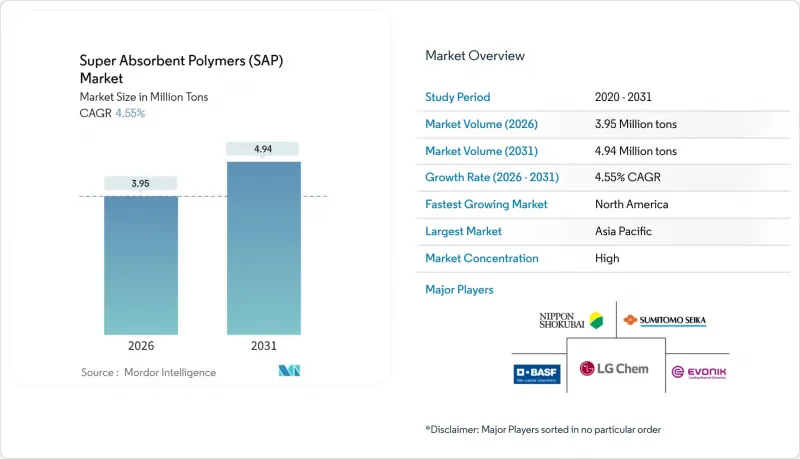
这一稳定成长主要得益于婴儿尿布需求的不断增长、高吸水性成人失禁垫的快速普及以及工业和农业领域应用范围的扩大。欧洲更严格的生物基化学品法规,加上中国和印度人均尿布消费量的成长,正推动产品系列为高端高性能等级。製造商不断升级工厂,提高能源效率并实现垂直整合,以降低丙烯酸价格波动。同时,面向消费者的订阅模式和电商主导的低温运输包装开闢了高利润的细分市场,抵消了标准卫生用品销售带来的利润压力。对纤维素和淀粉基替代品的投资增加表明,永续性正在推动超吸收性聚合物(SAP)市场的品牌价值和製程创新。
全球超吸收性聚合物(SAP)市场趋势与洞察
中国和印度人均尿布支出增加
在中国,受鼓励多胞胎生育政策和可支配收入成长的推动,预计自2022年起,都市区家庭尿布平均支出将增加15%。在印度,二、三线城市分销网络的扩张提高了尿布的渗透率,使高端尿布产品更受首次购买者的欢迎。采用高吸收性超强聚合物(SAP)并减少凝胶结块的优质产品正在加速超强吸收性聚合物市场的销售和价值成长。当地加工商正透过签订长期承购协议来加强供应保障,以确保产品品质并降低运输风险。
高吸水性成人尿垫迅速流行
日本、韩国、德国和义大利等国的人口老化推动了成人失禁用品的需求,而社会接纳宣传活动也有助于减少人们对失禁的歧视。新产品将吸水性聚合物(SAP)含量提高了高达40%,使其更轻薄,更接近普通内裤,从而鼓励白天使用。订阅式电商通路正在蓬勃发展,提供包含隐私配送、防漏保护和便于行动的SKU等组合产品。製造商正积极回应,研发差异化的核壳颗粒结构,以增强负重下的吸收能力,进而打造一个利润丰厚的细分市场。
原物料价格波动
丙烯酸占生产成本的70%之多,季波动幅度高达25%,为采购预算带来不确定性。长虹高分子投资16亿美元建设的丙烷制丙烯酸工厂计划于2026年竣工,预计将降低可变成本曲线,并打破现有西方供应商之间的价格模式。随着企业董事会将原料安全放在首位,对生物基路线和垂直整合的兴趣日益浓厚。
细分市场分析
到2025年,丙烯酸类产品将占据超吸收性聚合物市场71.30%的份额,这主要归功于其在婴儿尿布领域久经考验的可靠性。为了提高安全性,高端品牌越来越多地指定使用低游离单体含量的高纯度丙烯酸类超吸收性聚合物(SAP)。同时,聚丙烯酰胺类产品预计将继续以6.18%的复合年增长率成长,这主要得益于其在干旱农业应用和工业密封领域优异的保水性能。就超吸收性聚合物(SAP)市场规模而言,预计2026年至2031年间,聚丙烯酰胺的产量将增加12万吨,从而取代丙烯酸类产品占据市场份额。
产品开发人员正在探索结合丙烯酸和多醣骨架的混合网络,以平衡成本和降解性。日本触媒株式会社的生物质基超吸水性聚合物(SAP)产品线(获得清真认证,产自印尼)就是这种跨化学创新的典范。目前,投资重点正转向生物质采购物流、杂质管理以及可扩展的连续反应器设计,以确保聚合物结构的稳定性。
到2025年,凝胶聚合将维持59.20%的收入份额,其反应釜生产线经过最佳化,可实现高通量和均匀的交联密度。能源回收循环和连续单体循环正在推动成本竞争力的提升。溶液聚合将以4.72%的复合年增长率成长,因为它能够生产小批量特种级产品,精确控制分子量分布,并降低能耗,符合永续性目标。
悬浮聚合和反相悬浮聚合製程在需要特殊颗粒形态的细分领域仍然占据一席之地,例如用于医疗流体管理的核壳微球。製程工程师正致力于精确控制交联剂的进料量并在线连续光谱技术来调整负载下的吸收性能,这进一步加剧了超吸收性聚合物(SAP)市场的供应细分化。
超吸收性聚合物 (SAP) 市场按产品类型(聚丙烯酰胺、丙烯酸基、其他)、聚合工艺(溶液聚合、其他)、应用(婴儿尿布、成人失禁用品等)、终端用户行业(个人护理和卫生用品製造商、农业投入品供应商等)和地区(亚太地区、北美、欧洲等)进行细分。
区域分析
到2025年,亚太地区将占据超吸收性聚合物(SAP)市场41.40%的份额,这主要得益于中国丙烯酸-SAP一体化产业丛集的推动,该集群最大限度地减少了原材料物流环节。政府激励措施,尤其是在江苏和山东两省,正在支持产能瓶颈的消除和出口导向扩张。由于一次性尿布的日益普及,印度将为市场成长做出贡献,而日本则在特种和生物质基SAP领域保持着技术领先地位。
预计北美将达到最高成长率,到2031年复合年增长率将达到5.18% 。成长要素包括高端一次性尿布产品种类的增加、高吸水性超强(SAP)成人失禁护理产品在老龄化婴儿潮一代中的流行,以及水力压裂防水层和低温运输垫等特殊工业应用。一个由州立大学领导的研究联盟正在主导一个纤维素和蛋白质基网络,使企业永续性倡议与监管趋势保持一致。该地区园艺业也开始率先实用化大麻基吸水性超强聚合物,这有助于在超强吸水性聚合物(SAP)市场建立循环经济。
欧洲严格的政策环境正在加速生物基产品和包装可回收性的普及。德国在产量方面主导地位,而北欧国家的消费者对可堆肥尿布芯材的偏好日益增长。不断上涨的合规成本促使聚合物供应商和废弃物管理公司之间建立合作关係,闭合迴路回收方案也正在试行。欧盟标准对出口配方的影响日益增强,并迫使全球生产商统一产品安全性和标籤标准。
其他福利:
- Excel格式的市场预测(ME)表
- 3个月的分析师支持
目录
第一章 引言
- 研究假设和市场定义
- 调查范围
第二章调查方法
第三章执行摘要
第四章 市场情势
- 市场概览
- 市场驱动因素
- 中国和印度人均尿布支出增加
- SAP成人尿垫在亚洲和欧洲迅速普及
- 欧盟向生物基SAP过渡(由一次性塑胶指令推动)
- 电子商务主导了对吸水包装垫(低温运输)需求的快速成长。
- 在农业领域不断拓展应用
- 市场限制
- 原物料价格波动
- 婴儿尿布中残留单体的安全隐患
- 高成本生产
- 生产成本概览
- 价值链分析
- 波特五力分析
- 供应商的议价能力
- 买方的议价能力
- 新进入者的威胁
- 替代品的威胁
- 竞争加剧
第五章 市场规模与成长预测
- 依产品类型
- 聚丙烯酰胺
- 丙烯酸基
- 其他的
- 透过聚合过程
- 溶液聚合
- 悬浮聚合/反相悬浮聚合
- 凝胶聚合
- 透过使用
- 婴儿尿布
- 成人失禁护理产品
- 女性用卫生用品
- 农业支持
- 其他用途
- 按最终用户行业划分
- 个人护理和卫生用品製造商
- 农业投入品供应商
- 医疗保健提供者
- 其他终端用户产业(电信和电力电缆製造商、食品和药品低温运输物流)
- 按地区
- 亚太地区
- 中国
- 日本
- 印度
- 韩国
- 亚太其他地区
- 北美洲
- 我们
- 加拿大
- 墨西哥
- 欧洲
- 德国
- 英国
- 法国
- 义大利
- 西班牙
- 北欧国家
- 其他欧洲地区
- 南美洲
- 巴西
- 阿根廷
- 南美洲其他地区
- 中东和非洲
- 沙乌地阿拉伯
- 南非
- 埃及
- 奈及利亚
- 其他中东和非洲地区
- 亚太地区
第六章 竞争情势
- 市场集中度
- 策略趋势
- 市占率分析
- 公司简介
- ADM
- BASF
- Braskem
- Chase Corp.
- Chemtex Speciality Limited
- Evonik Industries AG
- Formosa Plastics Group
- LG Chem
- NIPPON SHOKUBAI CO., LTD.
- SANYO CHEMICAL INDUSTRIES, LTD.
- SAP SE
- Satellite Chemical
- SNF
- SONGWON
- SUMITOMO SEIKA CHEMICALS CO.,LTD.
- TOYO BOEKI Co.,Ltd.
- Wanhua
- Yixing Danson Technology
第七章 市场机会与未来展望
The Super Absorbent Polymers Market size in 2026 is estimated at 3.95 Million tons, growing from 2025 value of 3.78 Million tons with 2031 projections showing 4.94 Million tons, growing at 4.55% CAGR over 2026-2031.
Enlarging demand in baby diapers, rapid uptake of high-SAP adult incontinence pads, and a widening set of industrial and agricultural applications are the core forces behind this steady expansion. Tightening European regulations that reward bio-based chemistries, together with higher per-capita diaper spend in China and India, are reshaping product portfolios toward premium, high-performance grades. Manufacturers continue to upgrade plants for energy efficiency and vertical integration to buffer acrylic acid price swings. At the same time, direct-to-consumer subscription models and e-commerce-driven cold-chain packaging unlock high-margin niches that compensate for margin pressure in standard hygiene volumes. Rising investment in cellulosic and starch-derived alternatives signals that sustainability now drives both brand value and process innovation in the super absorbent polymers market.
Global Super Absorbent Polymers (SAP) Market Trends and Insights
Rising Per-Capita Diaper Spend in China and India
Urban households in China lifted their average diaper outlay by 15% since 2022, aided by policy changes that support larger families and rising disposable income. In India, distribution build-out in tier-2 and tier-3 cities raised penetration, bringing advanced diaper formats within reach of first-time buyers. Premium SKUs contain higher-capacity SAP grades and reduced gel blocking, accelerating unit consumption and value growth across the super absorbent polymers market. Local converters increasingly lock supply via long-term offtake deals to secure quality and mitigate freight risks.
Rapid Adoption of High-SAP Adult Incontinence Pads
Demographic aging in Japan, South Korea, Germany, and Italy has elevated adult incontinence prevalence, while social acceptance campaigns reduce stigma. New pads integrate up to 40% more SAP, enabling thinner profiles that resemble regular underwear and encourage daytime use. Subscription e-commerce channels are growing, bundling discrete delivery, leakage guarantees, and mobility-specific SKUs. Producers respond with differentiated core-shell particle morphologies that boost absorption under load, creating a high-margin sub-segment within the super absorbent polymers market.
Volatile Raw Material Prices
Acrylic acid constitutes up to 70% of production cost, and quarterly swings as wide as 25% destabilize procurement budgets. Changhong Polymer's USD 1.6 billion propane-to-acrylic-acid plant, due in 2026, could lower variable cost curves and unsettle pricing parity among established Western suppliers. Interest in bio-routes and vertical integration rises as boards prioritize feedstock security.
Other drivers and restraints analyzed in the detailed report include:
- Shift to Bio-Based SAP in EU Driven by Packaging Rules
- Expanding Agricultural Applications
- Safety Concerns Over Residual Monomers
For complete list of drivers and restraints, kindly check the Table Of Contents.
Segment Analysis
The acrylic fraction represented 71.30% of the super absorbent polymers market share in 2025, anchored by its proven reliability in baby diapers. To bolster safety perception, premium brands specify higher-purity acrylic SAPs with lower free monomer levels. In parallel, polyacrylamide grades are expanding at a 6.18% CAGR, propelled by their superior water retention in arid agriculture and industrial sealing. Within the super absorbent polymers market size context, polyacrylamide volumes are forecast to add 120 kilotons between 2026 and 2031, capturing incremental share from acrylic grades.
Product developers pursue hybrid networks that mix acrylic and polysaccharide backbones to marry cost and degradability. Nippon Shokubai's biomass-derived SAP line, certified Halal and produced in Indonesia, exemplifies such cross-chemistry innovation. Investment emphasis now tilts toward biomass sourcing logistics, impurity control, and scalable continuous reactor designs that ensure consistent polymer architecture.
Gel polymerization kept a 59.20% revenue share in 2025, with its reactor trains optimized for high throughput and uniform cross-link density. Energy recovery loops and continuous monomer recycling drive incremental cost competitiveness. Solution polymerization grows at 4.72% CAGR because it enables small-lot, specialty grades with tight molecular weight distribution and reduced energy load, aligning with sustainability targets.
Suspension and inverse-suspension routes persist in niche roles that require unique particle morphologies, such as core-shell microspheres for medical fluid management. Process engineers focus on precise cross-linker feed control and in-line spectroscopy to tune absorption under load, further segmenting supply within the super absorbent polymers market.
The Super Absorbent Polymer (SAP) Market Segments the Industry by Product Type (Polyacrylamide, Acrylic Acid Based, and Others), Polymerization Process (Solution Polymerization, and More), Application (Baby Diapers, Adult Incontinence Products, and More), End-User Industry (Personal Care and Hygiene Manufacturers, Agriculture Input Suppliers, and More), and Geography (Asia-Pacific, North America, Europe, and More).
Geography Analysis
Asia-Pacific held 41.40% of the super absorbent polymers market in 2025, powered by China's integrated acrylic acid-SAP clusters that minimize feedstock logistics. Government incentives, notably in Jiangsu and Shandong, support capacity debottlenecking and export-oriented expansions. India contributes volume growth through broader diaper penetration, while Japan retains a technology leadership niche in specialty and biomass-derived grades.
North America is projected to post the fastest 5.18% CAGR through 2031. Growth arises from premium diaper SKUs, high-SAP adult incontinence adoption among aging baby boomers, and specialized industrial uses such as fracking water blockers and cold-chain pads. Research consortia with land-grant universities pioneer cellulosic and protein-based networks, aligning corporate sustainability pledges with regulatory trends. The region also records early field use of hemp-based SAP in horticulture, reinforcing circular economy narratives within the superabsorbent polymers market.
Europe's stringent policy climate accelerates bio-based uptake and packaging recyclability. Germany leads production volume, whereas Nordic countries drive consumer preference for compostable diaper cores. Compliance costs spur alliances between polymer suppliers and waste-management firms to pilot closed-loop recovery schemes. EU standards increasingly influence export formulations, compelling global producers to harmonize product safety and labeling.
- ADM
- BASF
- Braskem
- Chase Corp.
- Chemtex Speciality Limited
- Evonik Industries AG
- Formosa Plastics Group
- LG Chem
- NIPPON SHOKUBAI CO., LTD.
- SANYO CHEMICAL INDUSTRIES, LTD.
- SAP SE
- Satellite Chemical
- SNF
- SONGWON
- SUMITOMO SEIKA CHEMICALS CO.,LTD.
- TOYO BOEKI Co.,Ltd.
- Wanhua
- Yixing Danson Technology
Additional Benefits:
- The market estimate (ME) sheet in Excel format
- 3 months of analyst support
TABLE OF CONTENTS
1 Introduction
- 1.1 Study Assumptions and Market Definition
- 1.2 Scope of the Study
2 Research Methodology
3 Executive Summary
4 Market Landscape
- 4.1 Market Overview
- 4.2 Market Drivers
- 4.2.1 Rising Per-Capita Diaper Spend in China and India
- 4.2.2 Rapid Adoption of High-SAP Adult Incontinence Pads Asia and Europe
- 4.2.3 Shift to Bio-based SAP in EU Driven by Single-Use Plastics Directive
- 4.2.4 E-Commerce-Led Demand Spike for Absorbent Packaging Pads (Cold Chain)
- 4.2.5 Expanding Agricultural Applications
- 4.3 Market Restraints
- 4.3.1 Volatile Raw Material Prices
- 4.3.2 Safety Concerns Over Residual Monomers in Infant Diapers
- 4.3.3 High Production Cost
- 4.4 Production Cost Overview
- 4.5 Value Supply-Chain Analysis
- 4.6 Porter's Five Forces Analysis
- 4.6.1 Bargaining Power of Suppliers
- 4.6.2 Bargaining Power of Buyers
- 4.6.3 Threat of New Entrants
- 4.6.4 Threat of Substitutes
- 4.6.5 Intensity of Rivalry
5 Market Size and Growth Forecasts (Volume)
- 5.1 By Product Type
- 5.1.1 Polyacrylamide
- 5.1.2 Acrylic Acid Based
- 5.1.3 Others
- 5.2 By Polymerization Process
- 5.2.1 Solution Polymerization
- 5.2.2 Suspension/Inverse-Suspension Polymerization
- 5.2.3 Gel Polymerization
- 5.3 By Application
- 5.3.1 Baby Diapers
- 5.3.2 Adult Incontinence Products
- 5.3.3 Feminine Hygiene
- 5.3.4 Agriculture Support
- 5.3.5 Other Application
- 5.4 By End-User Industry
- 5.4.1 Personal Care and Hygiene Manufacturers
- 5.4.2 Agriculture Input Suppliers
- 5.4.3 Healthcare Providers
- 5.4.4 Other End-use Industries (Telecom and Power Cable Makers and Food and Pharmaceutical Cold-Chain Logistics)
- 5.5 Geography
- 5.5.1 Asia-Pacific
- 5.5.1.1 China
- 5.5.1.2 Japan
- 5.5.1.3 India
- 5.5.1.4 South Korea
- 5.5.1.5 Rest of Asia-Pacific
- 5.5.2 North America
- 5.5.2.1 United States
- 5.5.2.2 Canada
- 5.5.2.3 Mexico
- 5.5.3 Europe
- 5.5.3.1 Germany
- 5.5.3.2 United Kingdom
- 5.5.3.3 France
- 5.5.3.4 Italy
- 5.5.3.5 Spain
- 5.5.3.6 Nordics
- 5.5.3.7 Rest of Europe
- 5.5.4 South America
- 5.5.4.1 Brazil
- 5.5.4.2 Argentina
- 5.5.4.3 Rest of South America
- 5.5.5 Middle-East and Africa
- 5.5.5.1 Saudi Arabia
- 5.5.5.2 South Africa
- 5.5.5.3 Egypt
- 5.5.5.4 Nigeria
- 5.5.5.5 Rest of Middle-East and Africa
- 5.5.1 Asia-Pacific
6 Competitive Landscape
- 6.1 Market Concentration
- 6.2 Strategic Moves
- 6.3 Market Share Analysis
- 6.4 Company Profiles (includes Global Overview, Market Overview, Core Segments, Financials, Strategic Info, Market Rank/Share, Products and Services, Recent Developments)
- 6.4.1 ADM
- 6.4.2 BASF
- 6.4.3 Braskem
- 6.4.4 Chase Corp.
- 6.4.5 Chemtex Speciality Limited
- 6.4.6 Evonik Industries AG
- 6.4.7 Formosa Plastics Group
- 6.4.8 LG Chem
- 6.4.9 NIPPON SHOKUBAI CO., LTD.
- 6.4.10 SANYO CHEMICAL INDUSTRIES, LTD.
- 6.4.11 SAP SE
- 6.4.12 Satellite Chemical
- 6.4.13 SNF
- 6.4.14 SONGWON
- 6.4.15 SUMITOMO SEIKA CHEMICALS CO.,LTD.
- 6.4.16 TOYO BOEKI Co.,Ltd.
- 6.4.17 Wanhua
- 6.4.18 Yixing Danson Technology
7 Market Opportunities and Future Outlook
- 7.1 White-space and Unmet-Need Assessment
- 7.2 Commercial Scale-up of 100% Bio-Based SAP

 超吸收性聚合物技术市场分析及预测(至2035年):按类型、产品、应用、最终用户、技术、形态、材料类型、功能和製程划分
 全球超吸收性聚合物市场规模、份额、趋势和成长分析报告(2026-2034年)
 2026年全球超吸收性聚合物市场报告全球超吸收性聚合物市场:市场规模、占有率、成长率、产业分析、类型、应用和地区因素及未来预测(2026-2034)
 日本超强吸水性聚合物市场报告(按类型、生产方法、应用和地区划分,2026-2034年)
 超吸收性聚合物市场规模、份额及成长分析(按类型、应用、最终用途和地区划分)-2026-2033年产业预测
 超吸收性聚合物市场规模、份额和成长分析(按类型、应用、终端用户产业和地区划分)-2026-2033年产业预测
 全球超吸收性聚合物市场:按天然来源、製造方法、应用、销售通路和地区划分-市场规模、产业趋势、机会分析和预测(2025-2033 年)
 高吸水性聚合物市场(依产品类型、材料形式、应用和销售管道)——2025-2030 年全球预测
 高吸水性聚合物市场-全球产业规模、份额、趋势、机会及预测(按原料、应用、地区和竞争细分,2020-2030 年)