


 |
市场调查报告书
商品编码
1939632
会计软体:市占率分析、产业趋势与统计、成长预测(2026-2031)Accounting Software - Market Share Analysis, Industry Trends & Statistics, Growth Forecasts (2026 - 2031) |
||||||

※ 本网页内容可能与最新版本有所差异。详细情况请与我们联繫。
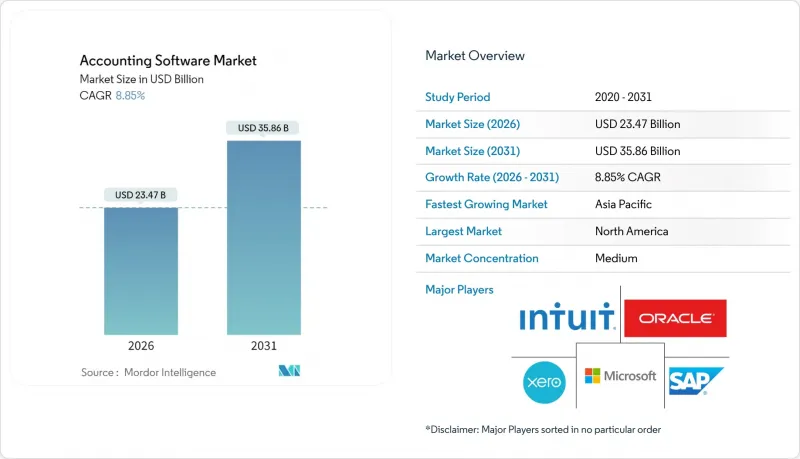
2025年会计软体市值为215.6亿美元,预计2031年将达到358.6亿美元,高于2026年的234.7亿美元。
预计在预测期(2026-2031 年)内,复合年增长率将达到 8.85%。
云端优先策略、即时监管报告要求以及嵌入式人工智慧功能正在不断重塑竞争优势,预计到2024年,云端采用将占营收的67.43%。供应商正在扩展行动端、以API为中心的套件,这些套件整合了银行、资金管理和费用管理功能,使企业能够缩短每月结算週期并获得营运资本洞察。同时,财务部门人才短缺正在加速软体的采用,因为自动化正在取代重复性的记帐工作。最后,新的ESG审核追踪要求迫使企业对旧有系统进行现代化改造,以便转向能够产生不可更改的环境和社会揭露资讯的解决方案。
全球会计软体市场趋势与洞察
采用云端优先的金融堆迭
企业正逐步放弃本地部署,转而采用云端架构,实现会计、财务和营运数据的即时同步,从而降低基础设施成本并提高现金流透明度。这种转变也实现了与金融科技(支付、费用卡、短期流动性管理)的无缝集成,而这些在传统系统中是无法实现的。
簿记工作流程的超自动化
机器学习驱动的资料提取和机器人流程自动化技术如今能够以98%的准确率完成交易分类、银行对帐和发票处理,使会计事务所能够在不相应增加员工人数的情况下承接更多客户。这种生产力的提升降低了中小企业的整体拥有成本,并缓解了整个行业的人才短缺问题。
资料主权和隐私监管
GDPR等法规强制要求本地资料存储,迫使供应商维护跨区域云,并推高部署预算。企业往往不愿意迁移敏感帐本,除非合约条款能够保证加密、存取控制和本地储存选项,这导致计划进度延误。
细分市场分析
到2025年,云端解决方案的营收将成长68.08%,年复合成长率(CAGR)为10.15%,这意味着本地部署的市场份额将持续下降。按需收费模式无需资本支出,并具备自动更新功能,从而增强了安全性。与银行和薪资核算服务提供者的无缝API整合将进一步推动云端解决方案的普及。依赖传统ERP系统的大型企业仍然倾向于采用混合策略来处理对延迟敏感的工作流程,但他们也尝试透过云端子公司来缩短财务结算週期。扩展的资料居住选项和区域资料中心布局将缓解传统的合规性问题,预计未来十年内,云端在会计软体市场的份额将接近饱和。
本地部署平台在高度监管的行业中仍占有一席之地,这些行业往往需要离线处理,或者係统因客製化而受到严格限制。然而,维护成本和大型主机工程师的短缺迫使财务长们不得不拨出预算用于现代化改造。供应商抓住这一机会,提供迁移工具包,将传统帐簿资料映射到多租户架构,从而将过渡期缩短至短短几週。因此,即使整个会计软体产业整体扩张,与本地部署相关的会计软体市场规模预计仍将萎缩。
大型企业将采用多币种、多实体全球合併会计套件,预计2025年,其营收占比将达到54.10%。同时,中小企业将以10.85%的复合年增长率成为成长最快的企业,因为直觉的云端模组和人工智慧驱动的数据收集减少了对专职IT人员的需求。订阅模式会根据交易量调整费用,即使在早期成长阶段也能维持价格合理。
随着强制性电子帐单政策推动数位化,亚太和拉丁美洲的创业生态系统将进一步刺激中小企业的需求。供应商透过提供包含聊天机器人功能的入门方案来降低采用门槛,从而将手动使用电子表格的用户转化为用户用户。因此,中小企业的会计软体市场占有率将稳定成长,并逐渐缩小与传统大型企业在会计软体应用上的差距。
会计软体市场按部署类型(本地部署、云端部署)、组织规模(大型企业、中小企业)、最终用户行业(银行、金融服务和保险、製造业、零售和电子商务、专业服务、IT和电信、医疗保健)、应用(薪资管理、帐单和发货单、其他)以及地区进行细分。市场预测以美元(USD)计价。
区域分析
到2025年,北美将占全球收入的38.35%,这主要得益于其较高的云端采用率、成熟的支付基础设施以及充足的技术预算。美国企业在员工人均财务应用方面的支出高于全球平均水平,从而促进了供应商的快速创新和伙伴关係关係的形成。加拿大也呈现类似的趋势,这得益于其统一的税收框架,该框架简化了跨境应用。
在欧洲,GDPR一般资料保护规则和永续发展报告义务正在推动平台更新,而多语言介面和欧洲电子帐单标准(例如Peppol)则推动了产品在地化。然而,与亚太地区相比,欧洲较慢的决策週期限制了其成长。
亚太地区以10.45%的复合年增长率成为成长最快的地区,这主要得益于印度和印尼强制推行电子帐单,以及日本对电子帐簿储存的非正式规定。中小企业正在跨越桌面软体阶段,直接采用行动优先的云端套件,这些套件整合了本地电子钱包和QR码支付功能。全球供应商对本地资料中心的投资正在缓解资料主权的担忧,并创造公共部门采购机会。
在拉丁美洲,巴西和墨西哥的发展势头强劲。这两个国家多年来一直实行即时发票支付,企业正在将自动化应用扩展到税务申报之外,并转向整合ERP和财务系统的云端平台。中东和非洲地区在经济多元化和不断扩展的金融科技生态系统的推动下正经历稳步增长,但网路连接和人才短缺限制了技术的普及速度。
其他福利:
- Excel格式的市场预测(ME)表
- 3个月的分析师支持
目录
第一章 引言
- 研究假设和市场定义
- 调查范围
第二章调查方法
第三章执行摘要
第四章 市场洞察
- 市场概览
- 市场驱动因素
- 云端优先金融系统实施
- 簿记工作流程的超自动化
- 人工智慧驱动的异常检测和合规性
- 对行动优先结帐体验的需求
- 利用开放银行平台实现即时应收帐款及应付帐款融资
- 基于ESG的审核追踪驱动软体更新
- 市场限制
- 资料主权和隐私监管
- 旧有系统切换成本
- 具备人工智慧能力的会计人员短缺
- 跨境电子帐单指令分散
- 价值链分析
- 监管环境
- 技术展望
- 波特五力分析
- 供应商的议价能力
- 买方的议价能力
- 新进入者的威胁
- 替代品的威胁
- 竞争对手之间的竞争
- 产业生态系分析
- 主要用例和案例研究
- 宏观经济趋势评估
- 投资分析
第五章 市场规模与成长预测
- 依部署类型
- 本地部署
- 基于云端的(SaaS)
- 按组织规模
- 大公司
- 中小企业
- 按最终用户行业划分
- BFSI
- 製造业
- 零售与电子商务
- 专业服务
- 资讯科技和电信
- 卫生保健
- 透过使用
- 薪资管理
- 帐单和发票
- 费用管理
- 税务管理
- 按地区
- 北美洲
- 我们
- 加拿大
- 墨西哥
- 南美洲
- 巴西
- 阿根廷
- 哥伦比亚
- 其他南美洲
- 欧洲
- 德国
- 英国
- 法国
- 义大利
- 西班牙
- 俄罗斯
- 荷兰
- 其他欧洲地区
- 亚太地区
- 中国
- 日本
- 韩国
- 印度
- 澳洲
- 新加坡
- 亚太其他地区
- 中东和非洲
- 中东
- 沙乌地阿拉伯
- 阿拉伯聯合大公国
- 其他中东地区
- 非洲
- 南非
- 埃及
- 其他非洲地区
- 中东
- 北美洲
第六章 竞争情势
- 市场集中度
- 策略趋势
- 市占率分析
- 公司简介
- Intuit Inc.
- The Sage Group plc
- SAP SE
- Oracle Corporation(subsidiary:NetSuite Inc.)
- Microsoft Corporation
- Xero Limited
- Infor, Inc.(aka Infor Global Solutions, Inc.)
- Epicor Software Corporation
- Unit4 NV(parent Unit4 Holding BV)
- Zoho Corporation Private Limited
- MYOB Group Pty Ltd
- 2ndSite Inc.(doing business as FreshBooks)
- Wave Financial Inc.
- KashFlow Software Limited
- FreeAgent Holdings plc(operating entity:FreeAgent Central Ltd)
- Patriot Software Company, LLC
- Odoo SA
- Saasu Pty Ltd
- Red Wing Software, Inc.
- Reckon Limited
第七章 市场机会与未来展望
The accounting software market was valued at USD 21.56 billion in 2025 and estimated to grow from USD 23.47 billion in 2026 to reach USD 35.86 billion by 2031, at a CAGR of 8.85% during the forecast period (2026-2031).
Cloud-first strategies, real-time regulatory reporting mandates and embedded artificial-intelligence features continue to redefine competitive advantage, with cloud deployments already anchoring 67.43% of revenue in 2024. Vendors are expanding mobile, API-centric suites that integrate banking, treasury and spend-management functions, helping enterprises compress monthly close cycles and unlock working-capital insights. At the same time, talent shortages inside finance departments accelerate software adoption because automation substitutes repetitive bookkeeping labor. Finally, emerging ESG audit-trail requirements force organizations to refresh legacy systems in favor of solutions that generate immutable environmental and social disclosures.
Global Accounting Software Market Trends and Insights
Cloud-First Finance-Stack Adoption
Organizations are abandoning on-premise installations in favor of cloud architectures that synchronize accounting, treasury and operational data in real time, cutting infrastructure costs and improving cash-flow visibility. The shift also unlocks seamless fintech integrations-payments, expense cards and short-term liquidity-once unattainable on legacy systems.
Hyper-Automation of Bookkeeping Workflows
Machine-learning extraction and robotic process automation now classify transactions, reconcile banks and process invoices with 98% accuracy, allowing accounting firms to absorb more clients without proportional head-count increases. The resulting productivity gains lower total ownership costs for small businesses and offset the industry-wide talent deficit.
Data-Sovereignty and Privacy Regulations
Rules such as GDPR compel local data residency, forcing vendors to maintain multi-region clouds and inflating implementation budgets. Enterprises hesitate to migrate sensitive ledgers until contractual clauses guarantee encryption, access controls and in-country storage options, delaying project timelines .
Other drivers and restraints analyzed in the detailed report include:
- AI-Led Anomaly Detection and Compliance
- Mobile-First Accounting Experience Demand
- Scarcity of AI-Ready Accounting Talent
For complete list of drivers and restraints, kindly check the Table Of Contents.
Segment Analysis
Cloud solutions generated 68.08% revenue in 2025, and their 10.15% CAGR signals that the on-premise share will continue to erode. The model's pay-as-you-grow pricing eliminates capital expenditure and embeds automatic updates that strengthen security posture. Seamless API connectivity with banks and payroll providers further cements adoption. Large enterprises wedded to legacy ERPs still favor hybrid strategies for latency-sensitive workflows, yet even they pilot cloud subsidiaries to reduce close cycles. Growing data-residency options and regional datacenters mitigate prior compliance objections, suggesting that the cloud slice of the accounting software market will near saturation by decade-end.
On-premise platforms retain niche relevance in highly regulated sectors where offline processing is mandatory or where bespoke customizations lock systems in place. However, maintenance overhead and scarce mainframe skills push CFOs to earmark modernization budgets. Vendors exploit this transition by offering migration toolkits that map historical ledgers into multi-tenant architectures, shortening cut-over periods to weeks. As a result, the accounting software market size tied to on-premise deployments is projected to contract despite overall industry expansion.
Large organizations captured 54.10% of 2025 revenue by deploying global-consolidation suites capable of multi-currency and multi-entity reporting. Yet SMEs drive the fastest 10.85% CAGR because intuitive cloud modules and AI-driven data capture reduce the need for dedicated IT staff. Subscription tiers align costs with transaction volume, ensuring affordability even during early growth stages.
Entrepreneurial ecosystems in Asia-Pacific and Latin America further catalyze SME demand as mandatory e-invoicing forces digital upgrades. Vendors releasing starter packages with embedded chatbot support lower adoption barriers and convert manual spreadsheet users into subscribers. Consequently, the accounting software market share commanded by SMEs will steadily rise, narrowing the historic gap with enterprise deployments.
Accounting Software Market is Segmented by Deployment Type (On-Premise, and Cloud-Based), Organization Size (Large Enterprises, and Small and Medium Enterprises (SMEs)), End-User Industry (BFSI, Manufacturing, Retail and E-Commerce, Professional Services, IT and Telecom, and Healthcare), Application (Payroll Management, Billing and Invoicing, and More), and Geography. The Market Forecasts are Provided in Terms of Value (USD).
Geography Analysis
North America contributed 38.35% revenue in 2025 on the back of high cloud readiness, mature payments rails and well-funded technology budgets. United States enterprises allocate larger per-employee spend on finance applications compared with global averages, spurring rapid vendor innovation and partnering ecosystems. Canada mirrors this trend, supported by harmonized taxation frameworks that simplify cross-border deployment.
Europe follows, where GDPR compliance and sustainability-reporting mandates stimulate platform refreshes. Multi-lingual interfaces and European e-invoicing standards such as Peppol drive product localization. However, slower decision cycles temper growth relative to Asia-Pacific.
Asia-Pacific charts the fastest 10.45% CAGR, propelled by India's and Indonesia's compulsory e-invoicing rollouts and by Japan's soft-mandate for electronic preservation of ledgers. SMEs leapfrog desktop software, adopting mobile-first cloud suites that integrate domestic e-wallets and QR code payments. Local datacenter investments by global vendors mitigate data-sovereignty hesitance and unlock public-sector procurements.
Latin America sees momentum in Brazil and Mexico, where real-time invoice clearance has existed for years, leading businesses to extend automation beyond tax reporting to full ERP-finance clouds. Middle East and Africa post steady gains aligned to economic diversification drives and expanding fintech ecosystems, though connectivity and talent shortages moderate adoption pace.
- Intuit Inc.
- The Sage Group plc
- SAP SE
- Oracle Corporation (subsidiary: NetSuite Inc.)
- Microsoft Corporation
- Xero Limited
- Infor, Inc. (a.k.a. Infor Global Solutions, Inc.)
- Epicor Software Corporation
- Unit4 N.V. (parent Unit4 Holding B.V.)
- Zoho Corporation Private Limited
- MYOB Group Pty Ltd
- 2ndSite Inc. (doing business as FreshBooks)
- Wave Financial Inc.
- KashFlow Software Limited
- FreeAgent Holdings plc (operating entity: FreeAgent Central Ltd)
- Patriot Software Company, LLC
- Odoo SA
- Saasu Pty Ltd
- Red Wing Software, Inc.
- Reckon Limited
Additional Benefits:
- The market estimate (ME) sheet in Excel format
- 3 months of analyst support
TABLE OF CONTENTS
1 INTRODUCTION
- 1.1 Study Assumptions and Market Definition
- 1.2 Scope of the Study
2 RESEARCH METHODOLOGY
3 EXECUTIVE SUMMARY
4 MARKET INSIGHTS
- 4.1 Market Overview
- 4.2 Market Drivers
- 4.2.1 Cloud-first finance-stack adoption
- 4.2.2 Hyper-automation of book-keeping workflows
- 4.2.3 AI-led anomaly detection and compliance
- 4.2.4 Mobile-first accounting experience demand
- 4.2.5 Real-time A/R-A/P financing via open-banking rails
- 4.2.6 ESG-grade audit trails driving software refresh
- 4.3 Market Restraints
- 4.3.1 Data-sovereignty and privacy regulations
- 4.3.2 Legacy-system switching costs
- 4.3.3 Scarcity of AI-ready accounting talent
- 4.3.4 Fragmented e-invoicing mandates across borders
- 4.4 Value Chain Analysis
- 4.5 Regulatory Landscape
- 4.6 Technological Outlook
- 4.7 Porter's Five Forces Analysis
- 4.7.1 Bargaining Power of Suppliers
- 4.7.2 Bargaining Power of Buyers
- 4.7.3 Threat of New Entrants
- 4.7.4 Threat of Substitutes
- 4.7.5 Competitive Rivalry
- 4.8 Industry Ecosystem Analysis
- 4.9 Key Use Cases and Case Studies
- 4.10 Assessment of Macroeconomic Trends
- 4.11 Investment Analysis
5 MARKET SIZE AND GROWTH FORECASTS (VALUE)
- 5.1 By Deployment Type
- 5.1.1 On-premise
- 5.1.2 Cloud-based (SaaS)
- 5.2 By Organization Size
- 5.2.1 Large Enterprises
- 5.2.2 Small and Medium Enterprises (SMEs)
- 5.3 By End-user Industry
- 5.3.1 BFSI
- 5.3.2 Manufacturing
- 5.3.3 Retail and E-commerce
- 5.3.4 Professional Services
- 5.3.5 IT and Telecom
- 5.3.6 Healthcare
- 5.4 By Application
- 5.4.1 Payroll Management
- 5.4.2 Billing and Invoicing
- 5.4.3 Expense Tracking
- 5.4.4 Tax Management
- 5.5 By Geography
- 5.5.1 North America
- 5.5.1.1 United States
- 5.5.1.2 Canada
- 5.5.1.3 Mexico
- 5.5.2 South America
- 5.5.2.1 Brazil
- 5.5.2.2 Argentina
- 5.5.2.3 Colombia
- 5.5.2.4 Rest of South America
- 5.5.3 Europe
- 5.5.3.1 Germany
- 5.5.3.2 United Kingdom
- 5.5.3.3 France
- 5.5.3.4 Italy
- 5.5.3.5 Spain
- 5.5.3.6 Russia
- 5.5.3.7 Netherlands
- 5.5.3.8 Rest of Europe
- 5.5.4 Asia-Pacific
- 5.5.4.1 China
- 5.5.4.2 Japan
- 5.5.4.3 South Korea
- 5.5.4.4 India
- 5.5.4.5 Australia
- 5.5.4.6 Singapore
- 5.5.4.7 Rest of Asia-Pacific
- 5.5.5 Middle East and Africa
- 5.5.5.1 Middle East
- 5.5.5.1.1 Saudi Arabia
- 5.5.5.1.2 United Arab Emirates
- 5.5.5.1.3 Rest of Middle East
- 5.5.5.2 Africa
- 5.5.5.2.1 South Africa
- 5.5.5.2.2 Egypt
- 5.5.5.2.3 Rest of Africa
- 5.5.5.1 Middle East
- 5.5.1 North America
6 COMPETITIVE LANDSCAPE
- 6.1 Market Concentration
- 6.2 Strategic Moves
- 6.3 Market Share Analysis
- 6.4 Company Profiles (includes Global level Overview, Market level overview, Core Segments, Financials as available, Strategic Information, Market Rank/Share for key companies, Products and Services, and Recent Developments)
- 6.4.1 Intuit Inc.
- 6.4.2 The Sage Group plc
- 6.4.3 SAP SE
- 6.4.4 Oracle Corporation (subsidiary: NetSuite Inc.)
- 6.4.5 Microsoft Corporation
- 6.4.6 Xero Limited
- 6.4.7 Infor, Inc. (a.k.a. Infor Global Solutions, Inc.)
- 6.4.8 Epicor Software Corporation
- 6.4.9 Unit4 N.V. (parent Unit4 Holding B.V.)
- 6.4.10 Zoho Corporation Private Limited
- 6.4.11 MYOB Group Pty Ltd
- 6.4.12 2ndSite Inc. (doing business as FreshBooks)
- 6.4.13 Wave Financial Inc.
- 6.4.14 KashFlow Software Limited
- 6.4.15 FreeAgent Holdings plc (operating entity: FreeAgent Central Ltd)
- 6.4.16 Patriot Software Company, LLC
- 6.4.17 Odoo SA
- 6.4.18 Saasu Pty Ltd
- 6.4.19 Red Wing Software, Inc.
- 6.4.20 Reckon Limited
7 MARKET OPPORTUNITIES AND FUTURE OUTLOOK
- 7.1 White-space and Unmet-Need Assessment

 会计软体市场:2026-2032年全球市场预测(依软体、功能、定价模式、应用程式、部署类型、企业规模、最终用户和产业划分)
 2026年全球税务和会计软体市场报告2026年全球线上记帐与会计软体市场报告2026年全球云端会计软体市场报告2026年全球会计软体市场报告2026年全球商业会计软体市场报告2026年全球预算管理软体市场报告
 中小企业会计软体市场分析及预测(至2035年):按类型、产品类型、服务、技术、组件、应用、部署类型、最终用户和模组划分
 全球线上会计软体市场规模、份额、趋势和成长分析报告(2026-2034)全球预算管理软体市场规模、份额、趋势和成长分析报告(2026-2034年)