


 |
市场调查报告书
商品编码
1939634
智慧水錶:市场占有率分析、产业趋势与统计、成长预测(2026-2031)Smart Water Meter - Market Share Analysis, Industry Trends & Statistics, Growth Forecasts (2026 - 2031) |
||||||

※ 本网页内容可能与最新版本有所差异。详细情况请与我们联繫。
2025年智慧水錶市场价值为48.1亿美元,预计到2031年将达到87.7亿美元,高于2026年的53.2亿美元。
预计在预测期(2026-2031 年)内,复合年增长率将达到 10.55%。
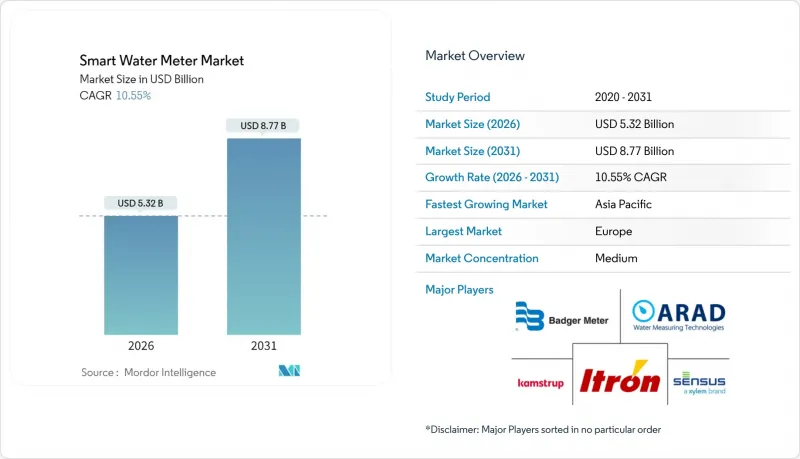
公共产业正持续从机械式水錶过渡到连网设备,以实现即时监测、自动收费和数据驱动的洩漏检测。节水监管要求、老旧配水设备更换压力日益增大以及物联网 (IoT) 平台的扩展,共同推动了各公共产业(TCO)。诸如按需付费模式等资金筹措方式的拓展,以及奖励检验的洩漏减少的绩效导向法规,将进一步增强已开发市场和新兴市场的需求。
全球智慧水錶市场趋势与洞察
支持性的政府法规
强制性部署计划和节水标准正推动公共产业转型为符合合规和报告要求的先进计量解决方案。欧盟饮用水指令要求端到端监测,促使德国和法国要求新建建筑和大型维修安装智慧水錶。加州的永久性用水法规要求提供详细数据以进行执法,并将高级计量基础设施(AMI)的部署作为合格资金筹措的先决条件。供水事业透过记录减少漏损和提高客户参与的绩效,获得成本回收机制,从而降低投资风险并支持在其辖区内推广。供应商受益于大量订单带来的更低单位成本,而政策制定者则可以利用透明的绩效指标来追踪节水进度。无论是在市政、区域或国家层面,相关法规都确保了智慧水錶市场广泛应用所需的长期确定性。
提高用水效率的必要性
在缺水地区,供水事业部署智慧水錶,以识别高耗水模式,并透过提供每小时数据来支援用户改变用水行为,从而提升用户的自主用水能力。使用连续遥测技术的工业设施透过洩漏识别和製程优化,实现了20%至30%的用水量减少。农业试点计画将土壤湿度感测与基于天气的灌溉计画结合,实现了高达28%的节水效果,展现了智慧水錶在跨产业的效用。由于水的生产和抽水是重要的营运成本,效率的提升也转化为能源的节约。透过分析应用程式进行需求预测,供水事业可以平滑用水高峰,并推迟产能扩张。当供水事业将节水与收入脱钩结合时,效率的提升就能转化为稳定的财务业绩,进而推动智慧水錶市场的发展。
高昂的初始成本和网路安全风险
一套完整的智慧水錶(AMI)部署方案,每个终端的成本可能在200至400美元之间,这对资本预算有限的公共产业来说是一个挑战。费率调整核准可能需要数年时间,从而延误计划启动。网路安全措施、加密、入侵侦测和24小时监控会使计划总成本增加15%至25%。小规模的系统,尤其是在开发中国家,如果没有优惠融资,往往会延后投资。备受瞩目的网路安全事件会加剧监管审查,进一步推高合规成本。在资金筹措机製成熟和安全框架标准化之前,这些因素将抑制智慧水錶市场的整体成长。
细分市场分析
到2025年,自动抄表(AMR)系统将占据智慧水錶市场57.10%的份额,这反映了其强大的基础和经济高效的单向资料传输特性。许多公共产业在现代化改造初期就采用AMR系统,因为它无需大规模的网路建设,并且可以透过移动抄表显着降低人事费用。虽然与AMR相关的智慧水錶市场规模仍然可观,但随着第二代部署优先采用双向架构,其成长速度正在放缓。
随着供水事业对即时漏水警报、远端断水和分时收费系统的需求日益增长,到2031年,高级计量基础设施(AMI)的复合年增长率将达到11.55%。蜂窝网路、NB-IoT和LoRaWAN模组成本的下降消除了AMI普及的关键障碍。服务供应商将水錶、分析工具和软体订阅捆绑销售,从而将资本成本分摊到营运预算中。数据丰富的AMI平台有助于与节水计画的整合,加速区域普及,并推动智慧水錶市场的发展。
到2025年,住宅智慧水錶市场规模将占智慧水錶市场的58.00%,这主要得益于欧洲和北美住宅新房屋强制安装智慧水錶。消费者可以透过用水入口网站将节水目标与实际节省的费用连结起来,并保持定期更新。
商业建筑领域采用智慧水錶的速度最快,复合年增长率高达 11.85%,这主要得益于整合水、能源和暖通空调数据的设施管理软体的普及。高层建筑业主透过营运成本的节约和绿建筑认证来证明其投资的合理性。零售连锁店和酒店集团正在利用分析技术进行跨站点对比分析,以发现隐藏的洩漏并优化灌溉系统。企业用户采用率的提高,以及永续发展报告架构的完善,正在推动智慧水錶市场的整体成长。
这份智慧水錶市场报告按技术(自动抄表/高级计量基础设施)、应用(住宅等)、水錶类型(机械/涡轮、超音波、电磁)、通讯技术(射频、LoRaWAN/其他LPWAN等)、组件(硬体、软体/分析、服务)、部署类型(新安装、维修/更换)和地区对市场进行分析。
区域分析
预计到2025年,欧洲将以36.10%的收入份额引领智慧水錶市场,这得益于欧盟指令强制要求追踪水损和实现透明计费。各国制定的实施蓝图确保了稳定的竞标机会,而长期供应商架构则简化了采购流程。此外,公共产业正利用旨在增强气候适应能力的復苏基金,加速采用高级计量基础设施(AMI),以支持全部区域的稳定用水需求。
亚太地区预计将成为成长最快的地区,到2031年复合年增长率将达到12.05%。中国正在大规模智慧城市示范计画中,将计量功能融入其区域数位双胞胎;印度的「饮用水生命线计画」(Jal Jeevan Mission)则在资金筹措农村地区的智慧互联,包括智慧设备。印尼和越南等东南亚国家的快速都市化正在推动传统资产的升级改造,以避免因技术过时而造成的沉没成本。政府补贴、多边融资和公私合营等多种因素的共同作用,透过扩大安装规模,推动了智慧水錶市场的成长。
在北美,老旧基础设施的更新换代和各州范围内的节水政策正在推动水务成长。加州公共产业正在部署高级计量基础设施(AMI),以强制执行人均用水量限制,并透过远端断水功能增强抵御野火的能力。加拿大各州的现代化计画重点在于非收益水的回收利用,水务成长也呈现渐进式成长。在拉丁美洲,巴西的特许经营竞标预示着巨大的发展机会。与此同时,中东和非洲的公共产业正在使用智慧水錶来应对水资源短缺和防止盗水,但部署进度因资金筹措和通讯网路的准备情况而异。
其他福利:
- Excel格式的市场预测(ME)表
- 3个月的分析师支持
目录
第一章 引言
- 研究假设和市场定义
- 调查范围
第二章调查方法
第三章执行摘要
第四章 市场情势
- 市场概览
- 市场驱动因素
- 支持性的政府法规
- 需要提高用水效率。
- 减少无收益水损失
- 智慧城市与物联网平台集成
- 按节省金额付费的融资模式
- 干旱引发的节水措施
- 市场限制
- 高昂的初始成本和网路安全风险
- 系统整合复杂性
- 公共产业数据分析人才短缺
- 超音波设备的电池寿命有限
- 产业价值链分析
- 监管环境
- 技术展望
- 波特五力分析
- 供应商的议价能力
- 买方的议价能力
- 新进入者的威胁
- 替代品的威胁
- 竞争对手之间的竞争
- 智慧电錶投资收益(ROI) 分析
- 通讯协定基准比较
- LoRaWAN 安装步骤和用例
- 公共产业数位化带来的益处
- 影响市场的宏观经济因素
第五章 市场规模与成长预测
- 透过技术
- 自动抄表(AMR)
- 进阶计量基础设施(AMI)
- 透过使用
- 住宅
- 商业
- 产业
- 农业
- 按计量类型
- 机械/涡轮机
- 超音波
- 电磁学
- 透过通讯技术
- 射频(专有射频技术)
- LoRaWAN/其他低功耗广域网
- 蜂窝通讯(NB-IoT/LTE-M)
- 有线(M-Bus/乙太网路)
- 按组件
- 硬体
- 软体和分析
- 服务
- 透过部署
- 新推出
- 维修/更换
- 按地区
- 北美洲
- 我们
- 加拿大
- 墨西哥
- 南美洲
- 巴西
- 阿根廷
- 智利
- 南美洲其他地区
- 欧洲
- 德国
- 英国
- 法国
- 义大利
- 西班牙
- 其他欧洲地区
- 亚太地区
- 中国
- 印度
- 日本
- 韩国
- 马来西亚
- 新加坡
- 澳洲
- 亚太其他地区
- 中东和非洲
- 中东
- 阿拉伯聯合大公国
- 沙乌地阿拉伯
- 土耳其
- 其他中东地区
- 非洲
- 南非
- 奈及利亚
- 其他非洲地区
- 中东
- 北美洲
第六章 竞争情势
- 市场集中度
- 策略趋势
- 市占率分析
- 公司简介
- Arad Ltd.
- Badger Meter Inc.
- Itron Inc.
- Sensus USA Inc.(Xylem Inc.)
- Kamstrup A/S
- Diehl Stiftung and Co. KG
- Zenner International GmbH and Co. KG
- Landis+Gyr Group AG
- Honeywell International Inc.
- Neptune Technology Group Inc.(Roper)
- Aclara Technologies LLC(Hubbell)
- Apator SA
- Axioma Metering
- B Meters Srl
- Datamatic Inc.
- Maddalena SpA
- Suntront Tech Co., Ltd.
- Mueller Systems LLC
- Waviot
- Watertech SpA(Arad)
- Jiangxi Sanchuan Water Meter Co. Ltd.
- Ningbo Water Meter Co. Ltd.
- BETAR Company
- Integra Metering AG
- IESLab Electronic Co. Ltd.
第七章 市场机会与未来展望
The Smart Water Meter market was valued at USD 4.81 billion in 2025 and estimated to grow from USD 5.32 billion in 2026 to reach USD 8.77 billion by 2031, at a CAGR of 10.55% during the forecast period (2026-2031).
Utilities continue to migrate from mechanical meters to connected devices that enable real-time monitoring, automated billing, and data-driven leak detection. Regulatory mandates for conservation, mounting pressure to replace aging distribution assets, and the expansion of Internet of Things platforms combine to accelerate adoption across utility classes. Vendor competition centers on integrating analytics and two-way communications while maintaining a favorable total cost of ownership. Expanding financing options, such as pay-as-you-save models, and performance-based regulation that rewards verified water-loss reduction, further strengthen demand pipelines in developed and emerging economies.
Global Smart Water Meter Market Trends and Insights
Supportive Government Regulations
Mandatory deployment timelines and water-efficiency standards push utilities toward advanced metering solutions that satisfy compliance and reporting needs. The EU Drinking Water Directive requires end-to-end monitoring, prompting Germany and France to stipulate smart meters in all new constructions and major renovations. California's permanent water-use rules demand granular data for enforcement, making AMI rollouts a prerequisite for funding eligibility. Utilities gain cost recovery mechanisms when they document water-loss cuts and customer engagement improvements, which lowers investment risk and supports full-territory deployments. Vendors benefit from volume orders that reduce per-unit costs, while policymakers secure transparent performance metrics to track conservation progress. Across municipal, regional, and national levels, regulation underwrites the long-term certainty needed for widespread Smart Water Meter market adoption.
Need to Improve Water-Use Efficiency
Utilities in water-scarce regions adopt connected meters to identify high-consumption patterns and empower customers with hourly data that supports behavioral changes. Industrial facilities using continuous telemetry report 20-30% consumption cuts after pinpointing leaks and optimizing processes. Agricultural pilots that combine soil-moisture sensing with weather-based scheduling record up to 28% savings, demonstrating cross-sector utility. Efficiency gains also yield energy savings because water production and pumping constitute large operational expenses. Analytics applications forecast demand, allowing utilities to flatten peaks and defer capacity expansion. As utilities tie conservation to revenue decoupling, efficiency gains translate into stable financial performance and propel the Smart Water Meter market forward.
High Upfront Costs and Cybersecurity Risks
Full AMI rollouts cost USD 200-400 per endpoint, challenging utilities with tight capital budgets. Rate-case approvals can stretch over several years, delaying project start dates. Cybersecurity countermeasures, encryption, intrusion detection, and 24-hour monitoring raise the total project expense by an additional 15-25%. Smaller systems, especially in developing economies, often defer investments without concessional finance. High-profile cyber incidents intensify regulatory scrutiny, further elevating compliance costs. These factors collectively weigh on Smart Water Meter market growth until financing mechanisms mature and security frameworks standardize.
Other drivers and restraints analyzed in the detailed report include:
- Reducing Non-Revenue Water Losses
- Smart-City and IoT Platform Integration
- Systems-Integration Complexity
For complete list of drivers and restraints, kindly check the Table Of Contents.
Segment Analysis
Automatic Meter Reading systems accounted for 57.10% of Smart Water Meter market share in 2025, reflecting their entrenched base and cost-efficient one-way data transmission. Many utilities adopt AMR during early modernization phases because drive-by collection sharply reduces manual labor without extensive network build-out. The Smart Water Meter market size attached to AMR remains large, yet its growth moderates as second-generation rollouts favor two-way architectures.
Advanced Metering Infrastructure records an 11.55% CAGR to 2031 as utilities seek real-time leak alerts, remote disconnect, and time-variant pricing schemes. Cellular, NB-IoT, and LoRaWAN modules drop in cost, erasing a key barrier to AMI adoption. Service providers package meters, analytics, and software subscriptions, distributing capital costs over operating budgets. Data-rich AMI platforms integrate easily with conservation programs, accelerating regional penetration and widening the Smart Water Meter market.
Residential deployments formed 58.00% of the Smart Water Meter market size in 2025 after multiple European and North American mandates required smart meters for new housing. Consumers benefit from usage portals that connect conservation goals to tangible savings, sustaining stable replacement cycles.
Commercial buildings show the fastest uptake at a 11.85% CAGR, propelled by facility-management software that pairs water, energy, and HVAC data. High-rise real-estate owners justify investment through lower operating expenses and green-building certifications. Retail chains and hospitality groups apply analytics to benchmark sites, uncover concealed leaks, and optimize irrigation. As sustainability reporting frameworks tighten, enterprise users expand deployments, bolstering overall Smart Water Meter market growth.
The Smart Water Meter Market Report is Segmented by Technology (Automatic Meter Reading & Advanced Metering Infrastructure), Application (Residential, and More), Meter Type (Mechanical/Turbine, Ultrasonic, and Electromagnetic), Communication Technology (Radio-Frequency, LoRaWAN/Other LPWAN, and More), Component (Hardware, Software and Analytics, and Services), Deployment (New Installations and Retrofit/Replacement), and Geography.
Geography Analysis
Europe dominated the Smart Water Meter market with 36.10% revenue share in 2025, anchored by EU directives that compel water-loss tracking and transparent billing. National implementation roadmaps guarantee steady tender pipelines, and long-term vendor frameworks streamline procurement. Utilities also tap recovery funds targeting climate resilience, accelerating district-wide AMI deployments that underpin stable regional demand.
Asia-Pacific registers the fastest expansion, clocking a 12.05% CAGR to 2031. China's extensive smart-city pilots embed metering within neighborhood digital twins, while India's Jal Jeevan Mission finances rural connections that include smart endpoints. Southeast Asian economies such as Indonesia and Vietnam upgrade legacy assets concurrently with rapid urbanization, avoiding sunk costs tied to older technologies. Government grants, multilateral loans, and public-private partnerships combine to scale installations and enlarge the Smart Water Meter market.
North America benefits from aging infrastructure replacement and statewide conservation mandates. California utilities deploy AMI to enforce per-capita usage limits and to support wildfire resilience through remote shut-off capabilities. Canada advances province-level modernization programs focusing on non-revenue water recovery, adding incremental growth. Latin America's concession tenders in Brazil signal sizable upcoming opportunities, while Middle East and Africa utilities leverage smart meters to address scarcity and reduce theft, though deployment progress varies by funding availability and communication-network readiness.
- Arad Ltd.
- Badger Meter Inc.
- Itron Inc.
- Sensus USA Inc. (Xylem Inc.)
- Kamstrup A/S
- Diehl Stiftung and Co. KG
- Zenner International GmbH and Co. KG
- Landis+Gyr Group AG
- Honeywell International Inc.
- Neptune Technology Group Inc. (Roper)
- Aclara Technologies LLC (Hubbell)
- Apator SA
- Axioma Metering
- B Meters Srl
- Datamatic Inc.
- Maddalena S.p.A.
- Suntront Tech Co., Ltd.
- Mueller Systems LLC
- Waviot
- Watertech S.p.A. (Arad)
- Jiangxi Sanchuan Water Meter Co. Ltd.
- Ningbo Water Meter Co. Ltd.
- BETAR Company
- Integra Metering AG
- IESLab Electronic Co. Ltd.
Additional Benefits:
- The market estimate (ME) sheet in Excel format
- 3 months of analyst support
TABLE OF CONTENTS
1 INTRODUCTION
- 1.1 Study Assumptions and Market Definition
- 1.2 Scope of the Study
2 RESEARCH METHODOLOGY
3 EXECUTIVE SUMMARY
4 MARKET LANDSCAPE
- 4.1 Market Overview
- 4.2 Market Drivers
- 4.2.1 Supportive government regulations
- 4.2.2 Need to improve water-use efficiency
- 4.2.3 Reducing non-revenue water (NRW) losses
- 4.2.4 Smart-city and IoT platform integration
- 4.2.5 Pay-as-you-save financing models
- 4.2.6 Drought-driven conservation mandates
- 4.3 Market Restraints
- 4.3.1 High upfront costs and cybersecurity risks
- 4.3.2 Systems-integration complexity
- 4.3.3 Shortage of utility data-analytics talent
- 4.3.4 Battery-life limits in ultrasonic units
- 4.4 Industry Value Chain Analysis
- 4.5 Regulatory Landscape
- 4.6 Technological Outlook
- 4.7 Porter's Five Forces Analysis
- 4.7.1 Bargaining Power of Suppliers
- 4.7.2 Bargaining Power of Buyers
- 4.7.3 Threat of New Entrants
- 4.7.4 Threat of Substitutes
- 4.7.5 Intensity of Competitive Rivalry
- 4.8 ROI Analysis for Smart Meters
- 4.9 Protocol Benchmarking and Comparison
- 4.10 LoRaWAN Implementation Steps and Use-cases
- 4.11 Utility Digitalisation Benefits
- 4.12 Impact of Macroeconomic Factors on the Market
5 MARKET SIZE AND GROWTH FORECASTS (VALUES)
- 5.1 By Technology
- 5.1.1 Automatic Meter Reading (AMR)
- 5.1.2 Advanced Metering Infrastructure (AMI)
- 5.2 By Application
- 5.2.1 Residential
- 5.2.2 Commercial
- 5.2.3 Industrial
- 5.2.4 Agricultural
- 5.3 By Meter Type
- 5.3.1 Mechanical / Turbine
- 5.3.2 Ultrasonic
- 5.3.3 Electromagnetic
- 5.4 By Communication Technology
- 5.4.1 Radio-frequency (Proprietary RF)
- 5.4.2 LoRaWAN / Other LPWAN
- 5.4.3 Cellular (NB-IoT/LTE-M)
- 5.4.4 Wired (M-Bus/Ethernet)
- 5.5 By Component
- 5.5.1 Hardware
- 5.5.2 Software and Analytics
- 5.5.3 Services
- 5.6 By Deployment
- 5.6.1 New Installations
- 5.6.2 Retrofit / Replacement
- 5.7 By Geography
- 5.7.1 North America
- 5.7.1.1 United States
- 5.7.1.2 Canada
- 5.7.1.3 Mexico
- 5.7.2 South America
- 5.7.2.1 Brazil
- 5.7.2.2 Argentina
- 5.7.2.3 Chile
- 5.7.2.4 Rest of South America
- 5.7.3 Europe
- 5.7.3.1 Germany
- 5.7.3.2 United Kingdom
- 5.7.3.3 France
- 5.7.3.4 Italy
- 5.7.3.5 Spain
- 5.7.3.6 Rest of Europe
- 5.7.4 Asia-Pacific
- 5.7.4.1 China
- 5.7.4.2 India
- 5.7.4.3 Japan
- 5.7.4.4 South Korea
- 5.7.4.5 Malaysia
- 5.7.4.6 Singapore
- 5.7.4.7 Australia
- 5.7.4.8 Rest of Asia-Pacific
- 5.7.5 Middle East and Africa
- 5.7.5.1 Middle East
- 5.7.5.1.1 United Arab Emirates
- 5.7.5.1.2 Saudi Arabia
- 5.7.5.1.3 Turkey
- 5.7.5.1.4 Rest of Middle East
- 5.7.5.2 Africa
- 5.7.5.2.1 South Africa
- 5.7.5.2.2 Nigeria
- 5.7.5.2.3 Rest of Africa
- 5.7.5.1 Middle East
- 5.7.1 North America
6 COMPETITIVE LANDSCAPE
- 6.1 Market Concentration
- 6.2 Strategic Moves
- 6.3 Market Share Analysis
- 6.4 Company Profiles (includes Global level Overview, Market level overview, Core Segments, Financials as available, Strategic Information, Market Rank/Share for key companies, Products and Services, and Recent Developments)
- 6.4.1 Arad Ltd.
- 6.4.2 Badger Meter Inc.
- 6.4.3 Itron Inc.
- 6.4.4 Sensus USA Inc. (Xylem Inc.)
- 6.4.5 Kamstrup A/S
- 6.4.6 Diehl Stiftung and Co. KG
- 6.4.7 Zenner International GmbH and Co. KG
- 6.4.8 Landis+Gyr Group AG
- 6.4.9 Honeywell International Inc.
- 6.4.10 Neptune Technology Group Inc. (Roper)
- 6.4.11 Aclara Technologies LLC (Hubbell)
- 6.4.12 Apator SA
- 6.4.13 Axioma Metering
- 6.4.14 B Meters Srl
- 6.4.15 Datamatic Inc.
- 6.4.16 Maddalena S.p.A.
- 6.4.17 Suntront Tech Co., Ltd.
- 6.4.18 Mueller Systems LLC
- 6.4.19 Waviot
- 6.4.20 Watertech S.p.A. (Arad)
- 6.4.21 Jiangxi Sanchuan Water Meter Co. Ltd.
- 6.4.22 Ningbo Water Meter Co. Ltd.
- 6.4.23 BETAR Company
- 6.4.24 Integra Metering AG
- 6.4.25 IESLab Electronic Co. Ltd.
7 MARKET OPPORTUNITIES AND FUTURE OUTLOOK
- 7.1 White-space and Unmet-need Assessment

 2026年全球变化检测分析市场报告
 全球漏水检测系统市场规模、份额、趋势和成长分析报告(2026-2034年)
 日本智慧水錶市场报告:按产品类型、水錶类型、配置类型、组件、应用和地区划分(2026-2034年)
 全球智慧水务市场:预测至2032年-按组件、部署方式、解决方案、最终用户和地区进行分析
 全球漏水检测系统市场
 漏水检测系统市场-全球产业规模、份额、趋势、机会和预测(按组件、技术、最终用户、地区和竞争细分,2020-2030 年)
 全球智慧水錶市场:市场规模、市场份额、趋势分析(按技术、仪表类型、应用和地区)、展望和未来预测(2025-2032 年)
 智慧水錶市场规模、份额、趋势分析报告:按水錶类型、技术、应用、地区、细分市场预测,2025-2030 年全球智慧水錶市场:市场规模(按类型、组件、应用和地区划分)、未来预测
 水循环淋浴设备市场分析及预测(至2034年):类型、产品、服务、技术、组件、应用、材料类型、安装类型、解决方案