


 |
市场调查报告书
商品编码
1939652
东协施工机械:市场占有率分析、产业趋势与统计、成长预测(2026-2031)ASEAN Construction Machinery - Market Share Analysis, Industry Trends & Statistics, Growth Forecasts (2026 - 2031) |
||||||

※ 本网页内容可能与最新版本有所差异。详细情况请与我们联繫。
预计东协施工机械市场规模将从 2025 年的 81.2 亿美元成长到 2026 年的 85.1 亿美元,到 2031 年将达到 107.7 亿美元,2026 年至 2031 年的复合年增长率为 4.82%。
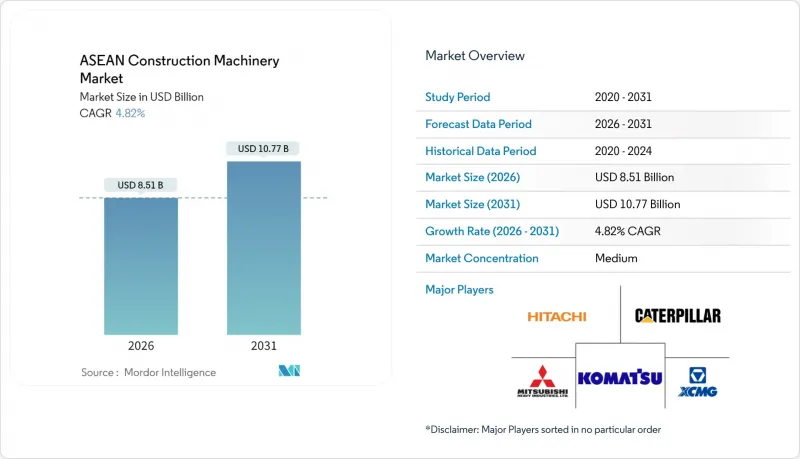
这一市场动能反映了基础设施超级週期,从印尼东加里曼丹的新首都到泰越高铁走廊,无不反映这一点。工业园区持续的外商直接投资、镍矿开采资本投资的復苏以及现场数位化的加速,持续推动关键设备类别的更新换代。同时,在承包商在地化需求的推动下,中国製造商正在快速扩张,重塑竞争格局和价格定位。电气化设备和氢燃料电池原型机的出现预示着新的机会,这得益于政府日益严格的排放法规和建设公司永续性的推动。儘管中美贸易紧张局势导致的供应链中断以及持续的操作员短缺仍然是製约增长的主要因素,但积极的技能培训计划和采购多元化战略正在逐步抵消这些风险。
东协施工机械市场趋势与洞察
印尼IKN资本建设推动基础建设超级週期
努桑塔拉计画的基础建设分阶段实施,采购週期将持续到2040年代中期。五家私人投资者承诺投入超过2.4兆印尼币,用于支持住宅区、综合用途区和关键基础设施建设,以期在2025年之前实现里程碑目标。公共部门预算拨款超过100兆印尼币,其中包括利用数位双胞胎技术进行路段设计。这些计划的规模保证了挖掘机、装载机、混凝土泵和专用起重设备的订单量,同时也鼓励原始设备製造商(OEM)实现零件本地化供应。然而,水泥运输延误和持续的预算调整带来了执行风险,并可能抑制近期设备订购。计画中的公私合营(PPP)模式预计在未来十年透过扩大贷款机构基础来缓解资金筹措压力。
镍矿开采热潮推动了对超大型挖土机的需求
印尼作为全球最大的镍生产国,带动了超大型设备的订单订单。 120吨级液压挖土机EX1200于2024年11月开始量产,目前主要针对新矿开发及现有矿场的扩建。预计到2029年,电池材料需求的成长将显着增加矿山设备的规模。原始设备製造商(OEM)正在展示专为红土矿开采条件定制的100吨和150吨级原型机,而当地承包商则力争实现两位数的市场份额增长。镍价回升鼓励矿场进行前期投资,但更严格的环境审核可能需要额外的技术投资。
初始资本投资增加及企划案融资利率收紧
随着全球利率週期波动,利息负担日益加重,提高了新设备采购的门槛利率。政府预算调整,尤其是在印尼削减了2025年基础设施预算,限制了公共部门的竞标。负债累累的国有承包商仍在为短期债务进行再融资,但利润下滑限制了它们自筹资金资金筹措机械设备的能力。区域性贷款文件标准化措施旨在将保险和退休资本投入长期基础设施投资,并缓解中期资金筹措压力。拥有大量建筑相关贷款的银行正在推出与永续发展挂钩的贷款工具,以激励低排放机械的采用。
细分市场分析
到2025年,挖土机将占东协施工机械市场总规模的35.10%,以巩固其在该领域的领先地位。大吨位挖土机将主导印尼的采矿市场,而中型挖土机仍广泛用于公路和铁路计划。在市政排水和通讯线路建设的推动下,能够在拥挤的城市环境中同时进行挖掘和装载的后铲式装载机预计将实现最高的复合年增长率,达到9.86%。履带挖土机(20-30吨级)占印尼订单的四分之三以上,展现了其在复杂地形中的多功能性。由于港口扩建,装载机的需求将保持强劲,而由于高速公路復线化项目,平地平土机和摊舖机的需求将会增加。加长型堆高机和自动卸货卡车虽然销量仍然较低,但在工业园区仓库和矿物运输路线中仍保持着一定的市场需求。
采用趋势表明,整合控制系统正稳步发展,这推动了二手市场对新型号设备的需求。租赁公司越来越多地将远端资讯处理合约纳入月费,这奖励承包商选择连网设备,并扩大了业务收益的潜在市场。本地组装正利用优惠关税和扩大信用额度,降低中小型承包商的购买门槛,并维持关键土木机械的更换週期。
土木工程和施工机械在东协施工机械市场中占53.72%的份额,是成长最快的应用领域,年复合成长率达4.83%。诸如努桑塔拉城建设项目和跨境铁路走廊等大型企划需要在广阔区域内进行持续的挖掘、平整和运输作业。越南大规模高速公路计划的订单推动了混凝土道路建设的发展,滑模摊舖机的日产量可达500公尺。随着工业园区租户进口生产线机械和预製模组,物料输送量也不断成长。
受镍矿开采持续投资的推动,矿业配套产业持续保持高于区域平均的成长。同时,为响应城市改造的需要,拆除和回收活动也不断扩大。公共产业工程,特别是涉及光纤干线和电网升级的工程,正采用具备先进感测功能的紧凑型设备,以最大限度地减少服务中断。数位双胞胎技术的应用,尤其是在智慧城市和铁路路线规划领域,正在缩短返工週期,并推动对精密导向机械的需求。承包商报告称,由于使用了远端资讯处理数据,停机时间减少了10-15%,这进一步凸显了先进技术方案的优势。
其他福利:
- Excel格式的市场预测(ME)表
- 分析师支持(3个月)
目录
第一章 引言
- 研究假设和市场定义
- 调查范围
第二章调查方法
第三章执行摘要
第四章 市场情势
- 市场概览
- 市场驱动因素
- 透过印尼资本迁移计划(IKN)促进基础设施超级週期
- 镍矿开采热潮推动了对超大型挖土机的需求
- 泰越高速铁路走廊带动跨境设备需求
- 强劲的外国直接投资流入东协工业园区和经济特区
- 受「一带一路」倡议相关建筑企业在地化要求的影响,中国OEM製造商的销售额有所成长。
- 透过现场数位化(BIM + 5G 车联网)加速车辆更新
- 市场限制
- 高额的初始资本投入和企划案融资利率收紧
- 由于合格操作员短缺,营运成本 (OPEX) 增加。
- 充电基础设施和氢气加註网路的缺乏减缓了绿色设备的普及。
- 中美贸易摩擦导致发动机和零件供应中断
- 价值/供应链分析
- 监管环境
- 技术展望
- 波特五力模型
- 新进入者的威胁
- 买方的议价能力
- 供应商的议价能力
- 替代品的威胁
- 竞争对手之间的竞争
第五章 市场规模与成长预测
- 按机器类型
- 挖土机
- 装载机
- 起重机
- 后铲式装载机
- 平土机机
- 摊舖机和压路机
- 其他(加长型堆高机堆高机、自动卸货卡车等)
- 透过使用
- 土木工程施工机械
- 混凝土和道路施工
- 物料输送与物流
- 采矿支持
- 拆卸和回收
- 公用设施安装
- 其他的
- 按最终用途行业划分
- 住宅
- 商业建筑
- 基础设施/公共工程
- 矿业
- 石油和天然气
- 工业製造
- 其他的
- 透过推广
- 柴油引擎
- 杂交种
- 电池式电动车
- 氢燃料电池
- 其他的
- 按国家/地区
- 印尼
- 泰国
- 越南
- 菲律宾
- 马来西亚
- 新加坡
- 其他东南亚国协(缅甸、寮国、柬埔寨、汶莱)
第六章 竞争情势
- 市场集中度
- 策略趋势
- 市占率分析
- 公司简介
- Caterpillar Inc.
- Komatsu Ltd.
- Hitachi Construction Machinery Co.
- XCMG Group
- Sany Heavy Industry
- Liebherr Group
- JCB
- CNH Industrial(CASE and New Holland)
- Volvo Construction Equipment
- Zoomlion Heavy Industry
- Doosan Infracore
- Hyundai Construction Equipment
- Kobelco Construction Machinery
- Yanmar Co., Ltd.
- Wirtgen Group
- Kubota Corporation
- Sandvik Mining and Rock Tech.
- Terex Corporation
- Sumitomo Construction Machinery
- Manitou Group
第七章 市场机会与未来展望
The ASEAN construction machinery market is expected to grow from USD 8.12 billion in 2025 to USD 8.51 billion in 2026 and is forecast to reach USD 10.77 billion by 2031 at 4.82% CAGR over 2026-2031.
The market's momentum reflects an infrastructure super-cycle stretching from Indonesia's new capital city in East Kalimantan to a Thailand-Vietnam high-speed rail corridor. Sustained foreign direct investment into industrial parks, a resurgence in nickel-mining capital expenditure, and accelerating job-site digitalization continue to refresh fleets across every major equipment category. At the same time, Chinese original-equipment manufacturers (OEMs) are expanding rapidly under contractor-localization mandates, reshaping competitive dynamics and price points. Equipment electrification and emerging hydrogen prototypes signal another layer of opportunity as governments tighten emissions regulations and construction firms pursue sustainability credentials. Supply-chain shocks tied to U.S.-China trade frictions and persistent operator shortages remain the principal brakes on growth, but proactive skills-training programs and diversified sourcing strategies are gradually offsetting these risks
ASEAN Construction Machinery Market Trends and Insights
Infrastructure Super-Cycle Driven by Indonesia's IKN Capital-City Build
Groundwork at the Nusantara project is proceeding in phased packages that extend procurement cycles into the mid-2040s. Five private investors have already committed more than Rp 2.4 trillion for 2025 milestones covering lifestyle centers, mixed-use precincts, and essential utilities. Public-sector allocations have surpassed Rp 100 trillion and include road sections designed within a digital-twin framework. Such project breadth sustains order pipelines for excavators, loaders, concrete pumps, and specialist lifting gear while encouraging OEMs to localize component supply. Nonetheless, delayed cement shipments and episodic budget revisions illustrate execution risks that could temper near-term equipment call-offs. Planned public-private-partnership structures are expected to relieve funding pressure by broadening the lender base over the next decade.
Nickel-Mine Boom Fuelling Demand for Ultra-Large Excavators
Indonesia's ascent as the world's leading nickel producer underpins a wave of ultra-large equipment orders. Mass production of 120-ton class EX1200 hydraulic excavators began in November 2024 and is now geared toward both green-field and brown-field mine expansions. The mining equipment fleet is positioned to climb significantly by 2029 as battery-materials demand widens. OEMs are showcasing 100-ton and 150-ton prototypes tailored for laterite ore conditions, while local contractors target double-digit market share gains. With nickel prices rebounding, mines are front-loading capital outlays although tighter environmental audits could require additional technology investments.
High Upfront Capex and Tightening Project-Finance Rates
Interest costs have climbed alongside global rate cycles, lifting hurdle rates for new equipment purchases. Government budget adjustments, most visible in Indonesia where the 2025 infrastructure allocation has narrowed, restrict public-sector tender releases. Highly leveraged state-owned contractors continue to refinance short-dated debt, but profit erosion limits their ability to self-fund machinery. A regional effort to standardize loan documentation seeks to mobilize insurance and pension capital into long-dated infrastructure vehicles, thereby easing financing constraints over the medium term. Banks with large construction portfolios are introducing sustainability-linked loan tranches that reward the uptake of low-emission machinery.
Other drivers and restraints analyzed in the detailed report include:
- Thailand-Vietnam High-Speed Rail Corridor Boosting Cross-Border Equipment Demand
- Strong FDI Inflows into ASEAN Industrial Parks and Sezs
- Shortage of Certified Operators Inflating OPEX
For complete list of drivers and restraints, kindly check the Table Of Contents.
Segment Analysis
The ASEAN construction equipment market size for excavators amounted to 35.10% of total value in 2025, solidifying the category's lead. High-tonnage models now dominate Indonesian mine specifications, while medium-class units remain omnipresent on road and railway projects. Backhoe loaders, which deliver combined digging and loading capability in congested urban environments, post the fastest 9.86% CAGR as municipalities upgrade drainage and telecom lines. Crawler excavators in the 20-30 tonne band captured more than three-quarters of Indonesian orders, underscoring their versatility within mixed-terrain sites. Loader demand stays resilient on account of port expansions, whereas motor graders and pavers benefit from motorway duplication programs. Telehandlers and dump trucks, although smaller in volume, enjoy niche resilience for industrial-park warehousing and mineral-haul circuits.
Adoption patterns reveal a steady pivot toward integrated control systems, a trend that moves secondary-market valuations in favor of more recent models. Rental companies increasingly bundle telematics subscriptions with monthly rates, incentivizing contractors to opt for connected equipment and thereby enlarging the addressable service revenue pool. Local assemblers, leveraging tariff preferences, extend credit lines that lower acquisition barriers for small contractors and sustain the replacement cycle for primary earth-moving machines.
Earth-moving held 53.72% of ASEAN construction equipment market share and remains the fastest-expanding application at a 4.83% CAGR. Mega-projects such as the Nusantara city build and the cross-border rail corridor require continuous excavation, grading, and hauling across vast footprints. Concrete-road construction benefits from large expressway packages in Vietnam where slip-form pavers reach productivity outputs of 500 meters per day. Material-handling volumes climb as industrial-park tenants import line machinery and prefabricated modules.
Mining support continues to outpace regional averages thanks to sustained investment in nickel extraction, while demolition and recycling activities scale up alongside inner-city redevelopment. Utility-installation works, especially fiber-optic backbones and grid upgrades, leverage compact equipment fitted with advanced detection to minimize service interruptions. Integration of digital twins, especially on smart-city and rail alignments, compresses rework cycles and elevates demand for precision-guided machines. Contractors report 10% to 15% reductions in idle time by exploiting telematics data, reinforcing the case for premium technology packages.
The ASEAN Construction Machinery Market Report is Segmented by Machinery Type (Excavators, Loaders, and More), Application (Earth-Moving, Concrete and Road Construction, and More), End-Use Industry (Residential Construction, Commercial Construction, and More), Propulsion (Diesel, Hybrid, and More), and Country (Indonesia, Thailand, and More). The Market Forecasts are Provided in Terms of Value (USD) and Volume (Units).
List of Companies Covered in this Report:
- Caterpillar Inc.
- Komatsu Ltd.
- Hitachi Construction Machinery Co.
- XCMG Group
- Sany Heavy Industry
- Liebherr Group
- JCB
- CNH Industrial (CASE and New Holland)
- Volvo Construction Equipment
- Zoomlion Heavy Industry
- Doosan Infracore
- Hyundai Construction Equipment
- Kobelco Construction Machinery
- Yanmar Co., Ltd.
- Wirtgen Group
- Kubota Corporation
- Sandvik Mining and Rock Tech.
- Terex Corporation
- Sumitomo Construction Machinery
- Manitou Group
Additional Benefits:
- The market estimate (ME) sheet in Excel format
- 3 months of analyst support
TABLE OF CONTENTS
1 Introduction
- 1.1 Study Assumptions and Market Definition
- 1.2 Scope of the Study
2 Research Methodology
3 Executive Summary
4 Market Landscape
- 4.1 Market Overview
- 4.2 Market Drivers
- 4.2.1 Infrastructure Super-Cycle Driven by Indonesia's IKN Capital-City Build
- 4.2.2 Nickel-Mine Boom Fuelling Demand for Ultra-Large Excavators
- 4.2.3 Thailand-Vietnam High-Speed Rail Corridor Boosting Cross-Border Equipment Demand
- 4.2.4 Strong FDI Inflows into ASEAN Industrial Parks and Sezs
- 4.2.5 Belt and Road Contractor-Localization Mandates Increasing Chinese OEM Sales
- 4.2.6 Job-Site Digitalization (BIM + 5G Telematics) Accelerating Fleet Renewal
- 4.3 Market Restraints
- 4.3.1 High Upfront Capex and Tightening Project-Finance Rates
- 4.3.2 Shortage of Certified Operators Inflating OPEX
- 4.3.3 Sparse Charging / Hydrogen Refuelling Network Slowing Green-Equipment Uptake
- 4.3.4 China-US Trade Volatility Causing Engine and Parts Supply Shocks
- 4.4 Value / Supply-Chain Analysis
- 4.5 Regulatory Landscape
- 4.6 Technological Outlook
- 4.7 Porter's Five Forces
- 4.7.1 Threat of New Entrants
- 4.7.2 Bargaining Power of Buyers
- 4.7.3 Bargaining Power of Suppliers
- 4.7.4 Threat of Substitutes
- 4.7.5 Intensity of Competitive Rivalry
5 Market Size and Growth Forecasts (Value (USD) and Volume (Units))
- 5.1 By Machinery Type
- 5.1.1 Excavators
- 5.1.2 Loaders
- 5.1.3 Cranes
- 5.1.4 Backhoe Loaders
- 5.1.5 Motor Graders
- 5.1.6 Pavers and Compactors
- 5.1.7 Others (Telehandlers, Dump Trucks, etc.)
- 5.2 By Application
- 5.2.1 Earth-Moving
- 5.2.2 Concrete and Road Construction
- 5.2.3 Material Handling and Logistics
- 5.2.4 Mining Support
- 5.2.5 Demolition and Recycling
- 5.2.6 Utilities Installation
- 5.2.7 Others
- 5.3 By End-Use Industry
- 5.3.1 Residential Construction
- 5.3.2 Commercial Construction
- 5.3.3 Infrastructure / Public Works
- 5.3.4 Mining
- 5.3.5 Oil and Gas
- 5.3.6 Industrial Manufacturing
- 5.3.7 Others
- 5.4 By Propulsion
- 5.4.1 Diesel
- 5.4.2 Hybrid
- 5.4.3 Battery-Electric
- 5.4.4 Hydrogen Fuel-Cell
- 5.4.5 Others
- 5.5 By Country
- 5.5.1 Indonesia
- 5.5.2 Thailand
- 5.5.3 Vietnam
- 5.5.4 Philippines
- 5.5.5 Malaysia
- 5.5.6 Singapore
- 5.5.7 Rest of ASEAN (Myanmar, Laos, Cambodia, Brunei)
6 Competitive Landscape
- 6.1 Market Concentration
- 6.2 Strategic Moves
- 6.3 Market Share Analysis
- 6.4 Company Profiles (Includes Global level Overview, Market level overview, Core Segments, Financials as available, Strategic Information, Market Rank/Share for key companies, Products and Services, and Recent Developments)
- 6.4.1 Caterpillar Inc.
- 6.4.2 Komatsu Ltd.
- 6.4.3 Hitachi Construction Machinery Co.
- 6.4.4 XCMG Group
- 6.4.5 Sany Heavy Industry
- 6.4.6 Liebherr Group
- 6.4.7 JCB
- 6.4.8 CNH Industrial (CASE and New Holland)
- 6.4.9 Volvo Construction Equipment
- 6.4.10 Zoomlion Heavy Industry
- 6.4.11 Doosan Infracore
- 6.4.12 Hyundai Construction Equipment
- 6.4.13 Kobelco Construction Machinery
- 6.4.14 Yanmar Co., Ltd.
- 6.4.15 Wirtgen Group
- 6.4.16 Kubota Corporation
- 6.4.17 Sandvik Mining and Rock Tech.
- 6.4.18 Terex Corporation
- 6.4.19 Sumitomo Construction Machinery
- 6.4.20 Manitou Group
7 Market Opportunities and Future Outlook
- 7.1 White-space and Unmet-Need Assessment

 施工机械市场规模、份额、趋势和预测:按解决方案类型、机器类型、应用、行业和地区划分,2026-2034年
 2026年全球挖沟机市场报告2026年全球施工机械售后市场报告2026年全球水泥和砂浆测试设备市场报告
 施工机械市场:2026-2032年全球市场预测(依产品类型、功率输出、燃料类型、设计类型、运作小时数、销售管道和最终用户划分)橡胶压机市场:依橡胶类型、压机类型、操作模式、产能、应用及通路划分-全球预测,2026-2032年电动施工机械市场:依设备类型、推进系统和应用划分-全球预测,2026-2032年自动液压机市场:按压机类型、控制类型、操作模式和终端用户产业划分,全球预测,2026-2032年
 2026 年至 2035 年施工机械轮胎市场的商业机会、成长要素、产业趋势分析与预测。
 中国施工机械:市场占有率分析、产业趋势与统计、成长预测(2026-2031)