


 |
市场调查报告书
商品编码
1939657
窗膜:市场占有率分析、产业趋势与统计、成长预测(2026-2031)Window Films - Market Share Analysis, Industry Trends & Statistics, Growth Forecasts (2026 - 2031) |
||||||

※ 本网页内容可能与最新版本有所差异。详细情况请与我们联繫。
预计到 2026 年,窗膜市值将达到 26.6 亿美元,高于 2025 年的 25 亿美元。
预计到 2031 年将达到 36.2 亿美元,2026 年至 2031 年的复合年增长率为 6.39%。
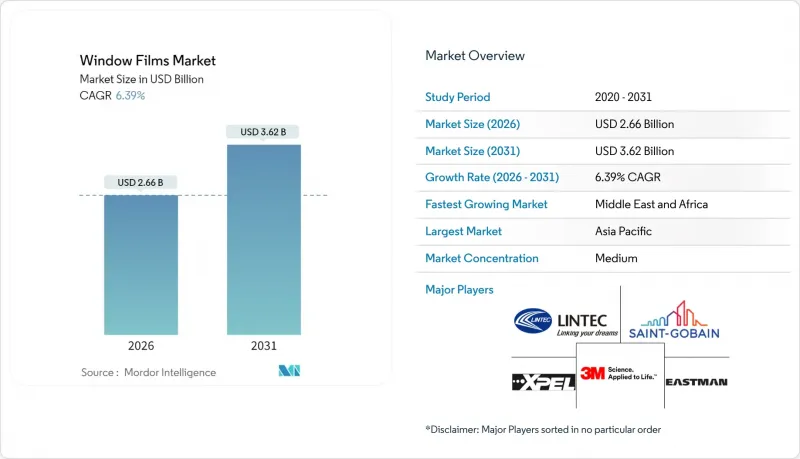
市场需求正从基本的太阳能控制转向兼具能源管理、安全性和互联性等优势的多功能薄膜,推动了汽车、建筑和特种应用领域的应用。净零排放建筑的强制性要求正在加速维修活动,而不断增长的电动车保有量和快速的玻璃更换週期也支撑了汽车行业的需求。供应商正在推出奈米陶瓷和低辐射结构,这些结构既符合严格的节能标准,又不会影响5G驾驶辅助系统所需的无线电波渗透性。亚太地区仍然是生产和消费中心,但中东和非洲地区正在崛起成为成长最快的地区,沙乌地阿拉伯和阿联酋的大型计划正在采用电涂装玻璃。儘管面临来自电致变色智慧玻璃和低成本通用薄膜日益增长的竞争压力,但主要现有企业仍透过创新和区域产能扩张来巩固其市场地位,因此市场集中度仍保持在中等水平。
全球窗膜市场趋势与洞察
安全防护膜的需求不断增长
人们对活跃威胁场景的日益关注推动了24密耳厚安全层压膜的应用,这种薄膜能够在强行闯入或爆炸中有效阻挡玻璃碎片。承包商越来越多地指定使用多层胺甲酸乙酯结构,这种结构比传统的聚酯产品具有更优异的抗撕裂性和边缘抓力。设施管理人员讚赏这种产品能够同时提供防入侵和紫外线防护功能,从而在单一产品中同时解决安全和节能方面的挑战。飓风易发地区的保险折扣也进一步促进了维修活动。随着相关人员寻求经济高效的外部加固方案,这项技术正从高风险的政府设施扩展到学校、零售连锁店和综合用途大楼。製造商正在积极响应这一趋势,推出符合ANSI Z97.1和EN 12600衝击测试标准的安全薄膜,进一步巩固了其在全球建筑规范中的重要性。
净零排放指令促进节能隔热膜的应用
欧盟建筑能源性能指令和加州第24号法规对玻璃的热传导係数(U值)和太阳能热增益係数进行了规定,鼓励业主对现有窗户维修,而不是进行高成本的更换。高性能太阳能控制薄膜可以即时提升能源性能证书,帮助房地产投资组合实现其2030年脱碳目标。奈米陶瓷配方在降低红外线透射率的同时保留自然光,使其成为以健康为导向的室内设计中的关键元素。智慧光致变色薄膜的研究原型表明,当与低辐射(Low-E)双层玻璃结合使用时,预计将年度能源消耗降低高达35%。卷对捲製造技术使其价格与电致变色玻璃相当,有望使这种薄膜成为数百万寻求提高能源效率的建筑的主流维修解决方案。
技术安装难题和保固问题
先进的多层薄膜需要完美的表面处理、湿度控制和精准的刮涂技术。施工人员技术水平的差异会导致气泡、边缘翘起和光学雾化,从而引发保固纠纷,尤其是在对价格敏感的新兴市场。行业协会已发布视觉品质标准,但执行力度仍参差不齐。製造商的回应是提供更多认证课程和预裁套件,但这推高了分销成本,并限制了客製化解决方案。在汽车售后市场,复杂的曲面增加了施工难度,延长了施工时间,一旦出现缺陷,就会引发消费者不满。
细分市场分析
到2025年,隔热和防紫外线薄膜将占窗膜市场40.89%的份额,巩固其作为领先的维修方案的地位,可即时降低热量吸收并提升居住者舒适度。由于人们越来越意识到其在家具、艺术品和汽车内装方面的防褪色性能,销售业绩强劲。高阶奈米陶瓷产品因其色彩还原度高且在恶劣气候条件下也具有良好的耐久性,推高了平均售价。结合频谱选择性涂层和装饰图案的混合型产品正在市场上涌现,满足了零售商在不牺牲性能的前提下对品牌差异化的需求。供应商正在推广非金属化层压结构,以避免对连网建筑和车辆造成无线电干扰。
受净零排放政策目标和中纬度地区供暖度日数增加的推动,隔热/低辐射(Low-E)产品预计将在2031年之前以7.26%的复合年增长率快速增长。多层溅镀层压结构可减少传导和辐射损失,使单层玻璃窗的性能指标接近双层玻璃,而更换成本却远低于双层玻璃。在温带地区,该产品的投资回收期不到三年,促使设施管理人员在维修B级办公大楼时广泛采用。虽然随着建筑规范的日益严格,隔热/低辐射(Low-E)窗膜市场预计将快速增长,但由于製造流程复杂和安装要求高,其应用仍然主要局限于专业管道。装饰性、隐私和安全等细分市场继续满足酒店、医疗保健和关键基础设施等行业的特殊需求。
区域分析
亚太地区将引领市场,到2025年将占全球收入的45.84%,主要得益于中国在建筑占地面积和汽车生产方面的双重优势。日本和韩国雄心勃勃的建筑节能法规正在推动高端低辐射(Low-E)和智慧薄膜的安装,而印度和东南亚国协由于快速的都市化,在较低的基数上实现了两位数的增长。本地价值链提供了具有竞争力的成本优势,大型跨国公司在中国和新加坡扩大大规模生产能力便是最好的证明。区域分销商正在将薄膜与遮阳装置和建筑自动化感测器结合,以凸显建筑幕墙的整体价值提案。
预计到2031年,中东和非洲地区的复合年增长率将达到6.83%,成为成长最快的地区,这主要得益于沙乌地阿拉伯「2030愿景」计划的推动。这些项目必须承受极端的太阳辐射,同时也要符合LEED或Estidama绿建筑标准。利雅德和杜拜的开发商正在指定使用高选择性薄膜来控制空调成本,同时保持现代建筑标誌性的大面积玻璃建筑幕墙。技术纯熟劳工短缺和建筑材料需求旺盛可能会限制施工能力,因此供应商正在实施加速培训计划,以培训安装人员并对大型企划的分包商进行资格预审。
北美和欧洲是成熟市场,其成长依赖于建筑规范驱动的维修以及对高端市场的渗透。儘管宏观经济波动,但需求依然强劲,这主要得益于欧盟强制要求到2030年维修至少16%的商业建筑存量。美国各州的深度节能维修奖励提供了稳定的专案来源,而企业脱碳承诺也持续推动市场发展。南美洲的普及速度较为缓慢,经济週期和货币波动抑制了投资,但圣保罗和圣地牙哥等都市区已采用更高的玻璃标准,这为中等性能薄膜创造了机会。
其他福利:
- Excel格式的市场预测(ME)表
- 3个月的分析师支持
目录
第一章 引言
- 研究假设和市场定义
- 调查范围
第二章调查方法
第三章执行摘要
第四章 市场情势
- 市场概览
- 市场驱动因素
- 安全防护膜的需求不断增长
- 净零排放指令推动节能隔热的发展
- 加速汽车售后市场的玻璃更换週期
- 资料中心外墙维修迅速增加,旨在阻挡红外线
- 购买抗飓风薄膜可享保险折扣
- 市场限制
- 安装过程中的技术和保固问题
- 与电致变色智慧玻璃的竞争
- 限制溶剂型黏合剂的VOC排放法规
- 价值链分析
- 波特五力模型
- 供应商的议价能力
- 买方的议价能力
- 新进入者的威胁
- 替代品的威胁
- 竞争程度
第五章 市场规模与成长预测
- 按类型
- 隔热和紫外线阻隔膜
- 装饰膜
- 安全保障影片
- 防窥膜
- 隔热/低辐射薄膜
- 其他的
- 按最终用户行业划分
- 车
- 建筑/施工
- 海洋
- 航太
- 其他的
- 按地区
- 亚太地区
- 中国
- 印度
- 日本
- 韩国
- 东南亚国协
- 亚太其他地区
- 北美洲
- 我们
- 加拿大
- 墨西哥
- 欧洲
- 德国
- 英国
- 法国
- 义大利
- 西班牙
- 北欧国家
- 俄罗斯
- 土耳其
- 其他欧洲地区
- 南美洲
- 巴西
- 阿根廷
- 哥伦比亚
- 南美洲其他地区
- 中东和非洲
- 沙乌地阿拉伯
- 阿拉伯聯合大公国
- 南非
- 埃及
- 奈及利亚
- 其他中东和非洲地区
- 亚太地区
第六章 竞争情势
- 市场集中度
- 策略趋势
- 市占率/排名分析
- 公司简介
- 3M
- Armolan Greece
- Avery Dennison Corporation
- Eastman Chemical Company
- Erickson International, LLC
- Garware Hi-Tech Films.
- HYOSUNG CHEMICAL
- Johnson Window Films Inc.
- Lintec Corporation
- Madico
- Nexfil
- Rayno Window Film
- Saint-Gobain
- TORAY INDUSTRIES INC.
- WINTECH CO., LTD.
- XPEL
第七章 市场机会与未来展望
Window Films market size in 2026 is estimated at USD 2.66 billion, growing from 2025 value of USD 2.50 billion with 2031 projections showing USD 3.62 billion, growing at 6.39% CAGR over 2026-2031.
Strong demand pivots from basic solar control toward multi-functional films that combine energy management, safety, and connectivity benefits, increasingly specified in automotive, building, and specialty applications. Net-zero building mandates accelerate retrofit activity, while an expanding electric-vehicle (EV) fleet and rapid glazing replacement cycles keep automotive volumes buoyant. Suppliers are introducing nanoceramic and low-emissivity constructions that meet stringent energy-code requirements without compromising the radio-wave transparency required for 5G-enabled driver-assistance systems. Asia-Pacific remains the production and consumption hub, yet Middle-East and Africa emerges as the fastest-growing geography as mega-projects in Saudi Arabia and the UAE embrace high-performance glazing. Market concentration stays moderate because leading incumbents defend their positions through innovation and regional capacity expansion, even as electrochromic smart glass and low-cost commodity films intensify competitive pressure.
Global Window Films Market Trends and Insights
Growing demand for safety and security films
Heightened awareness of active-threat scenarios drives wider adoption of 24-mil security laminates that retain glass fragments during forced entry or blast events. Installers are increasingly specifying multi-layer urethane constructions that surpass legacy polyester products in terms of tear resistance and edge-grip performance. Facility managers value the ability to combine intrusion mitigation with UV filtration, allowing a single product to address both safety and energy challenges. Insurance premium rebates in hurricane-prone regions further stimulate retrofit activity. The technology is migrating from high-risk government sites into schools, retail chains, and mixed-use towers as stakeholders seek cost-effective envelope hardening. Manufacturers answer the trend with security films certified under ANSI Z97.1 and EN 12600 impact protocols, reinforcing their relevance in global building codes.
Net-zero mandates driving energy-saving solar-control films
The EU Energy Performance of Buildings Directive and California's Title 24 cap glazing U-factor and solar heat-gain coefficients, pushing owners to upgrade existing windows rather than pursue costly replacements. High-performance solar-control films demonstrate immediate Energy Performance Certificate uplifts, enabling property portfolios to meet 2030 decarbonization targets. Nanoceramic formulations cut infrared transmittance while preserving daylight, an important factor in wellness-oriented interior design. Research prototypes of smart photochromic films indicate potential annual energy-use reductions of up to 35% when paired with low-E double glazing. Roll-to-roll manufacturing keeps price points competitive against electrochromic glass, positioning films as the mainstream retrofit path for millions of buildings needing efficiency gains.
Technical and warranty issues during installation
Advanced multi-layer films require pristine surface preparation, controlled humidity, and precise squeegee techniques. Variations in installer skill create bubbles, edge lift, and optical haze that trigger warranty disputes, particularly in price-sensitive emerging markets. Trade associations publish visual-quality standards, yet enforcement remains uneven. Manufacturers answer with expanded certification courses and pre-cut kits, but these initiatives raise channel costs and limit bespoke solutions. In the automotive aftermarket, compound curves amplify complexity, prolonging installation time and inviting consumer dissatisfaction when defects appear.
Other drivers and restraints analyzed in the detailed report include:
- Rapid glazing replacement cycle in automotive aftermarket
- Insurance-premium rebates for hurricane-resistant films
- VOC-emission regulations limiting solvent-based adhesives
For complete list of drivers and restraints, kindly check the Table Of Contents.
Segment Analysis
Solar-control and UV-blocking constructions retained a 40.89% slice of the window films market in 2025, confirming their status as the go-to retrofit option for instant heat-gain reduction and occupant comfort. Strong sales track widespread awareness of fading protection in furniture, artworks, and automotive interiors. Premium nanoceramic variants command higher average selling prices thanks to neutral color rendition and longevity in harsh climates. The market now witnesses hybrid products that fuse spectrally selective coatings with decorative patterns, appealing to retail storefronts seeking brand differentiation without sacrificing performance. Suppliers promote metallized-free stacks to avert radio interference in connected buildings and vehicles.
Insulating/low-E products post the fastest 7.26% CAGR through 2031, buoyed by net-zero policy targets and rising heating-degree-day counts in mid-latitude regions. Their multi-layer sputtered stacks cut conducted and radiative losses, allowing single-pane windows to approach double-pane performance metrics at a fraction of replacement cost. Demonstrated payback periods of three years or less in temperate zones catalyze adoption among facility managers retrofitting Class-B office stock. The window films market size for insulating/low-E solutions is projected to surge as building codes tighten, yet production complexity and higher installation skill requirements still confine uptake to professional channels. Decorative, privacy and safety niches continue serving specialized demand pockets in hospitality, healthcare and critical-infrastructure verticals.
The Window Films Market Report is Segmented by Type (Solar-Control and UV-Blocking Films, Decorative Films, Safety and Security Films, Privacy Films, Insulating/Low-E Films, Others), End-User Industry (Automotive, Building and Construction, Marine, Aerospace, Others), and Geography (Asia-Pacific, North America, Europe, South America, Middle-East and Africa). The Market Forecasts are Provided in Terms of Value (USD).
Geography Analysis
Asia-Pacific led with 45.84% of 2025 global revenue, thanks to China's dual dominance in construction floor space and vehicle production. Ambitious building-energy regulations in Japan and South Korea propel premium low-E and smart-film installations, while India and ASEAN nations show double-digit growth off lower bases as urbanization surges. Local supply chains grant competitive cost positions, evidenced by large-scale capacity additions in China and Singapore announced by major multinationals. Regional distributors bundle films with shading devices and building-automation sensors, highlighting holistic facade value propositions.
Middle-East and Africa records the highest 6.83% CAGR through 2031, underpinned by Saudi Vision 2030 giga-projects that must endure extreme solar loads and meet LEED or Estidama green-building criteria. Developers in Riyadh and Dubai specify high-selectivity films to curb HVAC bills while preserving expansive glass facades emblematic of contemporary architecture. Skilled-labor shortages and competing construction material demand occasionally constrain installation capacity, prompting suppliers to train applicators under accelerated programs and pre-qualify subcontractors for mega-project packages.
North America and Europe constitute mature arenas where growth relies on code-driven retrofits and premium segment penetration. The EU's mandate to refurbish the worst-performing 16% of commercial stock by 2030 keeps demand resilient despite macroeconomic swings. U.S. state-level incentives for deep-energy retrofits feed a steady pipeline, and corporate decarbonization pledges extend momentum. South America follows with moderate uptake as economic cycles and currency volatility temper investment, yet urban centers such as Sao Paulo and Santiago adopt higher glazing standards that open opportunities for mid-tier performance films.
- 3M
- Armolan Greece
- Avery Dennison Corporation
- Eastman Chemical Company
- Erickson International, LLC
- Garware Hi-Tech Films.
- HYOSUNG CHEMICAL
- Johnson Window Films Inc.
- Lintec Corporation
- Madico
- Nexfil
- Rayno Window Film
- Saint-Gobain
- TORAY INDUSTRIES INC.
- WINTECH CO., LTD.
- XPEL
Additional Benefits:
- The market estimate (ME) sheet in Excel format
- 3 months of analyst support
TABLE OF CONTENTS
1 Introduction
- 1.1 Study Assumptions and Market Definition
- 1.2 Scope of the Study
2 Research Methodology
3 Executive Summary
4 Market Landscape
- 4.1 Market Overview
- 4.2 Market Drivers
- 4.2.1 Growing demand for safety and security films
- 4.2.2 Net-zero mandates driving energy-saving solar-control films
- 4.2.3 Rapid glazing replacement cycle in automotive aftermarket
- 4.2.4 Surge in data-centre facade retrofits for Infrared rejection
- 4.2.5 Insurance-premium rebates for hurricane-resistant films
- 4.3 Market Restraints
- 4.3.1 Technical and warranty issues during installation
- 4.3.2 Competition from electro-chromic smart glass
- 4.3.3 VOC-emission regulations limiting solvent-based adhesives
- 4.4 Value Chain Analysis
- 4.5 Porter's Five Forces
- 4.5.1 Bargaining Power of Suppliers
- 4.5.2 Bargaining Power of Buyers
- 4.5.3 Threat of New Entrants
- 4.5.4 Threat of Substitutes
- 4.5.5 Degree of Competition
5 Market Size and Growth Forecasts (Value)
- 5.1 By Type
- 5.1.1 Solar-control and UV-blocking Films
- 5.1.2 Decorative Films
- 5.1.3 Safety and Security Films
- 5.1.4 Privacy Films
- 5.1.5 Insulating/Low-E Films
- 5.1.6 Others
- 5.2 By End-user Industry
- 5.2.1 Automotive
- 5.2.2 Building and Construction
- 5.2.3 Marine
- 5.2.4 Aerospace
- 5.2.5 Others
- 5.3 By Geography
- 5.3.1 Asia-Pacific
- 5.3.1.1 China
- 5.3.1.2 India
- 5.3.1.3 Japan
- 5.3.1.4 South Korea
- 5.3.1.5 ASEAN Countries
- 5.3.1.6 Rest of Asia-Pacific
- 5.3.2 North America
- 5.3.2.1 United States
- 5.3.2.2 Canada
- 5.3.2.3 Mexico
- 5.3.3 Europe
- 5.3.3.1 Germany
- 5.3.3.2 United Kingdom
- 5.3.3.3 France
- 5.3.3.4 Italy
- 5.3.3.5 Spain
- 5.3.3.6 Nordic Countries
- 5.3.3.7 Russia
- 5.3.3.8 Turkey
- 5.3.3.9 Rest of Europe
- 5.3.4 South America
- 5.3.4.1 Brazil
- 5.3.4.2 Argentina
- 5.3.4.3 Colombia
- 5.3.4.4 Rest of South America
- 5.3.5 Middle-East and Africa
- 5.3.5.1 Saudi Arabia
- 5.3.5.2 United Arab Emirates
- 5.3.5.3 South Africa
- 5.3.5.4 Egypt
- 5.3.5.5 Nigeria
- 5.3.5.6 Rest of Middle-East and Africa
- 5.3.1 Asia-Pacific
6 Competitive Landscape
- 6.1 Market Concentration
- 6.2 Strategic Moves
- 6.3 Market Share**/Ranking Analysis
- 6.4 Company Profiles (includes Global overview, Market overview, Core segments, Financials, Strategic info, Market share, Products and Services, Recent developments)
- 6.4.1 3M
- 6.4.2 Armolan Greece
- 6.4.3 Avery Dennison Corporation
- 6.4.4 Eastman Chemical Company
- 6.4.5 Erickson International, LLC
- 6.4.6 Garware Hi-Tech Films.
- 6.4.7 HYOSUNG CHEMICAL
- 6.4.8 Johnson Window Films Inc.
- 6.4.9 Lintec Corporation
- 6.4.10 Madico
- 6.4.11 Nexfil
- 6.4.12 Rayno Window Film
- 6.4.13 Saint-Gobain
- 6.4.14 TORAY INDUSTRIES INC.
- 6.4.15 WINTECH CO., LTD.
- 6.4.16 XPEL
7 Market Opportunities and Future Outlook
- 7.1 White-space and Unmet-need Assessment

 全球节能窗膜市场(按薄膜类型、应用和分销管道划分)预测(2026-2032年)
 2026年全球建筑窗膜市场报告2026年全球窗膜市场报告
 全球窗膜市场,2026-2030年过渡性窗膜市场按技术、应用、终端用户产业和分销管道划分-2026-2032年全球预测
 全球窗膜市场:市场规模、市场占有率、成长率、产业分析、按类型、应用和地区划分的分析以及未来预测(2026-2034)按应用、薄膜类型、最终用途、分销管道和价格分布范围分類的窗膜市场—2025-2032年全球预测
 2025 年至 2033 年窗膜市场规模、份额、趋势及预测(依产品、应用及地区)
 窗膜市场规模、份额、成长分析(按产品、应用、材料和地区)- 产业预测(2025-2032)
 2030 年窗膜市场预测:按类型、材料、技术、应用、最终用户和地区进行的全球分析