


 |
市场调查报告书
商品编码
1939668
云端人工智慧:市场占有率分析、产业趋势与统计、成长预测(2026-2031)Cloud AI - Market Share Analysis, Industry Trends & Statistics, Growth Forecasts (2026 - 2031) |
||||||

※ 本网页内容可能与最新版本有所差异。详细情况请与我们联繫。
预计到 2025 年,云端运算人工智慧市场规模将达到 894.3 亿美元,到 2031 年将达到 4,540.2 亿美元,高于 2026 年的 1,172.6 亿美元。
预计在预测期(2026-2031 年)内,复合年增长率将达到 31.10%。
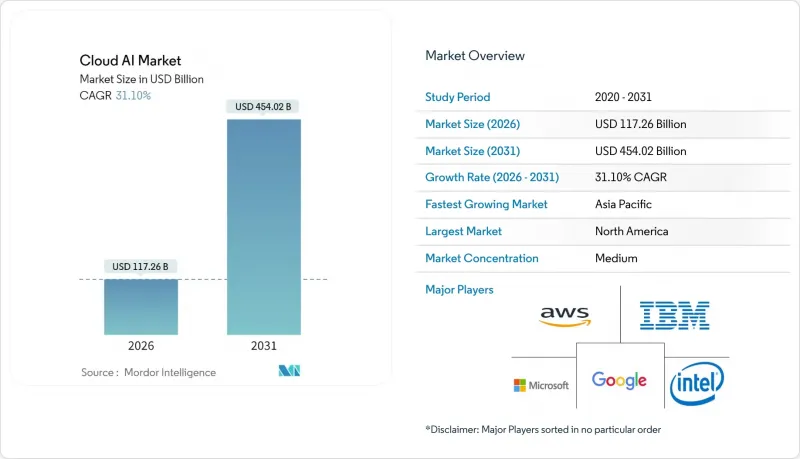
在生成式人工智慧领域,微软向OpenAI投资130亿美元,亚马逊向Anthropic投资80亿美元等合作项目,正帮助企业扩展处理能力、降低进入门槛并加速实现价值。 GPU分区技术透过降低基础设施成本,推动了中型企业对此技术的采用。同时,医疗保健和金融服务业的特定产业法规也更有利于那些能够展现强大管治的供应商。在超大规模资料中心业者领域,供应链趋势,尤其是高频宽记忆体领域的趋势,正在推动晶片多元化策略的实施,而注重碳排放的工作负载编配也开始影响资料中心的位置决策。
全球云端人工智慧市场趋势与洞察
人工智慧即服务 (AIaaS) 的采用率不断提高
企业正从资本密集的本地部署转向计量收费的人工智慧服务。微软的人工智慧业务预计将在2025财年第二季实现130亿美元的年化收入,为Azure的成长贡献16个百分点。诸如AWS Trainium2之类的客製化晶片可带来30-40%的性价比提升,从而扩大了必须满足区域资料主权法规的中型企业获取人工智慧服务的管道。欧洲和亚洲的采用率最高,这两个地区有60%的中型企业预计到2025年将使用特定区域的语言模型。
巨量资料量不断成长
非结构化资料占企业资料资产的 80% 以上,推动了对即时人工智慧分析的需求。在医疗保健领域,梅奥诊所处理 10 万名患者的基因组记录,以提高疾病的早期检测率。金融服务业应用云端人工智慧技术,将反洗钱筛检的误报率降低了 95%。边缘运算和云端融合使製造商能够利用物联网资料流,以毫秒级的响应速度执行预测性维护。
GPU/HBM供应链短缺持续存在
SK海力士控制着70%的HBM市场,并表示到2025年供应仍然紧张,这给云端服务供应商带来了成本压力。 AWS已推出客製化的Trainium晶片以应对这一局面,而Oracle采购了数千块NVIDIA Blackwell GPU以维持训练能力。记忆体供应紧张导致DDR5和VRAM价格飙升,促使三星与AMD签署了一项价值30亿美元的HBM3E供应协议。
细分市场分析
到 2025 年,解决方案将占云端 AI 市场的 62.40%。企业正专注于可与现有 DevOps 管线整合的打包平台,以确保快速部署和稳定的效能。随着采用率的提高,迁移蓝图和管治的专家指导变得至关重要,这将推动服务细分市场以预期 33.42% 的复合年增长率成长。
服务成长反映了涵盖策略制定、模式调整和营运管理的多年转型计划。例如,Accenture等公司正在为 Anthropic on AWS 部署专案对 1400 名工程师进行再培训,直接解决企业技能缺口问题。解决方案和服务交付模式正变得越来越普遍,使企业能够在建立内部能力的同时快速采用人工智慧。
预计到2025年,银行、金融和保险(BFSI)产业将占云端人工智慧市场份额的28.55%,主要驱动力来自诈欺分析和智慧投顾等应用情境。然而,医疗保健产业预计将以34.98%的复合年增长率成长,主要得益于人工智慧辅助诊断和环境临床文件记录等应用情境。
医院正在部署大规模语言模型,用于放射科分诊和个人化治疗建议。美国食品药物管理局 (FDA) 于 2025 年 1 月发布的指南提供了清晰的监管路径,刺激了资本投资。製造业和零售业也纷纷效仿,分别利用人工智慧进行缺陷检测和库存优化。
云端人工智慧市场报告按类型(解决方案和服务)、最终用户产业(银行、金融服务和保险、医疗保健、汽车和旅游等)、部署模式(公共云端、私有云端等)、应用(诈欺和风险分析、行销和个人化等)、技术(机器学习、生成式人工智慧等)和地区进行细分。
区域分析
北美将在2025年维持40.60%的云端运算AI市场份额,这主要得益于其超大规模资料中心业者资料中心和创业投资资金。监管政策的明朗化,例如FDA发布的AI设备指南,正在推动生命科学和金融领域的AI应用。包括亚马逊对Anthropic的80亿美元投资以及微软持续推动的OpenAI整合在内的资本支出,进一步巩固了该地区的领先地位。
亚太地区是成长最快的地区,复合年增长率高达31.88%。预计到2025年,中国云端运算支出将达到460亿美元,阿里巴巴的多年资本支出承诺也推动了基础设施的扩张。随着Oracle宣布投资80亿美元以及OpenAI在东京开设其首个印太地区办事处,日本的发展速度正在加速。印度和东南亚则受益于数位公共基础设施计画和不断成长的开发团体。
儘管法规环境复杂,欧洲仍呈现稳定成长态势。欧盟人工智慧法律提供了一个统一的框架,使拥有认证管治的供应商更具优势。主权云端计画和碳减排指令正在推动混合架构的发展。中东和非洲等新兴市场正率先采用混合架构,这得益于主权财富基金对资料中心的投资。
其他福利:
- Excel格式的市场预测(ME)表
- 3个月的分析师支持
目录
第一章 引言
- 研究假设和市场定义
- 调查范围
第二章调查方法
第三章执行摘要
第四章 市场情势
- 市场概览
- 市场驱动因素
- 巨量资料量不断成长
- 人工智慧即服务 (AIaaS) 的采用率不断提高
- 对虚拟助理和生成式人工智慧聊天机器人的需求不断增长
- 生成式人工智慧正在颠覆GPU,并为中小企业带来更大的应用前景。
- 边缘云端人工智慧互通性标准(例如 ONNX、MEDAL)
- 加速碳感知型工作负载编配
- 市场限制
- 技术工人短缺和资料安全问题
- GPU/HBM供应链短缺持续存在
- 人工智慧资料中心的能源限制和碳排放法规
- 地缘政治GPU出口管制框架
- 价值链分析
- 监管环境
- 技术展望
- 波特五力分析
- 新进入者的威胁
- 供应商的议价能力
- 买方的议价能力
- 替代品的威胁
- 竞争对手之间的竞争
第五章 市场规模与成长预测
- 按类型
- 解决方案
- 服务
- 终端用户产业
- BFSI
- 卫生保健
- 汽车与出行
- 零售与电子商务
- 政府和公共部门
- 教育
- 製造业
- 按部署模式
- 公共云端
- 私有云端
- 混合/多重云端
- 透过使用
- 人工智慧在客户服务和客服中心的应用
- 预测性维护和资产管理
- 诈欺和风险分析
- 行销与个人化
- 电脑视觉服务
- 透过技术
- 机器学习
- 自然语言处理
- 电脑视觉
- 人工智慧世代
- 增强人工智慧和边缘人工智慧
- 按地区
- 北美洲
- 我们
- 加拿大
- 墨西哥
- 南美洲
- 巴西
- 阿根廷
- 智利
- 其他南美洲
- 欧洲
- 德国
- 英国
- 法国
- 义大利
- 西班牙
- 荷兰
- 俄罗斯
- 其他欧洲地区
- 亚太地区
- 中国
- 印度
- 日本
- 韩国
- ASEAN
- 亚太其他地区
- 中东和非洲
- 中东
- 海湾合作委员会(沙乌地阿拉伯、阿联酋、卡达等)
- 土耳其
- 其他中东地区
- 非洲
- 南非
- 奈及利亚
- 肯亚
- 其他非洲地区
- 中东
- 北美洲
第六章 竞争情势
- 市场集中度
- 策略趋势
- 市占率分析
- 公司简介
- Amazon Web Services
- Microsoft Corp.
- Google LLC
- IBM Corp.
- Salesforce Inc.
- NVIDIA Corp.
- Oracle Corp.
- Alibaba Cloud
- SAP SE
- ServiceNow
- Databricks
- Snowflake Inc.
- Hugging Face
- OpenAI LP
- Anthropic PBC
- CoreWeave
- AMD Inc.
- Intel Corp.
- Wipro Ltd.
- Infosys Ltd.
- SoundHound AI Inc.
- Twilio Inc.
第七章 市场机会与未来展望
The Cloud AI market was valued at USD 89.43 billion in 2025 and estimated to grow from USD 117.26 billion in 2026 to reach USD 454.02 billion by 2031, at a CAGR of 31.10% during the forecast period (2026-2031).
Generative AI partnerships, such as Microsoft's USD 13 billion commitment to OpenAI and Amazon's USD 8 billion investment in Anthropic, are expanding capacity, lowering entry barriers, and accelerating time-to-value for enterprises. Mid-market adoption is rising as GPU-fractionalization technologies reduce infrastructure costs, while sector-specific regulations in healthcare and financial services favor providers that can demonstrate robust governance. Supply-chain dynamics, notably in high-bandwidth memory, spur chip diversification strategies among hyperscalers, and carbon-aware workload orchestration begins to influence data-center siting decisions.
Global Cloud AI Market Trends and Insights
Growing Adoption of AI-as-a-Service (AIaaS)
Enterprises are shifting from capital-heavy on-premises deployments to pay-as-you-go AI services. Microsoft's AI business reached a USD 13 billion annual run rate in Q2 FY 2025, contributing 16 percentage points to Azure growth. Custom silicon such as AWS Trainium2 delivers 30-40% price-performance gains, broadening AI accessibility for mid-market firms that must meet regional data-sovereignty rules. Uptake is evident across Europe and Asia, where 60% of mid-size enterprises expect regionally trained language models by 2025.
Rising Big-Data Volume
Unstructured data exceeds 80% of enterprise information assets, driving demand for real-time AI analytics. Healthcare use cases include Mayo Clinic processing genomic records from 100,000 patients to improve early disease detection. Financial services apply cloud AI to reduce false positives in anti-money-laundering screening by 95%. Edge-cloud convergence allows manufacturers to perform predictive maintenance on IoT data streams with millisecond response times.
Persistent GPU/HBM Supply-Chain Shortages
SK Hynix controls 70% of the HBM market and reports full allocation through 2025, creating cost pressures for cloud providers. AWS counters with Trainium custom chips, while Oracle procures thousands of NVIDIA Blackwell GPUs to sustain training capacity. Tight memory supply has triggered price spikes in DDR5 and VRAM, with Samsung inking a USD 3 billion HBM3E supply deal with AMD.
Other drivers and restraints analyzed in the detailed report include:
- Increasing Demand for Virtual Assistants and GenAI Chatbots
- GenAI GPU-Fractionalization Expanding SME Access
- Lack of Skilled Workforce and Data-Security Concerns
For complete list of drivers and restraints, kindly check the Table Of Contents.
Segment Analysis
Solutions represented 62.40% of the Cloud AI market in 2025. Enterprises gravitated to packaged platforms that integrate with existing DevOps pipelines, ensuring quick deployment and consistent performance. As adoption deepens, professional guidance becomes essential for migration roadmaps and governance, pushing the Services segment to a forecast 33.42% CAGR.
Services growth reflects multi-year transformation programs that include strategy, model tuning, and managed operations. Firms such as Accenture have retrained 1,400 engineers for Anthropic-on-AWS implementations, directly addressing enterprise skills gaps. Combined solution-service offerings are growing in popularity, enabling organizations to onboard AI quickly while building internal competencies.
BFSI held 28.55% Cloud AI market share in 2025 due to fraud analytics and robo-advisory use cases. However, Healthcare is set to grow at 34.98% CAGR, buoyed by AI-enabled diagnostics and ambient clinical documentation.
Hospitals deploy large language models for radiology triage and personalized treatment recommendations. The FDA's January 2025 guidance provides a clear regulatory path, encouraging capital investment. Manufacturing and retail follow, leveraging AI for defect detection and inventory optimization, respectively.
The Cloud AI Market Report is Segmented by Type (Solution and Service), End-User Vertical (BFSI, Healthcare, Automotive and Mobility, and More), Deployment Model (Public Cloud, Private Cloud, and More), Application (Fraud and Risk Analytics, Marketing and Personalisation, and More), Technology (Machine Learning, Generative AI, and More), and Geography.
Geography Analysis
North America retained 40.60% Cloud AI market share in 2025, anchored by hyperscaler footprints and venture funding. Regulatory clarity, exemplified by the FDA's AI device guidelines, encourages adoption across life-sciences and finance. Capital outlays include Amazon's USD 8 billion Anthropic investment and Microsoft's continued OpenAI integration, reinforcing regional dominance.
Asia Pacific is the fastest-growing territory with 31.88% CAGR. China's projected USD 46 billion cloud spend for 2025, along with Alibaba's multi-year capex commitment, fuels infrastructure expansion. Japan accelerates with Oracle's USD 8 billion pledge and Tokyo's selection for OpenAI's first Indo-Pacific branch. India and Southeast Asia benefit from digital public-infrastructure programs and rising developer communities.
Europe shows steady growth amid complex regulation. The EU AI Act provides a harmonized framework that advantages providers with certified governance. Sovereign cloud initiatives and carbon-reduction mandates encourage hybrid architectures. Emerging markets in the Middle East and Africa witness early uptake, backed by sovereign-wealth investments in data centers.
- Amazon Web Services
- Microsoft Corp.
- Google LLC
- IBM Corp.
- Salesforce Inc.
- NVIDIA Corp.
- Oracle Corp.
- Alibaba Cloud
- SAP SE
- ServiceNow
- Databricks
- Snowflake Inc.
- Hugging Face
- OpenAI LP
- Anthropic PBC
- CoreWeave
- AMD Inc.
- Intel Corp.
- Wipro Ltd.
- Infosys Ltd.
- SoundHound AI Inc.
- Twilio Inc.
Additional Benefits:
- The market estimate (ME) sheet in Excel format
- 3 months of analyst support
TABLE OF CONTENTS
1 INTRODUCTION
- 1.1 Study Assumptions and Market Definition
- 1.2 Scope of the Study
2 RESEARCH METHODOLOGY
3 EXECUTIVE SUMMARY
4 MARKET LANDSCAPE
- 4.1 Market Overview
- 4.2 Market Drivers
- 4.2.1 Rising big-data volume
- 4.2.2 Growing adoption of AI-as-a-Service (AIaaS)
- 4.2.3 Increasing demand for virtual assistants and GenAI chatbots
- 4.2.4 GenAI GPU-fractionalization expanding SME access
- 4.2.5 Edge-cloud AI interoperability standards (e.g., ONNX, MEDAL)
- 4.2.6 Carbon-aware workload orchestration incentives
- 4.3 Market Restraints
- 4.3.1 Lack of skilled workforce and data-security concerns
- 4.3.2 Persistent GPU/HBM supply-chain shortages
- 4.3.3 AI datacentre energy constraints and carbon regulations
- 4.3.4 Geopolitical GPU export-control frameworks
- 4.4 Value Chain Analysis
- 4.5 Regulatory Landscape
- 4.6 Technological Outlook
- 4.7 Porter's Five Forces Analysis
- 4.7.1 Threat of New Entrants
- 4.7.2 Bargaining Power of Suppliers
- 4.7.3 Bargaining Power of Buyers
- 4.7.4 Threat of Substitutes
- 4.7.5 Intensity of Competitive Rivalry
5 MARKET SIZE AND GROWTH FORECASTS (VALUE)
- 5.1 By Type
- 5.1.1 Solution
- 5.1.2 Service
- 5.2 By End-user Vertical
- 5.2.1 BFSI
- 5.2.2 Healthcare
- 5.2.3 Automotive and Mobility
- 5.2.4 Retail and E-commerce
- 5.2.5 Government and Public Sector
- 5.2.6 Education
- 5.2.7 Manufacturing
- 5.3 By Deployment Model
- 5.3.1 Public Cloud
- 5.3.2 Private Cloud
- 5.3.3 Hybrid / Multi-cloud
- 5.4 By Application
- 5.4.1 Customer Service and Contact-Centre AI
- 5.4.2 Predictive Maintenance and Asset Ops
- 5.4.3 Fraud and Risk Analytics
- 5.4.4 Marketing and Personalisation
- 5.4.5 Computer-Vision-as-a-Service
- 5.5 By Technology
- 5.5.1 Machine Learning
- 5.5.2 Natural Language Processing
- 5.5.3 Computer Vision
- 5.5.4 Generative AI
- 5.5.5 Reinforcement and Edge AI
- 5.6 By Geography
- 5.6.1 North America
- 5.6.1.1 United States
- 5.6.1.2 Canada
- 5.6.1.3 Mexico
- 5.6.2 South America
- 5.6.2.1 Brazil
- 5.6.2.2 Argentina
- 5.6.2.3 Chile
- 5.6.2.4 Rest of South America
- 5.6.3 Europe
- 5.6.3.1 Germany
- 5.6.3.2 United Kingdom
- 5.6.3.3 France
- 5.6.3.4 Italy
- 5.6.3.5 Spain
- 5.6.3.6 Netherlands
- 5.6.3.7 Russia
- 5.6.3.8 Rest of Europe
- 5.6.4 Asia Pacific
- 5.6.4.1 China
- 5.6.4.2 India
- 5.6.4.3 Japan
- 5.6.4.4 South Korea
- 5.6.4.5 ASEAN
- 5.6.4.6 Rest of Asia Pacific
- 5.6.5 Middle East and Africa
- 5.6.5.1 Middle East
- 5.6.5.1.1 GCC (Saudi Arabia, UAE, Qatar, etc.)
- 5.6.5.1.2 Turkey
- 5.6.5.1.3 Rest of Middle East
- 5.6.5.2 Africa
- 5.6.5.2.1 South Africa
- 5.6.5.2.2 Nigeria
- 5.6.5.2.3 Kenya
- 5.6.5.2.4 Rest of Africa
- 5.6.5.1 Middle East
- 5.6.1 North America
6 COMPETITIVE LANDSCAPE
- 6.1 Market Concentration
- 6.2 Strategic Moves
- 6.3 Market Share Analysis
- 6.4 Company Profiles (includes Global level Overview, Market level overview, Core Segments, Financials as available, Strategic Information, Market Rank/Share for key companies, Products and Services, and Recent Developments)
- 6.4.1 Amazon Web Services
- 6.4.2 Microsoft Corp.
- 6.4.3 Google LLC
- 6.4.4 IBM Corp.
- 6.4.5 Salesforce Inc.
- 6.4.6 NVIDIA Corp.
- 6.4.7 Oracle Corp.
- 6.4.8 Alibaba Cloud
- 6.4.9 SAP SE
- 6.4.10 ServiceNow
- 6.4.11 Databricks
- 6.4.12 Snowflake Inc.
- 6.4.13 Hugging Face
- 6.4.14 OpenAI LP
- 6.4.15 Anthropic PBC
- 6.4.16 CoreWeave
- 6.4.17 AMD Inc.
- 6.4.18 Intel Corp.
- 6.4.19 Wipro Ltd.
- 6.4.20 Infosys Ltd.
- 6.4.21 SoundHound AI Inc.
- 6.4.22 Twilio Inc.
7 MARKET OPPORTUNITIES AND FUTURE OUTLOOK
- 7.1 White-space and Unmet-need Assessment

 2026年全球付费语言模式市场报告2026年全球本地部署大型语言模型(LLM)交付平台市场报告
 云端人工智慧市场:2026-2032年全球市场预测(按组件、技术、託管模式、应用、最终用户产业、部署模式和企业规模划分)2026年全球大规模语言模型(LLM)云端服务市场报告2026年全球云端运算人工智慧市场报告
 云端人工智慧市场规模、份额和趋势分析报告:按技术、类型、行业、地区和细分市场预测(2026-2033 年)
 云端人工智慧市场规模、占有率、成长及全球产业分析:依类型、应用和地区划分的洞察与预测(2026-2034 年)
 云端人工智慧市场-全球产业规模、份额、趋势、机会及预测(依技术、类型、垂直产业、地区及竞争格局划分,2021-2031年)
 2032 年云端 AI 市场预测:按组件、部署类型、组织规模、技术、最终用户和地区进行的全球分析
 全球云端人工智慧市场:按产品、技术类型、託管类型、组织规模、业务功能、产业、地区划分 - 到 2029 年的预测