


 |
市场调查报告书
商品编码
1939682
计程车:市场占有率分析、产业趋势和统计数据、成长预测(2026-2031 年)Taxi - Market Share Analysis, Industry Trends & Statistics, Growth Forecasts (2026 - 2031) |
||||||

※ 本网页内容可能与最新版本有所差异。详细情况请与我们联繫。
2025年计程车市场价值为2,363.6亿美元,预计到2031年将达到3,669.1亿美元,而2026年为2,543.6亿美元。
预测期(2026-2031 年)的复合年增长率预计为 7.62%。
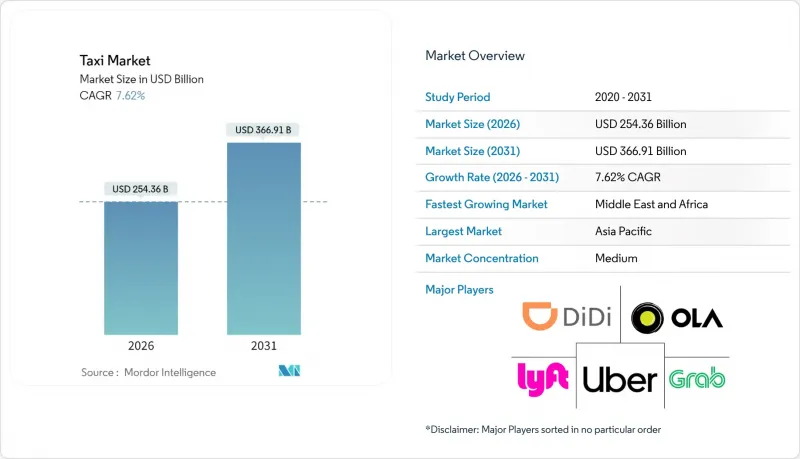
数位融合、人工智慧驱动的调度系统以及不断增长的都市区凸显了计程车市场蓬勃发展的规模。超级应用程式将按需出行与餐饮、支付和金融服务相结合,加速了市场需求,而一键预订功能则提升了平台用户黏着度和平均用户收入。营运商正透过提供电动、自动驾驶和无障碍车辆来扩展服务组合,从而降低全生命週期营运成本并探索车载广告等新的收入来源。各国政府日益将叫车视为公共交通的补充,并推出政策鼓励电动车普及、提升无障碍出行体验并促进数据共用。这为拥有强大监管团队的灵活运营商创造了优势。这些因素共同重塑了司机经济状况,迫使产业相关人员投资于演算法定价、动态路线规划和垂直整合,以缩短乘车时间并提高车队运转率。
全球计程车市场趋势与洞察
智慧型手机的快速普及和网路环境的发展
在主要都市区,智慧型手机普及率已超过 80%,平台利用演算法快速匹配乘客和驾驶人,将主要城市的平均等待时间从 15-20 分钟缩短至 5 分钟以内。 5G 网路的广泛覆盖实现了高度精准的定位信息,提高了车辆运转率,减少了空驶里程。更快的资料通讯传输速度支援应用程式内影片广告和即时驾驶人培训,从而拓展了收入来源。在已开发市场,整合到叫车应用的行动钱包交易量已占总交易量的五分之四以上,有助于降低现金交易风险,缩短机场候机时间。在新兴经济体,网路存取的改善正推动数位预订呈指数级增长,使叫车系统实现了跨越式发展。
都市区拥挤和汽车拥有量下降
人口密集的城市往往车辆运转率略低,这促使居民放弃私家车,转而选择无需支付停车费的按需出行服务。随着都市区拥堵收费和燃油价格上涨推高了汽车拥有成本,计程车服务变得越来越有吸引力,尤其是共乘模式,每次行程的费用最多可降低 40%。 25 至 35 岁的年轻消费者最容易接受这种模式,他们更倾向于「出行即服务」的订阅模式,这种模式将计程车、铁路、公车和微出行服务整合到一个应用程式中。交通拥堵每年给美国造成超过 1000 亿美元的损失,这给都市区带来了政治压力,迫使其优先发展高载客率的出行方式,间接刺激了计程车市场的需求。
不断完善的许可证制度和日益严格的监管
城市监管机构正在对其计程车牌照制度进行现代化改革,并收紧背景调查规定,这增加了叫车平台和传统计程车业者的合规成本。西雅图计划在2026年3月前逐步取消计程车牌照制度,纽约市则要求2025年3月前,一半的计程车必须配备无障碍设施。新加坡监管机构以反垄断为由,阻止了Grab对Trans-Cab的收购计划,并暗示将加强对平台整合的审查。不同的区域标准增加了法律的复杂性,并可能延迟市场准入,从而限制了短期内的成长势头。
细分市场分析
到2025年,线上通路将占据计程车市场份额的63.78%,这标誌着市场结构正向基于应用程式的需求聚合模式转变。数位化预订的普及加强了商业智慧的流通,提高了需求预测的准确性,从而提高了资产利用率并缩短了乘客的等待时间。虽然线下通路在老年人和允许路边叫车的计程车牌照发放地区仍然很重要,但其成长速度落后于整体计程车市场。因此,营运商正在将语音互动语音应答系统(IVR)和自助服务终端与应用程式整合,以留住传统用户并引导他们使用线上服务。
展望未来,线上预订预计将以7.92%的复合年增长率成长。整合出行、支付和电子商务的超级应用将推动乘客数量的成长,尤其是在智慧型手机普及率超过80%的亚太地区特大城市。线上通路还能提供详细的乘车数据,进而达到精准的会员忠诚度计画和动态定价,进而推动市场占有率的成长。基于合约的企业帐户、机场特许经营和强制性无障碍服务将继续保持其相对于线下管道的复合年增长率。然而,预计到2031年,它们的收入构成比将下降至计程车市场规模的三分之一以下。
到2025年,叫车将占计程车市场规模的74.85%,这主要得益于网路效应,确保了快速匹配和透明定价。市场领先的平台大力投资于安全检验、即时监控和司机培训,从而提供比非正规竞争对手更可靠的服务。由于共乘服务能够减少拥塞并降低乘客分摊成本,预计其年复合成长率将达到7.78%,超过计程车市场的整体成长速度。此外,为因应环境法规,各公司纷纷设定车队范围内的碳减排目标,也进一步推动了共乘的需求。
企业出行合约曾经由豪华车队主导,如今正日益转向提供电子收据和按座位计费的基于应用程式的供应商。嵌入式数据支持了注重环境、社会和治理 (ESG) 的董事会所要求的碳排放报告仪錶板。虽然叫车在总预订量方面仍然占据主导地位,但共乘可以带来更高的车辆利用率和更好的资产利用率,尤其是在高峰时段(此时单人乘客需支付突波定价)。
区域分析
到2025年,亚太地区将占据全球计程车市场份额的37.42%,这主要得益于快速的都市化、超过五分之四的智慧型手机普及率以及在人口密集区域蓬勃发展的摩托车计程车。在印度、越南和泰国,政府的电动车补贴和牌照豁免政策正在加速车队更新换代。在日本,现有计程车业者已与优步合作,将2万辆计程车整合到该平台上,加强了跨境数位化标准化。
预计到2031年,中东和非洲地区的复合年增长率将达到7.88%,这主要得益于各国数位经济计画和特大城市基础建设的推动。为响应阿联酋「2050年净零排放」蓝图,杜拜计程车公司计划在2029年将约80%的叫车服务转移到电子预订系统,同时将其车队的25%实现电气化。在埃及、沙乌地阿拉伯和奈及利亚,随着年轻且精通科技的人跳过传统的叫车模式,共享出行应用程式正在迅速普及。像Careem这样的区域性超级应用程式整合了支付、配送和交通运输功能,从而提高了用户留存率。各国政府正在收紧对网路可及性和资料隐私的监管,这需要大量的遵循成本,而大型业者往往从中受益。 Lyft于2025年4月收购了FREENOW,将其企业发展拓展至欧洲11个国家,使其每年能够覆盖约3000亿次个人车辆出行。同时,德国各地市政当局正在试行零排放区,这可能会比企业原计划更早提高电动车的普及阈值。因此,儘管增速放缓,但成长仍保持正值,因为平台正在向配送服务和订阅式出行通行证等领域多元化发展。
其他福利:
- Excel格式的市场预测(ME)表
- 3个月的分析师支持
目录
第一章 引言
- 研究假设和市场定义
- 调查范围
第二章调查方法
第三章执行摘要
第四章 市场情势
- 市场概览
- 市场驱动因素
- 智慧型手机和网路的快速普及
- 都市区拥挤和汽车拥有量下降
- 新兴经济体中共享出行平台的扩张
- 人工智慧驱动的动态路径规划和价格优化
- 无障碍法规推动车辆更新换代
- 超级应用 API 整合驱动嵌入式需求
- 市场限制
- 不断完善的许可证制度和日益严格的监管
- 由于价格竞争加剧,司机收入下降
- 公共电动车充电基础设施的缺乏减缓了电动计程车的普及。
- 资料隐私诉讼:超越跟踪
- 价值/供应链分析
- 监管环境
- 技术展望
- 波特五力分析
- 新进入者的威胁
- 买方的议价能力
- 供应商的议价能力
- 替代品的威胁
- 竞争对手之间的竞争
第五章 市场规模及成长预测(价值(美元))
- 按预订类型
- 线上预订
- 线下预订
- 按服务类型
- 叫车
- 共乘
- 公司和机构合约
- 按车辆类型
- 搭乘用车
- 摩托车和Scooter
- 厢型车和多用途汽车
- 自动人力车和嘟嘟车
- 依推进类型
- 内燃机(ICE)
- 电动车
- 杂交种
- 按地区
- 北美洲
- 我们
- 加拿大
- 北美其他地区
- 南美洲
- 巴西
- 阿根廷
- 其他南美洲
- 欧洲
- 德国
- 英国
- 法国
- 西班牙
- 俄罗斯
- 其他欧洲地区
- 亚太地区
- 中国
- 印度
- 日本
- 韩国
- 澳洲
- 越南
- 亚太其他地区
- 中东和非洲
- GCC
- 土耳其
- 南非
- 其他中东和非洲地区
- 北美洲
第六章 竞争情势
- 市场集中度
- 策略趋势
- 市占率分析
- 公司简介
- Uber Technologies Inc.
- Beijing Xiaoju Technology Co. Ltd(DiDi)
- Lyft Inc.
- Grab Holdings Inc.
- Bolt Technology OU
- ANI Technologies Pvt Ltd(Ola)
- Gojek Tech
- FREE NOW(Intelligent Apps GmbH)
- BlaBlaCar
- Curb Mobility LLC
- Flywheel Software Inc.
- Kabbee Exchange Ltd
- Addison Lee Group
- Gett Inc.
- Yandex Go(Yandex NV)
- Careem Networks FZ-LLC
- Via Transportation Inc.
- Beat Mobility Services Ltd
- Easy Taxi(Tappsi SAS)
- Cabify Espana SL
第七章 市场机会与未来展望
The Taxi Market was valued at USD 236.36 billion in 2025 and estimated to grow from USD 254.36 billion in 2026 to reach USD 366.91 billion by 2031, at a CAGR of 7.62% during the forecast period (2026-2031).
Underscoring a sizeable taxi market size that continues to expand on the back of digital integration, AI-driven dispatch systems, and growing urban populations. Demand accelerates as super-apps embed on-demand mobility alongside food, payments, and finance, enabling single-tap bookings that raise platform stickiness and average revenue per user. Operators are widening service portfolios with electric, autonomous, and accessibility-focused fleets that lower lifetime operating costs and open new revenue layers such as in-vehicle advertising. Governments increasingly view app-based taxis as complements to public transit and are issuing incentives for EV adoption, improved accessibility, and data sharing that favor agile players with strong regulatory teams. Taken together, these forces are reshaping driver economics, pushing industry participants to invest in algorithmic pricing, dynamic routing, and vertical integration that compress time-to-pickup and improve fleet utilization.
Global Taxi Market Trends and Insights
Rapid Smartphone & Internet Penetration
Smartphone penetration above four-fifths in leading urban centers lets platforms algorithmically match riders and drivers faster, shrinking average wait times from 15-20 minutes to under 5 minutes in top-tier cities. Ubiquitous 5G coverage allows richer location data, which boosts fleet utilisation and lowers deadhead mileage. Higher data speeds also mean in-app video ads and real-time driver coaching, unlocking diversified revenue streams. Mobile wallets embedded in ride-hailing apps now account for more than four-fifths of transactions in developed markets, lowering cash-handling risk and reducing airport queue times. In emerging economies, internet upgrades bypass legacy dispatch systems, enabling leap-frog adoption of digital bookings.
Urban Congestion & Declining Private-Car Ownership
Vehicle utilisation in dense cities often falls slightly, motivating residents to replace private cars with on-demand rides that eliminate parking fees. Municipal congestion charges plus rising fuel prices raise the total cost of car ownership, reinforcing the appeal of taxi services, especially pooled formats that can cut per-trip fares by up to 40%. Younger consumers aged 25-35 are most receptive, preferring bundled mobility-as-a-service subscriptions integrating taxis with rail, bus, and micro-mobility in one app. Congestion costs topping USD 100 billion annually in the U.S. place political pressure on cities to privilege high-occupancy modes, indirectly boosting taxi market demand.
Evolving Licensing & Regulatory Crack-Downs
City regulators are modernising medallion structures and tightening background-check rules, raising compliance costs for app-based and traditional operators. Seattle plans to phase out its medallion regime by March 2026, while New York City requires half of all cabs to be wheelchair-ready by March 2025. The Singaporean watchdog blocked Grab's planned acquisition of Trans-Cab over antitrust concerns, signalling closer scrutiny of platform consolidation. Divergent regional standards increase legal complexity and can delay market entries, suppressing near-term growth momentum.
Other drivers and restraints analyzed in the detailed report include:
- Ride-Hailing Platform Expansion In Emerging Economies
- AI-Based Dynamic Routing & Pricing Optimisation
- Intensifying Price Wars Eroding Driver Earnings
For complete list of drivers and restraints, kindly check the Table Of Contents.
Segment Analysis
Online channels delivered 63.78% of the taxi market share in 2025, illustrating the structural pivot toward app-based demand aggregation. The dominance of digital bookings strengthened business intelligence loops that sharpen demand prediction, resulting in higher asset utilisation and lower passenger wait times. The offline segment remains relevant among older demographics and jurisdictions where medallion systems still confer street-hail privilege, yet its growth trajectory lags the broader taxi market. Operators are therefore integrating voice-based IVR and kiosk interfaces alongside apps to preserve legacy users while nudging them toward digital interactions.
Looking forward, online bookings are forecast to grow at an 7.92% CAGR. Super-apps bundling mobility with payments and e-commerce will underpin incremental trip volumes, especially in APAC megacities where smartphone penetration exceeds four-fifths. Online channels also furnish granular trip-level data that powers targeted loyalty and dynamic pricing, reinforcing share gains. Contractual corporate accounts, airport concessions, and mandated accessibility services sustain the offline channel's CAGR. Yet, its revenue mix is expected to shrink below one-third of the taxi market size by 2031.
Ride-hailing controlled 74.85% of taxi market size in 2025, owing to network effects that ensure quicker matches and transparent pricing. Market-leading platforms invest heavily in safety verification, real-time monitoring, and driver training that elevate service reliability above informal rivals. Pooled rides are projected to outpace overall taxi market expansion with an 7.78% CAGR because they ease congestion and lower per-seat fares by sharing costs among passengers. Environmental compliance agendas further catalyse pooled demand as corporates set fleet-wide carbon reduction targets.
Corporate mobility contracts, once dominated by black-car fleets, are increasingly awarded to app-based providers offering digital receipts and per-seat expense allocation. The embedded data facilitates carbon-reporting dashboards now demanded by ESG-focused boards. Although ride-hailing maintains gross-booking supremacy, pooled formats generate higher occupancy and superior asset productivity, especially during peak hours when single-occupancy trips face surge pricing.
The Taxi Market Report is Segmented by Booking Type (Online Booking and Offline Booking), Service Type (Ride-Hailing, Ride-Sharing, and Corporate & Institutional Contracts), Vehicle Type (Passenger Cars, Motorcycles & Scooters, Vans & MPVs, and Auto-Rickshaws & Tuk-Tuks), Propulsion Type (ICE, Electric, and Hybrid), and Geography. The Market Forecasts are Provided in Terms of Value (USD).
Geography Analysis
Asia-Pacific contributed 37.42% taxi market share in 2025, sustained by rapid urbanisation, smartphone usage above four-fifth, and widespread two-wheeler taxis that thrive in dense corridors. Government policies offering EV subsidies and medallion exemptions accelerate fleet turnover throughout India, Vietnam, and Thailand. Japan's taxi incumbents partner with Uber to integrate 20,000 vehicles on the platform, reinforcing cross-border digital standardisation.
The Middle East and Africa is projected to register an 7.88% CAGR through 2031, due to national digital-economy programmes and mega-city infrastructure. Dubai Taxi Company aims to migrate around four-fifth of rides to e-booking by 2029 while electrifying one-quarter of its fleet, aligning with the UAE Net-Zero 2050 roadmap. Ride-hailing apps proliferate in Egypt, Saudi Arabia, and Nigeria where youthful, tech-savvy populations leapfrog legacy dispatch models. Pan-regional super-apps such as Careem integrate payments, delivery, and transport under one umbrella, enhancing user retention. Authorities impose stricter accessibility and data-privacy mandates, requiring material compliance outlays that favor scaled operators. Lyft's acquisition of FREENOW in April 2025 doubled its European reach to 11 countries and opened access to nearly 300 billion annual personal vehicle trips. Meanwhile, city councils across Germany are testing zero-emission zones that could bump EV adoption thresholds earlier than corporate plans anticipate. Net effect: growth slows but remains positive as platforms diversify into deliveries and subscription mobility passes.
- Uber Technologies Inc.
- Beijing Xiaoju Technology Co. Ltd (DiDi)
- Lyft Inc.
- Grab Holdings Inc.
- Bolt Technology OU
- ANI Technologies Pvt Ltd (Ola)
- Gojek Tech
- FREE NOW (Intelligent Apps GmbH)
- BlaBlaCar
- Curb Mobility LLC
- Flywheel Software Inc.
- Kabbee Exchange Ltd
- Addison Lee Group
- Gett Inc.
- Yandex Go (Yandex NV)
- Careem Networks FZ-LLC
- Via Transportation Inc.
- Beat Mobility Services Ltd
- Easy Taxi (Tappsi SAS)
- Cabify Espana SL
Additional Benefits:
- The market estimate (ME) sheet in Excel format
- 3 months of analyst support
TABLE OF CONTENTS
1 Introduction
- 1.1 Study Assumptions & Market Definition
- 1.2 Scope of the Study
2 Research Methodology
3 Executive Summary
4 Market Landscape
- 4.1 Market Overview
- 4.2 Market Drivers
- 4.2.1 Rapid Smartphone & Internet Penetration
- 4.2.2 Urban Congestion & Declining Private-Car Ownership
- 4.2.3 Ride-Hailing Platform Expansion In Emerging Economies
- 4.2.4 AI-Based Dynamic Routing & Pricing Optimisation
- 4.2.5 Accessibility Mandates Driving Fleet Renewal
- 4.2.6 Super-App Api Integrations Boosting Embedded Demand
- 4.3 Market Restraints
- 4.3.1 Evolving Licensing & Regulatory Crack-Downs
- 4.3.2 Intensifying Price Wars Eroding Driver Earnings
- 4.3.3 Limited Public Ev-Charging Slowing E-Taxi Uptake
- 4.3.4 Data-Privacy Litigation Around Trip-Tracking
- 4.4 Value / Supply-Chain Analysis
- 4.5 Regulatory Landscape
- 4.6 Technological Outlook
- 4.7 Porter's Five Forces Analysis
- 4.7.1 Threat of New Entrants
- 4.7.2 Bargaining Power of Buyers
- 4.7.3 Bargaining Power of Suppliers
- 4.7.4 Threat of Substitutes
- 4.7.5 Competitive Rivalry
5 Market Size & Growth Forecasts (Value (USD))
- 5.1 By Booking Type
- 5.1.1 Online Booking
- 5.1.2 Offline Booking
- 5.2 By Service Type
- 5.2.1 Ride-hailing
- 5.2.2 Ride-sharing (pooled)
- 5.2.3 Corporate & Institutional Contracts
- 5.3 By Vehicle Type
- 5.3.1 Passenger Cars
- 5.3.2 Motorcycles & Scooters
- 5.3.3 Vans & MPVs
- 5.3.4 Auto-Rickshaws & Tuk-tuks
- 5.4 By Propulsion Type
- 5.4.1 Internal Combustion Engine (ICE)
- 5.4.2 Electric
- 5.4.3 Hybrid
- 5.5 By Geography
- 5.5.1 North America
- 5.5.1.1 United States
- 5.5.1.2 Canada
- 5.5.1.3 Rest of North America
- 5.5.2 South America
- 5.5.2.1 Brazil
- 5.5.2.2 Argentina
- 5.5.2.3 Rest of South America
- 5.5.3 Europe
- 5.5.3.1 Germany
- 5.5.3.2 United Kingdom
- 5.5.3.3 France
- 5.5.3.4 Spain
- 5.5.3.5 Russia
- 5.5.3.6 Rest of Europe
- 5.5.4 Asia-Pacific
- 5.5.4.1 China
- 5.5.4.2 India
- 5.5.4.3 Japan
- 5.5.4.4 South Korea
- 5.5.4.5 Australia
- 5.5.4.6 Vietnam
- 5.5.4.7 Rest of Asia-Pacific
- 5.5.5 Middle East and Africa
- 5.5.5.1 GCC
- 5.5.5.2 Turkey
- 5.5.5.3 South Africa
- 5.5.5.4 Rest of Middle East and Africa
- 5.5.1 North America
6 Competitive Landscape
- 6.1 Market Concentration
- 6.2 Strategic Moves
- 6.3 Market Share Analysis
- 6.4 Company Profiles (Includes Global Level Overview, Market Level Overview, Core Segments, Financials as Available, Strategic Information, Market Rank/Share for Key Companies, Products and Services, SWOT Analysis, and Recent Developments)
- 6.4.1 Uber Technologies Inc.
- 6.4.2 Beijing Xiaoju Technology Co. Ltd (DiDi)
- 6.4.3 Lyft Inc.
- 6.4.4 Grab Holdings Inc.
- 6.4.5 Bolt Technology OU
- 6.4.6 ANI Technologies Pvt Ltd (Ola)
- 6.4.7 Gojek Tech
- 6.4.8 FREE NOW (Intelligent Apps GmbH)
- 6.4.9 BlaBlaCar
- 6.4.10 Curb Mobility LLC
- 6.4.11 Flywheel Software Inc.
- 6.4.12 Kabbee Exchange Ltd
- 6.4.13 Addison Lee Group
- 6.4.14 Gett Inc.
- 6.4.15 Yandex Go (Yandex NV)
- 6.4.16 Careem Networks FZ-LLC
- 6.4.17 Via Transportation Inc.
- 6.4.18 Beat Mobility Services Ltd
- 6.4.19 Easy Taxi (Tappsi SAS)
- 6.4.20 Cabify Espana SL
7 Market Opportunities & Future Outlook
- 7.1 White-space & Unmet-need Assessment

 2026年全球线上计程车服务市场报告2026年全球计程车和豪华轿车服务市场报告2026年全球计程车服务市场报告
 豪华轿车服务市场:2026-2032年全球市场预测(依服务类型、时间长度、车辆燃料类型、车辆类型、最终用户和预订方式划分)计程车和豪华轿车服务市场:按类型、服务时间、服务模式、距离和车辆类型划分-2026-2032年全球市场预测
 2026-2030年全球豪华轿车服务市场
 计程车市场规模、份额、趋势和预测:按预订类型、服务类型、车辆类型和地区划分,2026-2034 年
 2026-2034年全球新能源计程车市场规模、份额、趋势和成长分析报告
 新能源汽车计程车市场-全球产业规模、份额、趋势、机会与预测:按动力传动系统、车辆类型、地区和竞争格局划分,2021-2031年
 全球摩托车计程车服务市场 2026-2030