


 |
市场调查报告书
商品编码
1939713
基础油:市场占有率分析、产业趋势与统计、成长预测(2026-2031)Base Oil - Market Share Analysis, Industry Trends & Statistics, Growth Forecasts (2026 - 2031) |
||||||

※ 本网页内容可能与最新版本有所差异。详细情况请与我们联繫。
预计基油市场将从 2025 年的 3,515 万吨成长到 2026 年的 3,564 万吨,到 2031 年将达到 3,818 万吨,2026 年至 2031 年的复合年增长率为 1.40%。
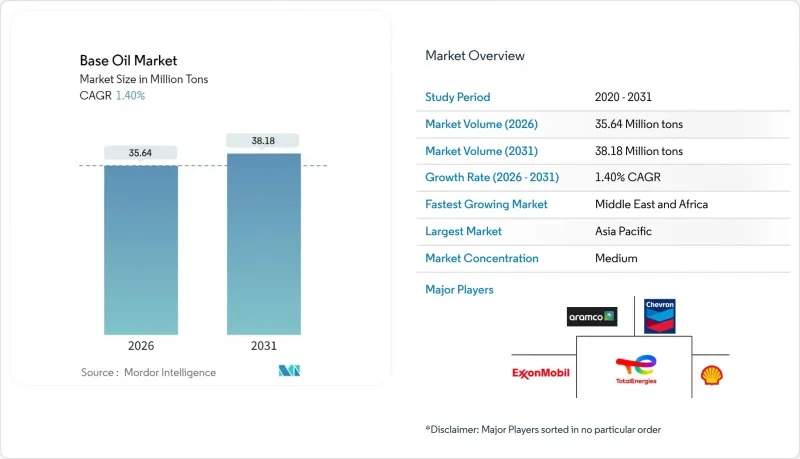
基油市场的稳定成长主要受三大因素驱动:首先,基础油市场正从I类基础油向性能更高的II类和III类基础油过渡;其次,全球排放法规日益严格;第三,合成油混合物在电动车(EV)主导中的作用日益增强。亚太地区在销售方面领先,但中东和非洲地区的成长速度最快,这表明供应链正逐步向原油主导地区调整。儘管加氢处理技术是竞争优势的关键,但由于闭合迴路与杜拜原油价格差收窄以及催化剂升级所需资本支出增加,炼油商正面临利润压力。资料中心浸没式冷却剂和闭环再炼油倡议正在涌现新的机会,以满足循环经济目标。
全球基础油市场趋势与洞察
亚太地区生产群集的快速工业化
亚太地区製造业的蓬勃发展正推动基油市场的大部分新增需求。预计到2024年,中国原油日加工量将达到1,480万桶,将带动金属加工液和液压油的强劲需求。日益壮大的炼油和石化一体化综合体网路为生产商提供了更大的营运柔软性,使其能够将生产转向盈利最高的基料等级。马来西亚国家石油公司(Petronas)计划在2025年至2027年期间实现日产相当于200万桶的基础油产量,併计划于2028年运作生物精炼,从而向下游拓展特种化学品业务。这些投资将有助于该地区在基油市场确立领先地位,并加速传统I类基础油产能的更新换代。
更严格的欧盟7和国七排放标准提振了III/IV类柴油车的需求
欧盟7排放标准的实施要求汽车製造商在所有轻型汽油引擎中安装颗粒物过滤系统,这增加了对超低挥发性III类基础油的需求。中国的同期标准-国七标准将加强对低SAPS润滑油的要求,预计2022年至2026年间核准的44个炼油厂计划将提振国内供应。将于2025年3月31日生效的ILSAC GF-7标准要求燃油经济性提高10%,将促使调和商转向更高品质的基础油[ORONITE.COM]。这推动了对加氢裂解装置和加氢异构化装置的投资,加速了基础油市场的优质化。
布兰特原油和杜拜原油价格差的波动对利润率带来压力。
2024年,布兰特原油与杜拜原油的价差一度转为负值,显示中硫原油供应趋紧,而中硫原油是VGO(真空减压瓦斯油)基础油原料的关键成分。科威特、阿曼和奈及利亚新建的炼油厂提高了全球炼油厂产能,挤压了利润空间,并导致一些营运商,例如利安德巴塞尔休士顿炼油厂,在2025年初退出炼油厂业务。这种供应紧张的局面迫使基础油市场的独立企业降低运转率并关闭老旧设施。
细分市场分析
第二类基础油凭藉其均衡的性能和成本优势以及完善的分销网络,预计将在2025年继续保持其在基油市场的领先地位,市场份额将达到42.20%。壳牌公司位于韦瑟林工厂的30万吨转化计划凸显了加氢裂解产品的持续可靠性。儘管第三类基础油的绝对销量较小,但由于欧7排放标准和电动车冷却液规范的推广(这些规范要求超低挥发性和高抗氧化性),预计到2031年,其复合年增长率将达到4.05%。因此,在预测期内,第三类基础油的市场规模预计将以高于其他等级基础油的速度成长。
第一类基础油在某些需要溶解性的橡胶加工和金属加工液领域仍然存在,但由于经济效益下降,其市场逐渐萎缩。第五类基础油则以其多样化的化学成分(包括用于生物润滑剂的仲多元醇酯)补充了这条创新路径。整体而言,基油市场正朝着更高的API等级发展,以满足更严格的OEM规格和永续性目标。
基油报告按基料类型(I类、II类、III类、IV类及其他)、应用领域(发动机油、变速箱及齿轮油、金属加工液、液压油、润滑脂及其他应用)和地区(亚太地区、北美地区、欧洲地区、南美地区以及中东和非洲地区)进行细分。市场预测以百万吨为单位。
区域分析
到2025年,亚太地区将占全球原油产量的46.30%,这主要得益于中国原油日加工量创纪录的1480万桶,以及印度计划于2025年前完成的19万亿至22万亿卢比的扩建项目。基油市场正受益于垂直一体化的综合设施,这些设施可以根据利润率在燃料、化学品和基料生产之间灵活切换。日本和韩国正在为电子产品的温度控管提供精密合成技术,而东南亚国家则正在扩大产能以满足区域工业需求。
中东和非洲地区将呈现全球最快的成长速度,到2031年年均复合成长率将达到3.33%。阿布达比国家石油公司(ADNOC)投资35亿美元的鲁瓦伊斯原油灵活化计划将可加工重质高硫原油,并优化II类和III类原油产品。在欧洲,利润率正在下降,脱碳转型正在进行中,道达尔能源的格兰德普伊炼油厂计划于2026年成为零产油平台。
在北美,页岩油经济效益正推动对特种PAO和III类计划的投资增加。雪佛龙帕萨迪纳炼油厂的升级改造使其产能提升至每日12.5万桶,并提高了喷射机燃料的柔软性。在南美,巴西石化产业的整合预计将带来温和的成长,但宏观经济的波动抑制了大规模投资。区域趋势总体表明,产能正逐步向石油主导且需求旺盛的地区扩散,而传统中心则透过专业转型进行调整。
其他福利:
- Excel格式的市场预测(ME)表
- 分析师支持(3个月)
目录
第一章 引言
- 研究假设和市场定义
- 调查范围
第二章调查方法
第三章执行摘要
第四章 市场情势
- 市场概览
- 市场驱动因素
- 亚太地区生产群集的快速工业化
- 更严格的欧7和国七排放气体标准推动了对第三/四类柴油的需求
- 电动车(EV)温度控管系统对高性能润滑油的需求不断增长
- 资料中心浸没式冷却液(新型合成基料)的扩展
- 基于循环经济需求的闭合迴路再炼油经济学
- 市场限制
- 快速替代一级产能
- 布兰特原油和杜拜原油价格差的波动正在给利润率带来压力。
- 欧盟即将实施聚丙烯酸类物质(PAO)微塑胶分类(ECHA)
- 价值链分析
- 波特五力模型
- 供应商的议价能力
- 买方的议价能力
- 新进入者的威胁
- 替代品的威胁
- 竞争程度
第五章 市场规模与成长预测
- 依基料类型
- 第一组
- 第二组
- 第三组
- 第四组
- 其他的
- 透过使用
- 机油
- 变速箱油和齿轮油
- 金属加工油
- 油压
- 润滑脂
- 其他用途
- 按地区
- 亚太地区
- 中国
- 印度
- 日本
- 韩国
- 马来西亚
- 印尼
- 越南
- 泰国
- 亚太其他地区
- 北美洲
- 我们
- 加拿大
- 墨西哥
- 欧洲
- 德国
- 英国
- 法国
- 义大利
- 西班牙
- 北欧国家
- 土耳其
- 俄罗斯
- 其他欧洲地区
- 南美洲
- 巴西
- 阿根廷
- 哥伦比亚
- 其他南美洲
- 中东和非洲
- 沙乌地阿拉伯
- 阿拉伯聯合大公国
- 卡达
- 埃及
- 南非
- 奈及利亚
- 其他中东和非洲地区
- 亚太地区
第六章 竞争情势
- 市场集中度
- 策略趋势
- 市占率(%)/排名分析
- 公司简介
- ADNOC
- Chevron Corporation
- China Petrochemical Corporation(SINOPEC)
- CNOOC Limited
- Exxon Mobil Corporation
- Formosa Petrochemical Corporation
- Gazprom Neft PJSC
- GS Caltex Corporation
- Hindustan Petroleum Corporation Limited
- Indian Oil Corporation Ltd
- LUKOIL
- Nynas AB
- Petrobras
- PetroChina
- PETRONAS Lubricants International
- Philips 66 Company
- Repsol
- Saudi Arabian Oil Co.
- Sepahan Oil Company
- Shandong Qingyuan Group Co. Ltd.
- Shell plc
- SK Innovation Co. Ltd.
- TotalEnergies
第七章 市场机会与未来展望
The Base Oil market is expected to grow from 35.15 million tons in 2025 to 35.64 million tons in 2026 and is forecast to reach 38.18 million tons by 2031 at 1.40% CAGR over 2026-2031.
The measured growth of the base oil market is underpinned by three forces: the migration from Group I to higher-performance Group II and III stocks, tightening global emission rules, and the expanding role of synthetic formulations in electric-vehicle (EV) drivetrains. Asia-Pacific commands volume leadership, yet the Middle East and Africa records the fastest expansion, signaling a gradual realignment of supply chains toward crude-advantaged regions. Competitive positioning hinges on hydroprocessing technology, while refiners confront margin pressure from compressed Brent-Dubai spreads and rising capital outlays for catalyst upgrades. Opportunities emerge in immersion-cooling fluids for data centers and closed-loop re-refining initiatives that meet circular-economy targets.
Global Base Oil Market Trends and Insights
Rapid Industrialization Across APAC Production Clusters
Asia-Pacific's manufacturing boom underpins a significant share of incremental base oil market demand. China processed 14.8 million barrels per day of crude in 2024, creating robust pull for metal-working and hydraulic fluids. An expanding network of integrated refinery-petrochemical complexes increases operational flexibility, enabling producers to shift yields toward the most profitable base-stock grades. PETRONAS projects 2 million barrels of oil-equivalent output per day in its 2025-2027 outlook, with a downstream push into specialty chemicals supported by a biorefinery startup in 2028. These investments solidify the region's pre-eminence in the base oil market and accelerate the displacement of legacy Group I capacity.
Stricter Euro 7 and China VII Emission Norms Boosting Group III/IV Demand
The adoption of Euro 7 standards obliges automakers to fit particulate-filter systems across all light-duty gasoline engines, upping demand for ultra-low-volatility Group III stocks. China's parallel China VII framework intensifies the requirement for low-SAPS lubricants, while forty-four refining projects approved between 2022-2026 are poised to reinforce local supply. ILSAC GF-7, effective 31 March 2025, calls for a 10% fuel-economy gain, nudging blenders toward higher-quality base oils [ORONITE.COM]. Hydrocracking and hydro-isomerization units thus attract capital, accelerating the premiumization of the base oil market.
Volatile Brent-Dubai Crude Differentials Squeezing Margins
The Brent-Dubai spread turned negative at times in 2024, signaling scarce medium-sour barrels crucial for VGO-based base-oil feed. New Kuwait, Oman, and Nigeria refineries lifted global capacity, depressing margins and driving some operators, such as LyondellBasell Houston, to exit refining by early 2025. The crunch pressures independent players in the base oil market to trim runs or shutter older assets.
Other drivers and restraints analyzed in the detailed report include:
- Rising Demand for High-Performance Lubricants in EV Thermal-Management Systems
- Expansion of Data-Center Immersion-Cooling Fluids
- Impending Micro-Plastic Classification of PAOs in the EU
For complete list of drivers and restraints, kindly check the Table Of Contents.
Segment Analysis
Group II maintained leadership with 42.20% of the base oil market share in 2025, owing to its balanced performance-cost equation and established distribution networks. Shell's 300,000-ton conversion at Wesseling underscores sustained confidence in hydrocracked stocks. Group III, though smaller on an absolute basis, advances at a 4.05% CAGR to 2031, buoyed by Euro 7 and EV-cooling mandates that call for ultra-low volatility and high oxidation resistance. The base oil market size for Group III is thus poised to expand faster than any other grade during the forecast horizon.
Group I endures in select rubber-processing and metal-working fluids requiring solvency, yet closures continue as economics deteriorate. Group V's diverse chemistries, including secondary polyol esters for bio-lubricants, round out innovation pathways. Altogether, the base oil market is migrating toward higher API groups to meet stricter OEM specifications and sustainability goals.
The Base Oil Report is Segmented by Base-Stock Type (Group I, Group II, Group III, Group IV, and Others), Application (Engine Oils, Transmission and Gear Oils, Metalworking Fluids, Hydraulic Fluids, Greases, and Other Applications), and Geography ( Asia-Pacific, North America, Europe, South America, and Middle-East and Africa). The Market Forecasts are Provided in Terms of Volume (Million Tons).
Geography Analysis
Asia-Pacific generated 46.30% of 2025 volume, underpinned by China's record 14.8 million barrels-per-day crude runs and India's INR 1.9-2.2 lakh crore expansion program slated for completion by 2025. The base oil market benefits from vertically integrated complexes able to toggle between fuels, chemicals, and base stocks as margins dictate. Japan and South Korea supply precision synthetic technology for electronics thermal management, while Southeast Asian nations add capacity to serve regional industrial demand.
The Middle East and Africa posts a 3.33% CAGR to 2031, the fastest globally. ADNOC's USD 3.5 billion Ruwais Crude Flexibility Project enables processing heavier sour crudes, optimizing Group II and III output. Europe contends with margin compression and decarbonization pivots such as TotalEnergies' Grandpuits conversion into a zero-crude platform by 2026.
North America, bolstered by shale-oil economics, invests in specialty PAO and Group III projects; Chevron's Pasadena upgrade lifts throughput to 125,000 barrels per day while raising jet-fuel flexibility. South America enjoys moderate upside from Brazil's petrochemical integration, although macro volatility dampens large-scale investments. Collectively, geographic dynamics reflect a gradual diffusion of capacity into crude-advantaged and demand-rich locales while traditional centers adapt through specialization.
- ADNOC
- Chevron Corporation
- China Petrochemical Corporation (SINOPEC)
- CNOOC Limited
- Exxon Mobil Corporation
- Formosa Petrochemical Corporation
- Gazprom Neft PJSC
- GS Caltex Corporation
- Hindustan Petroleum Corporation Limited
- Indian Oil Corporation Ltd
- LUKOIL
- Nynas AB
- Petrobras
- PetroChina
- PETRONAS Lubricants International
- Philips 66 Company
- Repsol
- Saudi Arabian Oil Co.
- Sepahan Oil Company
- Shandong Qingyuan Group Co. Ltd.
- Shell plc
- SK Innovation Co. Ltd.
- TotalEnergies
Additional Benefits:
- The market estimate (ME) sheet in Excel format
- 3 months of analyst support
TABLE OF CONTENTS
1 Introduction
- 1.1 Study Assumptions and Market Definition
- 1.2 Scope of the Study
2 Research Methodology
3 Executive Summary
4 Market Landscape
- 4.1 Market Overview
- 4.2 Market Drivers
- 4.2.1 Rapid industrialisation across APAC production clusters
- 4.2.2 Stricter Euro 7 and China VII emission norms boosting Group III/IV demand
- 4.2.3 Rising demand for high-performance lubricants in EV thermal-management systems
- 4.2.4 Expansion of data-centre immersion-cooling fluids (novel synthetic base-stocks)
- 4.2.5 Closed-loop re-refining economics under circular-economy mandates
- 4.3 Market Restraints
- 4.3.1 Rapid substitution away from Group I capacities
- 4.3.2 Volatile Brent-Dubai crude differentials squeezing margins
- 4.3.3 Impending micro-plastic classification of PAOs in the EU (ECHA)
- 4.4 Value Chain Analysis
- 4.5 Porter's Five Forces
- 4.5.1 Bargaining Power of Suppliers
- 4.5.2 Bargaining Power of Buyers
- 4.5.3 Threat of New Entrants
- 4.5.4 Threat of Substitutes
- 4.5.5 Degree of Competition
5 Market Size and Growth Forecasts (Volume)
- 5.1 By Base-Stock Type
- 5.1.1 Group I
- 5.1.2 Group II
- 5.1.3 Group III
- 5.1.4 Group IV
- 5.1.5 Others
- 5.2 By Application
- 5.2.1 Engine Oils
- 5.2.2 Transmission and Gear Oils
- 5.2.3 Metalworking Fluids
- 5.2.4 Hydraulic Fluids
- 5.2.5 Greases
- 5.2.6 Other Applications
- 5.3 By Geography
- 5.3.1 Asia-Pacific
- 5.3.1.1 China
- 5.3.1.2 India
- 5.3.1.3 Japan
- 5.3.1.4 South Korea
- 5.3.1.5 Malaysia
- 5.3.1.6 Indonesia
- 5.3.1.7 Vietnam
- 5.3.1.8 Thailand
- 5.3.1.9 Rest of Asia-Pacific
- 5.3.2 North America
- 5.3.2.1 United States
- 5.3.2.2 Canada
- 5.3.2.3 Mexico
- 5.3.3 Europe
- 5.3.3.1 Germany
- 5.3.3.2 United Kingdom
- 5.3.3.3 France
- 5.3.3.4 Italy
- 5.3.3.5 Spain
- 5.3.3.6 Nordic Countries
- 5.3.3.7 Turkey
- 5.3.3.8 Russia
- 5.3.3.9 Rest of Europe
- 5.3.4 South America
- 5.3.4.1 Brazil
- 5.3.4.2 Argentina
- 5.3.4.3 Colombia
- 5.3.4.4 Rest of South America
- 5.3.5 Middle-East and Africa
- 5.3.5.1 Saudi Arabia
- 5.3.5.2 United Arab Emirates
- 5.3.5.3 Qatar
- 5.3.5.4 Egypt
- 5.3.5.5 South Africa
- 5.3.5.6 Nigeria
- 5.3.5.7 Rest of Middle-East and Africa
- 5.3.1 Asia-Pacific
6 Competitive Landscape
- 6.1 Market Concentration
- 6.2 Strategic Moves
- 6.3 Market Share (%)/Ranking Analysis
- 6.4 Company Profiles (includes Global level Overview, Market level overview, Core Segments, Financials as available, Strategic Information, Market Rank/Share for key companies, Products and Services, and Recent Developments)
- 6.4.1 ADNOC
- 6.4.2 Chevron Corporation
- 6.4.3 China Petrochemical Corporation (SINOPEC)
- 6.4.4 CNOOC Limited
- 6.4.5 Exxon Mobil Corporation
- 6.4.6 Formosa Petrochemical Corporation
- 6.4.7 Gazprom Neft PJSC
- 6.4.8 GS Caltex Corporation
- 6.4.9 Hindustan Petroleum Corporation Limited
- 6.4.10 Indian Oil Corporation Ltd
- 6.4.11 LUKOIL
- 6.4.12 Nynas AB
- 6.4.13 Petrobras
- 6.4.14 PetroChina
- 6.4.15 PETRONAS Lubricants International
- 6.4.16 Philips 66 Company
- 6.4.17 Repsol
- 6.4.18 Saudi Arabian Oil Co.
- 6.4.19 Sepahan Oil Company
- 6.4.20 Shandong Qingyuan Group Co. Ltd.
- 6.4.21 Shell plc
- 6.4.22 SK Innovation Co. Ltd.
- 6.4.23 TotalEnergies
7 Market Opportunities and Future Outlook
- 7.1 White-space and Unmet-Need Assessment
- 7.2 Renewable/Bio-based PAO commercial scale-up
- 7.3 Integrated re-refining and virgin-base-oil hubs

 基础油市场:2026-2032年全球市场预测(依产品等级、基础油类型、应用、终端用户产业及销售管道)
 基础油市场规模、份额、成长及全球产业分析:按类型、应用和地区划分,并预测至2026-2034年
 基油市场分析及预测(至2035年):类型、产品、应用、技术、最终用户、形态、材质类型、製程、设备
 基础油市场报告:按类型、组别、应用和地区划分(2026-2034年)
 2026年全球基油市场报告
 全球基础油市场按类别、应用和地区划分-预测(至2030年)
 基础油市场规模、份额和趋势分析报告:按产品、应用、地区和细分市场预测(2026-2033 年)
 基础油市场 - 全球产业规模、份额、趋势、竞争格局、机会及预测(按原料、类型、应用、最终用途、地区和竞争情况划分,2021-2031年)
 2026-2030年全球再生基础油市场酯类基础油市场依产品类型、黏度等级、应用、终端用户产业及销售管道划分-2026-2032年全球预测