


 |
市场调查报告书
商品编码
1939720
越南快递、速递和小包裹(CEP):市场份额分析、行业趋势和统计数据、成长预测(2026-2031)Vietnam Courier, Express, And Parcel (CEP) - Market Share Analysis, Industry Trends & Statistics, Growth Forecasts (2026 - 2031) |
||||||

※ 本网页内容可能与最新版本有所差异。详细情况请与我们联繫。
越南快递、速递和小包裹(CEP) 市场预计将从 2025 年的 17.5 亿美元增长到 2026 年的 18.8 亿美元,预计到 2031 年将达到 26.6 亿美元,2026 年至 2031 年的复合年增长率为 7.2%。
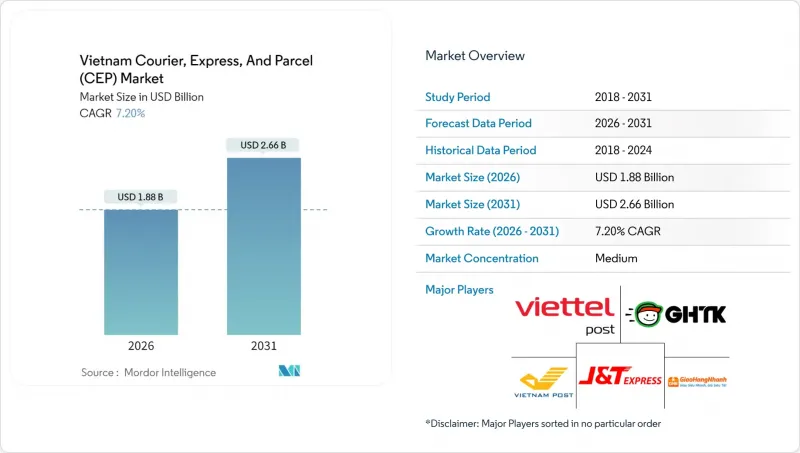
精通数位技术的消费者、不断壮大的製造业基础以及配套的基础设施规划正在推动配送量的成长。从TikTok Shop到Shopee等社交电商平台正在改变消费者的订购习惯,使其转向更小、更频繁的小包裹配送,这就需要灵活的末端物流网络。同时,外商直接投资(FDI)在出口导向电子和服装产业的涌入,正在支撑强大的B2B物流,并提高长途和跨境路线的运力运转率。可更换电池的电动车(EV)车队正逐渐成为一种节省成本的措施,预计将缩短配送週期并大幅降低燃料成本。然而,越南的物流成本仍然高昂,占GDP的16%至20%,迫使企业持续控製成本并投资优化路线。
越南快递、速递与小包裹(CEP) 市场趋势与洞察
电子商务的快速成长和数位钱包的日益普及
智慧型手机普及率高达78%,推动了线上零售的爆炸性成长,也使得小小包裹以两位数的月增长率持续攀升。如今,数位钱包已占B2C支付的55%以上,缩短了货到付款週期,并支持了胡志明市和河内等地当日达试点计画的发展。为了应对激增的包裹量,快递业者正在升级基于OCR的地址识别技术和自动化分类设备,同时与电商平台合作,确保足够的货量,从而支持固定路线摩托车配送。数位钱包的日益普及也刺激了郊区和区域城市的需求,使越南的宅配市场远远超出了主要零售区。然而,日益激烈的竞争也给单价带来了压力,迫使快递公司共用配送密度并整合高速公路运输资源。
持续的交通基础设施扩建
越南正投资131亿美元用于机场、港口和公路计划,预计省际平均运输时间将缩短18%。新建的隆城国际机场货运设施年吞吐能力将达120万吨,进而缓解新山一机场和内排机场的压力。在越南的宅配市场,干线周转率的提高将提升河内至胡志明市干线的网路速度和飞机运转率。同时,为盖梅港供应货物的内陆驳船码头正将高附加价值电子产品出口纳入一体化的多模态链,从而降低每小包裹公里的柴油消耗量。展望2027年及以后,当这些改善措施全面实现时,货运代理商已开始在新枢纽附近预订仓库空间,以应对运力短缺的问题。
物流成本占GDP比重高
越南整体物流系统成本约占国内生产总值的18%,是经合组织平均水准的两倍以上。这给承运商的利润率带来压力,并限制了它们的投资能力。多项道路通行费、港口附加费和非正式收费推高了每件小包裹的营运成本,尤其是在主要通道以外的地区。因此,越南的宅配市场严重依赖聚合策略(聚合递送和共用转运枢纽)来分散固定成本。虽然大型平台可以协商获得网路存取折扣,但小规模托运人却被迫承担更高的费用,这抑制了当地电子商务的订单频率,并减缓了整体市场扩张。
细分市场分析
至2025年,製造业将占总收入的32.60%,其出货量稳定,且多为多年期合约。电子产品和纺织品行业的出货週期可预测,与季节性时尚週期和产品发布活动密切相关。受人均收入成长和积极的免运费促销宣传活动的推动,越南宅配市场规模预计将在2026年至2031年间以8.02%的复合年增长率快速增长。
医疗保健、银行和保险业是规模虽小但成长迅速的利基市场,而药品低温运输配送和重要文件的安全递送则蕴含着高利润率,这促使具备符合GDP标准的包装和监管链通讯协定的专家进入该领域。
至2025年,国际小包裹将占越南国际包裹总量的37.90%,并在2026年至2031年间以7.60%的复合年增长率超过国内包裹量。欧盟-越南自由贸易协定(EVFTA)下的关税减免数位化清关流程已将平均清关时间缩短至24小时,促进了服装和运动鞋的出口。随着海外市场份额的成长,预计到2020年代末,越南国际宅配市场规模将达到10.6亿美元。虽然国内服务在人口稠密的都市区地区保持着规模优势,但Voso和Postmart等公司的区域扩张措施迫使快递公司服务于需求较低的地区,从而降低了单位经济效益。因此,快递公司正透过将出口货运与国内逆向物流结合併减少空驶回程来规避风险。
日益增强的国际化趋势也推动了服务品质标准的提升。以往只有大型宅配业者才能提供的服务,例如ISO认证流程、双重扫描追踪和保税仓库,如今在中型本土公司中也变得越来越普遍。科技的普及加剧了竞争,并将越南宅配市场份额向那些能够在不牺牲盈利的前提下达到国际水平KPI的营运商转移。
其他福利:
- Excel格式的市场预测(ME)表
- 3个月的分析师支持
目录
第一章 引言
- 研究假设和市场定义
- 调查范围
第二章调查方法
第三章执行摘要
第四章 市场情势
- 市场概览
- 人口统计数据
- 按经济活动分類的GDP分配
- 按经济活动分類的GDP成长
- 通货膨胀
- 经济表现及概览
- 电子商务产业的趋势
- 製造业趋势
- 运输和仓储业的GDP
- 出口趋势
- 进口趋势
- 燃油价格
- 物流绩效
- 基础设施
- 法律规范
- 价值炼和通路分析
- 市场驱动因素
- 电子商务的快速成长和数位钱包的日益普及
- 持续的交通基础设施扩建
- 製造业外商直接投资转移至越南(中国+1)
- 社群电商(例如TikTok Shops)的快速成长
- 政府透过 Voso/Postmart 促进本地电子商务发展
- 可换电池电动车网路实现超低成本的最后一公里
- 市场限制
- 物流成本占GDP比重较高(约16-20%)
- 都市区交通拥挤和最后一公里延误
- 物流人员缺乏具备数位技能的人员
- 分散式道路运输基础设施限制了规模经济效益。
- 市场创新
- 波特五力分析
- 新进入者的威胁
- 买方的议价能力
- 供应商的议价能力
- 替代品的威胁
- 竞争对手之间的竞争
第五章 市场规模与成长预测
- 收件地址
- 国内的
- 国际的
- 配送速度
- 快递
- 非快递
- 模型
- B2B
- B2C
- C2C
- 运输重量
- 重型货物运输
- 轻型货物
- 中等重量货物
- 交通工具
- 航空邮件
- 陆上
- 其他的
- 终端用户产业
- 电子商务
- 金融服务(BFSI)
- 卫生保健
- 製造业
- 一级产业
- 批发零售(线下)
- 其他的
第六章 竞争情势
- 市场集中度
- 关键策略倡议
- 市占率分析
- 公司简介
- 247 Express
- DHL Group
- FedEx
- Giao Hang Nhanh
- Giaohangtietkiem
- J&T Express
- United Parcel Service(UPS)
- Vietnam Posts and Telecommunications Group(including Vietnam Post Corporation)
- Vietstar Express
- ViettelPost
第七章 市场机会与未来展望
The Vietnam courier express parcel market is expected to grow from USD 1.75 billion in 2025 to USD 1.88 billion in 2026 and is forecast to reach USD 2.66 billion by 2031 at 7.2% CAGR over 2026-2031.
Digitally savvy consumers, an expanding manufacturing base, and supportive infrastructure programs are accelerating shipment volumes. Social-commerce platforms-from TikTok Shop to Shopee-are reshaping order profiles toward small, high-frequency parcels that demand agile last-mile networks. At the same time, foreign direct investment (FDI) in export-oriented electronics and apparel supports steady B2B flows, underpinning capacity utilization for long-haul and cross-border lanes. Battery-swap electric-vehicle (EV) fleets are emerging as a cost lever, promising faster rounds and sharply lower fuel expenses. Yet operators continue to battle Vietnam's 16-20% logistics-cost-to-GDP burden, forcing relentless cost discipline and route-optimization investments.
Vietnam Courier, Express, And Parcel (CEP) Market Trends and Insights
E-commerce Boom and Rising Digital-Wallet Adoption
Explosive online retail growth, reinforced by 78% smartphone penetration, is pouring small parcels into city hubs at double-digit monthly rates. Digital wallets now settle more than 55% of B2C checkouts, shortening cash-on-delivery cycles and supporting same-day service pilots in Ho Chi Minh City and Hanoi. CEP operators upgraded OCR-based address recognition and automated sorters to manage the surge, while marketplace alliances guarantee volume pools that justify constant-route motorcycles. Wider wallet acceptance is also unlocking suburban and tier-2 demand, expanding the Vietnam courier express parcel market well beyond primary retail districts. Intensifying competition, however, is compressing unit yields, pushing carriers toward higher drop densities and shared line-haul assets.
Ongoing Transport-Infrastructure Expansion
USD 13.1 billion in airport, seaport, and expressway projects is shrinking average interprovincial transit times by up to 18%. The new Long Thanh International Airport cargo facilities promise 1.2 million tons of annual throughput, a capacity boost that eases pressure on Tan Son Nhat and Noi Bai. For the Vietnam courier express parcel market, faster line-haul turns translate into higher network velocity and better aircraft utilization on Hanoi-Ho Chi Minh trunk routes. Inland barge terminals feeding Cai Mep port, meanwhile, are steering high-value electronics exports into integrated multimodal chains, burning less diesel per parcel kilometre. These improvements will reach full scale only after 2027, but forwarders already lock in warehouse plots near new interchanges to pre-empt capacity shortages.
High Logistics-Cost-to-GDP Ratio
Total system costs absorb close to 18% of national output, more than double the OECD average, squeezing carrier margins and hindering investment headroom. Multiple road-use tolls, port surcharges, and informal fees inflate per-parcel operating expenditure, especially outside major corridors. The Vietnam courier express parcel market, therefore, relies heavily on densification plays-clustered deliveries and shared trans-shipment nodes-to dilute fixed costs. Large platforms negotiate discounted network access, but small shippers bear higher tariffs, stunting rural e-commerce order frequency and slowing overall market expansion.
Other drivers and restraints analyzed in the detailed report include:
- Manufacturing-FDI Shift to Vietnam (China+1)
- Rapid Growth of Social-Commerce
- Urban Traffic Congestion and Last-Mile Delays
For complete list of drivers and restraints, kindly check the Table Of Contents.
Segment Analysis
Manufacturing generated 32.60% of 2025 revenue, providing volume stability and multi-year contracts. Electronics and textiles anchor predictable shipment calendars tied to seasonal fashion cycles and product-launch events. Vietnam courier express parcel market size from e-commerce is set to surge, given its 8.02% CAGR between 2026-2031, powered by rising per-capita income and aggressive free-shipping promotions.
Healthcare, banking, and insurance verticals represent smaller but fast-growing niches. Cold-chain pharmaceutical deliveries and secure document dispatches carry high margins, attracting specialist entrants with GDP-compliant packaging and chain-of-custody protocols.
International parcels accounted for 37.90% of volume in 2025, but their 7.60% CAGR between 2026-2031 outpaces the domestic track. Tariff relief under EVFTA and digitized customs pipelines have cut average EU-bound clearance to 24 hours, catalyzing apparel and sneaker exports. As overseas share widens, the Vietnam courier express parcel market size for cross-border flows is projected to close the decade at USD 1.06 billion. Domestic services retain scale advantages in dense urban sprawl, though rural push initiatives such as Voso/Postmart chip away at unit economics by forcing carriers to serve low-drop zones. Carriers therefore hedge by bundling outbound export freight with domestic reverse logistics to reduce empty backhauls.
A stronger international orientation also raises service-quality benchmarks. ISO-certified processes, double-scan tracking, and bonded warehousing-once exclusive to express giants-are diffusing to mid-tier local firms. This technology diffusion tightens competition and nudges overall Vietnam courier express parcel market share toward operators that can match global-standard KPIs without eroding profitability.
The Vietnam Courier, Express, and Parcel (CEP) Market Report is Segmented by Destination (Domestic and International), Speed of Delivery (Express and Non-Express), Model (Business-To-Business (B2B), and More), Shipment Weight (Heavy Weight, Light Weight, and Medium Weight), Mode of Transport (Air, Road, and Others), and End User Industry (E-Commerce, and More). The Market Forecasts are Provided in Terms of Value (USD).
List of Companies Covered in this Report:
- 247 Express
- DHL Group
- FedEx
- Giao Hang Nhanh
- Giaohangtietkiem
- J&T Express
- United Parcel Service (UPS)
- Vietnam Posts and Telecommunications Group (including Vietnam Post Corporation)
- Vietstar Express
- ViettelPost
Additional Benefits:
- The market estimate (ME) sheet in Excel format
- 3 months of analyst support
TABLE OF CONTENTS
1 Introduction
- 1.1 Study Assumptions and Market Definition
- 1.2 Scope of the Study
2 Research Methodology
3 Executive Summary
4 Market Landscape
- 4.1 Market Overview
- 4.2 Demographics
- 4.3 GDP Distribution by Economic Activity
- 4.4 GDP Growth by Economic Activity
- 4.5 Inflation
- 4.6 Economic Performance and Profile
- 4.6.1 Trends in E-Commerce Industry
- 4.6.2 Trends in Manufacturing Industry
- 4.7 Transport and Storage Sector GDP
- 4.8 Export Trends
- 4.9 Import Trends
- 4.10 Fuel Price
- 4.11 Logistics Performance
- 4.12 Infrastructure
- 4.13 Regulatory Framework
- 4.14 Value Chain and Distribution Channel Analysis
- 4.15 Market Drivers
- 4.15.1 E-commerce Boom and Rising Digital-Wallet Adoption
- 4.15.2 Ongoing Transport-Infrastructure Expansion
- 4.15.3 Manufacturing-FDI Shift to Vietnam (China + 1)
- 4.15.4 Rapid Growth of Social-Commerce (Tiktok Shop, etc.)
- 4.15.5 Government Push for Rural E-Commerce via Voso/Postmart
- 4.15.6 Battery-Swap EV Networks Enabling Ultra-Low-Cost Last-Mile
- 4.16 Market Restraints
- 4.16.1 High Logistics-Cost-to-GDP Ratio (≈ 16-20 %)
- 4.16.2 Urban Traffic Congestion and Last-Mile Delays
- 4.16.3 Shortage of Digitally-Skilled Logistics Labour
- 4.16.4 Fragmented Road-Transport Base Limiting Scale Economies
- 4.17 Technology Innovations in the Market
- 4.18 Porter's Five Forces Analysis
- 4.18.1 Threat of New Entrants
- 4.18.2 Bargaining Power of Buyers
- 4.18.3 Bargaining Power of Suppliers
- 4.18.4 Threat of Substitutes
- 4.18.5 Competitive Rivalry
5 Market Size and Growth Forecasts (Value, USD)
- 5.1 Destination
- 5.1.1 Domestic
- 5.1.2 International
- 5.2 Speed of Delivery
- 5.2.1 Express
- 5.2.2 Non-Express
- 5.3 Model
- 5.3.1 Business-to-Business (B2B)
- 5.3.2 Business-to-Consumer (B2C)
- 5.3.3 Consumer-to-Consumer (C2C)
- 5.4 Shipment Weight
- 5.4.1 Heavy Weight Shipments
- 5.4.2 Light Weight Shipments
- 5.4.3 Medium Weight Shipments
- 5.5 Mode of Transport
- 5.5.1 Air
- 5.5.2 Road
- 5.5.3 Others
- 5.6 End User Industry
- 5.6.1 E-Commerce
- 5.6.2 Financial Services (BFSI)
- 5.6.3 Healthcare
- 5.6.4 Manufacturing
- 5.6.5 Primary Industry
- 5.6.6 Wholesale and Retail Trade (Offline)
- 5.6.7 Others
6 Competitive Landscape
- 6.1 Market Concentration
- 6.2 Key Strategic Moves
- 6.3 Market Share Analysis
- 6.4 Company Profiles (Includes Global Level Overview, Market Level Overview, Core Segments, Financials as Available, Strategic Information, Market Rank/Share for Key Companies, Products and Services, and Recent Developments)
- 6.4.1 247 Express
- 6.4.2 DHL Group
- 6.4.3 FedEx
- 6.4.4 Giao Hang Nhanh
- 6.4.5 Giaohangtietkiem
- 6.4.6 J&T Express
- 6.4.7 United Parcel Service (UPS)
- 6.4.8 Vietnam Posts and Telecommunications Group (including Vietnam Post Corporation)
- 6.4.9 Vietstar Express
- 6.4.10 ViettelPost
7 Market Opportunities and Future Outlook
- 7.1 White-Space and Unmet-Need Assessment

 全球宅配、包裹及小包裹市场:2026-2032年市场预测(按类型、服务类型、货物类型、目的地、配送速度、货量、运输方式及最终用户划分)
 2026年全球包裹递送服务市场报告2026年全球宅配与小包裹递送市场报告2026年全球宅配服务市场报告2026年全球快递与信差市场报告2026年全球宅配市场报告2026年全球当日配送服务市场报告2026年全球超当地语系化配送应用市场报告
 2026-2030年全球宅配包裹(CEP)市场
 宅配、包裹及小包裹市场报告:按服务类型、目的地、物品、最终用途行业和地区划分(2026-2034 年)