


 |
市场调查报告书
商品编码
1939724
美国冷藏运输:市场份额分析、行业趋势和统计数据、成长预测(2026-2031 年)United States Refrigerated Trucking - Market Share Analysis, Industry Trends & Statistics, Growth Forecasts (2026 - 2031) |
||||||

※ 本网页内容可能与最新版本有所差异。详细情况请与我们联繫。
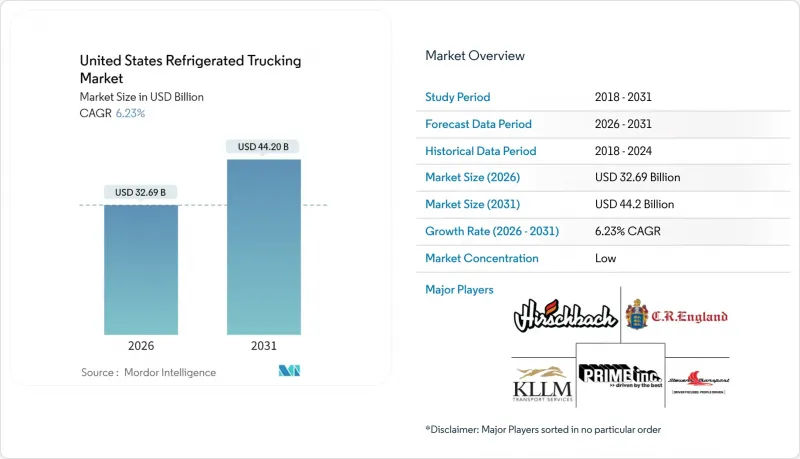
预计到 2026 年,美国冷藏卡车运输市场规模将达到 326.9 亿美元,较 2025 年的 307.7 亿美元持续成长。
预计到 2031 年将达到 442 亿美元,2026 年至 2031 年的复合年增长率为 6.23%。
这一增长是由多种因素共同推动的:消费者对全年生鲜食品的持续需求、超低温药品配送的扩张以及食品订购的增加导致配送时间缩短。为了回应零排放法规,营运商正在升级车队,采用电动运输冷冻设备;基于人工智慧的配送路线优化平台则减少了空驶和食物浪费成本。虽然大型承运商之间的整合使得昂贵的技术投资得以规模化,但分散的区域专家网路对于确保最后一公里配送仍然至关重要。对现代化冷藏保管设施的同步投资是网路优化的基础,尤其是在德克萨斯州、墨西哥湾沿岸和中西部农业带等农业综合企业走廊地区。
美国冷藏运输市场趋势与分析
FSMA实施促进冷藏车升级
《食品安全现代化法案》(FSMA) 第 204 条将于 2026 年 1 月全面生效,要求运输商提交 FDA 指定食品的 24 小时追踪记录。各公司正在为其货车配备物联网感测器、基于区块链的文件管理系统和 GPS 温度探头,从而将废品率降低 30%,同时将准时交付率提高 25%。领先先行者已将合规性作为加值服务提供给药品运输商,因为药品运输商每次温度超标都可能面临高达 78,000 美元的召回成本。该法规将使可追溯性从成本中心转变为竞争优势,迫使落后的公司进行技术改造,否则将成为资金更雄厚的竞争对手的收购目标。
食品宅配的快速成长扩大了本地冷藏链的容量
预计到2025年,美国生鲜电商销售额将达到1.24兆美元,其中「最后一公里」配送环节约占物流成本的50%。零售商正投资超过10亿美元,在人口密集的大都会区附近建造自动化冷藏中心。采用模组化冷冻面板的灵活温控系统,使运输商能够在同一路线上混合运输生鲜产品、乳製品和冷冻食品,避免交叉污染。创新的储物柜和携带式冷藏箱即使在终端消费者错过送货时间段的情况下也能保持产品质量,从而减少浪费并增强品牌忠诚度。这种对高频次、小批量配送日益增长的需求,使得区域性专业公司在美国冷藏运输市场,尤其是在纽约、洛杉矶和西雅图地区,变得越发重要。
冷藏车驾驶人短缺导致人事费用上涨。
目前,冷藏运输职位空缺总合已达24,043个,导致每週商机损失高达9,550万美元。冷藏运输需要温度控制、危险品知识以及严格的配送时间表,因此与干货车运输相比,合格的冷藏工人数量更为有限。冷藏仓库的离职率加剧了员工对等待时间的不满,进一步恶化了离职率。儘管美国联邦汽车运输安全管理局(FMCSA)的豁免条款允许卡车司机僱用没有商业驾驶执照(CDL)的司机,但安全隐患仍然存在。提高薪资和提供技能提升计画正逐渐成为美国冷藏运输市场的强制性要求。
细分市场分析
预计加工食品领域将主导美国冷藏运输市场,从 2026 年到 2031 年将以 7.02% 的复合年增长率成长。肉类、海鲜和家禽领域将在 2025 年占美国冷藏运输市场的 21.42%,这表明该领域仍然依赖不间断的低温运输。
如今,食材自煮包供应商和冷冻食品品牌需要SKU层级的温度数据,这推动了对冷藏室和气调包装的投资。运输公司和食品加工商正在合作建立预冷分拣流程,以减少码头入口处的环境温度流入。医疗和药品托运商正在利用为生技药品开发的超低温检验通道,而园艺产品出口商则透过美国农业部资助的回程传输运输改进措施,延长运往中西部配送中心的浆果和绿叶蔬菜的保质期。拖车内部的先进聚合物衬里能够实现乳製品温度的快速变化,从而在不违反特定产品储存规定的前提下,实现混合装载的经济效益。
2025 年,非货柜冷藏卡车凭藉专用硬体和路线柔软性,在美国冷藏卡车运输市场占了 85.45% 的份额。随着港口当局增加充电点,以及航运公司协调铁路和公路交接以缩短门到门运输时间,预计 2026 年至 2031 年货柜冷藏运输量将以 6.41% 的复合年增长率增长。
位于休士顿冷港的这座占地315,101平方英尺的设施以及位于海湾港耗资7300万美元的扩建项目将创建新的多式联运转运点,从而缩短短途运输距离并降低滞期费风险。嵌入冷藏集装箱的物联网感测器阵列将追踪衝击、湿度和位置讯息,帮助托运人检验海运、铁路和公路运输的品质。
预计到2025年,长途货运将占总收入的71.60%,并在2026年至2031年间以6.54%的复合年增长率快速增长,这主要得益于农产品、肉类和药品跨境运输量的增加。自动驾驶测试已在亚特兰大和达拉斯之间完成了5万英里无事故行驶,预示着一旦获得监管部门批准,将能显着降低成本。
长途柴油-电力混合动力汽车在严酷的沙漠环境中能够延长车辆使用寿命,而预测性维护平台则会在运输过程中通知终端压缩机的磨损情况。虽然短程运输路线正受益于电气化,但电池密度限制和公路充电基础设施的缺乏意味着长途柴油运输预计到2030年仍将保持可行性,并将继续支撑美国冷藏卡车运输市场的大部分份额。
其他福利:
- Excel格式的市场预测(ME)表
- 分析师支持(3个月)
目录
第一章 引言
- 研究假设和市场定义
- 调查范围
第二章调查方法
第三章执行摘要
第四章 市场情势
- 市场概览
- 人口统计数据
- 按经济活动分類的GDP分配
- 按经济活动分類的GDP成长
- 经济表现和公司概况
- 电子商务产业的趋势
- 製造业趋势
- 运输和仓储部门的GDP
- 物流绩效
- 道路长度
- 出口趋势
- 进口趋势
- 燃油价格趋势
- 卡车运输营运成本
- 公路货运量趋势
- 公路货运价格趋势
- 按交通方式分享
- 通货膨胀
- 法律规范
- 价值炼和通路分析
- 市场驱动因素
- FSMA实施促进冷藏车升级
- 食品杂货宅配的快速成长正在推动对区域低温运输产能的需求。
- 对需要超低温(-20°C 或以下)运输的特殊药品的需求不断增长
- 电气化桁架受惠于州级零排放激励计划
- 利用人工智慧进行动态路线规划有助于防止食物变质并最大限度地减少空驶里程。
- 农业出口走廊津贴(例如,墨西哥湾沿岸地区农产品补贴)旨在提高回程传输利用率
- 市场限制
- 合格冷冻车驾驶员短缺,给人事费用带来了越来越大的压力。
- 由于TRU排放法规日益严格,资本成本增加。
- 锂离子电池防火安全标准的不确定性正在减缓电动储能装置的普及。
- 针对低温运输资讯处理系统的网路安全漏洞导致营运中断
- 市场创新
- 波特五力分析
- 新进入者的威胁
- 买方的议价能力
- 供应商的议价能力
- 替代品的威胁
- 竞争对手之间的竞争
第五章 市场规模与成长预测
- 目的
- 园艺产品
- 乳製品
- 肉类、鱼贝类和家禽
- 加工食品
- 医疗和药品
- 其他用途
- 卡车装载规范
- 整车运输 (FTL)
- 小批量货物(零担)
- 货柜运输
- 货柜运输
- 非货柜运输
- 距离
- 长途
- 短程交通
- 货物类型
- 液体货物
- 固态货物
- 目的地
- 国内的
- 国际的
- 温度类型
- 冷藏
- 冷冻
- 环境的
第六章 竞争情势
- 市场集中度
- 关键策略倡议
- 市占率分析
- 公司简介
- ATS(Anderson Trucking Service)
- Bay and Bay Transportation
- CR England
- Covenant Logistics Group, Inc.(Including Southern Refrigerated Transport)
- Decker Truck Line, Inc.
- FFE(Frozen Food Express)Transportation Services, Inc.(Owned by Duff Capital Investors)
- Freymiller, Inc.
- Hirschbach Motor Lines, Inc.
- J&R Schugel Trucking
- K&B Transportation
- KLLM Transport Services(Owned by Duff Capital Investors)
- Knight-Swift Transportation Holdings, Inc.(Including Swift Transportation Company)
- Leonards Express
- Marten Transport, Ltd.
- Penske Corporation, Inc.(Including Black Horse Carriers, Inc.)
- Prime, Inc.
- Roehl Transport, Inc.
- Ryder System, Inc.(Including Cardinal Logistics)
- Stevens Transport, Inc.
- TransAm Trucking, Inc.
- WEL Companies
第七章 市场机会与未来展望
The United States refrigerated trucking market size in 2026 is estimated at USD 32.69 billion, growing from 2025 value of USD 30.77 billion with 2031 projections showing USD 44.2 billion, growing at 6.23% CAGR over 2026-2031.
Growth stems from several converging forces: sustained consumer demand for year-round fresh food, expanding ultra-cold pharmaceutical distribution, and rising e-commerce grocery orders that shorten delivery windows. Operators are upgrading fleets with electric transport-refrigeration units to comply with zero-emission mandates, while artificial-intelligence routing platforms lower empty-mile ratios and spoilage costs. Consolidation among top carriers provides scale for expensive technology investments, yet a fragmented tail of regional specialists remains crucial for last-mile coverage. Parallel investment in modern cold-storage nodes underpins network optimization, especially in Texas, the Gulf Coast, and Midwest agribusiness corridors.
United States Refrigerated Trucking Market Trends and Insights
FSMA Enforcement Spurring Upgrades in Refrigerated Fleets
Section 204 of the Food Safety Modernization Act takes full effect in January 2026 and obliges carriers to furnish 24-hour traceability records for foods on the FDA's list. Fleets are outfitting vans with IoT sensors, blockchain-enabled documentation, and GPS temperature probes, cutting spoilage by 30% while lifting on-time performance by 25%. Early adopters market compliance as a premium service for pharma shippers, who face recall costs of USD 78,000 per incident when excursions occur. The regulation thereby transforms traceability from a cost center into a competitive differentiator, pushing laggards toward tech-enabled retrofits or acquisition by better-capitalized rivals.
Rapid Growth in Home-Delivered Groceries Increasing Regional Cold-Chain Capacity
E-commerce grocery receipts are set to total USD 1.24 trillion in 2025, with last-mile activity representing roughly 50% of logistics spend. Retailers are allocating more than USD 1 billion to automated cold-storage hubs positioned closer to dense urban clusters. Modular refrigeration panels enable flexible temperature zoning, letting carriers combine produce, dairy, and frozen SKUs on the same route without cross-contamination. Innovative lockers and portable cooling totes preserve integrity when end-consumers miss delivery windows, shrinking spoilage write-offs and reinforcing brand loyalty. Demand for high-frequency, low-volume drops thereby elevates regional specialists in the United States refrigerated trucking market, particularly around New York, Los Angeles, and Seattle.
Shortage of Reefer-Qualified Drivers is Putting Upward Pressure on Labor Costs
Vacancies total 24,043 seats, costing USD 95.5 million weekly in forgone revenue. Reefer duties demand temperature checks, hazmat familiarity, and tighter appointment windows, narrowing the qualified labor pool relative to dry-van work. Cold-warehouse turnover elevates wait-time frustrations, worsening attrition. Although FMCSA exemptions let carriers seat commercial-learner-permit holders without CDL escorts, safety concerns remain. Enhanced compensation and upskilling programs are becoming table stakes across the United States refrigerated trucking market.
Other drivers and restraints analyzed in the detailed report include:
- Rising Demand for Specialty Pharmaceuticals Requiring Ultra-Cold Transport Lanes
- AI-Powered Dynamic Routing Helps Reduce Spoilage and Minimize Empty Miles
- Stricter TRU Emissions Regulations are Increasing Capital Costs
For complete list of drivers and restraints, kindly check the Table Of Contents.
Segment Analysis
Processed Food Products are expected to expand at a 7.02% CAGR (2026-2031), outstripping all other verticals in the United States refrigerated trucking market. Meats, Fish, and Poultry maintained a 21.42% United States refrigerated trucking market share in 2025, signifying continued reliance on uninterrupted cold-chain links.
Meal-kit providers and frozen entree brands now demand SKU-level temperature data, spurring investments in reefer compartmentalization and controlled-atmosphere packaging. Carrier collaboration with food processors yields pre-cool staging protocols that cut ambient ingress at dock doors. Healthcare and pharmaceutical shippers leverage ultra-cold validation lanes created for biologics, while horticultural exporters benefit from USDA-funded backhaul upgrades, extending shelf life for berries and leafy greens en route to Midwest distribution hubs. Advanced polymer linings inside trailers allow rapid temperature swings for dairy products, enabling mixed-load economics without violating product-specific storage rules.
Non-containerized reefers kept an 85.45% United States refrigerated trucking market share in 2025, owing to specialized hardware and lane flexibility. Containerized refrigerated flows are expected to grow at a 6.41% CAGR (2026-2031) as port authorities expand plug-in points, and carriers sync rail and truck hand-offs to shrink door-to-door transit times.
Houston ColdPort's 315,101 ft2 facility and Port Gulfport's USD 73 million expansion create new intermodal staging nodes that shorten drayage distance and slash demurrage risk. IoT-sensor arrays embedded in reefer containers track shock, humidity, and location, helping shippers validate integrity across marine-rail-road segments.
Long haul freight claims 71.60% of the revenue share in 2025 and is expected to grow the fastest at 6.54% CAGR (2026-2031) as cross-country produce, meat, and pharma volumes escalate. Autonomous pilots amassed 50,000 miles without accident on the Atlanta-Dallas lane, foreshadowing cost reductions once regulatory green lights emerge.
Extended-range diesel-electric hybrids prolong asset life in harsh desert corridors, while predictive maintenance platforms alert terminals to compressor wear mid-route. Short-haul lanes enjoy electrification gains, but battery-density constraints and sparse highway charging keep long-haul diesel viable through 2030, underpinning the bulk of the United States refrigerated trucking market.
The United States Refrigerated Trucking Market Report is Segmented by Application (Processed Food Products and More), Truckload Specification (Full-Truck-Load (FTL) and More), Containerization (Containerized and More), Distance (Long Haul and More), Goods Configuration (Fluid Goods and More), Destination (Domestic and International), and Temperature Type (Chilled and More). The Market Forecasts are Provided in Terms of Value (USD).
List of Companies Covered in this Report:
- ATS (Anderson Trucking Service)
- Bay and Bay Transportation
- C.R. England
- Covenant Logistics Group, Inc. (Including Southern Refrigerated Transport)
- Decker Truck Line, Inc.
- FFE (Frozen Food Express) Transportation Services, Inc. (Owned by Duff Capital Investors)
- Freymiller, Inc.
- Hirschbach Motor Lines, Inc.
- J&R Schugel Trucking
- K&B Transportation
- KLLM Transport Services (Owned by Duff Capital Investors)
- Knight-Swift Transportation Holdings, Inc. (Including Swift Transportation Company)
- Leonards Express
- Marten Transport, Ltd.
- Penske Corporation, Inc. (Including Black Horse Carriers, Inc.)
- Prime, Inc.
- Roehl Transport, Inc.
- Ryder System, Inc. (Including Cardinal Logistics)
- Stevens Transport, Inc.
- TransAm Trucking, Inc.
- WEL Companies
Additional Benefits:
- The market estimate (ME) sheet in Excel format
- 3 months of analyst support
TABLE OF CONTENTS
1 Introduction
- 1.1 Study Assumptions and Market Definition
- 1.2 Scope of the Study
2 Research Methodology
3 Executive Summary
4 Market Landscape
- 4.1 Market Overview
- 4.2 Demographics
- 4.3 GDP Distribution by Economic Activity
- 4.4 GDP Growth by Economic Activity
- 4.5 Economic Performance and Profile
- 4.5.1 Trends in E-Commerce Industry
- 4.5.2 Trends in Manufacturing Industry
- 4.6 Transport and Storage Sector GDP
- 4.7 Logistics Performance
- 4.8 Length of Roads
- 4.9 Export Trends
- 4.10 Import Trends
- 4.11 Fuel Pricing Trends
- 4.12 Trucking Operational Costs
- 4.13 Road Freight Tonnage Trends
- 4.14 Road Freight Pricing Trends
- 4.15 Modal Share
- 4.16 Inflation
- 4.17 Regulatory Framework
- 4.18 Value Chain and Distribution Channel Analysis
- 4.19 Market Drivers
- 4.19.1 FSMA Enforcement Spurring Upgrades in Refrigerated Fleets
- 4.19.2 Rapid Growth in Home-Delivered Groceries Increasing Demand for Regional Cold Chain Capacity
- 4.19.3 Rising Demand for Specialty Pharmaceuticals Requiring Ultra-Cold (Below -20°C) Transport Lanes
- 4.19.4 Electrified TRUs Benefiting from State-Level Zero-Emission Incentive Programs
- 4.19.5 AI-Powered Dynamic Routing Helping Reduce Spoilage and Minimize Empty Miles
- 4.19.6 Agricultural Export Corridor Grants (e.g., Gulf Coast Produce) Improving Back-Haul Utilization
- 4.20 Market Restraints
- 4.20.1 Shortage of Reefer-Qualified Drivers Putting Upward Pressure on Labor Costs
- 4.20.2 Stricter TRU Emissions Regulations Increasing Capital Costs
- 4.20.3 Uncertainty over Lithium-Ion Battery Fire Codes Slowing Adoption of Electric TRUs
- 4.20.4 Cybersecurity Breaches Targeting Cold Chain Telematics Disrupting Operations
- 4.21 Technology Innovations in the Market
- 4.22 Porter's Five Forces Analysis
- 4.22.1 Threat of New Entrants
- 4.22.2 Bargaining Power of Buyers
- 4.22.3 Bargaining Power of Suppliers
- 4.22.4 Threat of Substitutes
- 4.22.5 Competitive Rivalry
5 Market Size and Growth Forecasts (Value, USD)
- 5.1 Application
- 5.1.1 Horticultural Products
- 5.1.2 Dairy Products
- 5.1.3 Meats, Fish, and Poultry
- 5.1.4 Processed Food Products
- 5.1.5 Healthcare and Pharmaceutical
- 5.1.6 Other Applications
- 5.2 Truckload Specification
- 5.2.1 Full-Truck-Load (FTL)
- 5.2.2 Less than-Truck-Load (LTL)
- 5.3 Containerization
- 5.3.1 Containerized
- 5.3.2 Non-Containerized
- 5.4 Distance
- 5.4.1 Long Haul
- 5.4.2 Short Haul
- 5.5 Goods Configuration
- 5.5.1 Fluid Goods
- 5.5.2 Solid Goods
- 5.6 Destination
- 5.6.1 Domestic
- 5.6.2 International
- 5.7 Temperature Type
- 5.7.1 Chilled
- 5.7.2 Frozen
- 5.7.3 Ambient
6 Competitive Landscape
- 6.1 Market Concentration
- 6.2 Key Strategic Moves
- 6.3 Market Share Analysis
- 6.4 Company Profiles (Includes Global Level Overview, Market Level Overview, Core Segments, Financials as Available, Strategic Information, Market Rank/Share for Key Companies, Products and Services, and Recent Developments)
- 6.4.1 ATS (Anderson Trucking Service)
- 6.4.2 Bay and Bay Transportation
- 6.4.3 C.R. England
- 6.4.4 Covenant Logistics Group, Inc. (Including Southern Refrigerated Transport)
- 6.4.5 Decker Truck Line, Inc.
- 6.4.6 FFE (Frozen Food Express) Transportation Services, Inc. (Owned by Duff Capital Investors)
- 6.4.7 Freymiller, Inc.
- 6.4.8 Hirschbach Motor Lines, Inc.
- 6.4.9 J&R Schugel Trucking
- 6.4.10 K&B Transportation
- 6.4.11 KLLM Transport Services (Owned by Duff Capital Investors)
- 6.4.12 Knight-Swift Transportation Holdings, Inc. (Including Swift Transportation Company)
- 6.4.13 Leonards Express
- 6.4.14 Marten Transport, Ltd.
- 6.4.15 Penske Corporation, Inc. (Including Black Horse Carriers, Inc.)
- 6.4.16 Prime, Inc.
- 6.4.17 Roehl Transport, Inc.
- 6.4.18 Ryder System, Inc. (Including Cardinal Logistics)
- 6.4.19 Stevens Transport, Inc.
- 6.4.20 TransAm Trucking, Inc.
- 6.4.21 WEL Companies
7 Market Opportunities and Future Outlook
- 7.1 White-space and Unmet-need Assessment

 冷藏车市场:2026-2032年全球市场预测(按车辆类型、货柜类型、技术、温度、应用和最终用途产业划分)冷藏拖车市场:按产品类型、类别、冷冻装置、营运模式和最终用户划分-2026-2032年全球市场预测
 2026年全球冷藏拖车市场报告2026年全球冷藏货物运输市场报告
 冷藏车市场 - 全球产业规模、份额、趋势、机会及预测(按车辆类型、有效载荷、应用、地区和竞争格局划分,2021-2031年)
 日本冷藏车市场规模、份额、趋势及预测(按类型、吨位、应用及地区划分),2026-2034年
 冷藏拖车市场规模、份额和成长分析(按拖车类型、轴型、动力来源、最终用途产业和地区划分)-2026-2033年产业预测
 全球冷藏拖车市场冷藏拖车市场-全球产业规模、份额、趋势、机会和预测(按温度、应用、最终用途、地区和竞争细分,2020-2030 年)
 全球冷藏车市场:未来预测(2025-2030)