


 |
市场调查报告书
商品编码
1940627
无菌医疗包装:市场占有率分析、产业趋势与统计、成长预测(2026-2031)Sterile Medical Packaging - Market Share Analysis, Industry Trends & Statistics, Growth Forecasts (2026 - 2031) |
||||||

※ 本网页内容可能与最新版本有所差异。详细情况请与我们联繫。
无菌医疗包装市场预计将从 2025 年的 619.3 亿美元成长到 2026 年的 671.1 亿美元,预计到 2031 年将达到 1002.1 亿美元,2026 年至 2031 年的复合年增长率为 8.36%。
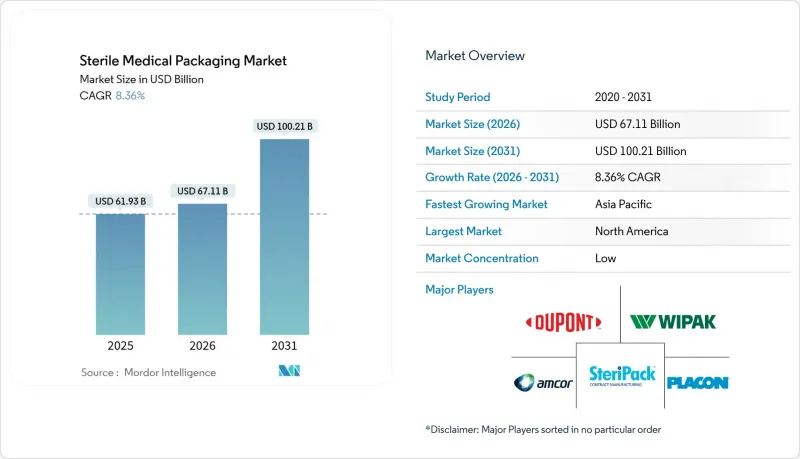
这一增长反映了药物传输领域向无污染方向的重大转变、日益严格的全球标准以及材料的快速创新。手术量的成长、生物製药产品线的不断扩展以及一次性医疗器材的普及推动了市场需求,而更严格的环氧乙烷排放法规则迫使製造商转向多样化的灭菌方法。数位化检验工具、基于风险的品质体係以及人工智慧驱动的检测平台正在重塑生产经济模式和竞争策略。同时,永续性发展的迫切需求促使供应商开发高阻隔阻隔性可回收基材,而树脂价格的波动以及有关再生材料含量的法规则增加了成本和技术复杂性。
全球无菌医疗包装市场趋势与洞察
严格的感染控制法规和标准
美国食品药物管理局 (FDA) 将于 2026 年 2 月前使其品管系统法规与 ISO 13485:2016 标准接轨,强制要求在整个无菌医疗包装市场实施基于风险的验证和容器密封测试。欧洲药品管理局 (EMA) 修订的 GMP 附录 1 已开始鼓励製药公司合格其初级包装,从而推动了对经过验证的无菌屏障系统的高端需求。 ISO 11607 的修订扩展了这些风险管理原则,并鼓励供应商采用可追溯性和数位化文件。在製药产业丛集附近设立近岸灭菌中心,透过减少运输过程中的风险暴露并确保随时准备接受审核,可以有效配合这些法规。像 West Pharmaceutical Services 这样的先驱报告称,符合这些更高标准的 NovaPure 组件订单强劲。
手术量增加及慢性疾病负担加重
受人口老化和微创手术兴起的推动,预计到2024年,全球手术量将增加12%。从可重复使用器械到一次性器械包的转变,推动了复杂器械套装无菌包装的需求。糖尿病管理就是这个趋势的典型例证:预计到2024年,预填充胰岛素笔的使用率将成长18%,这就要求包装能承受家庭环境中的温度波动,同时保持无菌状态。门诊和居家照护的普及,也促使人们需要易于开启、防篡改且提供清晰使用说明的包装设计。目前,67%的大型包装厂已采用基于人工智慧的视觉检测技术,这有助于製造商在不影响品质的前提下管理不断增长的产量。
树脂价格波动和供应链中断
2024年,受能源价格上涨和天气相关供应中断的影响,聚乙烯成本较去年同期飙升28%。中型包装製造商的利润率下降了12%至15%,被迫提高安全库存水平,营运资金也受到限制。更严格的环氧乙烷排放法规导致产能关闭,暂时延长了灭菌前置作业时间,进一步加剧了这种情况。一些公司试图透过签订多年树脂合约或垂直整合薄膜挤出製程来缓解价格波动,但短期压力仍然存在。对再生材料含量的监管基准值进一步扰乱了原材料规格,需要进行大量检验,并增加了营运资金。
细分市场分析
到2025年,塑胶将占无菌医疗包装市场67.62%的份额,主要得益于聚丙烯的耐灭菌循环性和聚乙烯的抗穿刺性。然而,纸张和纸板将以9.98%的复合年增长率引领该细分市场,这主要受医院永续性目标和品牌对回收承诺的推动。 PETG正越来越多地取代PVC用于热成型托盘,以提高手术包的可见度。预计到2031年,纸基无菌医疗包装市场规模将达到106.4亿美元,主要得益于可耐受蒸气和等离子灭菌的透气涂层技术。然而,再生材料的加入会影响阻隔性能的稳定性,需要对材料科学进行大量投资并进行额外的保质期测试。将消费后树脂应用于泡壳包装的供应商正在采用先进的纯化工艺,以确保符合ISO 11607标准。虽然由于运输成本压力,玻璃的使用量正在下降,但玻璃的惰性特性仍然支撑着对湿度敏感的生物製药的特定需求,这弥补了其重量上的劣势。
第二代塑胶因其在进程内添加了便于分类的添加剂,正逐渐成为合规解决方案。这些单一材料复合材料无需使用传统上阻碍回收的黏合剂,并维持了良好的微生物阻隔性能,使製造商能够达到欧盟25%的再生材料含量目标。然而,製药经销商仍需遵循美国药典的指导原则,该原则仍建议对高风险注射剂型使用新型聚合物。随着树脂供应商推出物料平衡认证的材料,品牌所有者无需改变包装的化学成分即可获得永续性积分,这提供了一种过渡性解决方案,预计将在2027年之前广泛应用。
截至2025年,热成型托盘将维持28.26%的无菌医疗包装市场份额,其刚性强、加工效率高。儘管该细分市场的成长趋于平缓,但无菌瓶和容器的成长却以12.18%的复合年增长率加速,这主要得益于吹灌封生产线降低了无菌转移的风险。新型吹灌封生产线模组的年产能可达每家工厂1.7亿件,足以满足大众市场吸入疗法的需求。袋装产品在高通量输液和透析迴路中越来越受欢迎,这得益于其灵活的供应链经济优势。
儘管管瓶和西林瓶仍然是注射剂填充的基础,但即用型包装正在削弱对玻璃脱氧隧道的需求。即用型产品联盟(Gerresheimer、Stevanato Group 和 SCHOTT Pharma)正在对包装规格和灭菌工艺进行标准化,以简化填充和表面处理工程。受患者自我给药的推动,预填充式注射器正以每年 22% 的速度增长,而与自动注射器相容的包装则保持着较高的价格。包装、瓶盖和无菌密封件仍然是必不可少的辅助配件,而带有氟聚合物薄膜的新型弹性体塞则有助于减少蛋白质生物製药中的药物相互作用。预计所有规格的注射器系统的无菌医疗包装市场将从 2026 年的 97.2 亿美元增长到 2031 年的 169.6 亿美元,这表明医疗器械的融合程度正在不断提高。
这份医用灭菌包装市场报告材料类型(塑胶、纸/纸板、玻璃等)、产品类型(热成型托盘、灭菌瓶/容器、包装袋/包装盒、泡壳包装等)、应用领域(药品/生技药品、外科/医疗器械等)、灭菌方法(化学灭菌、辐射灭菌、热灭菌等)和地区进行细分。市场预测以美元计价。
区域分析
北美地区凭藉严格的法律规范和丰富的生物製药研发管线,预计到2025年将占据无菌医疗包装市场38.45%的份额。该地区的领先地位得益于持续的再投资:格雷斯海默公司在洛尔投资1.08亿美元兴建的氧气混合熔炉,不仅减少了40%的排放,还提高了熔炉的生产能力,并确保了美国注射剂玻璃的供应。即将实施的FDA品管系统报告(QMSR)要求迫使美国本土製造商加强数位化文件管理,并推广采用基于云端的审核平台。然而,树脂价格的波动以及美国环保署(EPA)对环氧乙烷的监管,推高了营运成本,促使灭菌能力转移到邻近主要製药丛集的地区。
亚太地区预计将成为成长最快的地区,到2031年复合年增长率将达到11.42%,并在2028年实现绝对值超过欧洲。中国国家药品监督管理局(NMPA)的改革与国际人用药品註册技术协调会(ICH)指南相一致,并放宽了出口壁垒,吸引了新的投资涌入江苏和浙江两省。安姆科位于雪兰莪的包衣工厂建立了亚洲首条气刀医疗器材生产线,展现了成熟市场的技术转移。印度的学名药中心正在扩建泡壳包装和吹灌封(BFS)设施,以支持出口扩张,印度药品协会(IPA)成员公司中有67%计划在2026年前升级其包装设施。东南亚(泰国、越南)拥有成本效益高的无尘室劳动力,吸引了合约包装商为区域疫苗联盟提供服务。
欧洲持续引领创新,欧盟包装废弃物法规 (EU) 2025/40 要求到 2030 年塑胶包装中必须含有 25% 的再生材料。原始设备製造商 (OEM) 为获得环保标籤优势,正努力接受更高的材料成本,例如 Sudpac 的 PharmaGuard 荣获国家永续性奖。德国、义大利和荷兰正在扩大辐射加工产能,以填补环氧乙烷 (EO) 的供不应求。波兰等东欧国家正崛起为标籤印刷和包装袋加工的转运中心,既能满足欧盟的医药需求,也能避免西欧高昂的人事费用成本。
其他福利:
- Excel格式的市场预测(ME)表
- 分析师支持(3个月)
目录
第一章 引言
- 研究假设和市场定义
- 调查范围
第二章调查方法
第三章执行摘要
第四章 市场情势
- 市场概览
- 市场驱动因素
- 严格的感染控制法规和标准
- 手术量增加和慢性病负担加重
- 生物製药和注射需求激增,需要高度可靠的包装
- 阻隔性可再生塑胶和纸张的快速材料创新
- 将「消毒服务」基地近岸外包至製药产业丛集附近
- 人工智慧驱动的货柜近距离完整性(CCI)检测数位双胞胎
- 市场限制
- 树脂价格波动和供应链中断
- 多司法管辖区的监管复杂性和合规成本
- 法律强制规定最低再生材料含量,这可能会影响包装的完整性。
- 由于排放法规,环氧乙烷(EtO)产能短缺。
- 供应链分析
- 监管环境
- 技术展望
- 波特五力分析
- 新进入者的威胁
- 供应商的议价能力
- 买方的议价能力
- 替代品的威胁
- 产业间竞争
- 定价分析
第五章 市场规模与成长预测
- 依材料类型
- 塑胶
- 聚丙烯
- 聚乙烯
- 聚对苯二甲酸乙二酯
- 聚氯乙烯
- 聚苯乙烯
- 其他塑料
- 纸和纸板
- 玻璃
- 其他材料类型
- 塑胶
- 依产品类型
- 热成型托盘
- 无菌瓶和容器
- 小袋和袋子
- 泡壳包装
- 管瓶和安瓿
- 预填充式注射器和吸入器
- 包装和盖子
- 无菌封盖和塞子
- 透过使用
- 药品和生物製药
- 外科和医疗器械
- 体外诊断(IVD)试剂盒和试剂
- 医疗植入和一次性医疗设备
- 其他用途
- 透过灭菌方法
- 化学
- 辐射
- 热感的
- 冷等离子和臭氧
- 基于无菌/过滤
- 按地区
- 北美洲
- 我们
- 加拿大
- 墨西哥
- 欧洲
- 德国
- 英国
- 法国
- 义大利
- 西班牙
- 荷兰
- 俄罗斯
- 其他欧洲地区
- 亚太地区
- 中国
- 日本
- 印度
- 韩国
- 澳洲和纽西兰
- ASEAN
- 亚太其他地区
- 中东和非洲
- 中东
- 沙乌地阿拉伯
- 阿拉伯聯合大公国
- 土耳其
- 其他中东地区
- 非洲
- 南非
- 奈及利亚
- 埃及
- 其他非洲地区
- 中东
- 南美洲
- 巴西
- 阿根廷
- 南美洲其他地区
- 北美洲
第六章 竞争情势
- 市场集中度
- 策略性倡议(併购、合资、产能扩张)
- 市占率分析
- 公司简介
- Amcor plc
- DuPont de Nemours Inc.
- 3M Company
- Nelipak Healthcare Packaging
- Tekni-Plex Inc.
- Oliver Healthcare Packaging
- Wipak Group
- Steripack Group
- Placon Corporation
- Sonoco Products Co.
- Billerud
- Paxxus Inc.
- Charter Next Generation
- Riverside Medical Packaging
- Technipaq Inc.
- DWK Life Sciences
- Sigma Medical Supplies
- Sterimed Holdings
- West Pharmaceutical Services
- WestRock Company
- Gerresheimer AG
- APTAR Group
第七章 市场机会与未来展望
The sterile medical packaging market is expected to grow from USD 61.93 billion in 2025 to USD 67.11 billion in 2026 and is forecast to reach USD 100.21 billion by 2031 at 8.36% CAGR over 2026-2031.
This expansion reflects a decisive move toward contamination-free drug delivery, tighter global standards, and rapid material innovation. Heightened surgical volumes, growing biologics pipelines, and the migration to single-use devices are accelerating demand, while stricter emission rules for ethylene oxide are steering manufacturers toward diversified sterilization methods. Digital validation tools, risk-based quality systems, and AI-driven inspection platforms are reshaping production economics and competitive strategy. At the same time, sustainability mandates are pressuring suppliers to engineer high-barrier recyclable substrates, even as resin price volatility and recycled-content legislation add cost and technical complexity.
Global Sterile Medical Packaging Market Trends and Insights
Stringent Infection-Control Regulations and Standards
The FDA will fully align its Quality Management System Regulation with ISO 13485:2016 by February 2026, making risk-based validation and container-closure integrity testing mandatory across the sterile medical packaging market. EMA's revised GMP Annex 1 is already compelling pharmaceutical firms to requalify primary packs, spurring premium demand for validated sterile barrier systems. ISO 11607 amendments extend these risk-management principles, encouraging suppliers to embed traceability and digital documentation. Near-shoring of sterilization hubs close to pharma clusters complements these rules by cutting transit exposures and ensuring audit readiness. Early adopters like West Pharmaceutical Services report stronger order books for NovaPure components that conform to these upgraded standards.
Rise in Surgical Volumes and Chronic Disease Burden
Global procedure counts climbed 12% in 2024, led by aging populations and greater access to minimally invasive surgery. Single-use kits are replacing reusables, multiplying sterile pack demand for complex instrument sets. Diabetes management illustrates the trend: prefilled insulin pen uptake grew 18% in 2024, requiring packs that resist household temperature swings while safeguarding sterility. The shift to outpatient and home settings intensifies design needs for easy-open formats, tamper evidence, and clear instructions. AI-based visual inspection, now operating in 67% of large packaging plants, helps producers keep pace with rising volume without compromising quality.
Volatile Resin Pricing and Supply-Chain Shocks
Polyethylene costs jumped 28% year-over-year in 2024 on energy price spikes and weather-related disruptions. Mid-tier packagers saw 12-15% margin squeeze and were forced to raise safety-stock levels, tying up working capital. Ethylene-oxide emission curbs worsened the picture, as capacity shutdowns briefly raised sterilization lead times. Some firms locked multiyear resin contracts or vertically integrated film extrusion to tame volatility, yet exposure remains a near-term drag. Legislated recycled-content thresholds further destabilize raw-material specifications, demanding extensive validation that inflates working capital.
Other drivers and restraints analyzed in the detailed report include:
- Boom in Biologics and Injectables Needing High-Integrity Packs
- Rapid Material Innovations in High-Barrier Recyclable Plastics and Papers
- Multi-Jurisdiction Regulatory Complexity and Compliance Costs
For complete list of drivers and restraints, kindly check the Table Of Contents.
Segment Analysis
Plastics delivered 67.62% sterile medical packaging market share in 2025, led by polypropylene's sterility-cycle tolerance and polyethylene's puncture resistance. Paper and paperboard, however, are pacing the segment at a 9.98% CAGR, pushed by hospital sustainability targets and brand commitments to recyclability. PETG is replacing PVC in thermoformed trays for clearer visualization of surgical kits. The sterile medical packaging market size for paper formats is on track to reach USD 10.64 billion in 2031, enabled by breathable coatings that pass both steam and plasma sterilization. Yet recycled-content inclusion complicates barrier consistency, prompting widespread investment in material science and additional shelf-life testing. Suppliers integrating post-consumer resin into blister webs use advanced purification stages to preserve ISO 11607 compliance. Though glass usage declines amid freight-cost pressures, niche demand persists for moisture-sensitive biologics where glass's inertness still outweighs its weight penalty.
Second-generation plastics featuring in-process additives for easy sorting are emerging as compliance workarounds. These mono-material laminates eliminate adhesives that previously blocked recyclability, allowing converters to achieve EU's 25% recycled-content target while retaining microbial barrier performance. However, pharmaceutical license holders must reconcile these gains with U.S. Pharmacopeia guidelines, which still favor virgin polymers for high-risk parenterals. As resin suppliers roll out mass-balance certified feedstocks, brand owners can claim sustainability credits without altering pack chemistry, an interim solution expected to boost adoption through 2027.
Thermoform trays retained 28.26% share of the sterile medical packaging market in 2025, valued for rigidity and procedural efficiency. The segment's growth is flattening, while sterile bottles and containers are accelerating at a 12.18% CAGR, supported by blow-fill-seal lines that cut aseptic transfer risk. New BFS modules produce up to 170 million units per facility annually, enabling scale suitable for mass-market inhalation therapies. Pouches and bags capitalize on flexible supply-chain economics, finding traction in high-throughput IV fluid and dialysis circuits.
Vials and ampoules still underpin most injectable fills, but ready-to-use formats are cannibalizing glass depyrogenation tunnels. The Alliance for RTU-Gerresheimer, Stevanato Group, and SCHOTT Pharma-aims to standardize geometry and sterilization, smoothing fill-finish operations. Prefilled syringes exhibit 22% annual growth, fueled by patient self-administration, while autoinjector-compatible packs command premium pricing. Wraps, lids, and sterile closures remain essential adjuncts; newer elastomeric stoppers sporting fluoropolymer films mitigate drug-component interactions for proteinaceous biologics. Across formats, the sterile medical packaging market size attached to syringe systems is forecast to expand from USD 9.72 billion in 2026 to USD 16.96 billion in 2031, underscoring device convergence.
The Sterile Medical Packaging Market Report is Segmented by Material Type (Plastics, Paper and Paperboard, Glass, and More), Product Type (Thermoform Trays, Sterile Bottles and Containers, Pouches and Bags, Blister Packs and More), Application (Pharmaceutical and Biologics, Surgical and Medical Instruments and More), Sterilization Method (Chemical, Radiation, Thermal, and More), and Geography. Market Forecasts are in Value (USD).
Geography Analysis
North America generated 38.45% of the sterile medical packaging market revenue in 2025, backed by stringent regulatory oversight and deep biologics pipelines. The region's dominance is maintained through continual reinvestment: Gerresheimer's USD 108 million oxy-hybrid furnace in Lohr cuts emissions 40% and elevates melter capacity, securing glass supply for U.S. injectables. Compliance with the upcoming FDA QMSR compels domestic producers to upgrade digital documentation, supporting the adoption of cloud-hosted audit platforms. Yet resin price swings and EPA EO rules raise operating costs, encouraging near-shoring of sterilization capacity adjacent to major drug clusters.
Asia-Pacific is the fastest-advancing territory, recording an 11.42% CAGR through 2031 and poised to eclipse Europe in absolute value by 2028. China's NMPA reforms, aligning with ICH guidelines, ease export hurdles, attracting greenfield investments in Jiangsu and Zhejiang. Amcor's Selangor coating plant marks the first air-knife healthcare line in Asia, evidence of technology transfer from mature markets. India's generics hub is scaling blister and BFS capacity to support export ambitions; 67% of IPA members plan packaging upgrades by 2026. Southeast Asia-Thailand, Vietnam-offers cost-effective clean-room labor, drawing contract packagers that service regional vaccine alliances.
Europe remains an innovation stronghold, governed by Packaging Waste Regulation (EU) 2025/40 that forces 25% recycled content in plastic packs by 2030. OEMs accept higher material costs to secure eco-label advantages, evidenced by Sudpack's PharmaGuard winning a national sustainability award. Germany, Italy, and the Netherlands are scaling radiation capacity to offset EO bottlenecks. Eastern European states such as Poland are emerging as overflow sites for label printing and pouch converting, benefiting from proximity to EU pharmaceutical demand without the higher wage overhead of Western Europe.
- Amcor plc
- DuPont de Nemours Inc.
- 3M Company
- Nelipak Healthcare Packaging
- Tekni-Plex Inc.
- Oliver Healthcare Packaging
- Wipak Group
- Steripack Group
- Placon Corporation
- Sonoco Products Co.
- Billerud
- Paxxus Inc.
- Charter Next Generation
- Riverside Medical Packaging
- Technipaq Inc.
- DWK Life Sciences
- Sigma Medical Supplies
- Sterimed Holdings
- West Pharmaceutical Services
- WestRock Company
- Gerresheimer AG
- APTAR Group
Additional Benefits:
- The market estimate (ME) sheet in Excel format
- 3 months of analyst support
TABLE OF CONTENTS
1 INTRODUCTION
- 1.1 Study Assumptions and Market Definition
- 1.2 Scope of the Study
2 RESEARCH METHODOLOGY
3 EXECUTIVE SUMMARY
4 MARKET LANDSCAPE
- 4.1 Market Overview
- 4.2 Market Drivers
- 4.2.1 Stringent infection-control regulations and standards
- 4.2.2 Rise in surgical volumes and chronic disease burden
- 4.2.3 Boom in biologics and injectables needing high-integrity packs
- 4.2.4 Rapid material innovations in high-barrier recyclable plastics and papers
- 4.2.5 Near-shoring of "sterilization-as-a-service" hubs near pharma clusters
- 4.2.6 AI-driven container-closure integrity (CCI) inspection and digital twins
- 4.3 Market Restraints
- 4.3.1 Volatile resin pricing and supply-chain shocks
- 4.3.2 Multi-jurisdiction regulatory complexity and compliance costs
- 4.3.3 Legislative push for minimum recycled content risking pack integrity
- 4.3.4 Shortage of ethylene-oxide (EtO) capacity amid emission curbs
- 4.4 Supply-Chain Analysis
- 4.5 Regulatory Landscape
- 4.6 Technological Outlook
- 4.7 Porter's Five Forces Analysis
- 4.7.1 Threat of New Entrants
- 4.7.2 Bargaining Power of Suppliers
- 4.7.3 Bargaining Power of Buyers
- 4.7.4 Threat of Substitutes
- 4.7.5 Industry Rivalry
- 4.8 Pricing Analysis
5 MARKET SIZE AND GROWTH FORECASTS (VALUE)
- 5.1 By Material Type
- 5.1.1 Plastics
- 5.1.1.1 Polypropylene
- 5.1.1.2 Polyethylene
- 5.1.1.3 Polyethylene-terephthalate glycol
- 5.1.1.4 Polyvinyl Chloride
- 5.1.1.5 Polystyrene
- 5.1.1.6 Other Plastics
- 5.1.2 Paper and Paperboard
- 5.1.3 Glass
- 5.1.4 Other Material Types
- 5.1.1 Plastics
- 5.2 By Product Type
- 5.2.1 Thermoform Trays
- 5.2.2 Sterile Bottles and Containers
- 5.2.3 Pouches and Bags
- 5.2.4 Blister Packs
- 5.2.5 Vials and Ampoules
- 5.2.6 Pre-filled Syringes and Inhalers
- 5.2.7 Wraps and Lids
- 5.2.8 Sterile Closures and Stoppers
- 5.3 By Application
- 5.3.1 Pharmaceutical and Biologics
- 5.3.2 Surgical and Medical Instruments
- 5.3.3 In-Vitro Diagnostics (IVD) Kits and Reagents
- 5.3.4 Medical Implants and Disposables
- 5.3.5 Other Applications
- 5.4 By Sterilization Method
- 5.4.1 Chemical
- 5.4.2 Radiation
- 5.4.3 Thermal
- 5.4.4 Low-temperature Plasma and Ozone
- 5.4.5 Aseptic/Filtration-based
- 5.5 By Geography
- 5.5.1 North America
- 5.5.1.1 United States
- 5.5.1.2 Canada
- 5.5.1.3 Mexico
- 5.5.2 Europe
- 5.5.2.1 Germany
- 5.5.2.2 United Kingdom
- 5.5.2.3 France
- 5.5.2.4 Italy
- 5.5.2.5 Spain
- 5.5.2.6 Netherlands
- 5.5.2.7 Russia
- 5.5.2.8 Rest of Europe
- 5.5.3 Asia-Pacific
- 5.5.3.1 China
- 5.5.3.2 Japan
- 5.5.3.3 India
- 5.5.3.4 South Korea
- 5.5.3.5 Australia and New Zealand
- 5.5.3.6 ASEAN
- 5.5.3.7 Rest of Asia-Pacific
- 5.5.4 Middle East and Africa
- 5.5.4.1 Middle East
- 5.5.4.1.1 Saudi Arabia
- 5.5.4.1.2 United Arab Emirates
- 5.5.4.1.3 Turkey
- 5.5.4.1.4 Rest of Middle East
- 5.5.4.2 Africa
- 5.5.4.2.1 South Africa
- 5.5.4.2.2 Nigeria
- 5.5.4.2.3 Egypt
- 5.5.4.2.4 Rest of Africa
- 5.5.4.1 Middle East
- 5.5.5 South America
- 5.5.5.1 Brazil
- 5.5.5.2 Argentina
- 5.5.5.3 Rest of South America
- 5.5.1 North America
6 COMPETITIVE LANDSCAPE
- 6.1 Market Concentration
- 6.2 Strategic Moves (M&A, JVs, Capacity Expansions)
- 6.3 Market Share Analysis
- 6.4 Company Profiles (includes Global level Overview, Market level overview, Core Segments, Financials as available, Strategic Information, Market Rank/Share, Products and Services, and Recent Developments)
- 6.4.1 Amcor plc
- 6.4.2 DuPont de Nemours Inc.
- 6.4.3 3M Company
- 6.4.4 Nelipak Healthcare Packaging
- 6.4.5 Tekni-Plex Inc.
- 6.4.6 Oliver Healthcare Packaging
- 6.4.7 Wipak Group
- 6.4.8 Steripack Group
- 6.4.9 Placon Corporation
- 6.4.10 Sonoco Products Co.
- 6.4.11 Billerud
- 6.4.12 Paxxus Inc.
- 6.4.13 Charter Next Generation
- 6.4.14 Riverside Medical Packaging
- 6.4.15 Technipaq Inc.
- 6.4.16 DWK Life Sciences
- 6.4.17 Sigma Medical Supplies
- 6.4.18 Sterimed Holdings
- 6.4.19 West Pharmaceutical Services
- 6.4.20 WestRock Company
- 6.4.21 Gerresheimer AG
- 6.4.22 APTAR Group
7 MARKET OPPORTUNITIES AND FUTURE OUTLOOK
- 7.1 White-space and Unmet-needs Assessment

 无菌医疗包装市场:2026-2032年全球市场预测(按产品类型、灭菌方法、材料、最终用户、应用和分销管道划分)
 无菌医疗包装市场分析及预测(至2035年):依类型、材质、产品类型、应用、技术、最终用户、製程及设备划分
 无菌医疗包装市场规模、份额、成长及全球产业分析:按类型、应用和地区划分,并提供2026-2034年的洞察和预测
 2026年全球无菌医疗包装市场报告
 无菌医疗包装市场-全球产业规模、份额、趋势、机会及预测(按类型、材料、灭菌方法、应用、地区和竞争格局划分),2021-2031年医用包装薄膜市场(依材料类型、包装类型、灭菌方式、应用领域和最终用户划分)-全球预测,2026-2032年
 无菌医疗包装市场规模、份额和成长分析(按材料、类型、灭菌方法、应用和地区划分)—产业预测(2026-2033 年)
 医疗包装市场规模、份额和成长分析(按类型、材料、应用、最终用户和地区划分)-2026-2033年产业预测医疗包装市场 - 全球产业规模、份额、趋势、机会和预测,按材料、包装类型、应用、地区和竞争格局划分,2020-2030 年预测
 全球无菌医疗包装市场:预测(至 2032 年)—按产品类型、材料类型、灭菌方法、应用、最终用户和地区进行分析