


 |
市场调查报告书
商品编码
1940631
硼:市场占有率分析、产业趋势与统计、成长预测(2026-2031)Boron - Market Share Analysis, Industry Trends & Statistics, Growth Forecasts (2026 - 2031) |
||||||

※ 本网页内容可能与最新版本有所差异。详细情况请与我们联繫。
预计硼市场将从 2025 年的 509 万吨增长到 2026 年的 529 万吨,到 2031 年将达到 644 万吨,2026 年至 2031 年的复合年增长率为 4.01%。
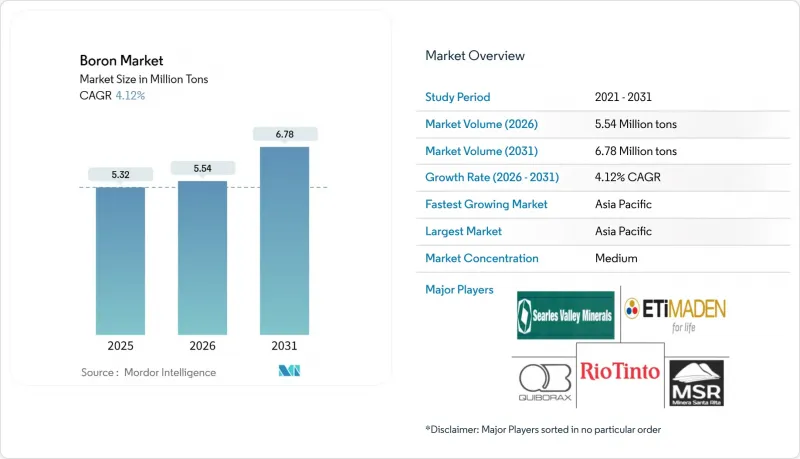
稳定的玻璃需求以及半导体、绿色储氢和先进陶瓷领域对高纯度硼化合物日益增长的需求支撑了市场扩张。以土耳其埃蒂马登为中心的供应集中度继续影响着价格,但一个新的锂硼联合生产计划正在引入替代供应。节能建筑规范、电动车的普及以及人们对农业微量元素日益增长的兴趣,共同推动了终端用途的多元化。大型矿业和化学企业以技术主导的垂直整合,是其在日益严格的环境法规下保持竞争力的关键所在。
全球硼市场趋势与洞察
扩大玻璃纤维在多个终端应用领域的应用
车辆轻量化、风力发电机叶片製造以及对高性能隔热材料日益增长的需求,正在推动对硼增强玻璃纤维的进一步需求。电动车电池外壳指定使用硼增强复合复合材料以提高热稳定性,从而支撑了需求的持续成长。领先的风电公司正在采用硼硅酸玻璃来承受循环应力,并延长离岸风力发电电场叶片的使用寿命。节能建筑规范正在加速向硼增强玻璃绒作为隔热材料的过渡。肖特公司(SCHOTT)的耐刮擦玻璃陶瓷Miradur拥有10 GPa的马氏体硬度,这标誌着高端市场对高性能的追求趋势。总而言之,玻璃纤维的日益普及,将长週期基础设施和交通运输两大趋势连结起来,巩固了硼市场。
农业中硼基微量营养素的使用量迅速增加
精密农业平台提供的土壤硼含量精确测量数据正在推动精准施肥,并创造了对纯化硼酸盐的稳定需求。试验显示,五水四硼酸钠在40週内几乎完全释放硼,优于硼砂基替代品。在开花期进行叶面喷布有助于缩小阔叶物中硼缺乏和过量之间的差距。在巴西塞拉多地区,大豆种植者正在将硼添加到均衡的微量元素配方中以提高产量。特种肥料生产商推出了促进硼运输的组合药物,可在不影响药效的前提下降低总施用量。这些改进意味着农业仍然是硼市场可持续的需求来源。
露天硼矿开采需遵守严格的环境法规
用水限制、栖息地保护区划定和温室气体排放报告标准等因素,都增加了新矿场的合规成本。生命週期评估显示,精炼硼的碳足迹高达每吨1702公斤二氧化碳当量,受到监管机构的严格审查。废弃物处理成本可能增加每吨50美元,挤压利润空间并延缓计划核准。土耳其在沙漠生态系中的矿场开采面临来自地下水抽取的特别压力。有条件的许可证通常要求缴纳巨额修復保证金,这延长了建设工期,并限制了短期内相对于需求的增长。
细分市场分析
技术级产品,即半导体製造、陶瓷微结构和特种化学品领域对纯度要求达到99.9%或更高的产品,在2025年占硼市场52.18%的份额。预计到2031年,该细分市场将以4.12%的复合年增长率成长。仅半导体掺杂剂的消耗就占技术级硼销售额的三分之一以上,这主要得益于晶圆代工厂不断扩大其碳化硅(SiC)和氮化镓(GaN)生产线。氮化硼奈米管的研究已促成航太隔热罩的试验合约。相较之下,用于标准玻璃和肥料的工业级材料因利润率下降,成长较为温和,仅为3.02%。在硼市场的技术领域,供应商与客户在污染控制方面的密切合作确保了定价权。
技术级硼生产商正利用闭合迴路回收技术从废弃物中回收硼,从而降低净现金成本并符合ESG审核。工业级硼供应商则在批量物流保持规模优势,尤其是在亚太地区的建筑玻璃工厂。儘管製程的逐步改进降低了杂质容差,但两种等级的硼之间仍然存在明显的价格差异。随着下一代晶片向3奈米及更小的製程节点发展,对超高纯度硼的需求将激增,进一步加剧不同等级硼市场之间的两极化。
硼市场报告按等级(技术级和工业级)、应用领域(玻璃、陶瓷、农业、清洁剂和清洁剂、其他应用)以及地区(亚太地区、北美、欧洲、南美、中东和非洲)进行细分。市场预测以吨为单位。
区域分析
到2025年,亚太地区将占全球出货量的52.21%,其中中国在电子产品、太阳能玻璃和建筑隔热材料领域占最大份额。该地区预计将以4.18%的复合年增长率成长,这主要得益于晶圆厂的持续扩张和基础设施投资。在印度,为提高棉花和油籽产量所做的努力正推动微量营养素进口实现两位数成长。日本和韩国虽然市场成熟,但对精密电子产品和先进陶瓷的需求仍保持稳定。
北美将成为全球第二大硼生产地区,这得归功于加州和内华达州完善的从采矿到精炼的一体化生产系统。莱奥莱特岭计划预计于2025年动工建设,届时将推出新的技术级产品,并增强供应安全。可再生能源补贴刺激了对硼硅酸太阳能罩和风力涡轮机叶片用玻璃纤维的需求,预计到2031年,其复合年增长率将达到4.02%。墨西哥的汽车和家电产业丛集将进一步推动工业级硼产品市场的需求成长。
在欧洲,汽车轻量化、风力发电零件和特殊化学品领域的需求较为平衡。严格的碳排放边境管制措施促使在地采购从西班牙和土耳其等跨地中海供应商购买硼。儘管成长率仅3.12%,但高纯度硼的增值潜力显着。南美洲(以巴西农业为主导)以及中东和非洲(以大型企划建设项目为支撑)将合计占据7.88%的硼市场份额,预计由于新的工业和基础设施投资,其增长速度将高于全球平均水平。
其他福利:
- Excel格式的市场预测(ME)表
- 3个月的分析师支持
目录
第一章 引言
- 研究假设和市场定义
- 调查范围
第二章调查方法
第三章执行摘要
第四章 市场情势
- 市场概览
- 市场驱动因素
- 扩大玻璃纤维在多个终端应用领域的应用
- 农业中硼基微量营养素的使用量迅速增加
- 对半导体和先进电子装置(掺杂、BN、BF3、BCl3)的需求不断增长
- 硼硅酸玻璃和玻璃陶瓷建筑业蓬勃发展
- 利用硼氢化物开发绿色储氢技术
- 市场限制
- 露天硼矿开采需遵守严格的环境法规
- 由于高能耗炼油过程导致的价格波动
- 硅基添加剂在玻璃和陶瓷中的潜在替代
- 价值链分析
- 波特五力模型
- 供应商的议价能力
- 消费者议价能力
- 新进入者的威胁
- 替代品的威胁
- 竞争程度
第五章 市场规模与成长预测
- 按年级
- 科技
- 工业的
- 透过使用
- 玻璃
- 陶瓷
- 农业
- 清洁剂和清洁剂
- 其他用途
- 按地区
- 亚太地区
- 中国
- 印度
- 日本
- 韩国
- 东南亚国协
- 亚太其他地区
- 北美洲
- 我们
- 加拿大
- 墨西哥
- 欧洲
- 德国
- 英国
- 法国
- 义大利
- 俄罗斯
- 北欧国家
- 其他欧洲地区
- 南美洲
- 巴西
- 阿根廷
- 其他南美洲
- 中东和非洲
- 沙乌地阿拉伯
- 南非
- 其他中东和非洲地区
- 亚太地区
第六章 竞争情势
- 市场集中度
- 策略趋势
- 市占率(%)/排名分析
- 公司简介
- 3M
- Air Liquide
- American Elements
- Boron Molecular
- Boron One Holdings
- Eti Maden
- Gujarat Boron Derivatives Pvt., Ltd.
- Ioneer
- Minera Santa Rita(MSR)
- Momentive Technologies
- Quiborax
- Resonac Holdings Corporation
- Rio Tinto
- Saint-Gobain
- SB Boron Corporation
- Searles Valley Minerals
- Stella Chemifa Corporation
第七章 市场机会与未来展望
The Boron market is expected to grow from 5.09 Million tons in 2025 to 5.29 Million tons in 2026 and is forecast to reach 6.44 Million tons by 2031 at 4.01% CAGR over 2026-2031.
Market expansion is anchored in steady glass demand and widening uptake of high-purity boron compounds in semiconductors, green-hydrogen storage, and advanced ceramics. Supply concentration around Turkey's Eti Maden continues to shape pricing, yet new lithium-boron co-production projects are introducing alternative volumes. Energy-efficient building norms, the shift to electric vehicles, and rising agricultural micronutrient awareness collectively sustain end-use diversification. Technology-driven vertical integration by leading miners and chemical producers underpins competitive resilience as environmental rules tighten.
Global Boron Market Trends and Insights
Growing Adoption of Fiberglass in Multiple End-Use Sectors
Automotive light-weighting, wind-blade fabrication, and high-performance insulation collectively pull additional volumes of boron-reinforced glass fibers. Electric-vehicle battery housings now specify boron-enhanced composites for thermal stability, supporting persistent demand growth. Wind-energy majors adopt borosilicate variants that withstand cyclic stress, extending service life of blades deployed in offshore farms. Building codes that prioritize energy savings are accelerating the shift to boron-enriched glass wool for insulation. SCHOTT's Miradur scratch-resistant glass-ceramic, posting 10 GPa Martens hardness, highlights the premium segment's focus on performance. Overall, fiberglass uptake strengthens the boron market by binding long-cycle infrastructure and mobility megatrends.
Surging Boron-Based Micronutrient Use in Agriculture
Precision-farming platforms quantify soil boron more accurately, prompting targeted application and steady demand for refined borates. Sodium tetraborate pentahydrate delivers near-complete boron release across a 40-week window, outperforming ulexite alternatives in controlled trials. Foliar sprays timed to flowering mitigate the narrow gap between deficiency and toxicity in broadleaf crops. In the Brazilian Cerrado, soybean growers integrate boron into balanced micronutrient packages to secure yield gains. Specialty fertilizer suppliers have introduced transport-stimulated formulations that lower total application rates without sacrificing efficacy. Such refinements keep agriculture an enduring offtake channel for the boron market.
Stringent Environmental Rules on Open-Pit Boron Mining
Water-use restrictions, habitat-protection zoning, and greenhouse-gas reporting standards elevate compliance costs for new mines. Life-cycle assessments place refined boron's carbon footprint at up to 1,702 kg CO2-equivalent per ton, drawing regulator scrutiny. Waste-treatment expenses can add USD 50 per ton, narrowing margins and slowing project approvals. Turkish operations in desert ecosystems face particular pressure to curtail groundwater extraction. Conditional permits often mandate costly remediation bonds, lengthening construction timelines and limiting near-term supply growth relative to demand.
Other drivers and restraints analyzed in the detailed report include:
- Rising Semiconductor and Advanced-Electronics Demand
- Construction Boom in Borosilicate and Glass-Ceramics
- Price Volatility from Energy-Intensive Refining
For complete list of drivers and restraints, kindly check the Table Of Contents.
Segment Analysis
Technical-grade volumes dominated the boron market in 2025 at 52.18% as fabs, ceramic microstructures, and specialty chemicals demanded >=99.9% purity. This slice is projected to log a 4.12% CAGR through 2031. Semiconductor dopant consumption alone underpins over one-third of technical sales as foundries ramp silicon-carbide and gallium-nitride lines. Boron nitride nanotube research is spawning pilot contracts for aerospace heat shields. By contrast, industrial-grade material-geared toward standard glass and fertilizer-faces slower 3.02% growth with tighter margins. Close supplier-customer collaboration around contamination control secures pricing power in the technical tranche of the boron market.
Technical-grade producers leverage closed-loop recycling to reclaim boron from effluents, trimming effective cash costs and aligning with ESG audits. Industrial-grade suppliers retain scale advantages in bulk logistics, particularly into construction glass plants across Asia-Pacific. Gradual process upgrades are narrowing impurity tolerances, but a clear pricing gulf between the two grades persists. As next-generation chips move to sub-3 nm nodes, demand for hyper-clean boron will intensify, reinforcing grade bifurcation within the boron market.
The Boron Market Report is Segmented by Grade (Technical and Industrial), Application (Glass, Ceramics, Agriculture, Detergent and Cleaning, and Other Applications), and Geography (Asia-Pacific, North America, Europe, South America, and Middle East and Africa). The Market Forecasts are Provided in Terms of Volume (Tons).
Geography Analysis
Asia-Pacific commanded 52.21% of 2025 shipments, with China absorbing the lion's share for electronics, solar glass, and construction insulation. Regional CAGR is forecast at 4.18%, sustained by continuous fab expansions and infrastructure investment. India's push for higher cotton and oilseed yields supports a double-digit rise in micronutrient imports. Japan and South Korea, while mature, maintain stable offtake for precision electronics and advanced ceramics.
North America ranked second in volume, supported by integrated mining and refining in California and Nevada. The Rhyolite Ridge project enters construction in 2025, promising fresh technical-grade output and bolstering supply security. Renewable-energy subsidies spur demand for borosilicate solar covers and wind-blade glass fibers, feeding a forecast 4.02% CAGR through 2031. Mexico's automotive and appliance clusters further widen industrial-grade pull within the boron market.
Europe exhibits balanced demand across automotive lightweighting, wind-energy components, and specialty chemicals. Strict carbon-border measures encourage local sourcing from Spanish and Turkish trans-Mediterranean suppliers. While growth is slower at 3.12%, value addition in high-purity segments remains notable. South America, led by Brazil's agriculture, and the Middle East and Africa, buoyed by construction megaprojects, together represent 7.88% of the boron market and are expected to grow above the global pace through new industrial and infrastructure investments.
- 3M
- Air Liquide
- American Elements
- Boron Molecular
- Boron One Holdings
- Eti Maden
- Gujarat Boron Derivatives Pvt., Ltd.
- Ioneer
- Minera Santa Rita (MSR)
- Momentive Technologies
- Quiborax
- Resonac Holdings Corporation
- Rio Tinto
- Saint-Gobain
- SB Boron Corporation
- Searles Valley Minerals
- Stella Chemifa Corporation
Additional Benefits:
- The market estimate (ME) sheet in Excel format
- 3 months of analyst support
TABLE OF CONTENTS
1 Introduction
- 1.1 Study Assumptions and Market Definition
- 1.2 Scope of the Study
2 Research Methodology
3 Executive Summary
4 Market Landscape
- 4.1 Market Overview
- 4.2 Market Drivers
- 4.2.1 Growing Adoption of Fiberglass in Multiple End-Use Sectors
- 4.2.2 Surging Boron-Based Micronutrient Use in Agriculture
- 4.2.3 Rising Semiconductor and Advanced-Electronics Demand (Doping, BN, BF3, Bcl3)
- 4.2.4 Construction Boom in Borosilicate and Glass-Ceramics
- 4.2.5 Green-Hydrogen Storage Development via Borohydrides
- 4.3 Market Restraints
- 4.3.1 Stringent Environmental Rules on Open-Pit Boron Mining
- 4.3.2 Price Volatility from Energy-Intensive Refining
- 4.3.3 Potential Substitution by Silicon-Based Additives in Glass and Ceramics
- 4.4 Value Chain Analysis
- 4.5 Porter's Five Forces
- 4.5.1 Bargaining Power of Suppliers
- 4.5.2 Bargaining Power of Consumers
- 4.5.3 Threat of New Entrants
- 4.5.4 Threat of Substitutes
- 4.5.5 Degree of Competition
5 Market Size and Growth Forecasts (Volume)
- 5.1 By Grade
- 5.1.1 Technical
- 5.1.2 Industrial
- 5.2 By Application
- 5.2.1 Glass
- 5.2.2 Ceramics
- 5.2.3 Agriculture
- 5.2.4 Detergent and Cleaning
- 5.2.5 Other Applications
- 5.3 By Geography
- 5.3.1 Asia-Pacific
- 5.3.1.1 China
- 5.3.1.2 India
- 5.3.1.3 Japan
- 5.3.1.4 South Korea
- 5.3.1.5 ASEAN Countries
- 5.3.1.6 Rest of Asia-Pacific
- 5.3.2 North America
- 5.3.2.1 United States
- 5.3.2.2 Canada
- 5.3.2.3 Mexico
- 5.3.3 Europe
- 5.3.3.1 Germany
- 5.3.3.2 United Kingdom
- 5.3.3.3 France
- 5.3.3.4 Italy
- 5.3.3.5 Russia
- 5.3.3.6 NORDIC Countries
- 5.3.3.7 Rest of Europe
- 5.3.4 South America
- 5.3.4.1 Brazil
- 5.3.4.2 Argentina
- 5.3.4.3 Rest of South America
- 5.3.5 Middle East and Africa
- 5.3.5.1 Saudi Arabia
- 5.3.5.2 South Africa
- 5.3.5.3 Rest of Middle East and Africa
- 5.3.1 Asia-Pacific
6 Competitive Landscape
- 6.1 Market Concentration
- 6.2 Strategic Moves
- 6.3 Market Share (%)/Ranking Analysis
- 6.4 Company Profiles (includes Global level Overview, Market level overview, Core Segments, Financials as available, Strategic Information, Market Rank/Share, Products and Services, Recent Developments)
- 6.4.1 3M
- 6.4.2 Air Liquide
- 6.4.3 American Elements
- 6.4.4 Boron Molecular
- 6.4.5 Boron One Holdings
- 6.4.6 Eti Maden
- 6.4.7 Gujarat Boron Derivatives Pvt., Ltd.
- 6.4.8 Ioneer
- 6.4.9 Minera Santa Rita (MSR)
- 6.4.10 Momentive Technologies
- 6.4.11 Quiborax
- 6.4.12 Resonac Holdings Corporation
- 6.4.13 Rio Tinto
- 6.4.14 Saint-Gobain
- 6.4.15 SB Boron Corporation
- 6.4.16 Searles Valley Minerals
- 6.4.17 Stella Chemifa Corporation
7 Market Opportunities and Future Outlook
- 7.1 White-space and Unmet-need Assessment

 2026 年至 2035 年硼矿物和化学品的市场机会、成长要素、产业趋势分析和预测。
 全球硼市场规模、份额、趋势和成长分析报告(2026-2034年)
 2026年全球硼市场报告科尔曼石材全球市场报告(2026年)2026年全球氮化硼涂层市场报告
 氮化硼涂层市场按类型、形态、涂层技术、应用和最终用途行业划分-2026-2032年全球预测氮化硼热膜市场依产品种类、厚度、材料等级、应用及通路划分,全球预测(2026-2032年)水性氮化硼涂料市场按类型、形态、最终用途产业、应用方法和分销管道划分-全球预测(2026-2032 年)
 硼市场规模、份额及成长分析(依产品类型、应用、最终用户及地区划分)-2026-2033年产业预测
 硼化合物市场:按产品类型、应用和地区划分