


 |
市场调查报告书
商品编码
1940640
3D列印耗材:市场占有率分析、产业趋势与统计、成长预测(2026-2031年)3D Printing Filament - Market Share Analysis, Industry Trends & Statistics, Growth Forecasts (2026 - 2031) |
||||||

※ 本网页内容可能与最新版本有所差异。详细情况请与我们联繫。
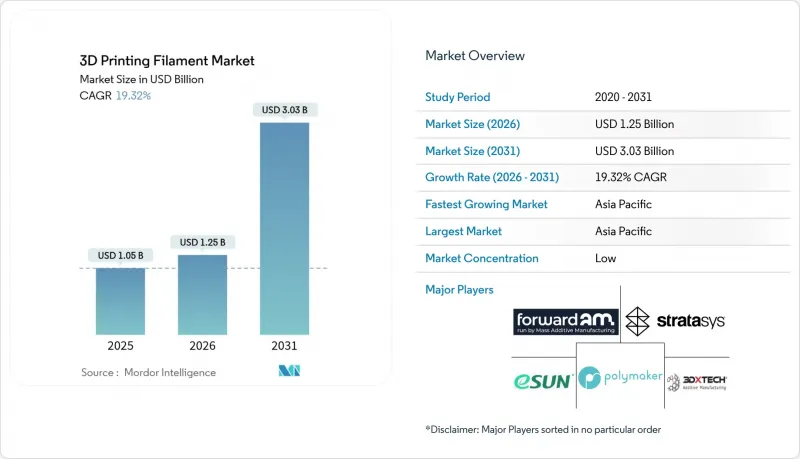
预计到 2025 年,3D 列印耗材市场价值将达到 10.5 亿美元,从 2026 年的 12.5 亿美元成长到 2031 年的 30.3 亿美元。
预计在预测期(2026-2031 年)内,复合年增长率将达到 19.32%。
桌上型印表机价格的下降,加上材料科学的稳定发展,正推动积层製造技术在航太、医疗和消费品等产业从原型製作阶段走向大规模生产阶段。中型製造商越来越多地采用熔融沈积成型 (FDM) 生产线生产终端零件,其性能可与射出成型相媲美,但模具成本更低。塑胶仍然是主要材料,种类繁多,从生物基 PLA 到工程级 PEEK,几乎可以针对所有应用场景优化成本和性能。从区域来看,亚太地区在产量方面主导,这得益于其整合了印表机组装和线材混合的紧密供应链。同时,北美和欧洲则专注于符合严格法规结构的认证高性能配方。
全球3D列印耗材市场趋势及洞察
将积层製造从原型製作转向大规模生产
随着航太和汽车製造商对用于座舱零件、引擎室支架和夹具的FDM(熔融沈积成型)零件进行认证,市场需求正转向经过认证的工程热塑性塑胶。大型製造商通常会在零件从设计实验室进入生产车间的过程中,将其线材采购量增加两倍。市场正在向那些能够保证批次间尺寸精度在±1%以内的公司扩展。采购部门现在优先考虑那些在聚合控制和ISO 13485及AS9100品管系统方面拥有成熟投资的成熟聚合物供应商,材料品质保证的重要性日益超过价格竞争力。
消费品和医疗保健领域大规模客製化的经济学
医院越来越多地采用3D列印技术製作患者客製化的钻孔导板和颅骨板,从而将手术时间缩短多达45分钟。高昂的材料成本很容易被抵销。义肢製造商报告称,在改用经认证的PEEK(聚醚醚酮)或PEKK(聚醚酮酮)长丝后,与机械加工相比,单位成本降低了40-60%。消费品牌也采用类似的小批量生产模式来製造个人化耳机和鞋垫。透过用材料溢价换取模具投资,他们得以维持毛利率。单一产品生产量固有的波动性进一步推动了灵活的积层製造工作流程,从而为能够维持材料机械性能(无论颜料或批量大小)的专业混料商创造了稳定的需求。
工业印表机和后处理需要高额资本投入。
高温聚合物的加工需要封闭式成型腔和在线连续退火工艺,系统价格超过10万美元。中小企业的预算限制减缓了高端长丝的普及,并限制了短期内的需求成长。北美以外地区设备租赁市场的不成熟,使得许多新兴市场製造商无法进入高性能材料生态系统。供应商正透过瞄准能够快速摊销资本的一级航太和医疗客户来弥补销售量成长的缓慢。
细分市场分析
2025年,塑胶在3D列印耗材市场占据71.90%的份额,预计到2031年将以21.05%的复合年增长率成长。成长主要集中在特种尼龙、碳纤维增强PETG和PEKK等等级的材料上,这些材料的模量接近铝,且可在性能更优的桌面级3D列印系统上进行列印。虽然PLA和ABS等通用材料仍供应教育机构和消费性电子产品,但工程热塑性塑胶目前已占据3D列印耗材市场塑胶收入的大部分。製造商正利用高通量双螺桿挤出机,将碳纤维、芳香聚酰胺或陶瓷填料融入材料中,以提高拉伸强度,同时避免喷嘴磨损超过硬化钢喷嘴的磨损程度。拥有闭合迴路参数资料库的材料供应商正在提高首次列印成功率,减少废弃物,并为汽车和模具用户提供极具吸引力的单件成本优势。
金属丝材市场属于小众市场,仅占3D列印耗材市场总量的不到5%,但不锈钢和钛合金丝材对于轻型航太支架和需要烧结后高密度化的医疗植入至关重要。陶瓷填充树脂适用于高温感测器和介电绝缘体,但由于需要多次脱脂循环,其生产效率受到限制。提供脱脂炉和烧结製程参数与粉末填充丝材技术捆绑销售的供应商,简化了从粉末层熔融技术过渡到3D列印的实验室的流程。这种整合方案除了材料利润外,还能带来业务收益。
区域分析
亚太地区预计2025年将贡献39.05%的收入,主要得益于深圳、苏州和首尔等地印表机和耗材产业丛集的协同发展。当地化学巨头大规模供应ABS、PLA和PETG等原料,而代工生产商则负责混合工程配方以出口。政府的经济刺激措施推动了专业积层製造产业园区的发展,降低了新参与企业的资金筹措成本,并促进了印表机硬体的创新。国内桌上型印表机领导者正在将专有材料设定檔预先载入到切片软体中,从而强化了支撑耗材消费的品牌生态系统。
北美市场专注于那些认证和可追溯性至关重要的应用领域。美国在医用级PEEK和碳纤维增强PEKK的销售中占据主导地位,这得益于供应商在FDA主文件提交和AS9100品质系统方面的大量投资。出于安全考虑,国防相关企业优先选择国内采购,这进一步保障了高端长丝的利润空间。此外,随着汽车製造商为遵守《通货膨胀与復苏法案》(IRA)的激励措施而缩短供应链,生产回流趋势也推动了需求成长。
在欧洲,环境保护是重中之重,迫使终端用户选择符合REACH和RoHS法规的生物基或再生材料。德国汽车製造商指定使用25%玻璃纤维增强的再生PET作为内饰支架材料,而法国消费品製造商正在试点使用甘蔗基PLA混合物,以满足企业排放目标。欧盟对生命週期评估(LCA)审核和材料创新的补贴,使本地供应商在研发方面拥有优势。因此,欧洲3D列印耗材市场向中高端市场倾斜,兼顾了永续性和高效能。
其他福利:
- Excel格式的市场预测(ME)表
- 3个月的分析师支持
目录
第一章 引言
- 研究假设和市场定义
- 调查范围
第二章调查方法
第三章执行摘要
第四章 市场情势
- 市场概览
- 市场驱动因素
- 将积层製造从原型製作转向大量生产
- 消费品和医疗保健领域大规模客製化的经济学
- 桌上型印表机价格的快速下降正在扩大业余爱好者市场。
- 推动永续性,采用生物基/再生PET和PLA长丝
- 人工智慧优化PEEK/PEKK航太零件的高速列印
- 市场限制
- 工业印表机和后处理的高额资本投入
- 通用PLA和ABS的机械和热学局限性
- 气候变迁影响玉米供应,导致PLA原料价格波动。
- 价值链分析
- 波特五力模型
- 供应商的议价能力
- 买方的议价能力
- 新进入者的威胁
- 替代品的威胁
- 竞争程度
第五章 市场规模与成长预测
- 按类型
- 金属
- 钛
- 不銹钢
- 其他金属
- 塑胶
- 聚对苯二甲酸乙二醇酯(PET)
- 聚乳酸(PLA)
- 丙烯腈丁二烯苯乙烯(ABS)
- 尼龙
- 其他塑料
- 陶瓷
- 其他类型
- 金属
- 透过使用
- 航太/国防
- 车
- 医疗和牙科
- 电子学
- 其他用途
- 按地区
- 亚太地区
- 中国
- 印度
- 日本
- 韩国
- 澳洲
- 马来西亚
- 泰国
- 越南
- 印尼
- 亚太其他地区
- 北美洲
- 我们
- 加拿大
- 墨西哥
- 欧洲
- 德国
- 英国
- 法国
- 义大利
- 西班牙
- 俄罗斯
- 北欧国家
- 土耳其
- 其他欧洲地区
- 南美洲
- 巴西
- 阿根廷
- 哥伦比亚
- 其他南美洲
- 中东和非洲
- 沙乌地阿拉伯
- 阿拉伯聯合大公国
- 卡达
- 南非
- 奈及利亚
- 埃及
- 其他中东和非洲地区
- 亚太地区
第六章 竞争情势
- 市场集中度
- 策略趋势
- 市占率(%)/排名分析
- 公司简介
- 3DXTECH
- Amolen
- BASF
- Braskem
- Covestro AG
- Evonik Industries AG
- Fillamentum
- Forward AM
- Village Plastics
- Markforged
- Mitsubishi Chemical Group
- NatureWorks LLC
- Polymaker
- SABIC
- Shenzhen Esun Industrial Co., Ltd.
- Solvay
- Stratasys
第七章 市场机会与未来展望
The 3D Printing Filament Market was valued at USD 1.05 billion in 2025 and estimated to grow from USD 1.25 billion in 2026 to reach USD 3.03 billion by 2031, at a CAGR of 19.32% during the forecast period (2026-2031).
Rising desktop-printer affordability, coupled with steady material-science advances, continues to pull additive manufacturing from prototyping toward scaled production settings across aerospace, healthcare, and consumer products. Momentum builds as mid-sized manufacturers deploy fused-deposition modeling (FDM) lines for end-use parts that match injection-molded performance while removing tooling costs. Plastics remain the dominant material family because suppliers now offer grades ranging from bio-based PLA to engineering-level PEEK, enabling cost-to-performance matching for virtually every use case. Regionally, Asia-Pacific commands volume leadership, supported by cohesive supply chains that integrate printer assembly with filament compounding, while North America and Europe concentrate on certified, high-performance formulations that meet stringent regulatory frameworks.
Global 3D Printing Filament Market Trends and Insights
Additive Manufacturing Shift from Prototyping to Serial Production
Demand is migrating toward certified engineering thermoplastics as aerospace and automotive producers qualify FDM (Fused Deposition Modeling) parts for cabin components, under-hood brackets, and jigs. Large manufacturers typically triple filament purchases once a part moves from design lab to production floor. Batch traceability and statistical process control have become baseline supplier requirements, opening space for companies that can guarantee +-1 % dimensional consistency lot-to-lot. Procurement teams now prioritize legacy polymer suppliers that invested in polymerization control and ISO 13485 or AS9100 quality management, underlining how material assurance eclipses price sensitivity.
Mass-customisation Economics in Consumer and Medical Sectors
Hospitals increasingly print patient-specific drill guides and cranial plates, cutting operating-room time by up to 45 minutes and absorbing premium material costs with ease. Prosthetic manufacturers report 40-60 % unit savings versus subtractive machining after switching to certified PEEK (Polyetheretherketone) or PEKK (Polyetherketoneketone) filaments. Consumer brands adopt the same small-lot logic for personalized earbuds and footwear midsoles, trading tooling investments for material premiums that leave gross margins intact. Volume volatility inherent in individualized production further incentivizes flexible additive workflows, pushing steady demand to specialized compounders that can hold mechanical properties across pigments and lot sizes.
High Cap-ex for Industrial Printers and Post-processing
Processing high-temperature polymers requires enclosed build chambers and in-line annealing that push system prices beyond USD 100,000. Budget constraints among small and mid-size enterprises delay adoption, limiting near-term pull-through for premium filaments. Equipment leasing is nascent outside North America, leaving many emerging-market manufacturers locked out of high-performance material ecosystems. Suppliers offset sluggish volume growth by targeting Tier 1 aerospace and medical customers able to amortize capital quickly.
Other drivers and restraints analyzed in the detailed report include:
- Rapid Desktop-printer Price Erosion Expanding Hobbyist Base
- Sustainability Push for Bio-based/recycled PET and PLA Filaments
- Mechanical/thermal Limits of Commodity PLA and ABS
For complete list of drivers and restraints, kindly check the Table Of Contents.
Segment Analysis
Plastics held 71.90 % of 3D Printing Filament market share in 2025 and are projected to deliver a 21.05 % CAGR to 2031. Growth concentrates in specialty nylons, carbon-fiber reinforced PETG, and PEKK grades that approach aluminum's modulus yet print on modified desktop systems. Commodity PLA and ABS continue to supply classroom and consumer gadgets, but engineering thermoplastics now command over half of plastics revenue inside the 3D printing filament market. Manufacturers leverage high-throughput twin-screw extrusion to blend carbon fibers, aramid, or ceramic fillers that raise tensile strength without introducing abrasive wear beyond hardened-steel nozzles. Material suppliers with closed-loop parameter databases improve first-time print success, trimming scrap and validating cost-per-part economics attractive to automotive and tooling users.
Metal filaments remain a niche at less than 5 % of 3D Printing Filament market size, yet stainless-steel and titanium blends are indispensable for lightweight aerospace brackets and medical implants requiring high-density after sintering. Ceramic-loaded resins address high-temperature sensors and dielectric insulators but face throughput bottlenecks due to multiple debind cycles. Vendors that bundle de-binder ovens and sintering profiles along with powder-in-filament technology simplify adoption for labs migrating from powder-bed fusion. Their integrated approach generates service revenue streams in addition to material margins.
The 3D Printing Filament Market Report is Segmented by Type (Metals, Plastics, Ceramics, and Other Types), Application (Aerospace and Defense, Automotive, Medical and Dental, Electronics, and Other Applications), and Geography (Asia-Pacific, North America, Europe, South America, and Middle East and Africa). The Market Forecasts are Provided in Terms of Value (USD).
Geography Analysis
The Asia-Pacific region generated 39.05 % of revenue in 2025, underpinned by synergistic printer-and-filament clusters in Shenzhen, Suzhou, and Seoul. Local chemical giants supply ABS, PLA, and PETG feedstocks at scale, while contract compounding houses blend engineering formulations for export. Government stimulus packages fund additive-focused industrial parks, which lower financing costs for new entrants and stimulate printer hardware innovation. Domestic desktop-printer leaders preload slicer software with proprietary material profiles, reinforcing brand ecosystems that keep filament consumption sticky.
North America emphasizes applications where certification and traceability are mandatory. The United States dominates sales of medical-grade PEEK and carbon-fiber PEKK because suppliers have invested heavily in FDA master-file submissions and AS9100 quality systems. Defense contractors favor domestic procurement for security reasons, which further insulates high-end filament margins. Demand growth also benefits from the onshoring trend as automakers shorten supply chains to meet Inflation Reduction Act incentives.
Europe champions environmental stewardship, compelling end users to select bio-based or recycled grades that meet REACH and RoHS compliance. German automotive firms specify recycled PET with 25 % glass fibers for interior brackets, while French consumer-goods makers pilot sugarcane-derived PLA blends to hit corporate emissions goals. EU grants subsidize LCA audits and material innovation, giving local suppliers an R&D edge. The 3D printing filament market size in Europe thus skews toward mid-to-premium segments where sustainability and performance blend.
- 3DXTECH
- Amolen
- BASF
- Braskem
- Covestro AG
- Evonik Industries AG
- Fillamentum
- Forward AM
- Village Plastics
- Markforged
- Mitsubishi Chemical Group
- NatureWorks LLC
- Polymaker
- SABIC
- Shenzhen Esun Industrial Co., Ltd.
- Solvay
- Stratasys
Additional Benefits:
- The market estimate (ME) sheet in Excel format
- 3 months of analyst support
TABLE OF CONTENTS
1 Introduction
- 1.1 Study Assumptions and Market Definition
- 1.2 Scope of the Study
2 Research Methodology
3 Executive Summary
4 Market Landscape
- 4.1 Market Overview
- 4.2 Market Drivers
- 4.2.1 Additive Manufacturing Shift from Prototyping to Serial Production
- 4.2.2 Mass-customisation Economics in Consumer and Medical Sectors
- 4.2.3 Rapid Desktop-printer Price Erosion Expanding Hobbyist Base
- 4.2.4 Sustainability Push for Bio-based/recycled PET and PLA Filaments
- 4.2.5 AI-optimised High-speed Printing of PEEK/PEKK Aerospace Parts
- 4.3 Market Restraints
- 4.3.1 High Cap-ex for Industrial Printers and Post-processing
- 4.3.2 Mechanical/thermal Limits of Commodity PLA and ABS
- 4.3.3 PLA feed-stock Price Swings Linked to Climate-hit Corn Supply
- 4.4 Value Chain Analysis
- 4.5 Porter's Five Forces
- 4.5.1 Bargaining Power of Suppliers
- 4.5.2 Bargaining Power of Buyers
- 4.5.3 Threat of New Entrants
- 4.5.4 Threat of Substitutes
- 4.5.5 Degree of Competition
5 Market Size and Growth Forecasts (Value)
- 5.1 By Type
- 5.1.1 Metals
- 5.1.1.1 Titanium
- 5.1.1.2 Stainless Steel
- 5.1.1.3 Other Metals
- 5.1.2 Plastics
- 5.1.2.1 Polyethylene Terephthalate (PET)
- 5.1.2.2 Polylactic Acid (PLA)
- 5.1.2.3 Acrylonitrile Butadiene Styrene (ABS)
- 5.1.2.4 Nylon
- 5.1.2.5 Other Plastics
- 5.1.3 Ceramics
- 5.1.4 Other Types
- 5.1.1 Metals
- 5.2 By Application
- 5.2.1 Aerospace and Defense
- 5.2.2 Automotive
- 5.2.3 Medical and Dental
- 5.2.4 Electronics
- 5.2.5 Other Applications
- 5.3 By Geography
- 5.3.1 Asia-Pacific
- 5.3.1.1 China
- 5.3.1.2 India
- 5.3.1.3 Japan
- 5.3.1.4 South Korea
- 5.3.1.5 Australia
- 5.3.1.6 Malaysia
- 5.3.1.7 Thailand
- 5.3.1.8 Vietnam
- 5.3.1.9 Indonesia
- 5.3.1.10 Rest of Asia-Pacific
- 5.3.2 North America
- 5.3.2.1 United States
- 5.3.2.2 Canada
- 5.3.2.3 Mexico
- 5.3.3 Europe
- 5.3.3.1 Germany
- 5.3.3.2 United Kingdom
- 5.3.3.3 France
- 5.3.3.4 Italy
- 5.3.3.5 Spain
- 5.3.3.6 Russia
- 5.3.3.7 Nordics
- 5.3.3.8 Turkey
- 5.3.3.9 Rest of Europe
- 5.3.4 South America
- 5.3.4.1 Brazil
- 5.3.4.2 Argentina
- 5.3.4.3 Colombia
- 5.3.4.4 Rest of South America
- 5.3.5 Middle East and Africa
- 5.3.5.1 Saudi Arabia
- 5.3.5.2 United Arab Emirates
- 5.3.5.3 Qatar
- 5.3.5.4 South Africa
- 5.3.5.5 Nigeria
- 5.3.5.6 Egypt
- 5.3.5.7 Rest of Middle East and Africa
- 5.3.1 Asia-Pacific
6 Competitive Landscape
- 6.1 Market Concentration
- 6.2 Strategic Moves
- 6.3 Market Share (%)/Ranking Analysis
- 6.4 Company Profiles (includes Global level Overview, Market level overview, Core Segments, Financials as available, Strategic Information, Market Rank/Share, Products and Services, Recent Developments)
- 6.4.1 3DXTECH
- 6.4.2 Amolen
- 6.4.3 BASF
- 6.4.4 Braskem
- 6.4.5 Covestro AG
- 6.4.6 Evonik Industries AG
- 6.4.7 Fillamentum
- 6.4.8 Forward AM
- 6.4.9 Village Plastics
- 6.4.10 Markforged
- 6.4.11 Mitsubishi Chemical Group
- 6.4.12 NatureWorks LLC
- 6.4.13 Polymaker
- 6.4.14 SABIC
- 6.4.15 Shenzhen Esun Industrial Co., Ltd.
- 6.4.16 Solvay
- 6.4.17 Stratasys
7 Market Opportunities and Future Outlook
- 7.1 White-space and Unmet-Need Assessment

 3D列印线材生产线市场按材料类型、直径、应用和最终用途产业划分-2026-2032年全球预测柔性3D列印耗材市场:依材料类型、颜色及最终用途产业划分-2026-2032年全球预测
 可回收3D列印耗材市场规模、份额及趋势分析报告:依产品、应用、地区及细分市场预测(2025-2033年)
 3D列印耗材市场-2025-2030年预测3D列印耗材市场:依材料类型、技术、终端用户产业、应用及通路划分-2025-2032年全球预测
 3D列印长丝市场:按类型、材料类型、应用和地区
 PVA 3D 列印长丝市场报告:2031 年趋势、预测与竞争分析
 全球 3D 列印长丝市场(按类型、最终用途产业和地区划分)- 预测至 2030 年
 可回收 3D 列印长丝市场分析及预测至 2033 年:按类型、产品、服务、技术、应用、材料类型、製程、最终用户、安装类型和解决方案全球柔性长丝3D列印材料市场:预测(2025-2030)