


 |
市场调查报告书
商品编码
1940666
超高分子量聚乙烯(UHMWPE):市占率分析、产业趋势与统计、成长预测(2026-2031)Ultra-high Molecular Weight Polyethylene - Market Share Analysis, Industry Trends & Statistics, Growth Forecasts (2026 - 2031) |
||||||

※ 本网页内容可能与最新版本有所差异。详细情况请与我们联繫。
2025 年超高分子量聚乙烯 (UHMWPE) 市值为 525.15 千吨,预计到 2031 年将达到 1,056.14 千吨,高于 2026 年的 590.01 千吨。
预测期(2026-2031 年)的复合年增长率预计为 12.35%。
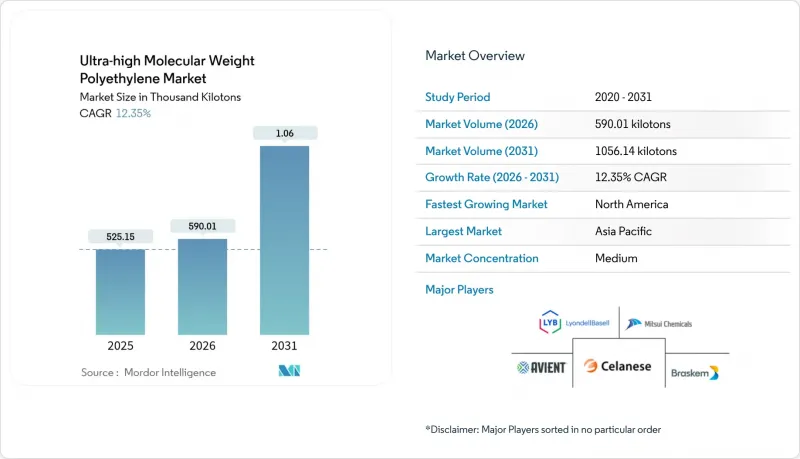
这种成长轨迹反映了其在电池隔膜、整形外科植入和海洋绳索等领域的广泛应用,在这些领域,该树脂的超长链结构、低摩擦係数和生物相容性至关重要。电气化项目的扩展、关节重建手术的增加以及深海基础设施的建设推动了市场需求。生产商在北美实现供应本地化,并在亚太地区扩张,缩短了前置作业时间,降低了物流风险,并为电池和医疗专用等级产品开闢了新的生产能力。永续性需求正促使供应商转向生物基乙烯生产路线和低温加工技术,这些技术在维持超高分子量特性的同时,也能降低能耗。
全球超高分子量聚乙烯(UHMWPE)市场趋势及洞察
电动汽车电池中高性能聚合物的替代品
电动车电池製造商正越来越多地从传统的聚烯隔膜转向超高分子量聚乙烯(UHMWPE)隔膜。 UHMWPE隔膜在140°C以上的高温下仍能维持尺寸稳定性,同时还能製造出更薄的薄膜,进而提高能量密度。 Braskem公司在德克萨斯州计划5,000万美元,获得美国能源局(DOE)的支持,将新增2万吨专用电池级UHMWPE隔膜产能,并创造250个技术职位,显示UHMWPE市场与北美电气化策略高度契合。采用缠结技术的隔膜生产线可将电解吸收率提高15%,并降低内阻,这对于长续航里程的电动车至关重要。
维生素E稳定超高分子量聚乙烯(UHMWPE)在关节重建手术的快速应用
维生素E稳定的超高分子量聚乙烯(UHMWPE)树脂具有优异的氧化稳定性,与第一代交联型树脂相比,磨损产生的碎屑减少了42%。碎屑减少意味着植入使用寿命更长,因此,对于年轻一代的髋关节和膝关节关节重建手术而言,UHMWPE树脂是首选材料。自2024年以来,FDA核准的含有此类树脂的医疗设备稳定成长,增强了临床信心,并巩固了UHMWPE市场的长期成长。
与生物基替代品相比,加工能耗强度
传统的齐格勒-纳塔製程需要约250°C的反应器温度和高压挤出,这会增加范围1的排放。布拉斯科公司以甘蔗为原料的乙烯生产路线可减少60%的碳足迹,但原料成本增加12%。欧盟买家越来越重视生物基原料,但生物质供应有限,使得规模化生产难以实现。
细分市场分析
到2025年,粉末将主导超高分子量聚乙烯(UHMWPE)市场,占总市场份额的44.63%。 100µm至150µm之间的精细粒径控制可确保用于溜槽衬里和防弹板的压模片材均匀烧结。到2031年,粉末的复合年增长率将达到12.62%,超过纤维和薄膜。这主要是由于电动车隔膜製造商对窄分子量分布的需求,而目前只有粉末生产才能满足这项需求。
该领域也受惠于触媒技术的进步,该技术可在不增加黏度的情况下将分子量提升至1000万g/mol,从而实现食品加工机械用棒材的高速挤压成型。因此,对粉末生产能力的投资正在为更广泛的超高分子量聚乙烯(UHMWPE)市场扩张奠定基础。纤维是第二种产品形式,在船舶和国防领域的需求得到保障,而片材和薄膜则正在渗透到薄壁分离器市场。棒材和管材虽然属于小众市场,但对于使用寿命超过5万小时的化学泵浦应用至关重要。
超高分子量聚乙烯 (UHMWPE) 报告按形态(粉末、纤维、片材/薄膜、棒材/管材等)、终端用户产业(汽车、航太/国防、医疗、化学、电子等)和地区(亚太地区、北美、欧洲、南美、中东和非洲)进行细分。市场预测以千吨为单位。
区域分析
预计到2025年,亚太地区将以44.55%的市占率引领超高分子量聚乙烯(UHMWPE)市场,这主要得益于该地区拥有完善的石化产业中心,能够为下游纤维和薄膜工厂提供充足的原料。中国的「一带一路」计划正在推动新港口对轻质、耐腐蚀绳索的需求成长,而日本医疗设备供应商也已签订了长期粉末采购合约。此外,中日沿海地区离岸风力发电的快速发展也进一步增加了深水繫锚碇缆绳对纤维的需求。
预计北美将维持全球最快的成长速度,到2031年复合年增长率将达到12.97%。联邦政府的激励措施正在推动三座新的膜工厂的建设,这些工厂的核心是一条专门用于生产超高分子量聚乙烯(UHMWPE)的生产线,旨在降低供应风险。布拉斯科公司在德克萨斯州的扩张计画获得了美国能源局5000万美元的津贴支持,这标誌着製造业回流的势头强劲,并凸显了UHMWPE市场在电池价值链中的战略价值。
在以永续性为导向的 PFAS 替代和积极的循环经济目标的推动下,欧洲保持着温和的个位数成长。德国的一个试点计画展示了医用衬垫的闭合迴路回收利用,推进了该地区的回收理念。南美洲和中东及非洲是新兴但具有重要战略意义的市场,巴西盐盐层下油田钻井平台和沙乌地阿拉伯的石化多元化发展为超高分子量聚乙烯 (UHMWPE) 开闢了独特的应用领域,并逐步提高了其在该地区市场的渗透率。
其他福利:
- Excel格式的市场预测(ME)表
- 3个月的分析师支持
目录
第一章 引言
- 研究假设和市场定义
- 调查范围
第二章调查方法
第三章执行摘要
第四章 市场情势
- 市场概览
- 市场驱动因素
- 电动汽车电池中高性能聚合物的替代趋势
- 快速采用维生素E高分子量聚乙烯进行关节重建手术(2025年及以后)
- 亚太地区对造船和船用绳索的需求快速成长
- 3D列印超高分子量聚乙烯整形外科植入
- 实现医疗级循环利用的回收途径
- 市场限制
- 与生物基替代品相比,加工能耗强度
- 低熔点是承载复合材料的限制因素。
- 对亚洲粉末出口征收贸易救济税
- 价值链分析
- 波特五力模型
- 新进入者的威胁
- 买方的议价能力
- 供应商的议价能力
- 替代品的威胁
- 竞争程度
第五章 市场规模与成长预测
- 按形式
- 粉末
- 纤维
- 片材和薄膜
- 桿和管
- 其他的
- 按最终用户行业划分
- 车
- 航太/国防
- 医疗保健
- 化学
- 电子设备
- 其他的
- 按地区
- 亚太地区
- 中国
- 日本
- 印度
- 韩国
- 亚太其他地区
- 北美洲
- 我们
- 加拿大
- 墨西哥
- 欧洲
- 德国
- 英国
- 法国
- 义大利
- 其他欧洲地区
- 南美洲
- 巴西
- 阿根廷
- 南美洲其他地区
- 中东和非洲
- 沙乌地阿拉伯
- 南非
- 其他中东和非洲地区
- 亚太地区
第六章 竞争情势
- 市场集中度
- 策略趋势
- 市占率(%)/排名分析
- 公司简介
- Asahi Kasei Corporation
- Avient Corporation
- Braskem
- Celanese Corporation
- dsm-firmenich
- DuPont
- Honeywell International Inc.
- Korea Petrochemical Ind. Co., LTD.
- LyondellBasell Industries Holdings BV
- Mitsui Chemicals Inc.
- Rochling SE & Co. KG
- Shandong Longforce Engineering Material Co., Ltd
- TEIJIN LIMITED
第七章 市场机会与未来展望
The Ultra-high Molecular Weight Polyethylene Market was valued at 525.15 kilotons in 2025 and estimated to grow from 590.01 kilotons in 2026 to reach 1056.14 kilotons by 2031, at a CAGR of 12.35% during the forecast period (2026-2031).
This trajectory reflects broad adoption in battery separators, orthopedic implants, and marine ropes, where the resin's distinct combination of very long chains, low friction, and biocompatibility is indispensable. Widening electrification programs, accelerated joint-replacement procedures, and deep-water infrastructure all reinforce demand. Producers' moves to localize supply in North America and expand in Asia-Pacific shorten lead-times, mitigate logistics risk, and unlock new capacity for grades tailored to battery and medical specifications. Sustainability mandates are pushing suppliers toward bio-based ethylene routes and lower-temperature processing technologies that cut energy intensity while preserving ultra-high molecular weight attributes.
Global Ultra-high Molecular Weight Polyethylene Market Trends and Insights
High-performance Polymer Substitution in EV Batteries
Electric-vehicle cell makers are switching from conventional polyolefins to UHMWPE separators because the latter remain dimensionally stable above 140 °C while allowing thinner films that raise energy density. Braskem's USD 50 million DOE-backed project in Texas will add 20 kilo tons of dedicated battery-grade capacity and create 250 skilled jobs, underscoring the Ultra-high Molecular Weight Polyethylene market's alignment with North American electrification policy. Separator lines adopting disentangled-chain technology improve electrolyte uptake by 15% and cut internal resistance, attributes critical for longer-range vehicles.
Rapid Adoption of Vitamin-E HXLPE in Joint Arthroplasty
Vitamin E-stabilized UHMWPE resins exhibit superior oxidative stability, reducing wear debris generation by 42% versus first-generation cross-linked grades. Lower debris translates into longer implant lifespans, a priority as younger patients undergo hip and knee replacements. FDA approvals for devices containing these resins have risen steadily since 2024, reinforcing clinical confidence and locking in long-term growth for the Ultra-high Molecular Weight Polyethylene market.
Processing Energy Intensity Vs. Bio-Based Alternatives
Traditional Ziegler-Natta pathways demand reactor temperatures near 250 °C and high-pressure extrusion, inflating Scope-1 emissions. Braskem's sugarcane-derived ethylene route offers a 60% lower carbon footprint but raises feedstock costs by 12%. EU buyers increasingly favor bio-attributed volumes, yet limited biomass availability restrains scale.
Other drivers and restraints analyzed in the detailed report include:
- Surge in APAC Shipbuilding and Offshore Ropes Demand
- 3-D Printed UHMWPE Orthopedic Implants
- Low Melting Point Limits High-Load Composites
For complete list of drivers and restraints, kindly check the Table Of Contents.
Segment Analysis
Powder accounted for 44.63% of the 2025 volume, making it the backbone of the Ultra-high Molecular Weight Polyethylene market. Tailored particle sizes between 100 µm and 150 µm ensure uniform sintering in compression-molded sheets used for chute liners and ballistic plates. Powder's 12.62% CAGR to 2031 outpaces fiber and film because EV separator producers prefer a tight molecular weight distribution that only powder routes currently guarantee.
The segment also benefits from catalyst advances that push molecular weight to 10 million g/mol without raising viscosity, enabling higher-speed ram-extrusion of rods for food-processing machinery. Investments in powder capacity, therefore, underpin broader Ultra-high Molecular Weight Polyethylene market expansion. Fibers, the second-largest form, secure marine and defense demand, while sheets and films penetrate thin-wall separators. Rods and tubes remain niche but critical for chemical pumps where wear life eclipses 50,000 hours.
The Ultra-High Molecular Weight Polyethylene Report is Segmented by Form (Powder, Fibers, Sheets and Films, Rods and Tubes, and Others), End-User Industry (Automotive, Aerospace and Defense, Medical, Chemical, Electronics, and Others), and Geography (Asia-Pacific, North America, Europe, South America, and Middle-East and Africa). The Market Forecasts are Provided in Terms of Volume (Kilo Tons).
Geography Analysis
Asia-Pacific dominated the Ultra-high Molecular Weight Polyethylene market with a 44.55% share in 2025, leveraging integrated petrochemical hubs that feed downstream fiber and film plants. China's Belt and Road projects intensify demand for lightweight, corrosion-proof ropes in new ports, while Japan's medical-device suppliers secure long-term powder contracts. Regional offshore wind build-out along Chinese and Japanese coasts further multiplies fiber consumption for deep-water mooring lines.
North America is on track for a 12.97% CAGR up to 2031, the fastest globally. Federal incentives are catalyzing three new separator-film plants, each structured around captive UHMWPE lines to de-risk supply. Braskem's Texas expansion, supported by a USD 50 million DOE grant, illustrates domestic re-shoring momentum and underscores the Ultra-high Molecular Weight Polyethylene market's strategic value in battery supply chains.
Europe maintains mid-single-digit growth through sustainability-driven substitution of PFAS and aggressive circular-economy goals. Pilots in Germany demonstrate closed-loop reclaim of medical liners, aligning with the continent's recycling ethos. South America and MEA remain emerging but strategically significant, with Brazil's pre-salt rigs and Saudi petrochemical diversification opening localized applications that will gradually raise regional Ultra-high Molecular Weight Polyethylene market penetration.
- Asahi Kasei Corporation
- Avient Corporation
- Braskem
- Celanese Corporation
- dsm-firmenich
- DuPont
- Honeywell International Inc.
- Korea Petrochemical Ind. Co., LTD.
- LyondellBasell Industries Holdings B.V.
- Mitsui Chemicals Inc.
- Rochling SE & Co. KG
- Shandong Longforce Engineering Material Co., Ltd
- TEIJIN LIMITED
Additional Benefits:
- The market estimate (ME) sheet in Excel format
- 3 months of analyst support
TABLE OF CONTENTS
1 Introduction
- 1.1 Study Assumptions and Market Definition
- 1.2 Scope of the Study
2 Research Methodology
3 Executive Summary
4 Market Landscape
- 4.1 Market Overview
- 4.2 Market Drivers
- 4.2.1 High?Performance Polymer Substitution in EV Batteries
- 4.2.2 Rapid Adoption of Vitamin E HXLPE In Joint Arthroplasty (Post-2025)
- 4.2.3 Surge in APAC Shipbuilding and Offshore Ropes Demand
- 4.2.4 3-D Printed UHMWPE Orthopedic Implants
- 4.2.5 Recycling Routes Enabling Medical-Grade Circularity
- 4.3 Market Restraints
- 4.3.1 Processing Energy Intensity Vs. Bio-Based Alternatives
- 4.3.2 Low Melting Point Limits High-Load Composites
- 4.3.3 Trade-Remedy Duties on Asian Powder Exports
- 4.4 Value Chain Analysis
- 4.5 Porter's Five Forces
- 4.5.1 Threat of New Entrants
- 4.5.2 Bargaining Power of Buyers
- 4.5.3 Bargaining Power of Suppliers
- 4.5.4 Threat of Substitute Products
- 4.5.5 Degree of Competition
5 Market Size and Growth Forecasts (Volume)
- 5.1 By Form
- 5.1.1 Powder
- 5.1.2 Fibers
- 5.1.3 Sheets and Films
- 5.1.4 Rods and Tubes
- 5.1.5 Others
- 5.2 By End-user Industry
- 5.2.1 Automotive
- 5.2.2 Aerospace and Defense
- 5.2.3 Medical
- 5.2.4 Chemical
- 5.2.5 Electronics
- 5.2.6 Others
- 5.3 By Geography
- 5.3.1 Asia-Pacific
- 5.3.1.1 China
- 5.3.1.2 Japan
- 5.3.1.3 India
- 5.3.1.4 South Korea
- 5.3.1.5 Rest of Asia-Pacific
- 5.3.2 North America
- 5.3.2.1 United States
- 5.3.2.2 Canada
- 5.3.2.3 Mexico
- 5.3.3 Europe
- 5.3.3.1 Germany
- 5.3.3.2 United Kingdom
- 5.3.3.3 France
- 5.3.3.4 Italy
- 5.3.3.5 Rest of Europe
- 5.3.4 South America
- 5.3.4.1 Brazil
- 5.3.4.2 Argentina
- 5.3.4.3 Rest of South America
- 5.3.5 Middle-East and Africa
- 5.3.5.1 Saudi Arabia
- 5.3.5.2 South Africa
- 5.3.5.3 Rest of Middle-East and Africa
- 5.3.1 Asia-Pacific
6 Competitive Landscape
- 6.1 Market Concentration
- 6.2 Strategic Moves
- 6.3 Market Share (%)/Ranking Analysis
- 6.4 Company Profiles (includes Global level Overview, Market level overview, Core Segments, Financials as available, Strategic Information, Market Rank/Share for key companies, Products and Services, and Recent Developments)
- 6.4.1 Asahi Kasei Corporation
- 6.4.2 Avient Corporation
- 6.4.3 Braskem
- 6.4.4 Celanese Corporation
- 6.4.5 dsm-firmenich
- 6.4.6 DuPont
- 6.4.7 Honeywell International Inc.
- 6.4.8 Korea Petrochemical Ind. Co., LTD.
- 6.4.9 LyondellBasell Industries Holdings B.V.
- 6.4.10 Mitsui Chemicals Inc.
- 6.4.11 Rochling SE & Co. KG
- 6.4.12 Shandong Longforce Engineering Material Co., Ltd
- 6.4.13 TEIJIN LIMITED
7 Market Opportunities and Future Outlook
- 7.1 White-space and Unmet-need Assessment

 超高分子量聚乙烯市场:依产品、等级、製程、功能、终端用户产业及通路划分-2026-2032年全球市场预测全球抗静电超高分子量聚乙烯(UHMWPE)板材市场:按类型、厚度范围、抗静电等级、应用和终端用户产业划分,2026-2032年预测
 超高分子量聚乙烯市场规模、份额及成长分析(按类型、应用、终端用户产业及地区划分)-2026-2033年产业预测
 医用超高分子量聚乙烯:全球市占率及排名、总收入及需求预测(2025-2031年)
 超高分子量聚乙烯 (UHMWPE) 市场预测(至 2032 年):以基础材料、形式、等级、最终用户和地区进行的全球分析
 全球医用超高分子量聚乙烯单体市场全球超高分子量(UHMW)聚乙烯市场
 全球医用超高分子量聚乙烯市场规模(依产品类型、应用、最终用户、区域范围、预测)
 超高分子量聚乙烯板材市场报告:趋势、预测和竞争分析(至 2031 年)
 超高分子量聚乙烯纤维市场规模、份额、趋势分析报告:按应用、地区、细分市场、预测,2025-2030 年