


 |
市场调查报告书
商品编码
1940682
车载充电器:市场份额分析、行业趋势和统计数据、成长预测(2026-2031 年)Automotive On-board Charger - Market Share Analysis, Industry Trends & Statistics, Growth Forecasts (2026 - 2031) |
||||||

※ 本网页内容可能与最新版本有所差异。详细情况请与我们联繫。
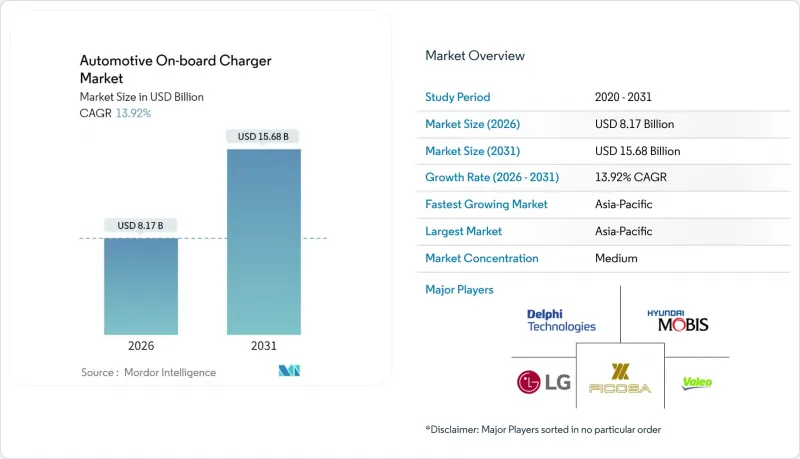
预计汽车车载充电器市场将从 2025 年的 71.7 亿美元成长到 2026 年的 81.7 亿美元,到 2031 年将达到 156.8 亿美元,2026 年至 2031 年的复合年增长率为 13.92%。
主要经济体电动车强制令的激增、向800V汽车平臺的快速转型以及宽能带隙半导体价格的持续下降,共同推动了规范升级週期,并提升了对高功率充电解决方案的整体需求。在欧洲和部分亚洲市场,汽车製造商正将11-22kW的充电单元作为标准配置,以充分利用三相住宅电网的优势。北美原始设备製造商(OEM)优先考虑本土充电器生产和ISO 15118合规性,在成本敏感度和联邦奖励之间寻求平衡。随着一级供应商与绕过传统价值链、追求牵引整合架构的纯半导体公司争夺市场份额,竞争日益激烈。同时,政策制定者正在收紧铝製机壳的安全性和可回收性法规,这增加了设计变更的需求,并为供应商扩大了商机。预计这些结构性因素将在未来十年内支撑车载充电器市场持续两位数的成长。
全球车用充电器市场趋势及洞察
积极的全球电动车渗透目标和购车奖励
各国零排放法规和购车补贴正在推动车载充电器基本规格的提升,因为汽车製造商竞相提案具有竞争力的总拥有成本 (TCO)。中国2025年新能源汽车销售目标、欧盟2030年所有车辆二氧化碳排放减半的要求以及加州「先进清洁汽车II」计划,都在加速标配11kW或22kW交流充电功能的车型上市。韩国的目标是在本十年末大幅提高电动车的普及率,现代摩比斯计划从本十年后半期开始扩大整合充电控制单元 (ICCU) 的生产。此举凸显了该地区需求的快速成长,并有助于降低碳化硅 (SiC) 装置的价格。同时,补贴计画也越来越多地提供家用充电桩代金券。这不仅缩短了消费者投资购买高功率壁挂式充电桩的投资回收期,也证明了汽车製造商投资于车载充电器双向功率传输和ISO 15118认证等先进功能的合理性。
快速过渡到800V车载系统,可实现11-22kW车载充电器
向 800V 电气系统的过渡重新定义了成本绩效的界限,它能够在不增加铜材用量或热负荷的情况下实现高功率密度。现代的 E-GMP 和通用的 Ultium 可快速充电,其 22kW 的交流充电容量与住宅能源套利完美互补。 FORVIA HELLA 等供应商正在将英飞凌的 CoolSiC 模组整合机壳,以实现最高效率并将冷却板面积减少三分之一,从而释放引擎室空间用于辅助电子设备。早期采用者利用充电时间的缩短来获取溢价,并在将奖励合格与最低充电性能标准挂钩的市场中获得宝贵的合规积分。随着一级供应商对 800V 相容设计进行预先认证,二级采用者面临着更短的设计时间,从而推动了对承包参考平台的需求。这种协同效应正在推动基础级功率等级的提高,并将车载充电器市场扩展到传统的 3.3-7.4kW 范围之外。
22kW三相车载充电器中宽能带隙基板持续高成本
儘管晶圆代工厂扩张创下纪录,但碳化硅晶锭产量比率仍低于五分之三,氮化镓外延片前置作业时间超过30晶粒,基板成本仍居高不下。车规级650V碳化硅MOSFET晶片的价格仍比平面硅IGBT高出三到四分之三,这使得高功率三相设计仅限于高阶品牌和商用车领域。散热器和电磁干扰屏蔽进一步增加了系统材料成本,部分抵消了宽能带隙带来的密度优势。在成本敏感的C级跨界车市场,每瓦0.02美元的价格差异就意味着组件成本增加约45美元,这挤压了价格弹性较大市场的零售利润。因此,原始设备製造商(OEM)推迟了在欧洲以外地区推出22kW可选充电线的计划,直到成本下降,这暂时限制了下一代充电器在车载充电市场的渗透率。
细分市场分析
从 2025 年到 2031 年,商用车的复合年增长率最高,达 14.05%,而乘用车在 2025 年占车用充电器市场规模的 65.82%。由于以仓库为中心的运作週期强调最大限度地减少待机时间,物流运营商正在指定使用 22kW 双向充电器,以最大限度地提高夜间能源处理能力并参与公用事业需量反应计划。
由于潜在车牌基数较大,乘用车仍将支撑其绝对出货量,但随着平台通用限制了期权价格的弹性,其单价贡献将会下降。安全法规、网路安全要求和可回收性规则的趋同将增加车队专用解决方案的非经常性工程成本,从而为专业供应商提供利润空间。车队也率先使用增值分析功能,例如充电器利用率仪錶板和预防性维护警报,这使得整合式车载充电器解决方案的获利模式更加多元化。因此,儘管不同车型的发展趋势将塑造不同的成长轨迹,但总体而言,车载充电器市场将保持两位数的收入成长。
截至2025年,纯电动车(BEV)将占车用充电器市场76.18%的份额,并将在2031年之前维持14.02%的复合年增长率。纯电动滑板式架构释放了后轴上方的空间,从而可以安装集中式电力电子设备舱,车载充电器(OBC)、牵引逆变器和直流-直流转换器共用一个标准冷却迴路。由于底置式燃料箱的限制,这种布局能够实现插电式混合动力汽车(PHEV)布局无法复製的成本节约型协同工作。
儘管插电式混合动力汽车持续满足监管和区域市场的小众需求,但由于成本和重量控制,双燃料系统的复杂性限制了车载充电器(OBC)的额定功率,使其仅为7.4kW左右。中国和欧洲的监管积分制度正在逐步降低插电式混合动力汽车(PHEV)的奖励倍数,从而削弱了高端充电功能的商业价值。供应商优先考虑为纯电动车(BEV)车队客韧体,以实现动态相位切换和谐波抑制,同时保持插电式混合动力车的设计基本上衍生BEV的设计。预计到2029年,纯电动车将占西欧新车註册量的一半,供应商预测,纯电动车专用车用充电器将占总收入的85%以上,这巩固了车载充电器市场的长期成长前景。
区域分析
亚太地区将引领车用充电器市场,到2025年将占据37.35%的市场份额,并将继续保持领先地位,到2031年将以14.07%的复合年增长率增长,这主要得益于中国GB38031-2025电池安全标准和创纪录的电动车推广政策。截至2023年底,中国当地已安装数百万个公共和私人充电桩。这项里程碑式的成就不仅树立了充电密度标准,也使得在高层公寓大楼等共用三相立管的场所实现家庭充电成为可能。为完成铝製机壳回收配额,中国工业和资讯化部正在推进材料替代倡议。
欧洲作为全球第二大市场,持续保持强劲成长动能。这一增长势头主要得益于《汽车基础设施法规》(AFIR) 的实施,该法规强制要求充电桩符合 ISO 15118 标准,并规定了跨欧洲交通网络沿线充电站的密度。德国和法国正在将核能和可再生能源併入电网,以稳定其碳排放强度。这种整合使得电力公司能够利用中高容量充电桩的车网互动 (V2G) 功能,提供动态费率方案。
北美地区受惠于《通膨控制法案》下的先进製造业税额扣抵。此外,由东北电动车倡议(NEVI)资助的走廊开发案也有助于加强该地区的基础设施。然而,除高端品牌外,大容量充电桩的普及率仍然有限,这主要是由于单相住宅供电的限制。为此,汽车製造商推出了高功率的双相充电桩,但市场渗透率仍然不高。
其他福利:
- Excel格式的市场预测(ME)表
- 分析师支持(3个月)
目录
第一章 引言
- 研究假设和市场定义
- 调查范围
第二章调查方法
第三章执行摘要
第四章 市场情势
- 市场概览
- 市场驱动因素
- 积极的全球电动车普及目标和购车激励措施
- 快速迁移至 800V 汽车架构,实现 11-22kW 车用电脑
- 由于SIC/GAN装置价格下降,OBC功率密度不断提高。
- 欧盟和美国资金筹措计画中强制性的 ISO 15118/即插即用和 V2G 条款
- 一级供应商/OEM过渡到牵引整合式双向3合1电力驱动桥(OBC)
- 新兴市场太阳能光电系统整合商通路:屋顶太阳能光电发电+相容车载电池的电动车套餐捆绑销售
- 市场限制
- 22kW三相OBC中宽能带隙基板持续高成本
- 随着直流超快充电器(功率超过350kW)的普及,汽车零件製造商不愿改进交流充电器的规格。
- 高密度城市中住宅11kW扩容的併网瓶颈。
- 中国废料回收法规即将对大型OBC铝製外壳课税。
- 价值/供应链分析
- 监管环境
- 技术展望
- 波特五力模型
- 新进入者的威胁
- 买方和消费者的议价能力
- 供应商的议价能力
- 替代品的威胁
- 竞争对手之间的竞争
第五章 市场规模及成长预测(价值(美元)及销售量(单位))
- 按车辆类型
- 搭乘用车
- 商用车辆
- 依动力传动系统类型
- 电池式电动车(BEV)
- 插电式混合动力电动车(PHEV)
- 额定功率
- 小于 3.3 千瓦
- 3.3~11 kW
- 11千瓦或以上
- 按销售管道
- 原厂配套设备
- 售后市场
- 按地区
- 北美洲
- 我们
- 加拿大
- 墨西哥
- 南美洲
- 巴西
- 阿根廷
- 其他南美洲
- 欧洲
- 德国
- 英国
- 法国
- 义大利
- 俄罗斯
- 其他欧洲地区
- 亚太地区
- 中国
- 日本
- 印度
- 韩国
- 亚太其他地区
- 中东和非洲
- 沙乌地阿拉伯
- 阿拉伯聯合大公国
- 土耳其
- 南非
- 埃及
- 奈及利亚
- 其他中东和非洲地区
- 北美洲
第六章 竞争情势
- 市场集中度
- 策略趋势
- 市占率分析
- 公司简介
- BorgWarner Inc.
- Hyundai Mobis
- LG Electronics
- STMicroelectronics
- Ficosa International SA
- Valeo SE
- Delta Energy Systems AG
- Toyota Industries Corp.
- Brusa Elektronik AG
- VisIC Technologies
- Infineon Technologies AG
- Eaton Corp.
- DENSO Corp.
- Panasonic Industry
- TDK Corp.
- Onsemi
- Stercom Power Solutions
- Delta-Q Technologies
第七章 市场机会与未来展望
The Automotive On-board Charger Market is expected to grow from USD 7.17 billion in 2025 to USD 8.17 billion in 2026 and is forecast to reach USD 15.68 billion by 2031 at 13.92% CAGR over 2026-2031.
Surging electric-vehicle adoption mandates across major economies, the rapid migration to 800 V vehicle platforms, and steady declines in wide-band-gap semiconductor pricing collectively reinforce a cycle of specification upgrades that lift overall demand for higher-power charging solutions. Automakers leverage three-phase residential grids in Europe and selected Asian markets to standardize 11-22 kW units. North American OEMs balance cost sensitivities against federal incentives, prioritizing domestic charger production and ISO 15118 compliance. Competitive momentum intensifies as tier-1 suppliers defend share against semiconductor specialists that bypass traditional value chains to pursue traction-combined architectures. At the same time, policymakers tighten safety and recyclability rules on aluminum housings, creating incremental redesign requirements that expand supplier addressable revenue. Together, these structural forces sustain double-digit growth for the Automotive on-board charger market through the decade.
Global Automotive On-board Charger Market Trends and Insights
Aggressive Global EV Adoption Targets & Purchase Incentives
National zero-emission mandates and purchase subsidies elevate the baseline specification of on-board chargers as OEMs race to deliver compelling total-cost-of-ownership propositions. China's new-energy vehicle sales goal for 2025, the European Union's half of fleet-wide CO2-reduction requirement for 2030, and California's Advanced Clean Cars II program together accelerate model launches that embed 11 kW or 22 kW AC capability as standard equipment . With South Korea aiming for a significant increase in EV adoption by the end of the decade, Hyundai Mobis is set to ramp up production of integrated charging control units (ICCU) starting in the latter half of the decade. This move underscores a regional demand surge, contributing to a price drop for SiC devices. Meanwhile, subsidy frameworks are increasingly offering home-charging vouchers. This tactic not only shortens the payback period for consumers investing in higher-power wallboxes but also validates OEMs' investments in advanced features like bi-directional energy flow and ISO 15118 authentication for on-board chargers.
Rapid Switch To 800 V Vehicle Architectures Enabling 11-22 kW OBCs
The migration toward 800 V electrical systems reshapes cost-performance frontiers by enabling higher power densities without proportional increases in copper mass or thermal overhead. Hyundai's E-GMP and GM's Ultium demonstrate quick charging scenarios, making 22 kW AC capability a natural complement for residential energy arbitrage . Suppliers such as FORVIA HELLA integrate Infineon CoolSiC modules into compact housings, achieving maximum efficiency and reducing cooling plate area by one-third, freeing under-hood volume for auxiliary electronics. Early adopters leverage reduced charge times to command pricing premiums and secure valuable compliance credits in markets that tie incentive eligibility to minimum charging performance thresholds. As tier-1s pre-qualify 800 V-ready designs, secondary adopters face compressed design windows, intensifying the demand for turnkey reference platforms. The net effect elevates base-grade power ratings and scales the Automotive on-board charger market beyond its historical 3.3-7.4 kW spine.
Persistently High Wide-Band-Gap Substrate Costs in 22 kW Three-Phase OBCs
Despite record foundry expansions, SiC boule yields under three-fifths and GaN epi-wafer lead times surpassing 30 weeks prolong elevated substrate economics. Automotive-grade 650 V SiC MOSFET die still commands a 3-4 times premium over planar silicon IGBTs, limiting high-power three-phase designs to premium badges and commercial fleets. Heat-spreading plates and EMI shielding further inflate system material costs, offsetting some of the density gains from wide-band-gap adoption. For value-oriented C-segment crossovers, each USD 0.02 / W price delta translates to roughly USD 45 in incremental BOM, pressuring retail margins in price-elastic markets. OEMs thus defer 22 kW option codes outside Europe until cost curves decline, creating a temporary ceiling on the penetration rate of next-gen chargers in the Automotive on-board charger market.
Other drivers and restraints analyzed in the detailed report include:
- Declining SiC/GaN Device Prices Lifting OBC Power Density
- Mandatory ISO 15118 / Plug-and-Charge & V2G Readiness Clauses
- OEM Hesitancy To Up-Spec AC Chargers As DC Ultra-Fast Networks Accelerate
For complete list of drivers and restraints, kindly check the Table Of Contents.
Segment Analysis
Commercial vehicles contributed the fastest 14.05% CAGR during 2025-2031, even though passenger cars controlled 65.82% of the Automotive on-board charger market size in 2025. Depot-centric duty cycles reward fleets that minimize dwell times; thus, logistics operators specify 22 kW bi-directional chargers to maximize overnight energy throughput and participate in utility demand-response.
Passenger cars will continue to anchor absolute shipments because of larger addressable license-plate bases, yet their unit-value contribution tapers as platform commonization curbs option-pricing latitude. The convergence of safety regulations, cybersecurity mandates, and recyclability rules amplifies non-recurring engineering outlays for fleet-specific solutions, giving specialized suppliers a margin buffer. Fleets also pioneer value-added analytics such as charger-utilization dashboards and preventive-maintenance alerts that monetarily differentiate integrated OBC offerings. Consequently, vehicle-type dynamics shape divergent growth trajectories but collectively keep the broader Automotive on-board charger market on a double-digit revenue track.
Battery electric vehicles captured 76.18% of the Automotive on-board charger market share in 2025 and maintain the lead with a 14.02% CAGR through 2031. Pure-electric skateboard architectures free volume above the rear axle, enabling centralized power-electronics bays where OBCs, traction inverters, and DC-DC stages share a standard coolant loop. Due to under-floor fuel-tank constraints, this packaging unlocks cost collaborations that PHEV layouts cannot replicate.
Plug-in hybrids continue to serve compliance and rural-market niches, but their dual-fuel complexity caps OBC ratings near 7.4 kW to manage cost and mass. Regulatory credit systems in China and Europe progressively lower bonus multipliers for PHEVs, tightening the business case for premium charging upgrades. Suppliers prioritize firmware customization for BEV fleets-enabling dynamic phase switching and harmonic mitigation-while keeping PHEV designs largely derivative. As BEVs cross half of new-car registrations in Western Europe by 2029, suppliers expect BEV-dedicated OBCs to represent more than 85% of total revenue, solidifying long-term growth prospects for the Automotive on-board charger market.
The Automotive On-Board Charger Market Report is Segmented by Vehicle Type (Passenger Cars and Commercial Vehicles), Powertrain Type (Battery Electric Vehicles and Plug-In Hybrid Electric Vehicles), Power Rating (Less Than 3. 3 KW, 3. 3-11 KW, and More Than 11 KW), Sales Channel (OEM-Installed and Aftermarket), and Geography. The Market Forecasts are Provided in Terms of Value (USD) and Volume (Units).
Geography Analysis
Asia-Pacific led with 37.35% share of the Automotive on-board charger market size in 2025 and continues to outpace peers at a 14.07% CAGR through 2031, buoyed by China's GB38031-2025 battery-safety mandate and record EV adoption incentives. By the close of 2023, mainland installations boasted millions of public and private charging units. This milestone set density thresholds, making home charging feasible for high-rise apartments with shared three-phase risers. In a move to address recycling quotas on aluminum housings, the Chinese Ministry of Industry and Information Technology spurred material-substitution initiatives.
Europe, holding the second spot, continues to witness vigorous growth. This momentum is primarily fueled by AFIR's mandates on ISO 15118 compatibility and the requisite density of charging stations along the Trans-European Transport Network. Germany and France are weaving nuclear and renewable energy into their grids to stabilize grid-carbon intensity. This integration empowers utilities to roll out dynamic tariff products, capitalizing on the vehicle-to-grid capabilities of mid-to-high capacity chargers.
North America is reaping the benefits of the Inflation Reduction Act's advanced-manufacturing tax credits. Additionally, NEVI-funded corridor developments are bolstering the region's infrastructure. However, the adoption of higher-capacity chargers remains limited outside luxury brands, primarily due to the constraints of single-phase residential services. In response, OEMs offer dual chargers with higher output capacities, though market penetration is still modest.
- BorgWarner Inc.
- Hyundai Mobis
- LG Electronics
- STMicroelectronics
- Ficosa International S.A.
- Valeo SE
- Delta Energy Systems AG
- Toyota Industries Corp.
- Brusa Elektronik AG
- VisIC Technologies
- Infineon Technologies AG
- Eaton Corp.
- DENSO Corp.
- Panasonic Industry
- TDK Corp.
- Onsemi
- Stercom Power Solutions
- Delta-Q Technologies
Additional Benefits:
- The market estimate (ME) sheet in Excel format
- 3 months of analyst support
TABLE OF CONTENTS
1 Introduction
- 1.1 Study Assumptions & Market Definition
- 1.2 Scope of the Study
2 Research Methodology
3 Executive Summary
4 Market Landscape
- 4.1 Market Overview
- 4.2 Market Drivers
- 4.2.1 Aggressive Global EV Adoption Targets & Purchase Incentives
- 4.2.2 Rapid Switch To 800 V Vehicle Architectures Enabling 11-22 kW OBCs
- 4.2.3 Declining SIC/GAN Device Prices Lifting OBC Power Density
- 4.2.4 Mandatory ISO 15118 / Plug-&-Charge & V2G Readiness Clauses In EU & US Funding Schemes
- 4.2.5 Tier-1/OEM Migration To Traction-Integrated & Bidirectional OBCs (3-In-1 E-Axle)
- 4.2.6 PV-Integrator Channel In Emerging Markets Bundling Rooftop Solar + OBC-Ready EV Packages
- 4.3 Market Restraints
- 4.3.1 Persistently High Wide-Band-Gap Substrate Costs In 22 Kw Three-Phase OBCs
- 4.3.2 OEM Hesitancy To Up-Spec AC Chargers As DC Ultra-Fast (>=350 Kw) Roll-Outs Accelerate
- 4.3.3 Grid-Connection Bottlenecks For Residential 11 Kw Upgrades In Dense Cities
- 4.3.4 Impending Scrap-Recycling Regulation In China Taxing Large OBC Aluminum Housings
- 4.4 Value / Supply-Chain Analysis
- 4.5 Regulatory Landscape
- 4.6 Technological Outlook
- 4.7 Porter's Five Forces
- 4.7.1 Threat of New Entrants
- 4.7.2 Bargaining Power of Buyers/Consumers
- 4.7.3 Bargaining Power of Suppliers
- 4.7.4 Threat of Substitute Products
- 4.7.5 Intensity of Competitive Rivalry
5 Market Size & Growth Forecasts (Value (USD) and Volume (Units))
- 5.1 By Vehicle Type
- 5.1.1 Passenger Cars
- 5.1.2 Commercial Vehicles
- 5.2 By Powertrain Type
- 5.2.1 Battery Electric Vehicles (BEVs)
- 5.2.2 Plug-in Hybrid Electric Vehicles (PHEVs)
- 5.3 By Power Rating
- 5.3.1 Less than 3.3 kW
- 5.3.2 3.3-11 kW
- 5.3.3 More than 11 kW
- 5.4 By Sales Channel
- 5.4.1 OEM-installed
- 5.4.2 Aftermarket
- 5.5 By Geography
- 5.5.1 North America
- 5.5.1.1 United States
- 5.5.1.2 Canada
- 5.5.1.3 Mexico
- 5.5.2 South America
- 5.5.2.1 Brazil
- 5.5.2.2 Argentina
- 5.5.2.3 Rest of South America
- 5.5.3 Europe
- 5.5.3.1 Germany
- 5.5.3.2 United Kingdom
- 5.5.3.3 France
- 5.5.3.4 Italy
- 5.5.3.5 Russia
- 5.5.3.6 Rest of Europe
- 5.5.4 Asia Pacific
- 5.5.4.1 China
- 5.5.4.2 Japan
- 5.5.4.3 India
- 5.5.4.4 South Korea
- 5.5.4.5 Rest of Asia Pacific
- 5.5.5 Middle East & Africa
- 5.5.5.1 Saudi Arabia
- 5.5.5.2 UAE
- 5.5.5.3 Turkey
- 5.5.5.4 South Africa
- 5.5.5.5 Egypt
- 5.5.5.6 Nigeria
- 5.5.5.7 Rest of Middle East and Africa
- 5.5.1 North America
6 Competitive Landscape
- 6.1 Market Concentration
- 6.2 Strategic Moves
- 6.3 Market Share Analysis
- 6.4 Company Profiles (includes Global Level Overview, Market Level Overview, Core Segments, Financials as Available, Strategic Information, Market Rank/Share for Key Companies, Products and Services, SWOT Analysis, and Recent Developments)
- 6.4.1 BorgWarner Inc.
- 6.4.2 Hyundai Mobis
- 6.4.3 LG Electronics
- 6.4.4 STMicroelectronics
- 6.4.5 Ficosa International S.A.
- 6.4.6 Valeo SE
- 6.4.7 Delta Energy Systems AG
- 6.4.8 Toyota Industries Corp.
- 6.4.9 Brusa Elektronik AG
- 6.4.10 VisIC Technologies
- 6.4.11 Infineon Technologies AG
- 6.4.12 Eaton Corp.
- 6.4.13 DENSO Corp.
- 6.4.14 Panasonic Industry
- 6.4.15 TDK Corp.
- 6.4.16 Onsemi
- 6.4.17 Stercom Power Solutions
- 6.4.18 Delta-Q Technologies
7 Market Opportunities & Future Outlook
- 7.1 White-space & unmet-need assessment

 汽车充电器市场:2026-2032年全球市场预测(依车辆类型、电压、输出功率及销售管道划分)
 全球电动车车载充电器市场:依动力类型、车辆类型、输出功率、国家及地区划分-产业分析、市场规模、份额及2025年至2032年未来预测
 交流电动车车载充电器市场分析及预测(至2035年):依类型、产品类型、技术、组件、应用、安装类型、最终用户、功能、设备及解决方案划分
 车载充电器市场规模、份额、趋势和预测(按功率输出、车辆类型、动力方式、分销管道和地区划分),2026-2034年
 2026年全球车用充电器市场报告双向汽车电池充电器市场报告(2026 年)
 电动车车用充电器市场-全球产业规模、份额、趋势、机会与预测:按动力类型、车辆类型、分销管道、设计类型、产品类型、地区和竞争格局划分,2021-2031年
 电动汽车车载充电器:全球市场份额和排名、总收入和需求预测(2025-2031 年)
 全球双向充电市场(至2035年):按应用(V2G、V2H、V2L)、动力类型(纯电动车、插电式混合动力车)、车辆类型(乘用车、轻型商用车)、充电型(交流电充电、直流充电)、最终用户和地区划分
 2032 年车用充电器市场预测:按车辆类型、推进类型、充电器类型、输出功率、最终用户和地区进行的全球分析