


 |
市场调查报告书
商品编码
1940763
新加坡设施管理:市场占有率分析、产业趋势与统计、成长预测(2026-2031)Singapore Facility Management - Market Share Analysis, Industry Trends & Statistics, Growth Forecasts (2026 - 2031) |
||||||

※ 本网页内容可能与最新版本有所差异。详细情况请与我们联繫。
新加坡设施管理市场在 2025 年的价值为 36.9 亿美元,预计到 2031 年将达到 42.6 亿美元,高于 2026 年的 37.8 亿美元。
预计在预测期(2026-2031 年)内,复合年增长率将达到 2.41%。
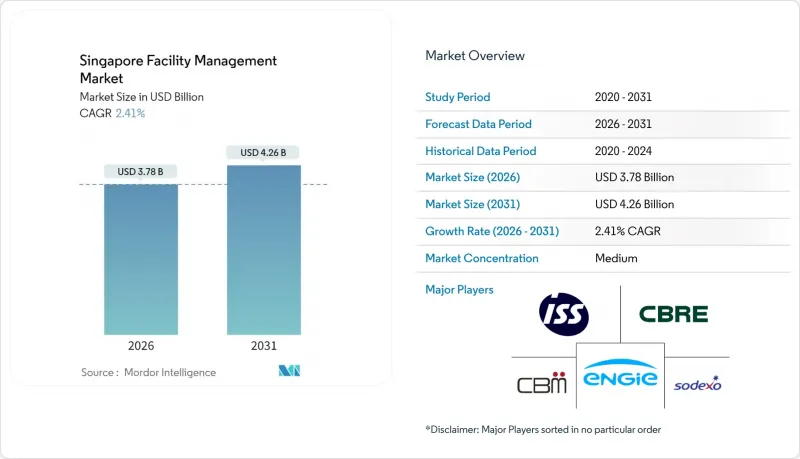
新加坡的建筑环境已高度发达,因此成长将较为稳健而非爆发式。市场需求正从新增占地面积转向更智慧的服务交付。 「智慧国家」计画正透过广泛应用物联网感测器、云端仪錶板和数据驱动型工作流程,革新服务合约模式。这促使客户倾向于签订更长期、基本契约。外籍劳工配额的减少和工资的上涨持续推动自动化进程,而强制性的「绿色建筑标誌升级版」(BCA Green Mark Plus)法规则加速了节能维修的投资。随着客户要求软硬体服务的无缝整合以及关键绩效指标的保障,竞争格局正从价格主导的竞标转向技术驱动的价值提案。
新加坡设施管理市场趋势与洞察
加速非核心业务外包
为了专注于核心收入来源,各机构纷纷将楼宇营运外包。自2020年5月起,所有公共部门保全合约均采用「基于结果的基本契约」模式,要求竞标展示技术能力而非人员配备。凯德集团整合式商业信託的案例充分体现了外包的广泛应用:其价值179亿美元的资产组合由专业子公司管理,该子公司负责端到端的租赁、工程和永续发展项目。企业内部开发成本高昂,而先进的分析工具、电脑视觉巡逻监控、预测性维护工具以及其他相关技术,进一步强化了外包的合理性。日益严格的环境资讯揭露法规促使客户依赖外部设施管理合作伙伴提供碳排放报告的专业知识。这些趋势共同推高了新加坡设施管理市场对服务供应商的期望,同时也扩大了合约的范围和期限。
地铁沿线地区基础建设快速扩张
新加坡持续开通新的铁路线路,每条线路都附带长期的营运和维护(O&M)义务。陆路交通管理局授予的价值3.552亿美元的跨岛线二期工程马朱站土木工程项目,以及授予新捷运(SBS Transit)和巴黎大众运输公司(RATP Dev)联合体的九年裕廊区域线运营许可证,均要求从启用之日起就采用人工智能驱动的状态监测。这促使资产所有者儘早寻找综合设施管理合作伙伴,从而确保拥有轨道旁设施、车站设施和客流分析专业知识的供应商获得长达数十年的收入来源。这种连锁反应延伸至围绕新车站的商业、办公和住宅计划,这些项目需要整合建筑系统以确保无缝的通勤体验。这种以铁路为中心的开发模式是服务线路多元化和支持新加坡设施管理市场区域溢出成长的基础。
高度分散的本地供应商群体
数百家小规模清洁和保全公司使合约管理变得复杂。每增加一家分包商,都会增加实施时间、网路安全风险和协调风险,迫使大规模业主整合供应商。儘管新加坡建设局 (BCA) 目前提供基于能力的认证体系,但公共机构的接受度仍然有限。在整合和认证加速推进之前,标准不一致很可能会限制新加坡设施管理市场的效率提升。
细分市场分析
在新加坡的设施管理市场,到2025年,硬性服务将占总收入的53.62%,运作湿热的热带气候下对完美无瑕的机械、电气和管道系统的需求。消防安全认证和电梯维护记录等监管要求也支撑了这个基本需求。市场正朝着预测性维护的方向发展,例如Green Mark 冷却器 Portal,它透过分析振动和温度数据来预防停机。客户越来越重视生命週期成本优化,而非被动维修,这推动了具有结果保证的硬体维修管理总价合约的签订。
随着绩效付费合约将价格与人员规模脱钩,软性服务正以2.99%的复合年增长率快速成长。安保按绩效付费合约正在重新定义人员配备模式,要求保全人员使用无人机、影像分析和事件报告应用程式。清洁服务供应商正在部署即时品质感测器,而租户互动应用程式则在协调餐饮和礼宾服务。儘管软性服务在绝对规模上仍落后于硬性服务,但这种技术驱动的復苏表明,新加坡的设施管理市场正在从劳动密集型的例行工作向数据检验的体验式服务转型。
到2025年,外包将占新加坡设施管理市场规模的62.98%,因为客户更倾向于选择能够一站式处理合规、品质保证管理和永续发展报告的专业供应商。整合工程、环境和饭店服务的综合设施管理合约正日益普及,凯德集团(CapitaLand)在单一供应商责任架构下提供租赁、技术和ESG(环境、社会和治理)服务。自动化工单平台和服务等级协定(SLA)仪錶板确保了绩效透明度,并日益被业主视为一种风险转移机制。
预计到2025年,自管式服务仅占设施总量的37.02%,但随着资料中心营运商和政府机构寻求强化网路安全和关键系统管理,其复合年增长率将达到3.88%。新加坡建设局学院(BCA Academy)新推出的智慧建筑课程旨在支持这项变革,培养数位双胞胎、物联网网路安全和故障诊断的认证技术人员。混合模式也正在兴起,业主保留分析和策略,但将现场执行外包,这反映了新加坡设施管理市场需求模式的细微变化。
其他福利:
- Excel格式的市场预测(ME)表
- 3个月的分析师支持
目录
第一章 引言
- 研究假设和市场定义
- 调查范围
第二章调查方法
第三章执行摘要
第四章 市场情势
- 市场概览
- 市场驱动因素
- 加速非核心业务外包
- 地铁沿线地区基础建设快速扩张
- 必须符合新加坡建设局绿色标誌Plus标准
- 老旧商业设施需要进行生命週期更新。
- 新加坡智慧国家计画中的智慧社区
- 公共医疗保健领域的综合设施合约
- 市场限制
- 本地供应商群体高度分散
- 外籍劳工配额收紧和劳动成本上升
- 政府设施竞标规则复杂
- 由于是岛国,扩充性有限
- 产业价值链分析
- 监管环境
- 技术展望
- 宏观经济因素的影响
- 波特五力分析
- 供应商的议价能力
- 买方的议价能力
- 新进入者的威胁
- 替代产品和服务的威胁
- 竞争对手之间的竞争
第五章 市场规模与成长预测
- 按服务类型
- 硬服务
- 资产管理
- 机电及暖通空调服务
- 消防设备和安全措施
- 其他硬体维修服务
- 软服务
- 办公室支援与安全
- 清洁服务
- 餐饮服务
- 其他软性调频服务
- 硬服务
- 以规定形式
- 内部管理
- 外包
- 单频调频
- 捆绑式调频广播
- 综合设施管理(综合FM)
- 按最终用户行业划分
- 商业设施、零售商店、餐厅
- 製造业/工业
- 政府、基础设施和公共组织
- 对机构而言
- 其他终端用户产业
- 依设施类型
- 商业建筑
- 工业设施
- 公共基础设施
- 教育机构及研究设施
- 其他设施类型
第六章 竞争情势
- 市场集中度
- 策略趋势
- 市占率分析
- 公司简介
- Abacus Property Management Pte. Ltd.
- ACMS Facilities Management Pte. Ltd.
- CBM Pte. Ltd.
- CBRE Group, Inc.
- Certis CISCO Security Pte. Ltd.
- Compass Group PLC
- Cushman and Wakefield PLC
- ENGIE Services Singapore Pte. Ltd.
- Exceltec Property Management Pte. Ltd.
- ISS A/S
- Jones Lang LaSalle Incorporated
- OCS Group International Limited
- Savills(Singapore)Pte. Ltd.
- Serco Group PLC
- Sodexo Singapore Pte. Ltd.
- United Tec Engineering Pte. Ltd.
- UTiZ Facilities Management Services Pte. Ltd.
- Vinci Facilities SAS
第七章 市场机会与未来展望
The Singapore facility management market was valued at USD 3.69 billion in 2025 and estimated to grow from USD 3.78 billion in 2026 to reach USD 4.26 billion by 2031, at a CAGR of 2.41% during the forecast period (2026-2031).
Growth is steady rather than explosive because Singapore's built environment is already well-developed, so demand pivots toward smarter service delivery instead of new square footage. Widespread deployment of IoT sensors, cloud dashboards, and data-driven workflows under the Smart Nation program is reshaping service contracts, nudging customers toward longer-tenure, outcome-based agreements. Tighter foreign-worker quotas and escalating wages continue to push automation, while mandatory BCA Green Mark Plus rules accelerate investment in energy-efficient retrofits. Competition is shifting from price-led bidding to technology-rich value propositions as clients expect seamless hard and soft service integration with guaranteed key-performance outcomes.
Singapore Facility Management Market Trends and Insights
Outsourcing of Non-core Operations Accelerating
Organizations are handing off building operations so they can focus on core revenue drivers. Since May 2020, every public-sector contract for security has had to comply with Security Outcome-Based Contracting, forcing bidders to prove technology capabilities rather than supply headcount. CapitaLand Integrated Commercial Trust illustrates how extensive outsourcing can become: property management for its USD 17.9 billion portfolio is handled by specialist subsidiaries that run leasing, engineering, and sustainability programs end-to-end. Access to advanced analytics, computer-vision patrols, and predictive maintenance tools that would be cost-prohibitive to build in-house further strengthens the outsourcing rationale. As environmental disclosure rules tighten, clients also rely on external FM partners for carbon-reporting expertise. Collectively, these dynamics raise the bar for service providers while expanding contract scope and duration within the Singapore facility management market.
Infrastructure Boom in MRT-Linked Districts
Singapore is adding entire rail corridors, each embedding long-term O&M obligations. The Land Transport Authority's USD 355.2 million Maju station civil package for Cross Island Line Phase 2 and the nine-year Jurong Region Line operating license awarded to the SBS Transit and RATP Dev consortium require AI-driven condition monitoring from day one. Asset owners, therefore, lock in integrated FM partners early, guaranteeing multi-decade revenue streams for vendors proficient in track-side facilities, station utilities, and crowd-flow analytics. Knock-on effects spread to retail podiums, office towers, and residential projects clustered around new stations, all of which demand unified building systems to ensure a frictionless commuter experience. This rail-centric development model underpins service line diversification and regional spillover growth for the Singapore facility management market.
Highly Fragmented Local Vendor Base
Hundreds of micro-scale cleaning and security firms make contract administration cumbersome. Each additional subcontractor adds onboarding time, cybersecurity exposure, and interface risk, prompting large owners to consolidate suppliers. BCA now offers competency-based accreditations, but public-agency acceptance remains partial. Until aggregation or certification gains speed, disparate standards will temper efficiency gains in the Singapore facility management market.
Other drivers and restraints analyzed in the detailed report include:
- Mandatory BCA Green Mark Plus Compliance
- Ageing Commercial Stock Requiring Lifecycle Upgrades
- Tight Foreign-Worker Quotas and Rising Labour Costs
For complete list of drivers and restraints, kindly check the Table Of Contents.
Segment Analysis
Hard services represented 53.62% of 2025 revenue within the Singapore facility management market share because mechanical, electrical, and plumbing systems must operate flawlessly in a humid tropical climate. Regulatory obligations for fire-safety certifications and lift-maintenance logs sustain baseline demand. Momentum toward predictive analytics is palpable, exemplified by the Green Mark chiller portal that digests vibration and temperature data to prevent downtime. Clients increasingly value lifecycle-cost optimization over reactive fixes, prompting bundled hard-FM contracts with outcome guarantees.
Soft services are expanding at 2.99% CAGR as outcome-based contracting decouples pricing from headcount. Security Outcome-Based Contracting compels guards to use drones, video analytics, and incident-reporting apps, redefining manpower deployment. Cleaning vendors adopt real-time quality sensors, while tenant-engagement apps coordinate catering and concierge tasks. Although soft services still trail hard services in absolute value, their technology-enabled rebound illustrates how the Singapore facility management market evolves from labour-intensive routines to data-validated experiences.
Outsourcing held 62.98% of the Singapore facility management market size in 2025 because clients prefer one-stop specialists for compliance, warranty management, and sustainability reporting. Integrated FM contracts that fuse engineering, environmental, and hospitality tasks gain traction, with CapitaLand bundling leasing, technical, and ESG services under single-vendor accountability. Automated ticketing platforms and SLA dashboards lock in performance transparency, which owners increasingly treat as a risk-transfer mechanism.
In-house delivery, though just 37.02% in 2025, is forecast to grow 3.88% CAGR as data-center operators and government agencies seek tighter control over cybersecurity and critical systems. BCA Academy's new smart-building curricula underpin this shift by supplying certified engineers versed in digital twins, IoT cybersecurity, and fault diagnostics. Hybrid models are also emerging where owners retain analytics and strategy while outsourcing boots-on-ground execution, reflecting nuanced demand patterns in the Singapore facility management market.
The Singapore Facility Management Market Report is Segmented by Service Type (Hard Services, and Soft Services), Offering Type (In-House, and Outsourced [Single FM, Bundled FM, and Integrated FM]), End-User Industry (Commercial/Retail/Restaurants, Manufacturing/Industrial, and More), Facility Type (Commercial Buildings, Industrial Facilities, and More), and Geography. The Market Forecasts are Provided in Terms of Value (USD).
List of Companies Covered in this Report:
- Abacus Property Management Pte. Ltd.
- ACMS Facilities Management Pte. Ltd.
- CBM Pte. Ltd.
- CBRE Group, Inc.
- Certis CISCO Security Pte. Ltd.
- Compass Group PLC
- Cushman and Wakefield PLC
- ENGIE Services Singapore Pte. Ltd.
- Exceltec Property Management Pte. Ltd.
- ISS A/S
- Jones Lang LaSalle Incorporated
- OCS Group International Limited
- Savills (Singapore) Pte. Ltd.
- Serco Group PLC
- Sodexo Singapore Pte. Ltd.
- United Tec Engineering Pte. Ltd.
- UTiZ Facilities Management Services Pte. Ltd.
- Vinci Facilities S.A.S.
Additional Benefits:
- The market estimate (ME) sheet in Excel format
- 3 months of analyst support
TABLE OF CONTENTS
1 INTRODUCTION
- 1.1 Study Assumptions and Market Definition
- 1.2 Scope of the Study
2 RESEARCH METHODOLOGY
3 EXECUTIVE SUMMARY
4 MARKET LANDSCAPE
- 4.1 Market Overview
- 4.2 Market Drivers
- 4.2.1 Outsourcing of Non-core Operations Accelerating
- 4.2.2 Infrastructure Boom in MRT-Linked Districts
- 4.2.3 Mandatory BCA Green Mark Plus Compliance
- 4.2.4 Ageing Commercial Stock Requiring Lifecycle Upgrades
- 4.2.5 Smart Estates under Singapore Smart Nation Drive
- 4.2.6 Integrated Facilities Contracts in Public Healthcare
- 4.3 Market Restraints
- 4.3.1 Highly Fragmented Local Vendor Base
- 4.3.2 Tight Foreign-Worker Quotas and Rising Labour Costs
- 4.3.3 Complex Tender Regulations for Government Sites
- 4.3.4 Limited Scalability in Island-State Geography
- 4.4 Industry Value-Chain Analysis
- 4.5 Regulatory Landscape
- 4.6 Technological Outlook
- 4.7 Impact of Macroeconomic Factors
- 4.8 Porter's Five Forces Analysis
- 4.8.1 Bargaining Power of Suppliers
- 4.8.2 Bargaining Power of Buyers
- 4.8.3 Threat of New Entrants
- 4.8.4 Threat of Substitute Products and Services
- 4.8.5 Intensity of Competitive Rivalry
5 MARKET SIZE AND GROWTH FORECASTS (VALUE)
- 5.1 By Service Type
- 5.1.1 Hard Services
- 5.1.1.1 Asset Management
- 5.1.1.2 MEP and HVAC Services
- 5.1.1.3 Fire Systems and Safety
- 5.1.1.4 Other Hard FM Services
- 5.1.2 Soft Services
- 5.1.2.1 Office Support and Security
- 5.1.2.2 Cleaning Services
- 5.1.2.3 Catering Services
- 5.1.2.4 Other Soft FM Services
- 5.1.1 Hard Services
- 5.2 By Offering Type
- 5.2.1 In-house
- 5.2.2 Outsourced
- 5.2.2.1 Single FM
- 5.2.2.2 Bundled FM
- 5.2.2.3 Integrated FM
- 5.3 By End-User Industry
- 5.3.1 Commercial, Retail and Restaurants
- 5.3.2 Manufacturing and Industrial
- 5.3.3 Government, Infrastructure and Public Entities
- 5.3.4 Institutional
- 5.3.5 Other End-user Industries
- 5.4 By Facility Type
- 5.4.1 Commercial Buildings
- 5.4.2 Industrial Facilities
- 5.4.3 Public Infrastructure
- 5.4.4 Institutional Buildings
- 5.4.5 Other Facility Types
6 COMPETITIVE LANDSCAPE
- 6.1 Market Concentration
- 6.2 Strategic Moves
- 6.3 Market Share Analysis
- 6.4 Company Profiles (includes Global level Overview, Market level overview, Core Segments, Financials as available, Strategic Information, Market Rank/Share for key companies, Products and Services, and Recent Developments)
- 6.4.1 Abacus Property Management Pte. Ltd.
- 6.4.2 ACMS Facilities Management Pte. Ltd.
- 6.4.3 CBM Pte. Ltd.
- 6.4.4 CBRE Group, Inc.
- 6.4.5 Certis CISCO Security Pte. Ltd.
- 6.4.6 Compass Group PLC
- 6.4.7 Cushman and Wakefield PLC
- 6.4.8 ENGIE Services Singapore Pte. Ltd.
- 6.4.9 Exceltec Property Management Pte. Ltd.
- 6.4.10 ISS A/S
- 6.4.11 Jones Lang LaSalle Incorporated
- 6.4.12 OCS Group International Limited
- 6.4.13 Savills (Singapore) Pte. Ltd.
- 6.4.14 Serco Group PLC
- 6.4.15 Sodexo Singapore Pte. Ltd.
- 6.4.16 United Tec Engineering Pte. Ltd.
- 6.4.17 UTiZ Facilities Management Services Pte. Ltd.
- 6.4.18 Vinci Facilities S.A.S.
7 MARKET OPPORTUNITIES AND FUTURE OUTLOOK
- 7.1 White-space and Unmet-need Assessment

 设施管理市场:2026-2032年全球市场预测(依产品、产品模式、部署类型、公司规模及最终用途划分)
 设施管理市场规模、份额、趋势和预测:按解决方案、服务、部署类型、组织规模、行业和地区划分,2026-2034 年设施管理服务市场:2026-2032年全球市场预测(依服务类型、合约类型、服务交付方式、最终用户和组织规模划分)
 2026年全球地下设施维护与管理市场报告2026年全球硬性服务设施管理市场报告2026年全球设施支援服务市场报告2026年全球设施管理服务市场报告2026年全球软性服务设施管理市场报告
 设施管理市场规模、份额、成长及全球产业分析:按类型、应用和地区分類的洞察,2026-2034 年预测硬设施管理市场:依服务类型、合约类型、所有权类型和最终用户产业划分-2026-2032年全球市场预测