


 |
市场调查报告书
商品编码
1940810
泰国网路安全:市场占有率分析、产业趋势与统计、成长预测(2026-2031)Thailand Cybersecurity - Market Share Analysis, Industry Trends & Statistics, Growth Forecasts (2026 - 2031) |
||||||

※ 本网页内容可能与最新版本有所差异。详细情况请与我们联繫。
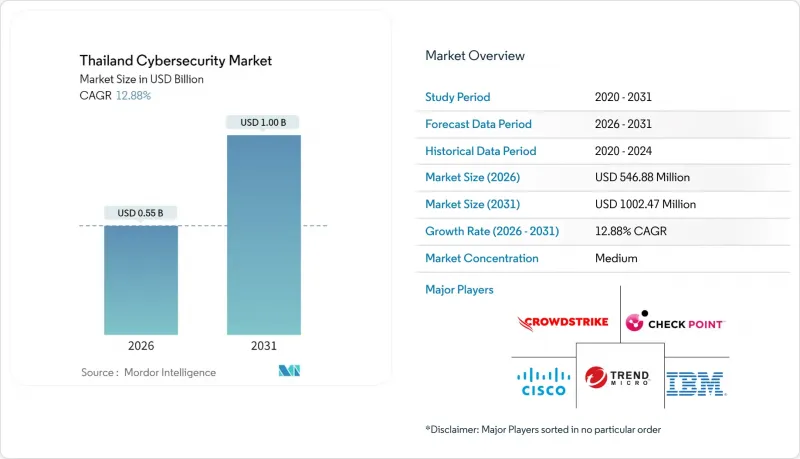
2025年泰国网路安全市场价值4.8448亿美元,预计到2031年将达到10.0247亿美元,高于2026年的5.4688亿美元。
预计在预测期(2026-2031 年)内,复合年增长率将达到 12.88%。
支付系统的数位化、公共部门云端迁移以及工业界5G的普及正在扩大威胁面,并将网路安全支出转向关键基础设施投资。国家数位身分平台、PromptPay的成长以及G-Cloud政策正在推动各组织向零信任架构和云端原生安全控制转型。能够提供泰语支援、符合PDPA标准的自动化解决方案以及託管服务交付的供应商,其表现始终优于仅提供产品的竞争对手。儘管人才短缺和中小企业对成本的敏感性仍然是阻碍因素,但勒索软体攻击的日益增多以及关键基础设施监管的加强,已将网路风险提升至全国经营团队的首要位置。
泰国网路安全市场趋势与洞察
加速泰国金融服务业数位化银行的普及
2023年,PromptPay处理了92亿笔交易,总额达13.9兆泰铢(约4,270亿美元),为行动银行和开放API银行业务创造了新的攻击面。金融机构正在部署应用防火墙、交易等级异常侦测分析和身分编配,以满足沙箱需求并保障行动管道的安全。基于强身份验证和微隔离的零信任框架正在取代以防火墙为中心的设计。为了满足金融机构的业务法规要求,支出重点正从事件回应转向持续的威胁搜寻。供应商的差异化优势正在转向能够自动产生合规报告并缩短混合环境中平均侦测时间的整合平台。
加速政府云端迁移(G-Cloud 和 NDID)
数位政府发展局已拨款10亿泰铢(约3000万美元)用于2025年的云端服务,加速政府各部会和机构采用G-Cloud。国家数位身分识别码(NDID)註册数量已超过5000万,推动了生物识别身分管治和加密金钥管理解决方案的采购。各机构必须遵守2025年网站安全标准,该标准强制要求加密、基于角色的存取控制和事件回应手册。国际供应商已与国家网路安全中心(NCSA)签署谅解备忘录,以实现威胁情报源的本地化并提供泰语安全营运中心(SOC)培训。在多重云端日益复杂的背景下,云端安全态势管理和合规自动化工具在竞标清单中占据主导地位。
泰语网路安全人员短缺
仅有58万人具备足够的数位技能,而每年IT专业毕业生人数仍维持在约3,500人。曼谷25%至30%的薪资成长迫使企业将安全营运中心(SOC)营运外包或延后计划。在地化的认证计画仍然匮乏,促使ISC2和NCSA共同发起一项计划,目标是在2026年前培训1万人。然而,许多本地企业仍依赖通用IT人员来管理安全工具,这降低了其防御成熟度,并增加了安全漏洞的风险。人才短缺导致采购週期延长,并促使企业倾向于采用包含专业知识的託管服务模式。
细分市场分析
到2025年,解决方案领域将占泰国网路安全市场份额的60.88%,显示企业仍将持续依赖边界控制。虽然该领域对于分公司连接和OT隔离仍然至关重要,但随着预算转向云端弹性,其成长速度正在放缓。受G-Cloud部署以及金融科技和电子商务企业采用多重云端架构的推动,云端安全正以16.05%的复合年增长率推动创新。能够将以工作负载为中心的微隔离、CASB功能和合规性仪表板相结合的供应商,能够满足寻求深度网路防御(NDID)的买家的需求。随着企业面临复杂的最佳化和技能短缺问题,专业服务和託管服务的需求正在增长。端点、数据和身份模组与基于人工智慧的异常检测功能集成,这些功能可以从泰国数据集中学习,帮助团队减少警报噪音并加快响应速度。
云端原生安全防护也推动了对姿态管理工具的需求,这些工具能够根据 PDPA 和 CII 标准对配置进行基准测试。受 API 驱动的银行和超级应用生态系统的推动,应用程式安全方面的支出正在增加。在发生 5273 起资料外洩事件后,资料安全的迫切性促使支付工作流程中采用令牌化和资料防洩漏 (DLP) 技术。随着零售商和医疗机构在云端迁移截止日期前对敏感栏位进行加密,泰国以资料为中心的控製网路安全市场正在扩张。交付模式正从硬体设备转向整合威胁情报、自动化和区域合规性组件的 SaaS 平台,预计到 2030 年,这一趋势将重塑采购评估模式。
预计到2025年,云端技术将占泰国网路安全市场规模的64.26%,并在2031年之前以14.20%的复合年增长率成长。政府的「云端优先」政策、AWS 50亿美元的基础设施投资承诺以及微软的政府安全计划,共同推动了向IaaS和PaaS的新计画转型。泰国银行、金融和保险(BFSI)监管机构现已允许在其监管沙箱内运行公共云端工作负载,鼓励银行迁移非核心应用程式并采用API安全网关。跨境资料流的需求正在推动由国家通讯业者营运的租户管理加密金钥和主权云端区域的普及。
在公共产业、交通运输和传统SCADA营运商等对空气间隙和确定性延迟要求极高的行业,本地部署解决方案仍然占据主导地位。随着工厂将OT网路连接到云端分析平台,混合环境正在兴起,这就需要一个统一的管理平台,涵盖防火墙设备和云端工作负载代理。提供两种部署模式以及单一策略引擎的供应商正在赢得市场份额。泰国网路安全市场本地部署的份额正在逐渐下降,因为更新换代週期往往倾向于虚拟化部署模式,即使在私人资料中心也是如此。将5G MEC节点整合到云端仪表板中正是这种融合部署趋势的典型体现。
其他福利:
- Excel格式的市场预测(ME)表
- 分析师支持(3个月)
目录
第一章 引言
- 研究假设和市场定义
- 调查范围
第二章调查方法
第三章执行摘要
第四章 市场情势
- 市场概览
- 市场驱动因素
- 加速泰国银行、金融和保险(BFSI)产业数位化银行服务的采用
- 加速政府云端迁移(G-Cloud 和 NDID)
- 5G部署推动了对物联网边缘安全的需求
- 泰国电子商务商品交易总额(GMV)正在快速成长。
- 针对中小企业的勒索软体即服务攻击激增
- 东部经济走廊的OT/ICS安全漏洞
- 市场限制
- 泰语网路安全人员短缺
- 中小企业的价格敏感型采购行为
- 修补遗留的关键基础设施系统非常困难
- 网路保险市场的碎片化
- 产业价值链分析
- 波特五力模型
- 供应商的议价能力
- 买方的议价能力
- 新进入者的威胁
- 替代品的威胁
- 竞争对手之间的竞争
- 宏观经济因素如何影响市场
- 监管环境
- 技术展望
第五章 市场规模与成长预测
- 报价
- 解决方案
- 应用程式安全
- 云端安全
- 资料安全
- 身分和存取管理
- 基础设施保护
- 综合风险管理
- 网路安全设备
- 端点安全
- 服务
- 专业服务
- 託管服务
- 解决方案
- 透过部署模式
- 本地部署
- 云
- 按最终用户行业划分
- BFSI
- 卫生保健
- 资讯科技/通讯
- 工业与国防
- 製造业
- 零售与电子商务
- 能源与公共产业
- 其他的
- 按公司规模
- 小型企业
- 大公司
第六章 竞争情势
- 市场集中度
- 策略趋势
- 市占率分析
- 公司简介
- Cisco Systems, Inc.
- Palo Alto Networks, Inc.
- Fortinet, Inc.
- Check Point Software Technologies Ltd.
- Trend Micro Incorporated
- CrowdStrike Holdings, Inc.
- McAfee LLC
- International Business Machines Corporation
- Microsoft Corporation
- Amazon Web Services, Inc.
- Atos SE
- Thales Group
- NEC Corporation
- Accenture plc
- Deloitte Touche Tohmatsu Ltd.
- MFEC Public Company Limited
- G-Able Company Limited
- ACinfotec Company Limited
- National Telecom Public Company Limited
- Bangkok Systems and Software Co., Ltd.
第七章 市场机会与未来展望
The Thailand cybersecurity market was valued at USD 484.48 million in 2025 and estimated to grow from USD 546.88 million in 2026 to reach USD 1002.47 million by 2031, at a CAGR of 12.88% during the forecast period (2026-2031).
Payment-system digitalization, public-sector cloud migration, and industrial 5G adoption are expanding the threat surface and turning cybersecurity spending into critical infrastructure outlays. The National Digital ID platform, PromptPay growth, and G-Cloud policy have pushed organizations toward zero-trust architectures and cloud-native security controls. Vendors that combine Thai-language support, PDPA compliance automation, and managed service delivery continue to out-perform product-only competitors. The talent gap and SME cost sensitivity remain constraints, yet rising ransomware incidents and CII regulations keep cyber risk on executive agendas nationwide.
Thailand Cybersecurity Market Trends and Insights
Accelerated Digital-Banking Adoption in Thai BFSI
PromptPay processed 9.2 billion transactions worth THB 13.9 trillion (USD 0.427 trillion ) in 2023, exposing new attack surfaces in mobile and open-API banking. Financial institutions are deploying application firewalls, transaction-level anomaly analytics, and identity orchestration to meet sandbox requirements and protect mobile channels. Zero-trust frameworks built on strong authentication and micro-segmentation are replacing firewall-centric designs. Spending priorities are shifting from incident response toward continuous threat hunting that satisfies the Financial Institutions Business Act. Vendor differentiation now favors integrated platforms that automate compliance reporting and reduce mean-time-to-detect across hybrid environments.
Fast-Track Government Cloud Migration (G-Cloud and NDID)
The Digital Government Development Agency allocated THB 1 billion (USD 0.03 billion) for cloud services in FY 2025, accelerating G-Cloud rollouts across ministries. NDID enrollment has surpassed 50 million citizens, driving procurement of biometric identity governance and encryption key management. Agencies must comply with the 2025 Website Security Standard, which mandates encryption, role-based access, and incident response playbooks. International vendors have entered memoranda with NCSA to localize threat-intelligence feeds and Thai-language SOC training. Cloud security posture management and compliance automation tools dominate tender lists as multi-cloud complexity rises.
Shortage of Thai-Language Cybersecurity Talent
Only 0.58 million citizens possess adequate digital skills, and annual IT graduate output is roughly 3,500 professionals. Salary inflation of 25-30% in Bangkok prompts firms to outsource SOC operations or delay projects. Localized certification pathways remain scarce, so ISC2 and NCSA launched a program to train 10,000 practitioners by 2026. Nevertheless, most provincial enterprises rely on generalist IT staff to manage security tooling, lowering defense maturity and elevating breach risk. The talent shortfall prolongs procurement cycles and favors managed service models that embed expertise.
Other drivers and restraints analyzed in the detailed report include:
- 5G Rollout Spurring IoT-Edge Security Demand
- Rapid Growth of Thailand E-Commerce GMV
- Price-Sensitive SME Buyer Behavior
For complete list of drivers and restraints, kindly check the Table Of Contents.
Segment Analysis
Solutions held the largest 60.88% Thailand cybersecurity market share in 2025, underscoring the residual reliance on perimeter controls. The segment remains vital for branch connectivity and OT segregation, but its growth pace is moderating as budgets pivot to cloud resilience. Cloud Security leads the innovation curve with a 16.05% CAGR, propelled by G-Cloud rollouts and multi-cloud adoption among fintech and e-commerce operators. Vendors that fuse workload-centric micro-segmentation, CASB functions, and compliance dashboards resonate with buyers seeking NDID alignment. Professional Services and Managed Services expand as enterprises confront complex optimization and skills shortages. Endpoint, data, and identity modules integrate AI-based anomaly detection that learns from Thai-language data sets, helping teams cut alert noise and accelerate response.
Cloud-native protection also amplifies demand for posture-management tools that benchmark configurations against PDPA and CII baselines. Application Security spending rises alongside API-driven banking and super-app ecosystems. Data Security urgency grows after 5,273 leak cases, pushing tokenization and DLP adoption inside payment workflows. Thailand cybersecurity market size for data-centric controls is climbing as retailers and hospitals encrypt sensitive fields ahead of cloud migration deadlines. The offering mix is shifting from hardware appliances toward SaaS platforms that bundle threat intelligence, automation, and localized compliance artifacts, a trend expected to reshape procurement scoring models by 2030.
Cloud deployments captured 64.26% share of the Thailand cybersecurity market size in 2025 and are set to grow at a 14.20% CAGR through 2031. The government's Cloud First policy, AWS's USD 5 billion infrastructure pledge, and Microsoft's Government Security Program have tipped new projects toward IaaS and PaaS. BFSI regulators now permit public cloud workloads in regulatory sandboxes, encouraging banks to migrate non-core applications and adopt API security gateways. Cross-border data-flow requirements drive uptake of tenant-controlled encryption keys and sovereign cloud zones operated by National Telecom.
On-premise solutions still hold sway in utilities, transport, and legacy SCADA operators where air-gaps and deterministic latency matter. Hybrid environments emerge as plants connect OT networks to cloud analytics platforms, requiring unified management planes that span firewall appliances and cloud workload agents. Vendors supplying both form factors with a single policy engine win favor. Thailand cybersecurity market share for on-premise deployments gradually declines as refresh cycles favor virtual form factors even inside private data centers. Integration of 5G MEC nodes into cloud dashboards exemplifies the converging deployment story.
The Thailand Cybersecurity Market Report is Segmented by Offering (Solutions, Services), Deployment Mode (On-Premise, Cloud), End-User Vertical (BFSI, Healthcare, IT and Telecom, and More), End-User Enterprise Size (Small and Medium Enterprises, Large Enterprises). The Market Forecasts are Provided in Terms of Value (USD).
List of Companies Covered in this Report:
- Cisco Systems, Inc.
- Palo Alto Networks, Inc.
- Fortinet, Inc.
- Check Point Software Technologies Ltd.
- Trend Micro Incorporated
- CrowdStrike Holdings, Inc.
- McAfee LLC
- International Business Machines Corporation
- Microsoft Corporation
- Amazon Web Services, Inc.
- Atos SE
- Thales Group
- NEC Corporation
- Accenture plc
- Deloitte Touche Tohmatsu Ltd.
- MFEC Public Company Limited
- G-Able Company Limited
- ACinfotec Company Limited
- National Telecom Public Company Limited
- Bangkok Systems and Software Co., Ltd.
Additional Benefits:
- The market estimate (ME) sheet in Excel format
- 3 months of analyst support
TABLE OF CONTENTS
1 INTRODUCTION
- 1.1 Study Assumptions and Market Definition
- 1.2 Scope of the Study
2 RESEARCH METHODOLOGY
3 EXECUTIVE SUMMARY
4 MARKET LANDSCAPE
- 4.1 Market Overview
- 4.2 Market Drivers
- 4.2.1 Accelerated digital-banking adoption in Thai BFSI
- 4.2.2 Fast-track government cloud migration (G-Cloud and NDID)
- 4.2.3 5G rollout spurring IoT-edge security demand
- 4.2.4 Rapid growth of Thailand E-commerce GMV
- 4.2.5 Surge in ransomware-as-a-service attacks on SMEs
- 4.2.6 OT/ICS security gaps in Eastern Economic Corridor
- 4.3 Market Restraints
- 4.3.1 Shortage of Thai-language cybersecurity talent
- 4.3.2 Price-sensitive SME buyer behavior
- 4.3.3 Legacy critical-infrastructure systems difficult to patch
- 4.3.4 Fragmented cyber-insurance landscape
- 4.4 Industry Value Chain Analysis
- 4.5 Porter's Five Forces
- 4.5.1 Bargaining Power of Suppliers
- 4.5.2 Bargaining Power of Buyers
- 4.5.3 Threat of New Entrants
- 4.5.4 Threat of Substitutes
- 4.5.5 Competitive Rivalry
- 4.6 Impact of Macroeconomic Factors on the Market
- 4.7 Regulatory Landscape
- 4.8 Technological Outlook
5 MARKET SIZE AND GROWTH FORECASTS (VALUE)
- 5.1 By Offering
- 5.1.1 Solutions
- 5.1.1.1 Application Security
- 5.1.1.2 Cloud Security
- 5.1.1.3 Data Security
- 5.1.1.4 Identity and Access Management
- 5.1.1.5 Infrastructure Protection
- 5.1.1.6 Integrated Risk Management
- 5.1.1.7 Network Security Equipment
- 5.1.1.8 Endpoint Security
- 5.1.2 Services
- 5.1.2.1 Professional Services
- 5.1.2.2 Managed Services
- 5.1.1 Solutions
- 5.2 By Deployment Mode
- 5.2.1 On-Premise
- 5.2.2 Cloud
- 5.3 By End-User Vertical
- 5.3.1 BFSI
- 5.3.2 Healthcare
- 5.3.3 IT and Telecom
- 5.3.4 Industrial and Defense
- 5.3.5 Manufacturing
- 5.3.6 Retail and E-commerce
- 5.3.7 Energy and Utilities
- 5.3.8 Others
- 5.4 By Enterprise Size
- 5.4.1 Small and Medium Enterprises (SMEs)
- 5.4.2 Large Enterprises
6 COMPETITIVE LANDSCAPE
- 6.1 Market Concentration
- 6.2 Strategic Moves
- 6.3 Market Share Analysis
- 6.4 Company Profiles {(includes Global level Overview, Market level overview, Core Segments, Financials as available, Strategic Information, Market Rank/Share for key companies, Products and Services, and Recent Developments)}
- 6.4.1 Cisco Systems, Inc.
- 6.4.2 Palo Alto Networks, Inc.
- 6.4.3 Fortinet, Inc.
- 6.4.4 Check Point Software Technologies Ltd.
- 6.4.5 Trend Micro Incorporated
- 6.4.6 CrowdStrike Holdings, Inc.
- 6.4.7 McAfee LLC
- 6.4.8 International Business Machines Corporation
- 6.4.9 Microsoft Corporation
- 6.4.10 Amazon Web Services, Inc.
- 6.4.11 Atos SE
- 6.4.12 Thales Group
- 6.4.13 NEC Corporation
- 6.4.14 Accenture plc
- 6.4.15 Deloitte Touche Tohmatsu Ltd.
- 6.4.16 MFEC Public Company Limited
- 6.4.17 G-Able Company Limited
- 6.4.18 ACinfotec Company Limited
- 6.4.19 National Telecom Public Company Limited
- 6.4.20 Bangkok Systems and Software Co., Ltd.
7 MARKET OPPORTUNITIES AND FUTURE OUTLOOK
- 7.1 White-space and Unmet-Need Assessment

 后量子安全市场分析及至2035年预测:产品、服务、技术、组件、应用、部署状态及最终用户
 网路安全市场:按组件、安全类型、组织规模、部署模式和产业划分-2026-2032年全球市场预测
 人工智慧网路安全市场预测至2034年—按交付方式、安全类型、部署方式、技术、应用、最终用户和地区分類的全球分析金融科技网路安全解决方案市场预测至2034年-按组件、安全类型、部署模式、组织规模、应用、最终用户和地区分類的全球分析
 2026-2030年全球智慧体与自主人工智慧系统网路安全解决方案市场
 网路安全市场规模、份额、趋势和预测:按组件、部署类型、用户类型、行业和地区划分,2026-2034 年
 2026年全球建筑网路安全市场报告2026年全球电网网路安全市场报告2026年全球旅游安全市场报告
 全球网路靶场市场报告:实际结果与预测(2021-2032)