


 |
市场调查报告书
商品编码
1940880
环境咨询:市场占有率分析、产业趋势与统计、成长预测(2026-2031)Environmental Consulting - Market Share Analysis, Industry Trends & Statistics, Growth Forecasts (2026 - 2031) |
||||||

※ 本网页内容可能与最新版本有所差异。详细情况请与我们联繫。
2025年环境咨询市场价值465亿美元,预计2031年将达到657.2亿美元,高于2026年的492.6亿美元。
预计在预测期(2026-2031 年)内,复合年增长率将达到 5.94%。
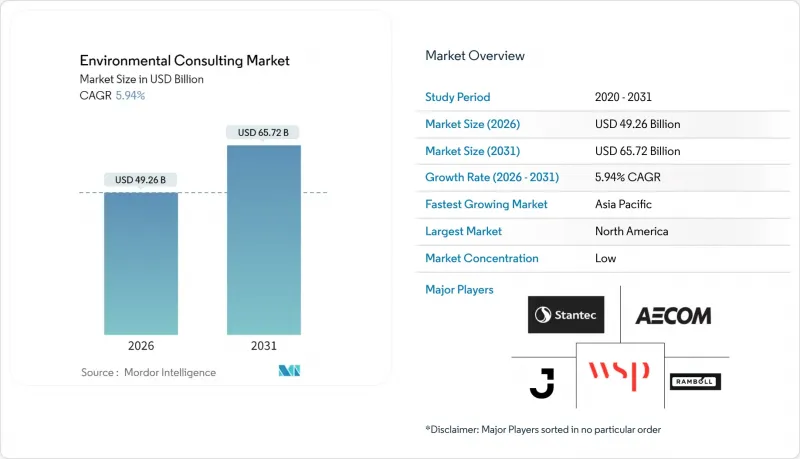
这一持续增长反映了经合组织和二十国集团各国气候政策的同步推进、企业资讯揭露义务的加强以及数位化的快速发展,数位化在扩大咨询服务范围的同时降低了服务成本。需求集中在高价值领域,特别是环境影响评估(EIA)和ESG咨询,因为监管标准化已将合规性从可自由支配的支出转变为必要的基础设施。企业净零排放目标、绿色金融的成长以及工业脱碳基金的设立,扩大了目标计划范围,而人工智慧驱动的场地特征分析等技术则提高了咨询效率。竞争格局仍然平衡,专业公司占据了利基技术业务,而大规模综合公司则利用跨服务协同效应,在基本费用面临压力的情况下维持利润率。
全球环境咨询市场趋势与洞察
经合组织和二十国集团经济体强制执行气候政策
气候法规的趋同正在改变咨询需求,使其从一次性计划转向标准化、可重复的服务模式。经合组织更新后的环境绩效评估报告要求制定量化的脱碳路径,而碳边境调节机制的引入则催生了跨境供应链检验的需求。咨询公司正在多个司法管辖区部署统一的调查方法,从而降低定製成本并扩大基本客群。随着合规性从自愿转向强制,服务流程变得更加可预测,从而能够进行长期资源规划并投资于数位化交付平台。
企业净零排放及ESG资讯揭露要求
欧盟企业永续发展报告指令将于2024年起适用于超过5万家公司,强制要求其提供比以往自愿性指南更为详尽的环境资讯揭露。许多公司缺乏内部专业知识来使其业务活动与分类标准相匹配,导致咨询工作积压多年。美国证券交易委员会(SEC)和其他监管机构正在考虑的类似规则将在全球加剧这种需求。因此,环境咨询市场的关係正在从短期合规性合作转向包含情境建模和保证准备等内容的持续策略伙伴关係。
框架协议带来的持续价格压力
企业买家透过包含年度成本节约条款的多年期合约架构来整合供应商。常规合规工作日益商品化,迫使顾问公司多元化发展,进入诸如 PFAS污染防治和自然友善会计等专业化、高附加价值领域。大型公司利用其规模和交叉销售来维持利润率,而规模较小的专业公司则因其独特的技术深度而收取更高的费用。
细分市场分析
到2025年,环境影响评估将占环境咨询市场30.25%的份额,反映出其在主要经济体计划审批流程中的强势地位。儘管规模庞大,但由于标准化数位化工作流程缩短了现场勘察时间,其收费标准面临压力。同时,由于资讯揭露要求需要持续参与而非计划项目,ESG报告和永续发展策略预计将以6.12%的复合年增长率成长。随着转型路径建模成为经营团队主管关注的重点,气候变迁咨询领域的环境咨询市场规模将加速成长,顾问顾问也将自身定位为资本配置的策略顾问。
用水和污水管理产业将受益于基础设施奖励策略和新的污染物法规,例如美国环保署提出的铅和铜污染治理改善方案,预计到2030年将创造价值450亿美元的潜在计划。 PFAS污染防治咨询公司正在赢得需要水文地质专业知识和先进处理设计能力的复杂多年期合同,而人工智能驱动的污染场地评估正在简化传统的现场工作,同时在数据分析和遥感探测解译方面开闢新的收入来源。
区域分析
到2025年,北美将占据环境咨询市场35.53%的份额,这得益于《国家环境政策法案》等成熟的法规对环境影响评估和修復需求的支持。联邦基础设施规划正在增加以气候适应能力、供水系统和电网升级为重点的长期计划,从而提升了收入前景。各州层级正在酝酿的气候变迁资讯揭露法案将进一步拓展咨询业务。
亚太地区将引领区域成长,到2031年年均复合成长率将达到6.31%。中国的《生态环境法》(草案)整合了分散的法规,并鼓励工业企业寻求标准化的咨询支援。印度的可再生能源目标和「印度製造」计画将增加对环境许可的需求,而东南亚国家正在推行碳定价和ESG(环境、社会和治理)报告框架。熟悉当地法规并拥有全球技术资源的顾问公司将获得先发优势。
在欧洲,欧盟分类法和企业永续发展报告指令持续强劲发展,使数千家公司的资讯揭露义务制度化。顾问公司正将其经验输出到采用类似框架的地区,将欧洲的专业知识转化为全球竞争力。中东和非洲是与大型企划和水资源短缺解决方案相关的高成长地区,但监管执法不力将阻碍市场发展速度。拉丁美洲预计将从采矿投资和可再生能源扩张中受益,但仍面临政治不稳定和冗长的审批流程。
其他福利:
- Excel格式的市场预测(ME)表
- 3个月的分析师支持
目录
第一章 引言
- 研究假设和市场定义
- 调查范围
第二章调查方法
第三章执行摘要
第四章 市场情势
- 市场概览
- 市场驱动因素
- 经合组织和二十国集团经济体强制执行气候政策
- 企业净零排放目标及ESG资讯揭露义务
- 绿色和转型债券的成长需要第三方检验
- 工业脱碳基金与咨询支出之间的联繫
- 快速的AI驱动型场地特征分析工具可缩短实质审查时间
- 「自然正面」影响核算框架的出现
- 市场限制
- 框架协议带来的持续价格压力
- 新兴市场大型基础设施审核延误
- 合格的水文地质学家和毒理学家短缺
- 客户过渡到内部数位化EHS平台
- 监管环境
- 技术展望
- 波特五力分析
- 新进入者的威胁
- 供应商的议价能力
- 买方的议价能力
- 替代品的威胁
- 竞争对手之间的竞争
- 宏观经济衝击的影响
第五章 市场规模与成长预测
- 按服务类型
- 气候变迁咨询
- EHS
- 环境影响评估
- 用水和污水管理
- 环境、社会及公司治理(ESG)报告与永续发展策略
- 其他服务类型
- 按最终用户行业划分
- 能源与电力
- 采矿和金属
- 公共部门
- 製造业
- 製药
- 其他终端使用者产业(建筑和基础设施、交通运输等)
- 按地区
- 北美洲
- 我们
- 加拿大
- 墨西哥
- 南美洲
- 巴西
- 阿根廷
- 南美洲其他地区
- 欧洲
- 德国
- 英国
- 法国
- 义大利
- 西班牙
- 波兰
- 俄罗斯
- 其他欧洲地区
- 亚太地区
- 中国
- 印度
- 日本
- 韩国
- 澳洲
- 亚太其他地区
- 中东和非洲
- 中东
- 沙乌地阿拉伯
- 阿拉伯聯合大公国
- 土耳其
- 其他中东地区
- 非洲
- 南非
- 奈及利亚
- 埃及
- 其他非洲地区
- 中东
- 北美洲
第六章 竞争情势
- 市场集中度
- 策略趋势
- 市占率分析
- 公司简介
- Jacobs Solutions Inc.
- AECOM
- WSP Global Inc.
- Tetra Tech, Inc.
- Stantec Inc.
- Ramboll Group A/S
- ERM International Group Limited
- Arup Group Limited
- GHD Group Pty Ltd
- Sweco AB
- Arcadis NV
- John Wood Group PLC(Wood)
- SNC-Lavalin Group Inc.(AtkinsRealis)
- HDR, Inc.
- SLR Consulting Limited
- Antea Group NV
- Mott MacDonald Group Limited
- Montrose Environmental Group, Inc.
- Brown and Caldwell, Inc.
- Worley Limited
- ICF International, Inc.
- EA Engineering, Science, and Technology, Inc., PBC
- Cardno Limited
- Golder Associates Ltd.
第七章 市场机会与未来展望
The environmental consulting market was valued at USD 46.50 billion in 2025 and estimated to grow from USD 49.26 billion in 2026 to reach USD 65.72 billion by 2031, at a CAGR of 5.94% during the forecast period (2026-2031).
This sustained performance reflects synchronized climate-policy mandates across OECD and G20 economies, rising corporate disclosure obligations, and rapid digitization that compresses delivery costs while expanding advisory scope. Demand concentrates in high-value segments, particularly Environmental Impact Assessment and ESG advisory, because regulatory standardization turns compliance from discretionary spending into essential infrastructure. Corporate net-zero commitments, growth in green finance, and industrial decarbonization funds deepen the addressable pool of projects, while technology such as AI-enabled site characterization elevates consulting productivity. Competitive intensity remains balanced: specialized boutiques capture niche technical mandates, whereas large integrated players leverage cross-service synergies to defend margins despite framework fee pressure.
Global Environmental Consulting Market Trends and Insights
Mandatory Climate-Policy Compliance in OECD and G20 Economies
Converging climate rules transform consulting demand into a standardized, repeatable service line rather than episodic project work. Updated OECD Environmental Performance Reviews require quantified decarbonization pathways, while carbon-border adjustment mechanisms introduce supply-chain verification needs that transcend national boundaries.Consulting firms deploy single methodological frameworks across multiple jurisdictions, lowering customization costs and enlarging their client base. As compliance shifts from voluntary to mandatory, service pipelines become more predictable, enabling long-term resource planning and investment in digital delivery platforms.
Corporate Net-Zero and ESG Disclosure Mandates
The EU Corporate Sustainability Reporting Directive applies to more than 50,000 companies starting in 2024, compelling detailed environmental disclosures that exceed prior voluntary guidelines. Many firms lack in-house expertise to map operations to taxonomy criteria, producing a multi-year backlog of advisory assignments. Similar rules under consideration by the U.S. Securities and Exchange Commission and other regulators extend the same demand pattern globally. Consequently, environmental consulting market relationships migrate from short-term compliance engagements to continuous strategic partnerships that include scenario modeling and assurance readiness.
Persistent Fee-Pressure from Framework Contracts
Corporate buyers consolidate vendors under multiyear frameworks that embed annual cost-down clauses. Routine compliance tasks become commoditized, forcing consultants to diversify toward specialized, high-value niches such as PFAS remediation or nature-positive accounting. Larger firms leverage scale and cross-selling to defend margins, whereas smaller boutiques rely on unique technical depth to command premium rates.
Other drivers and restraints analyzed in the detailed report include:
- Growth of Green and Transition Bonds Requiring 3rd-Party Verification
- Industrial Decarbonization Funds Tied to Advisory Spend
- Delayed Permitting for Large Infrastructure in Emerging Markets
For complete list of drivers and restraints, kindly check the Table Of Contents.
Segment Analysis
Environmental Impact Assessment captured 30.25% of the environmental consulting market in 2025, reflecting its entrenched role in project permitting across every major economy. Despite its scale, fee rates face pressure as standardized digital workflows shorten field programs. Conversely, ESG Reporting and Sustainability Strategy is forecast to increase at a 6.12% CAGR, propelled by mandatory disclosure rules that necessitate continuous rather than project-based engagement. The environmental consulting market size for climate-change consulting accelerates as transition pathway modeling becomes a board-level priority, positioning consultants as strategic advisors on capital allocation.
Water and wastewater management benefits from infrastructure stimulus and new contaminant regulations such as the EPA Lead and Copper Rule Improvements, which unlock USD 45 billion of addressable projects through 2030. Consultants specializing in PFAS remediation secure complex, multi-year assignments requiring hydrogeological expertise and advanced treatment design. Meanwhile, AI-driven contaminated-site assessment compresses traditional fieldwork yet opens new revenue streams in data analytics and remote sensing interpretation.
The Environmental Consulting Market Report is Segmented by Service Type (Climate Change Consulting, EHS, Environmental Impact Assessment, Water and Wastewater Management, and More), End-User Industry (Energy and Power, Mining and Metals, Public Sector, Manufacturing, and More), and Geography. The Market Forecasts are Provided in Terms of Value (USD).
Geography Analysis
North America held 35.53% of environmental consulting market share in 2025, leveraging mature rules such as the National Environmental Policy Act that underpin steady demand for impact assessments and remediation. Federal infrastructure packages add long-cycle projects focused on climate resilience, water systems, and grid renewal, enhancing revenue visibility. Emerging state-level climate disclosure bills further amplify advisory pipelines.
Asia-Pacific leads regional growth at a 6.31% CAGR through 2031. China's draft Ecological and Environmental Code consolidates fragmented regulations, compelling industrial operators to seek standardized consulting support. India's renewable-energy targets and Make-in-India manufacturing expansion elevate demand for environmental permitting, while Southeast Asian countries adopt carbon-pricing and ESG reporting frameworks. Consultants with local regulatory fluency and global technical resources gain first-mover advantage.
Europe maintains robust activity through the EU Taxonomy and Corporate Sustainability Reporting Directive, which institutionalize disclosure obligations for thousands of firms. Consultants export their experience to jurisdictions adopting similar frameworks, transforming European expertise into a global competitive asset. Middle East and Africa present pockets of high growth tied to megaprojects and emerging water scarcity solutions, though uneven regulatory enforcement tempers market velocity. Latin America benefits from mining investments and renewable build-out but continues to battle political volatility and elongated permitting.
- Jacobs Solutions Inc.
- AECOM
- WSP Global Inc.
- Tetra Tech, Inc.
- Stantec Inc.
- Ramboll Group A/S
- ERM International Group Limited
- Arup Group Limited
- GHD Group Pty Ltd
- Sweco AB
- Arcadis N.V.
- John Wood Group PLC (Wood)
- SNC-Lavalin Group Inc. (AtkinsRealis)
- HDR, Inc.
- SLR Consulting Limited
- Antea Group N.V.
- Mott MacDonald Group Limited
- Montrose Environmental Group, Inc.
- Brown and Caldwell, Inc.
- Worley Limited
- ICF International, Inc.
- EA Engineering, Science, and Technology, Inc., PBC
- Cardno Limited
- Golder Associates Ltd.
Additional Benefits:
- The market estimate (ME) sheet in Excel format
- 3 months of analyst support
TABLE OF CONTENTS
1 INTRODUCTION
- 1.1 Study Assumptions and Market Definition
- 1.2 Scope of the Study
2 RESEARCH METHODOLOGY
3 EXECUTIVE SUMMARY
4 MARKET LANDSCAPE
- 4.1 Market Overview
- 4.2 Market Drivers
- 4.2.1 Mandatory Climate-Policy Compliance in OECD and G20 Economies
- 4.2.2 Corporate Net-Zero and ESG Disclosure Mandates
- 4.2.3 Growth of Green and Transition Bonds Requiring 3rd-Party Verification
- 4.2.4 Industrial Decarbonisation Funds Tied to Advisory Spend
- 4.2.5 AI-Enabled Rapid Site-Characterisation Tools Cut Due-Diligence Time
- 4.2.6 "Nature-Positive" Impact Accounting Frameworks Emerge
- 4.3 Market Restraints
- 4.3.1 Persistent Fee-Pressure from Framework Contracts
- 4.3.2 Delayed Permitting for Large Infrastructure in Emerging Markets
- 4.3.3 Scarcity of Licensed Hydro-geologists and Toxicologists
- 4.3.4 Client Shift to In-House Digital EHS Platforms
- 4.4 Regulatory Landscape
- 4.5 Technological Outlook
- 4.6 Porter's Five Forces Analysis
- 4.6.1 Threat of New Entrants
- 4.6.2 Bargaining Power of Suppliers
- 4.6.3 Bargaining Power of Buyers
- 4.6.4 Threat of Substitutes
- 4.6.5 Intensity of Competitive Rivalry
- 4.7 Impact of Macroeconomic Shocks
5 MARKET SIZE AND GROWTH FORECASTS (VALUE)
- 5.1 By Service Type
- 5.1.1 Climate Change Consulting
- 5.1.2 EHS
- 5.1.3 Environmental Impact Assessment
- 5.1.4 Water and Wastewater Management
- 5.1.5 ESG Reporting and Sustainability Strategy
- 5.1.6 Other Service Types (Includes Contaminated Site Assessment)
- 5.2 By End-User Industry
- 5.2.1 Energy and Power
- 5.2.2 Mining and Metals
- 5.2.3 Public Sector
- 5.2.4 Manufacturing
- 5.2.5 Pharmaceuticals
- 5.2.6 Other End-user Industries (Construction and Infrastructure, Transportation, etc.)
- 5.3 By Geography
- 5.3.1 North America
- 5.3.1.1 United States
- 5.3.1.2 Canada
- 5.3.1.3 Mexico
- 5.3.2 South America
- 5.3.2.1 Brazil
- 5.3.2.2 Argentina
- 5.3.2.3 Rest of South America
- 5.3.3 Europe
- 5.3.3.1 Germany
- 5.3.3.2 United Kingdom
- 5.3.3.3 France
- 5.3.3.4 Italy
- 5.3.3.5 Spain
- 5.3.3.6 Poland
- 5.3.3.7 Russia
- 5.3.3.8 Rest of Europe
- 5.3.4 Asia Pacific
- 5.3.4.1 China
- 5.3.4.2 India
- 5.3.4.3 Japan
- 5.3.4.4 South Korea
- 5.3.4.5 Australia
- 5.3.4.6 Rest of Asia Pacific
- 5.3.5 Middle East and Africa
- 5.3.5.1 Middle East
- 5.3.5.1.1 Saudi Arabia
- 5.3.5.1.2 United Arab Emirates
- 5.3.5.1.3 Turkey
- 5.3.5.1.4 Rest of Middle East
- 5.3.5.2 Africa
- 5.3.5.2.1 South Africa
- 5.3.5.2.2 Nigeria
- 5.3.5.2.3 Egypt
- 5.3.5.2.4 Rest of Africa
- 5.3.5.1 Middle East
- 5.3.1 North America
6 COMPETITIVE LANDSCAPE
- 6.1 Market Concentration
- 6.2 Strategic Moves
- 6.3 Market Share Analysis
- 6.4 Company Profiles (includes Global level Overview, Market level overview, Core Segments, Financials as available, Strategic Information, Market Rank/Share for key companies, Products and Services, and Recent Developments)
- 6.4.1 Jacobs Solutions Inc.
- 6.4.2 AECOM
- 6.4.3 WSP Global Inc.
- 6.4.4 Tetra Tech, Inc.
- 6.4.5 Stantec Inc.
- 6.4.6 Ramboll Group A/S
- 6.4.7 ERM International Group Limited
- 6.4.8 Arup Group Limited
- 6.4.9 GHD Group Pty Ltd
- 6.4.10 Sweco AB
- 6.4.11 Arcadis N.V.
- 6.4.12 John Wood Group PLC (Wood)
- 6.4.13 SNC-Lavalin Group Inc. (AtkinsRealis)
- 6.4.14 HDR, Inc.
- 6.4.15 SLR Consulting Limited
- 6.4.16 Antea Group N.V.
- 6.4.17 Mott MacDonald Group Limited
- 6.4.18 Montrose Environmental Group, Inc.
- 6.4.19 Brown and Caldwell, Inc.
- 6.4.20 Worley Limited
- 6.4.21 ICF International, Inc.
- 6.4.22 EA Engineering, Science, and Technology, Inc., PBC
- 6.4.23 Cardno Limited
- 6.4.24 Golder Associates Ltd.
7 MARKET OPPORTUNITIES AND FUTURE OUTLOOK
- 7.1 White-Space and Unmet-Need Assessment

 环境咨询服务市场:2026-2032年全球市场预测(按服务类型、环境领域、合约类型、最终用户和组织规模划分)
 2026年全球健康、安全与环境(HSE)咨询与培训服务市场报告2026年全球建筑与自然环境咨询市场报告2026年全球环境咨询服务市场报告2026年全球环境管理、合规和实质审查市场报告海洋环境模拟设备市场:按设备类型、模拟环境、技术和最终用户划分,全球预测(2026-2032)
 全球监理实质审查市场展望、详细分析及至2032年预测医疗保健实质审查服务市场按服务类型、交付模式、应用、产业和最终用户划分,全球预测(2026-2032年)地质咨询服务市场:依服务类型、产业垂直领域、市场技术、应用与客户类型划分-全球预测,2026-2032年2025年客户审查(CDD)服务全球市场报告