


 |
市场调查报告书
商品编码
1940898
永续发展咨询服务:市场占有率分析、产业趋势与统计、成长预测(2026-2031)Sustainability Consulting Services - Market Share Analysis, Industry Trends & Statistics, Growth Forecasts (2026 - 2031) |
||||||

※ 本网页内容可能与最新版本有所差异。详细情况请与我们联繫。
2025年永续发展咨询服务市值为457.5亿美元,预计到2031年将达到1,805.3亿美元,而2026年为575.1亿美元。
预测期(2026-2031 年)的复合年增长率预计为 25.68%。
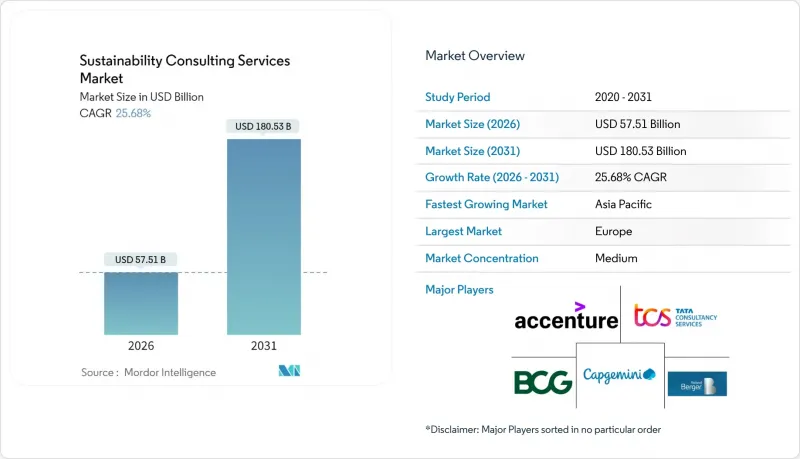
日益严格的监管要求、企业净零排放承诺的激增以及数位碳数据平台的普及,正将环境、社会和管治(ESG) 管理提升为董事会层面的优先事项。仅欧盟的《企业可持续发展报告指令》就已强制要求超过 5 万家公司披露相关信息,从而推动了对专业指导的需求激增。同时,投资人正加速将资本重新配置到气候友善资产,企业也寻求对其脱碳计画的外部检验。科技的日益普及正在重塑服务交付模式,人工智慧驱动的碳核算引擎实现了资料收集的自动化,使咨询顾问能够专注于更高价值的咨询服务。儘管竞争激烈,但市场仍然高度分散,这为全球巨头和利基专家在生物多样性、循环经济和基于自然的解决方案等新兴领域抢占市场份额提供了机会。
全球永续发展咨询服务市场趋势与洞察
企业净零排放目标推动咨询支出成长
大型企业目前将净零排放目标视为硬性期限,而不仅仅是目标。董事会必须将基于科学的目标转化为可操作的蓝图,涵盖供应链规划、技术选择和相关人员。范围3的排放通常超过总排放的70%,这增加了复杂性,也增加了对第三方指导的需求。全球2000家最大的企业中,只有16%预计在2050年前实现净零排放,凸显了巨大的实施差距,需要外部顾问来弥补。随着监管日益严格和调查方法不断发展,持续监测、目标调整和保障要求成为多年咨询计画的基础。
扩大ESG和永续发展资讯揭露法规
欧盟《企业永续性报告指令》(CSRD)引入了双重重要性分析、结构化数位标籤和第三方鑑证,这给在欧洲开展业务的公司带来了巨大的学习挑战。 2024年至2026年的分阶段实施计画将持续推高报告企业的咨询需求。总部位于欧盟以外的跨国公司,如果其在欧盟地区拥有显着的销售额,也将被纳入该指令的适用范围,从而将合规计划扩展到全球层面。资料收集的深度需求迫使企业升级其报告流程、IT系统和内部控制,顾问公司也因此在这些领域提供评估、设计和变革管理服务。
严重的劳动力短缺推高了计费成本。
对兼具气候科学、监管洞察和策略咨询能力的专业人才的需求远远超过供给。生物多样性评估、循环产品设计和人工智慧驱动的排放分析等专业尤其供不应求。儘管企业正在提高薪资、从竞争对手那里挖人并投资技能提升项目,但人才储备仍然有限。不断上涨的每日津贴标准疏远了一些中端市场客户,减少了计划数量,并自然而然地抑制了永续发展咨询服务市场的发展。技术赋能的交付模式正在弥补部分缺口,但复杂的案例仍需要人类的专业知识。
细分市场分析
至2025年,气候变迁咨询将占永续发展咨询服务市场收入的29.12%。循环经济和资源效率的交易规模虽小,但预计到2031年将以18.05%的复合年增长率高速成长,反映出企业对减少废弃物和可再生设计的日益关注。由于资讯揭露要求的扩大,ESG报告咨询的需求不断增长;而绿色建筑咨询则受益于监管的加强和认证系统的普及。
推行循环经济策略的客户需要进行产品重新设计、逆向物流规划、开发新的收入模式。咨询团队正在整合生命週期评估工具和财务影响模型,以支援决策。随着原物料成本上涨和掩埋法规日益严格,经营团队将循环经济视为降低风险和创造价值的双重途径,从而推动永续发展咨询服务市场的长期成长。
到了2025年,能源和电力公司将占总支出的23.78%,凸显该产业在全球脱碳进程中的核心作用。同时,製造业预计将以15.74%的复合年增长率推动成长,这得益于不断完善的供应链监管和工业4.0投资与资源效率目标的同步推进。金融服务客户将需要气候风险情境分析和永续金融产品设计,而绿色建筑标准和碳排放追踪将成为建筑和蕴藏量行业的关键活动。
製造商面临越来越大的压力,需要报告范围 3 的排放、遵守客户主导的供应商规范并降低能源强度。咨询服务涵盖物料流图绘製、可再生能源采购数位双胞胎实施等各个面向。随着监管和商业性因素的融合,工业客户在永续发展咨询服务市场中所占的份额越来越大。
永续发展咨询服务市场按服务类型(例如,气候变迁咨询、绿色建筑咨询)、终端用户产业(例如,能源电力、建筑房地产)、咨询交付模式(例如,策略与顾问)、永续发展重点领域(例如,气候变迁与净零排放)以及地区进行细分。市场预测以美元计价。
区域分析
到2025年,欧洲将占全球收入的38.74%,反映出欧洲较早采纳了相关监管措施,企业永续发展实践日趋成熟。 《企业永续发展报告指令》(CSRD)、欧盟分类标准以及各国的气候中和法律,都为持续进行多年咨询服务提供了支持。例如,德国联邦机构正在聘请顾问制定产业脱碳蓝图,并监测其2045年碳中和目标的进展。复杂的双重实质评估和数位标籤法规进一步增加了对兼具法律、金融和技术学科专业知识的需求。
预计到2031年,亚太地区将以16.92%的复合年增长率实现最快成长速度。工业化、出口导向供应链以及主权财富基金的投资策略共同推动了咨询支出的成长。中国和印度等国已启动排放交易试点计画和绿色金融框架,促使国内企业寻求合规和机会的指导。彭博新能源财经预测,到2050年,该地区将需要74兆至89兆美元的转型资本,将为大规模的永续发展咨询服务市场奠定基础。能够利用全球经验并实现服务在地化的服务提供者将占据最佳优势。
北美市场日趋成熟,但规模仍庞大。企业自愿性倡议、州级清洁能源标准以及投资者的积极参与支撑着市场的稳定成长,但缺乏全面的联邦监管限制了其加速发展。随着跨国公司供应链向下游扩展,南美市场需求正在涌现;而中东和非洲市场则受到资源产业多元化计画以及主权财富基金ESG目标的推动。各地区政策成熟度的差异造就了不同的服务组合,从而增强了永续发展咨询服务市场的全球韧性。
其他福利:
- Excel格式的市场预测(ME)表
- 3个月的分析师支持
目录
第一章 引言
- 研究假设和市场定义
- 调查范围
第二章调查方法
第三章执行摘要
第四章 市场洞察
- 市场概览
- 市场驱动因素
- 企业为实现净零排放目标所做的努力推动了咨询支出。
- 扩大 ESG 和永续性资讯揭露法规(例如,CSRD)
- 投资者面临压力,需要在配置资本时考虑气候风险。
- 公共部门脱碳促进计划
- 人工智慧驱动的碳核算平台推动综合计划
- 新兴市场主权财富基金的永续性要求
- 市场限制
- 由于劳动力严重短缺,帐单成本上升。
- 监管确定性缺口和「绿色清洗」诉讼风险
- 现成的SaaS永续发展工具淘汰咨询服务
- 碳信用价格的波动降低了投资报酬率的吸引力。
- 价值链分析
- 监管环境
- 技术展望
- 波特五力分析
- 供应商的议价能力
- 买方的议价能力
- 新进入者的威胁
- 替代品的威胁
- 竞争对手之间的竞争
- 产业生态系分析
- 主要用例和案例研究
- 宏观经济趋势评估
- 投资分析
第五章 市场规模与成长预测
- 按服务类型
- 气候变迁咨询
- 绿建筑咨询
- ESG和报告咨询
- 循环经济与资源效率咨询
- 永续发展策略与管治
- 按最终用户行业划分
- 能源与电力
- 建筑和房地产
- 製造业和工业
- 金融服务和保险
- 公共部门和非政府组织(NGO)
- 透过咨商模式
- 策略与咨询
- 部署与集成
- 託管服务/外包
- 数位平台和分析
- 培训和能力建设
- 按可持续发展优先领域划分
- 气候变迁与净零排放
- 生物多样性和基于自然的解决方案
- 循环经济与废弃物管理
- 社会影响与多元、公平与包容
- 永续金融与报告
- 按地区
- 北美洲
- 我们
- 加拿大
- 墨西哥
- 南美洲
- 巴西
- 阿根廷
- 哥伦比亚
- 南美洲其他地区
- 欧洲
- 德国
- 英国
- 法国
- 义大利
- 西班牙
- 俄罗斯
- 荷兰
- 其他欧洲地区
- 亚太地区
- 中国
- 日本
- 韩国
- 印度
- 澳洲
- 新加坡
- 亚太其他地区
- 中东和非洲
- 中东
- 沙乌地阿拉伯
- 阿拉伯聯合大公国
- 其他中东地区
- 非洲
- 南非
- 埃及
- 其他非洲地区
- 中东
- 北美洲
第六章 竞争情势
- 市场集中度
- 策略趋势
- 市占率分析
- 公司简介
- Accenture plc
- Boston Consulting Group, Inc.
- Tata Consultancy Services Ltd.
- Capgemini SE
- Roland Berger GmbH
- Bain and Company, Inc.
- KPMG International Ltd.
- Ernst and Young Global Ltd.
- Deloitte Touche Tohmatsu Ltd.
- PricewaterhouseCoopers LLP
- McKinsey and Company, Inc.
- AECOM
- WSP Global Inc.
- Environmental Resources Management Ltd.
- Jacobs Solutions Inc.
- Arcadis NV
- Wood Group plc
- Tetra Tech, Inc.
- Ramboll Group A/S
- Stantec Inc.
第七章 市场机会与未来展望
The sustainability consulting services market was valued at USD 45.75 billion in 2025 and estimated to grow from USD 57.51 billion in 2026 to reach USD 180.53 billion by 2031, at a CAGR of 25.68% during the forecast period (2026-2031).
Heightened regulatory mandates, fast-rising corporate net-zero pledges and digital carbon-data platforms are turning environmental, social and governance management into a board-level priority. The European Union's Corporate Sustainability Reporting Directive alone brings more than 50,000 firms into mandatory disclosure scope, multiplying demand for specialized guidance. At the same time, investors are reallocating capital toward climate-aligned assets, prompting companies to seek external verification of decarbonization plans. Technology adoption is reshaping service delivery as AI-enabled carbon-accounting engines automate data capture, freeing consultants to focus on high-value advisory. Competition is intensifying, yet the market remains sufficiently fragmented for both global majors and niche boutiques to capture share in emerging areas such as biodiversity, circularity and nature-based solutions.
Global Sustainability Consulting Services Market Trends and Insights
Corporate Net-Zero Commitments Accelerating Advisory Spend
Large enterprises now treat net-zero targets as hard compliance deadlines rather than aspirational statements. Boards must translate science-based targets into operational roadmaps that span supply-chain mapping, technology selection and stakeholder engagement. Scope 3 emissions regularly exceed 70% of total footprints, amplifying complexity and elevating the need for third-party guidance. Only 16% of the world's 2,000 largest firms remain on track for 2050 net-zero, underscoring a vast execution gap that external advisors are hired to close . Continuous monitoring, target recalibration and assurance requirements sustain multi-year consulting engagements as regulations tighten and methodologies evolve.
Expanding ESG and Sustainability Disclosure Regulations
The EU CSRD introduces double materiality analysis, structured digital tagging and third-party assurance, creating a steep learning curve for companies with European operations. Staggered adoption timelines from 2024 to 2026 keep advisory demand elevated across successive cohorts of filers. Non-EU multinationals with significant regional sales also fall within scope, extending compliance projects worldwide. Required data-collection depth forces upgrades to reporting processes, IT systems and internal controls, areas where consultancies provide assessment, design and change-management services.
Acute Talent Shortage Inflating Billing Rates
Demand for professionals who blend climate science, regulatory insight and strategic consulting far outweighs supply. Specialized roles in biodiversity valuation, circular-product design and AI-driven emissions analytics remain especially scarce. Firms raise compensation, poach competitors and invest in upskilling programs, yet pipeline constraints persist. Elevated day rates deter some midmarket clients, dampening project volumes and placing a natural brake on the sustainability consulting services market. Technology-enabled delivery models partly offset the shortfall, but complex engagements still require human expertise.
Other drivers and restraints analyzed in the detailed report include:
- AI-Enabled Carbon-Accounting Platforms Driving Integration Projects
- Public-Sector Decarbonization Stimulus Programs
- Off-the-Shelf SaaS Sustainability Tools Disintermediating Consulting
For complete list of drivers and restraints, kindly check the Table Of Contents.
Segment Analysis
Climate-change consulting accounted for 29.12% of 2025 revenue within the sustainability consulting services market. Circular-economy and resource-efficiency engagements, though smaller, will post the strongest 18.05% CAGR to 2031, reflecting growing corporate interest in waste elimination and regenerative design. ESG-reporting advisory gains traction as disclosure obligations expand, while green-building consulting benefits from stricter codes and certification schemes.
Clients pursuing circular-economy strategies demand product redesign, reverse-logistics planning and new revenue-model development. Advisory teams integrate life-cycle assessment tools with financial-impact modeling to guide decision-making. As material costs rise and landfill regulations tighten, leaders view circularity as both risk mitigation and value creation, reinforcing long-run expansion of the sustainability consulting services market.
Energy and power companies generated 23.78% of 2025 spending, underscoring the sector's central role in global decarbonization. Manufacturers, however, will pace growth at a 15.74% CAGR as supply-chain mandates propagate and Industry 4.0 investments intersect with resource-efficiency goals. Financial-services clients request climate-risk scenario analysis and sustainable-finance product design, while construction and real estate engagements revolve around green-building codes and embodied-carbon tracking.
Manufacturers face mounting pressure to report scope-3 emissions, comply with customer-driven supplier codes and reduce energy intensity. Consulting assignments span material-flow mapping, renewable-energy sourcing and digital twin deployment. As regulatory and commercial drivers converge, industrial clients contribute an ever-larger slice of the sustainability consulting services market size.
Sustainability Consulting Services Market is Segmented by Service Type (Climate-Change Consulting, Green-Building Consulting, and More), End-User Industry (Energy and Power, Construction and Real Estate, and More), Consulting Delivery Model (Strategy and Advisory, and More), Sustainability Focus Area (Climate-Change and Net-Zero, and More), and Geography. The Market Forecasts are Provided in Terms of Value (USD).
Geography Analysis
Europe generated 38.74% of 2025 revenue, reflecting early regulatory adoption and mature corporate sustainability practices. The CSRD, EU Taxonomy and national climate-neutrality laws sustain multiyear advisory pipelines. German federal agencies, for instance, enlist consultants to draft sector-specific decarbonization roadmaps and monitor progress toward the 2045 neutrality goal. Complex double-materiality assessments and digital tagging rules reinforce demand for integrated legal, financial, and technical expertise.
Asia-Pacific will deliver the fastest 16.92% CAGR to 2031. Industrialization, supply-chain export exposure and sovereign-wealth-fund mandates converge to spur consulting spend. Nations such as China and India launch emissions-trading pilots and green-finance frameworks, compelling domestic firms to seek guidance on compliance and opportunity capture. BloombergNEF projects the region needs USD 74-89 trillion in transition capital through 2050, anchoring a sizeable sustainability consulting services market. Service providers that localize offerings while leveraging global playbooks are best positioned.
North America remains sizeable though maturing. Voluntary corporate commitments, state-level clean-energy standards and investor activism underpin steady growth, yet lack of comprehensive federal regulation tempers acceleration. South American demand is emerging as multinational supply-chain requirements extend downstream, whereas the Middle East and Africa benefit from resource-sector diversification agendas and sovereign-fund ESG goals. Varied policy maturity across geographies ensures differentiated service mixes, bolstering global resilience of the sustainability consulting services market.
- Accenture plc
- Boston Consulting Group, Inc.
- Tata Consultancy Services Ltd.
- Capgemini SE
- Roland Berger GmbH
- Bain and Company, Inc.
- KPMG International Ltd.
- Ernst and Young Global Ltd.
- Deloitte Touche Tohmatsu Ltd.
- PricewaterhouseCoopers LLP
- McKinsey and Company, Inc.
- AECOM
- WSP Global Inc.
- Environmental Resources Management Ltd.
- Jacobs Solutions Inc.
- Arcadis N.V.
- Wood Group plc
- Tetra Tech, Inc.
- Ramboll Group A/S
- Stantec Inc.
Additional Benefits:
- The market estimate (ME) sheet in Excel format
- 3 months of analyst support
TABLE OF CONTENTS
1 INTRODUCTION
- 1.1 Study Assumptions and Market Definition
- 1.2 Scope of the Study
2 RESEARCH METHODOLOGY
3 EXECUTIVE SUMMARY
4 MARKET INSIGHTS
- 4.1 Market Overview
- 4.2 Market Drivers
- 4.2.1 Corporate net-zero commitments accelerating advisory spend
- 4.2.2 Expanding ESG and sustainability disclosure regulations (e.g., CSRD)
- 4.2.3 Investor pressure for climate-risk-aligned capital allocation
- 4.2.4 Public-sector decarbonization stimulus programs
- 4.2.5 AI-enabled carbon-accounting platforms driving integration projects
- 4.2.6 Sovereign-wealth-fund sustainability mandates in emerging markets
- 4.3 Market Restraints
- 4.3.1 Acute talent shortage inflating billing rates
- 4.3.2 Regulatory-certainty gaps and greenwashing litigation risk
- 4.3.3 Off-the-shelf SaaS sustainability tools disintermediating consulting
- 4.3.4 Carbon-credit price volatility undermining ROI narratives
- 4.4 Value Chain Analysis
- 4.5 Regulatory Landscape
- 4.6 Technological Outlook
- 4.7 Porter's Five Forces Analysis
- 4.7.1 Bargaining Power of Suppliers
- 4.7.2 Bargaining Power of Buyers
- 4.7.3 Threat of New Entrants
- 4.7.4 Threat of Substitutes
- 4.7.5 Competitive Rivalry
- 4.8 Industry Ecosystem Analysis
- 4.9 Key Use Cases and Case Studies
- 4.10 Assessment of Macroeconomic Trends
- 4.11 Investment Analysis
5 MARKET SIZE AND GROWTH FORECASTS (VALUE)
- 5.1 By Service Type
- 5.1.1 Climate-Change Consulting
- 5.1.2 Green-Building Consulting
- 5.1.3 ESG and Reporting Advisory
- 5.1.4 Circular-Economy and Resource-Efficiency Consulting
- 5.1.5 Sustainability Strategy and Governance
- 5.2 By End-User Industry
- 5.2.1 Energy and Power
- 5.2.2 Construction and Real Estate
- 5.2.3 Manufacturing and Industrials
- 5.2.4 Financial Services and Insurance
- 5.2.5 Public Sector and NGOs
- 5.3 By Consulting Delivery Model
- 5.3.1 Strategy and Advisory
- 5.3.2 Implementation and Integration
- 5.3.3 Managed Services / Outsourcing
- 5.3.4 Digital Platforms and Analytics
- 5.3.5 Training and Capacity-Building
- 5.4 By Sustainability Focus Area
- 5.4.1 Climate-Change and Net-Zero
- 5.4.2 Biodiversity and Nature-Based Solutions
- 5.4.3 Circular-Economy and Waste-Management
- 5.4.4 Social Impact and DEI
- 5.4.5 Sustainable Finance and Reporting
- 5.5 By Geography
- 5.5.1 North America
- 5.5.1.1 United States
- 5.5.1.2 Canada
- 5.5.1.3 Mexico
- 5.5.2 South America
- 5.5.2.1 Brazil
- 5.5.2.2 Argentina
- 5.5.2.3 Colombia
- 5.5.2.4 Rest of South America
- 5.5.3 Europe
- 5.5.3.1 Germany
- 5.5.3.2 United Kingdom
- 5.5.3.3 France
- 5.5.3.4 Italy
- 5.5.3.5 Spain
- 5.5.3.6 Russia
- 5.5.3.7 Netherlands
- 5.5.3.8 Rest of Europe
- 5.5.4 Asia-Pacific
- 5.5.4.1 China
- 5.5.4.2 Japan
- 5.5.4.3 South Korea
- 5.5.4.4 India
- 5.5.4.5 Australia
- 5.5.4.6 Singapore
- 5.5.4.7 Rest of Asia-Pacific
- 5.5.5 Middle East and Africa
- 5.5.5.1 Middle East
- 5.5.5.1.1 Saudi Arabia
- 5.5.5.1.2 United Arab Emirates
- 5.5.5.1.3 Rest of Middle East
- 5.5.5.2 Africa
- 5.5.5.2.1 South Africa
- 5.5.5.2.2 Egypt
- 5.5.5.2.3 Rest of Africa
- 5.5.5.1 Middle East
- 5.5.1 North America
6 COMPETITIVE LANDSCAPE
- 6.1 Market Concentration
- 6.2 Strategic Moves
- 6.3 Market Share Analysis
- 6.4 Company Profiles (includes Global level Overview, Market level overview, Core Segments, Financials as available, Strategic Information, Market Rank/Share for key companies, Products and Services, and Recent Developments)
- 6.4.1 Accenture plc
- 6.4.2 Boston Consulting Group, Inc.
- 6.4.3 Tata Consultancy Services Ltd.
- 6.4.4 Capgemini SE
- 6.4.5 Roland Berger GmbH
- 6.4.6 Bain and Company, Inc.
- 6.4.7 KPMG International Ltd.
- 6.4.8 Ernst and Young Global Ltd.
- 6.4.9 Deloitte Touche Tohmatsu Ltd.
- 6.4.10 PricewaterhouseCoopers LLP
- 6.4.11 McKinsey and Company, Inc.
- 6.4.12 AECOM
- 6.4.13 WSP Global Inc.
- 6.4.14 Environmental Resources Management Ltd.
- 6.4.15 Jacobs Solutions Inc.
- 6.4.16 Arcadis N.V.
- 6.4.17 Wood Group plc
- 6.4.18 Tetra Tech, Inc.
- 6.4.19 Ramboll Group A/S
- 6.4.20 Stantec Inc.
7 MARKET OPPORTUNITIES AND FUTURE OUTLOOK
- 7.1 White-space and Unmet-Need Assessment

 咨询4.0市场:2026-2032年全球预测(依产品类型、技术、应用、最终用户及通路划分)企业敏捷转型服务市场:2026-2032年全球市场预测(依服务类型、调查方法、转型阶段、合约模式、部署模式、产业及组织规模划分)
 2026年全球IT咨询市场报告2026年全球企业敏捷转型服务市场报告
 企业敏捷转型服务市场规模、份额、趋势和预测:按方法论、服务类型、组织规模、产业和地区划分,2026-2034 年2026年全球公司秘书服务市场报告2026年全球房地产咨询服务市场报告2026年全球精算咨询服务市场报告2026年全球设计、研究、促销与咨询服务市场报告
 2026-2030年全球行销咨询市场