


 |
市场调查报告书
商品编码
1940909
美国屋顶材料市场:市场份额分析、行业趋势和统计数据、成长预测(2026-2031 年)United States Roofing - Market Share Analysis, Industry Trends & Statistics, Growth Forecasts (2026 - 2031) |
||||||

※ 本网页内容可能与最新版本有所差异。详细情况请与我们联繫。
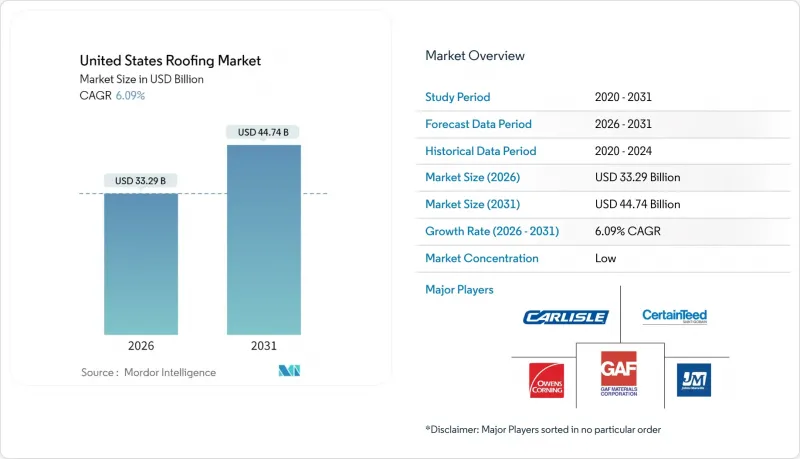
据估计,到 2026 年,美国屋顶市场价值将达到 332.9 亿美元,高于 2025 年的 313.8 亿美元。
预计到 2031 年,该市场规模将达到 447.4 亿美元,2026 年至 2031 年的复合年增长率为 6.09%。
美国老旧住宅存量、频繁发生的极端天气事件以及联邦政府的节能奖励,共同支撑着这一行业的稳定扩张。屋顶更换占年度安装总量的五分之四以上,确保了即使新建筑项目放缓,该行业也能拥有可预测的需求基础。对于商业计划,平屋顶和低坡度屋顶系统占据主导地位,因为膜材技术能够满足现代建筑规范的能源性能要求。同时,由于业主对耐用且适用于太阳能的屋顶表面的需求,金属和TPO产品的市场份额正在超过其他材料。分销整合推动了家得宝和QXO等公司达成的数十亿美元交易,并将人工智慧工具引入供应链,为大型平台铺平了道路,使其能够为承包商提供更快捷的交货和客製化的产品服务。
美国屋顶市场趋势与分析
住宅存量维修週期将推动持续的需求。
每年超过80%的屋顶工程需求源自于屋顶更换,而美国住宅的平均房龄已接近40年。强风的侵袭加速了沥青瓦的劣化,现场研究表明,沥青瓦的使用寿命通常只有10年。美国东北部和中西部地区住宅了大量战后建造的房屋,这些住宅目前正处于维修阶段,这使得承包商无论经济状况如何波动都能获得稳定的订单。抵押房屋抵押贷款利率的下降进一步推动了这一趋势,使业主能够将部分房产价值用于维修预算。无人机辅助的房屋状况评估可以缩短检查时间并产生客观的数据集,从而加快保险理赔速度,并进一步优化计划流程。
与气候相关的风暴灾害修復将重塑市场动态
2024年,美国与屋顶相关的保险理赔金额超过300亿美元。对流风暴造成的财产损失高达570亿美元,几乎是去年的两倍。德克萨斯州、科罗拉多以及邻近的龙捲风走廊各州发生的此类事件比例不断上升,非危险性风灾和冰雹灾害的索赔比例从2022年的17%上升到2024年的25%。这种反覆发生的灾害将缩短屋顶更换週期,导致本已紧张的劳动市场需求激增。目前,保险公司正在降低15至20年以上屋顶的承保范围,并为4级抗衝击等级的屋顶系统提供保费折扣,引导客户选择高成本的金属和复合材料产品。
技术纯熟劳工短缺限制了成长潜力
到2025年,建设产业需要新增50.1万名工人,然而五分之一的屋顶工人已经超过55岁。艰苦的工作条件导致屋顶工人的离职率高于其他行业。儘管美国国家屋顶承包商协会(NRCA)扩大了TRAC课程,克莱姆森大学也斥资100万美元建立了屋顶产业中心,但学徒毕业生仍无法满足市场需求。劳动力短缺推高了建筑成本,导致计划延期,并限制了承包商向风暴灾区扩张的速度。私募股权支持的平台正在积极招聘,但小规模承包商在工资和福利方面无法与之竞争,导致人才缺口进一步扩大。
细分市场分析
预计到2025年,住宅应用将占美国屋顶市场收入的59.12%,并在2031年之前以7.18%的复合年增长率增长,这主要得益于老旧住宅和风暴造成的屋顶更换需求。可预测的更换週期为安装商提供了稳定的收入基础,而第25C条税额扣抵鼓励业主升级到节能型屋顶材料和金属板,从而有助于提升房产价值。保险公司也正在鼓励使用抗衝击系统,这进一步缩短了更换週期。
受企业净零排放目标和电子商务扩张的推动,仓库建设热潮带动商业需求持续成长。低坡度防水捲材及其太阳能适用表面正吸引寻求降低营运成本的设施管理人员的关注,而联邦基础设施资金也正投入学校、交通枢纽和公共设施建设。儘管住宅市场仍然是美国屋顶市场的支柱,但大型全国性承包商正越来越多地调整其业务组合,增加各类商业计划,以对冲单户住宅需求的区域性波动风险。
到2025年,维修将占美国屋顶市场的81.65%,反映出建筑存量趋于成熟以及风暴灾害保险赔偿频繁。无人机影像、人工智慧辅助的状况评估以及简化的保险入口网站正在缩短理赔週期,加快风暴过后屋顶的拆除速度,促使承包商将人力和资源集中投入到专门负责屋顶翻新的快速响应团队中。
虽然新增安装量目前占比不高,但随着阳光地带住宅量增加以及资料中心建设在区域性城市蓬勃发展,预计其年复合成长率将达到7.52%。现代建筑规范强制要求使用反光和耐火材料,这推高了单位成本。建筑商与经销商之间的合作使得现场材料储存成为可能,最大限度地减少了盗窃和天气造成的延误,即使在人手不足的情况下,也促进了相关技术的应用。
其他福利:
- Excel格式的市场预测(ME)表
- 分析师支持(3个月)
目录
第一章 引言
- 研究假设和市场定义
- 调查范围
第二章调查方法
第三章执行摘要
第四章 市场情势
- 市场概览
- 市场驱动因素
- 住宅存量维修週期(占需求的 80% 以上)
- 气候变迁导致的风暴灾害修復和保险费用
- 联邦和州政府的节能奖励(IRA税额扣抵,第 24 章)
- 大型零售商进军专业经销领域(家得宝与SRS的合作)
- 人工智慧驱动的航空数据定价和保险理赔处理(Verisk、EagleView)
- 市场限制
- 由于技术纯熟劳工短缺,建筑成本不断上涨
- 沥青和聚合物原料价格波动;
- 假冒仿冒品材料的普遍存在
- 保险收紧:提高免赔额,并将劣化屋顶排除在承保范围之外
- 价值/供应链分析
- 监管环境
- 技术展望
- 产业吸引力-波特五力分析
- 新进入者的威胁
- 供应商的议价能力
- 买方的议价能力
- 替代品的威胁
- 竞争对手之间的竞争
第五章 市场规模及成长预测(价值,单位:十亿美元)
- 按行业
- 住宅
- 商业的
- 办公室和零售设施
- 工业与物流
- 其他的
- 基础设施
- 按安装类型
- 新安装
- 更换/维修(屋顶更换)
- 按屋顶类型
- 斜屋顶
- 平屋顶/低坡度屋顶
- 依材料类型
- 改性沥青
- EPDM橡胶
- 热塑性聚烯
- PVC膜
- 金属
- 瓦
- 其他的
- 按地区
- 东北
- 中西部
- 东南
- 西
- 西南
第六章 竞争情势
- 市场集中度
- 策略趋势
- 市占率分析
- 公司简介
- GAF Materials Corporation
- Owens Corning
- CertainTeed(Saint-Gobain)
- Carlisle Companies Inc.
- Johns Manville(Berkshire Hathaway)
- IKO Industries
- TAMKO Building Products
- Atlas Roofing Corporation
- Beacon Building Products
- ABC Supply Co.
- Holcim Elevate(Firestone Building Products)
- Duro-Last Inc.
- Malarkey Roofing Products
- CentiMark Corporation
- Tecta America
- Flynn Group
- Baker Roofing Company
- IronHead Roofing
- Sika Sarnafil
- MFM Building Products
第七章 市场机会与未来展望
United States Roofing Market market size in 2026 is estimated at USD 33.29 billion, growing from 2025 value of USD 31.38 billion with 2031 projections showing USD 44.74 billion, growing at 6.09% CAGR over 2026-2031.
Renewals triggered by the nation's aging housing stock, the growing frequency of severe weather events, and federal energy-efficiency incentives underpin this steady expansion. Re-roofing activities account for more than four-fifths of annual installation volume, giving the industry a predictable demand foundation even when new construction moderates. Flat and low-slope systems dominate commercial projects because their membrane technologies satisfy modern building-code requirements for energy performance, while metal and TPO products outpace other materials as owners seek durability and solar-ready surfaces. Distribution consolidation, led by Home Depot's and QXO's multibillion-dollar deals, ushers artificial-intelligence tools into supply chains and positions large platforms to offer contractors faster deliveries and tailored assortments.
United States Roofing Market Trends and Insights
Housing-Stock Re-Roofing Cycle Drives Sustained Demand
More than four-fifths of annual roofing demand comes from re-roofing, and the median U.S. home age is nearing 40 years. Elevated wind exposure accelerates asphalt-shingle degradation, with field studies showing failures as early as 10 years into service life. Concentrated cohorts of post-war homes in the Northeast and Midwest are now simultaneously entering their renewal windows, giving contractors consistent volume regardless of macroeconomic swings. The cycle intensifies when mortgage rates dip, allowing owners to convert equity into upgrade budgets. Drone-based condition assessments shorten inspection times and create objective datasets that speed insurance claims, further smoothing project pipelines.
Climate-Driven Storm Repairs Reshape Market Dynamics
U.S. roof-related claims exceeded USD 30 billion in 2024 as convective storms produced USD 57 billion in property damage, almost double the prior year. Texas, Colorado, and adjacent Tornado Alley states account for a rising share of events, with non-catastrophic wind and hail claims climbing from 17% in 2022 to 25% in 2024. This recurring hazard compresses replacement cycles and pushes demand spikes into already tight labor markets. Insurers now depreciate coverage for roofs older than 15-20 years and offer premium credits for Class 4 impact-rated systems, nudging customers toward higher-cost metal and synthetic products.
Skilled-Labor Shortages Constrain Growth Potential
The construction sector needs 501,000 more workers in 2025, yet 1 in 5 roofers is already over 55 years old. Harsh job-site conditions drive higher turnover than in other trades, and apprenticeship completions lag demand despite NRCA's expanded TRAC curriculum and Clemson's USD 1 million Roofing Industry Center commitment. Labor shortfalls inflate installation costs, extend project backlogs, and limit the pace at which contractors can scale into storm-damaged regions. Private equity-backed platforms recruit aggressively, but smaller shops struggle to match wage offers and benefit packages, widening capacity gaps.
Other drivers and restraints analyzed in the detailed report include:
- Federal Energy Efficiency Incentives Accelerate Premium Adoption
- Retail Distribution Consolidation Transforms Market Access
- Material Price Volatility Pressures Margin Stability
For complete list of drivers and restraints, kindly check the Table Of Contents.
Segment Analysis
Residential applications generated 59.12% of 2025 revenue for the United States roofing market and are on track for a 7.18% CAGR through 2031 as aging homes collide with storm-driven replacements. Predictable renewal cycles give installers steady baselines, while Section 25C credits persuade owners to upgrade to energy-efficient shingles or metal panels that boost property values. Insurers incentivize impact-rated systems, compressing replacement timelines even further.
Commercial demand gains momentum from corporate net-zero commitments and an e-commerce-fueled warehouse boom. Low-slope membranes with solar-ready surfaces attract facility managers seeking lower operating costs, and federal infrastructure funding channels work to schools, transit centers, and public offices. Although residential still anchors the United States roofing market, large national contractors increasingly balance their portfolios with diversified commercial projects to hedge regional single-family swings.
Replacement undertakings represented 81.65% of the United States roofing market size in 2025, reflecting a mature building inventory and frequent storm damage settlements. Drone imagery, AI-assisted condition scoring, and streamlined insurance portals shorten claim cycles, driving faster roof tear-offs once weather events hit. Contractors, therefore, allocate personnel and inventory toward ready-response teams that specialize in reroof projects.
New installations account for a smaller share yet are forecast to grow 7.52% CAGR as migration pushes housing starts in the Sun Belt and data-center builds sweep secondary metros. Modern codes mandate reflective or fire-rated coverings, often elevating unit costs. Partnerships between builders and distributors enable job-site staging that minimizes theft and weather delays, reinforcing adoption even when labor remains tight.
The United States Roofing Market Report is Segmented by Sector (Residential, Commercial, Infrastructure), by Installation Type (New Installation, Replacement/Renovation), by Roofing Type (Slope Roof, Flat/Low-Slope Roof), by Material Type (Modified Bitumen, EPDM Rubber, TPO, PVC Membrane, and More), and by Geography (Northeast, Midwest, Southeast, West, Southwest). The Market Forecasts are Provided in Terms of Value (USD).
List of Companies Covered in this Report:
- GAF Materials Corporation
- Owens Corning
- CertainTeed (Saint-Gobain)
- Carlisle Companies Inc.
- Johns Manville (Berkshire Hathaway)
- IKO Industries
- TAMKO Building Products
- Atlas Roofing Corporation
- Beacon Building Products
- ABC Supply Co.
- Holcim Elevate (Firestone Building Products)
- Duro-Last Inc.
- Malarkey Roofing Products
- CentiMark Corporation
- Tecta America
- Flynn Group
- Baker Roofing Company
- IronHead Roofing
- Sika Sarnafil
- MFM Building Products
Additional Benefits:
- The market estimate (ME) sheet in Excel format
- 3 months of analyst support
TABLE OF CONTENTS
1 Introduction
- 1.1 Study Assumptions & Market Definition
- 1.2 Scope of the Study
2 Research Methodology
3 Executive Summary
4 Market Landscape
- 4.1 Market Overview
- 4.2 Market Drivers
- 4.2.1 Housing-stock re-roofing cycle (>=80 % of demand)
- 4.2.2 Climate-driven storm repairs & insurance spend
- 4.2.3 Federal/State energy-efficiency incentives (IRA tax credits, Title 24)
- 4.2.4 Retail giant entry into specialty distribution (Home Depot-SRS deal)
- 4.2.5 AI-enabled aerial data pricing/claims (Verisk, EagleView)
- 4.3 Market Restraints
- 4.3.1 Skilled-labor shortages elevating installation costs
- 4.3.2 Volatility in asphalt & polymer feedstock prices
- 4.3.3 Proliferation of counterfeit/sub-spec materials
- 4.3.4 Insurance tightening: higher deductibles & roof-age exclusions
- 4.4 Value / Supply-Chain Analysis
- 4.5 Regulatory Landscape
- 4.6 Technological Outlook
- 4.7 Industry Attractiveness - Porter's Five Forces Analysis
- 4.7.1 Threat of New Entrants
- 4.7.2 Bargaining Power of Suppliers
- 4.7.3 Bargaining Power of Buyers
- 4.7.4 Threat of Substitutes
- 4.7.5 Intensity of Competitive Rivalry
5 Market Size & Growth Forecasts (Value, In USD Billion)
- 5.1 By Sector
- 5.1.1 Residential
- 5.1.2 Commercial
- 5.1.2.1 Offices and Retail
- 5.1.2.2 Industrial and Logistics
- 5.1.2.3 Others
- 5.1.3 Infrastructure
- 5.2 By Installation Type
- 5.2.1 New Installation
- 5.2.2 Replacement / Renovation (Re-Roofing)
- 5.3 By Roofing Type
- 5.3.1 Slope Roof
- 5.3.2 Flat / Low-Slope Roof
- 5.4 By Material Type
- 5.4.1 Modified Bitumen
- 5.4.2 EPDM Rubber
- 5.4.3 Thermoplastic Polyolefin
- 5.4.4 PVC Membrane
- 5.4.5 Metals
- 5.4.6 Tiles
- 5.4.7 Others
- 5.5 By Geography
- 5.5.1 Northeast
- 5.5.2 Midwest
- 5.5.3 Southeast
- 5.5.4 West
- 5.5.5 Southwest
6 Competitive Landscape
- 6.1 Market Concentration
- 6.2 Strategic Moves
- 6.3 Market Share Analysis
- 6.4 Company Profiles (includes Global level Overview, Market level overview, Core Segments, Financials as available, Strategic Information, Products & Services, and Recent Developments)
- 6.4.1 GAF Materials Corporation
- 6.4.2 Owens Corning
- 6.4.3 CertainTeed (Saint-Gobain)
- 6.4.4 Carlisle Companies Inc.
- 6.4.5 Johns Manville (Berkshire Hathaway)
- 6.4.6 IKO Industries
- 6.4.7 TAMKO Building Products
- 6.4.8 Atlas Roofing Corporation
- 6.4.9 Beacon Building Products
- 6.4.10 ABC Supply Co.
- 6.4.11 Holcim Elevate (Firestone Building Products)
- 6.4.12 Duro-Last Inc.
- 6.4.13 Malarkey Roofing Products
- 6.4.14 CentiMark Corporation
- 6.4.15 Tecta America
- 6.4.16 Flynn Group
- 6.4.17 Baker Roofing Company
- 6.4.18 IronHead Roofing
- 6.4.19 Sika Sarnafil
- 6.4.20 MFM Building Products
7 Market Opportunities & Future Outlook
- 7.1 White-space & Unmet-need Assessment

 2026年全球低坡度住宅屋顶市场报告2026年全球屋顶材料市场报告
 绿色和蓝色屋顶市场:按屋顶类型、组件、系统设计、安装类型、屋顶结构、应用和用例划分——2026-2032年全球预测非住宅建筑屋面纱织物市场:按产品、材料、安装类型、应用、最终用途和分销管道划分-2026-2032年全球预测屋顶通风产品市场:依产品类型、安装类型、材质类型、最终用户、通路划分,全球预测(2026-2032)
 全球屋顶材料市场规模、份额、趋势及成长分析报告(2026-2034)2026年全球复合塑胶屋顶瓦市场报告
 屋顶材料市场-全球产业规模、份额、趋势、机会、预测:依产品类型、应用、地区、竞争格局划分,2021-2031年屋顶系统市场 - 全球产业规模、份额、趋势、机会及预测(依材料、产品、建筑类型、最终用户产业、地区及竞争格局划分,2021-2031年)
 2026-2030年全球屋顶通风产品市场