


 |
市场调查报告书
商品编码
1919788
全球基因组学人工智慧市场(至 2040 年):按组件类型、技术类型、功能类型、应用类型、最终用户类型、公司规模、主要地区、行业趋势和预测AI in Genomics Market, till 2040: Distribution by Type of Component, Type of Technology, Type of Functionality, Type of Application, Type of End User, Company Size and Key Geographical Regions: Industry Trends and Global Forecasts |
||||||

基因体学人工智慧市场展望
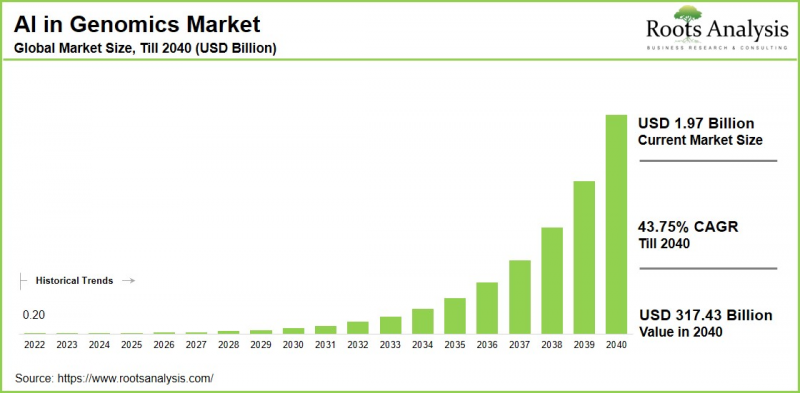
全球基因组学人工智慧市场预计将从目前的 19.7 亿美元成长到 2040 年的 3,174 亿美元,预测期内复合年增长率 (CAGR) 为 43.75%。
人工智慧正在透过处理来自 DNA 测序的大量数据集并揭示传统技术以前忽略的见解,从而改变基因组学领域。下一代测序等先进技术产生了大量的遗传数据。机器学习和深度学习等人工智慧应用在预测疾病风险、确定蛋白质结构、分析基因表现以及整合多组学资讯以实现个人化医疗方面表现出色。这将有助于快速发现新药、利用 CRISPR 进行精准的基因组编辑,以及根据每个人的基因蓝图客製化治疗方案。
随着新一代定序技术产生的基因组数据爆炸式增长,传统分析方法难以应对,需要人工智慧的模式识别能力,基因组学领域的人工智慧市场预计将显着增长。
高阶主管的策略洞察
人工智慧在药物发现和基因组学研究中的变革性作用
人工智慧正在透过提高效率、准确性和决策能力,在革新药物发现和基因组学研究中发挥变革性作用。传统上,药物开发是一个漫长而昂贵的过程,通常需要数年时间和大量投资。然而,人工智慧驱动的工具使得快速分析大量生物医学资料集成为可能。在药物研发领域,人工智慧演算法能够更准确地预测分子交互作用、优化先导化合物并识别潜在的候选药物。
在基因组学研究中,人工智慧正在促进复杂基因组数据的解读,从而能够识别疾病相关基因并了解影响药物反应的遗传变异。这些进展正在加速标靶治疗和个人化医疗的发展。此外,人工智慧的应用透过改善患者选择和预测治疗结果,支持更有效率的临床试验设计。总而言之,人工智慧在药物研发和基因组学研究中的融合正在重塑医疗保健格局,激发创新并推动全球向精准医疗转型。
基因组学人工智慧市场的主要成长驱动因素
基因组学人工智慧市场的成长受到多种因素的驱动,这些因素提高了基因组学研究和药物研发的效率和准确性。新一代定序技术产生的基因组数据呈指数级增长,这催生了对能够管理和分析复杂数据集的人工智慧工具的强劲需求。机器学习演算法能够快速识别基因模式、预测疾病并发现药物标靶,从而显着降低研发成本和所需时间。
对个人化医疗日益增长的关注也是一个主要驱动因素,人工智慧有助于解读个人基因谱,并推动开发更具针对性和更有效的治疗策略。此外,计算成本的下降和数据处理基础设施的进步正在推动人工智慧技术的广泛应用。大型科技公司的巨额投资以及製药和生物技术公司与人工智慧公司之间日益密切的合作,进一步加速了该领域的创新。
人工智慧在精准医疗的新应用
人工智慧透过实现数据驱动的个人化医疗,正在推动精准医疗取得重要进展。精准医疗根据个人的基因谱、生活方式和环境因素来客製化诊断和治疗策略。人工智慧技术透过高效处理和解读来自基因组定序、电子健康记录、医学影像、穿戴式装置等的大量数据,为此方法提供了支持。借助机器学习演算法,人工智慧能够发现复杂的模式和关联,从而指导疾病的早期检测、预测治疗反应并帮助制定标靶治疗方案。例如,在肿瘤学领域,人工智慧模型正被用于预测肿瘤行为、优化药物选择和设计个人化治疗方案。人工智慧还能透过提高变异解读的准确性和识别具有临床应用价值的生物标记来加速基因组数据分析。此外,它还能透过放射学和病理学中的影像分析技术来提高诊断准确性。这些应用使人工智慧成为精准医疗的关键推动因素,能够改善临床决策、减少试误治疗,最终改善患者的治疗效果。
本报告探讨了全球基因组学人工智慧市场,并提供了市场规模估算、机会分析、竞争格局和公司概况。
目录
第一部分:报告概述
第一章:引言
第二章:研究方法
第三章:市场动态
第四章:宏观经济指标
第二部分:质性研究结果
第五章:摘要整理
第六章:引言
第七章:监理环境
第三部分:市场概览
第八章:关键指标综合资料库
第九章:竞争格局
第十章:空白市场分析
第十一章:竞争分析
第十二章:基因体学人工智慧市场的新创企业生态系统
第四部分:公司简介
第十三章:公司简介
- 章节概述
- 23andMe
- Cradle Bio
- Deep Genomics
- DNAnexus
- DNAnexus
- Fabric Genomics
- Gencove
- Google DeepMind
- IBM Watson健康
- Immunai
- Recursion Pharmaceuticals
- Sophia Genetics
- Tempus AI
- Zebra Medical Vision
第五部分:市场趋势
第十四章:大趋势分析
第十五章:专利分析
第十六章:最新进展
第六部分:市场机会分析
第十七章:全球基因体学人工智慧市场
第十八章:依组件类型划分的市场机会
第十九章:依技术划分的市场机会
第20章:依功能类型划分的市场机会
第21章:依应用类型划分的市场机会
第22章:依最终使用者类型划分的市场机会
第23章:北美人工智慧基因组学市场机会
第24章:欧洲人工智慧基因组学市场机会
第25章:亚洲人工智慧基因组学市场机会
第26章:中东和北非(MENA)市场机会
第27章:拉丁美洲人工智慧基因组学市场机会市场
第28章:全球其他地区人工智慧基因体学市场的市场机会
第29章:市场集中度分析:主要参与者
第30章:邻近市场分析
第7节:策略工具
第31章:关键成功策略
第32章:波特五力分析
第33章:SWOT分析
第34章:Roots的策略建议
第8节:其他专有发现
第35章:主要研究结果
第36章:报告结论
第9节:附录
Ai in Genomics Market Outlook
As per Roots Analysis, the global AI in genomics market size is estimated to grow from USD 1.97 billion in the current year to USD 317.4 billion by 2040, at a CAGR of 43.75% during the forecast period, till 2040. The new study provides market size, growth scenarios, industry trend and future forecast.
Artificial intelligence is transforming the field of genomics by processing huge datasets from DNA sequencing to reveal insights that conventional techniques overlook. Advanced technologies like next-generation sequencing produce extensive genetic data. AI applications such as machine learning and deep learning are proficient at forecasting disease risks, determining protein structures, analyzing gene expressions, and synthesizing multi-omics information for personalized medicine. This fosters quicker drug discovery, accurate genome editing through CRISPR, and customized treatments tailored to individual genetic blueprints.
The market for AI in genomics is expected to grow significantly due to the massive increase in genomic data from next-generation sequencing technologies, which outpaces traditional analysis methods and requires AI's pattern recognition capabilities.
Strategic Insights for Senior Leaders
Transformative Role of Artificial Intelligence in Drug Discovery and Genomic Research
Artificial Intelligence (AI) is playing a transformative role in revolutionizing drug discovery and genomic research by enhancing efficiency, accuracy, and decision-making. Traditionally, drug development has been a lengthy and costly process, often taking several years and substantial investment; however, AI-driven tools now enable rapid analysis of vast biomedical datasets. In drug discovery, AI algorithms can predict molecular interactions, optimize lead compounds, and identify potential drug candidates with higher precision.
Within genomic research, AI facilitates the interpretation of complex genomic data, enabling the identification of disease-associated genes and the understanding of genetic variations influencing drug response. These advancements are accelerating the development of targeted and personalized therapies. Furthermore, AI applications support the design of more efficient clinical trials by improving patient selection and predicting therapeutic outcomes. Overall, the integration of AI into drug discovery and genomics is reshaping the healthcare landscape, expediting innovation, and advancing the global shift toward precision medicine.
Key Drivers Propelling Growth of AI in genomics Market
The growth of artificial intelligence (AI) in genomics market is being driven by several key factors enhancing the efficiency and accuracy of genomic research and drug discovery. The rapid increase in genomic data generated by next-generation sequencing technologies has created a strong demand for AI-based tools capable of managing and analyzing complex datasets. Machine learning algorithms are enabling faster identification of genetic patterns, disease prediction, and drug target discovery, thereby significantly reducing both cost and time in research and development.
The expanding focus on personalized medicine is another major driver, as AI supports the interpretation of individual genetic profiles to develop targeted and more effective treatment strategies. Additionally, decreasing computational costs, coupled with advancements in data processing infrastructure, have made AI technologies more accessible. Substantial investments from major technology companies and growing collaborations between pharmaceutical, biotechnology, and AI firms are further accelerating innovation in this field.
Emerging Applications of Artificial Intelligence in Precision Medicine
Artificial Intelligence (AI) is driving significant advancements in precision medicine by enabling data-driven personalization of healthcare. Precision medicine aims to tailor diagnosis and treatment strategies based on an individual's genetic profile, lifestyle, and environmental factors. AI technologies facilitate this approach by efficiently processing and interpreting large-scale data from genomic sequencing, electronic health records, medical imaging, and wearable devices. Through machine learning algorithms, AI can uncover complex patterns and correlations that inform early disease detection, predict therapeutic responses, and assist in developing targeted treatment plans. In oncology, for instance, AI models are being utilized to predict tumor behavior, optimize drug selection, and design personalized interventions. Furthermore, AI accelerates genomic data analysis by improving variant interpretation and identifying clinically relevant biomarkers. It also enhances diagnostic accuracy through image-based analytics in radiology and pathology. Collectively, these applications position AI as a key enabler of precision medicine, improving clinical decision-making, reducing trial-and-error treatments, and ultimately enhancing patient outcomes.
AI in genomics Evolution: Emerging Trends in the Industry
Artificial intelligence is revolutionizing genomics by making it faster and more accurate to analyze large genetic datasets. One major trend is multi-omics integration, where AI combines data from genomics, proteomics, and other biological sources to better understand how genes influence diseases and to identify new drug targets. Generative AI models, such as those that predict protein structures or create synthetic gene sequences, help scientists design new therapies and speed up drug discovery. Another growing area is AI-powered CRISPR, where advanced algorithms like CRISPR-GPT make gene editing safer and more precise by predicting and avoiding unwanted effects. Overall, AI is enabling more personalized treatments, improving disease prediction, and transforming how genetic research is done.
Key Market Challenges
The AI in genomics market faces several critical challenges that hinder its full-scale adoption. These include data quality and standardization issues, as genomic datasets often originate from heterogeneous sources, leading to inconsistencies and biases in model performance. Data privacy and compliance with stringent regulations, such as GDPR and HIPAA remain significant concerns due to the sensitive nature of genetic information. Additionally, the high computational costs, limited availability of skilled AI professionals, and the lack of model interpretability ("black box" problem) restrict clinical trust and integration. Collectively, these barriers continue to slow commercialization despite strong market potential.
AI In Genomics Market: Key Market Segmentation
Type of Component
- Hardware
- Software
- Services
Type of Technology
- Machine Learning
- Computer Vision
- Natural Language Processing
- Others
Type of Functionality
- Genome Sequencing
- Gene Editing
- Clinical Workflow Analysis
- Predictive Genetic Testing
- Others
Type of Application
- Drug Discovery & Development
- Precision Medicine
- Diagnostics / Prognostics
- Agriculture / Animal Genetics
- Others
Type of End-User
- Pharmaceutical & Biotechnology Companies
- Healthcare Providers / Hospitals
- Research & Academia / Government
- CROs
- Others
Geographical Regions
- North America
- US
- Canada
- Mexico
- Other North American countries
- Europe
- Austria
- Belgium
- Denmark
- France
- Germany
- Ireland
- Italy
- Netherlands
- Norway
- Russia
- Spain
- Sweden
- Switzerland
- UK
- Other European countries
- Asia
- China
- India
- Japan
- Singapore
- South Korea
- Other Asian countries
- Latin America
- Brazil
- Chile
- Colombia
- Venezuela
- Other Latin American countries
- Middle East and North Africa
- Egypt
- Iran
- Iraq
- Israel
- Kuwait
- Saudi Arabia
- UAE
- Other MENA countries
- Rest of the World
- Australia
- New Zealand
- Other countries
Example Players in AI in Genomics Market
- 23andMe
- Cradle Bio
- Deep Genomics
- DNAnexus
- Fabric Genomics
- Gencove
- Google DeepMind
- IBM Watson Health
- Illumina
- Immunai
- Lila Sciences
- Owkin
- Recursion Pharmaceuticals
- Sophia Genetics
- Tempus AI
AI In Genomics Market: Report Coverage
The report on the Ai in genomics market features insights on various sections, including:
- Market Sizing and Opportunity Analysis: An in-depth analysis of the AI in genomics market, focusing on key market segments, including [A] type of component, [B] type of technology, [C] type of functionality, [D] type of application, [E] type of end user, [F] company size, and [G] key geographical regions
- Competitive Landscape: A comprehensive analysis of the companies engaged in the AI in genomics market, based on several relevant parameters, such as [A] year of establishment, [B] company size, [C] location of headquarters and [D] ownership structure.
- Company Profiles: Elaborate profiles of prominent players engaged in the AI in genomics market, providing details on [A] location of headquarters, [B] company size, [C] company mission, [D] company footprint, [E] management team, [F] contact details, [G] financial information, [H] operating business segments, [I] portfolio, [J] recent developments, and an informed future outlook.
- Megatrends: An evaluation of ongoing megatrends in the Ai in genomics industry.
- Patent Analysis: An insightful analysis of patents filed / granted in the AI in genomics domain, based on relevant parameters, including [A] type of patent, [B] patent publication year, [C] patent age and [D] leading players.
- Recent Developments: An overview of the recent developments made in the AI in genomics market, along with analysis based on relevant parameters, including [A] year of initiative, [B] type of initiative, [C] geographical distribution and [D] most active players.
- Porter's Five Forces Analysis: An analysis of five competitive forces prevailing in the AI in genomics market, including threats of new entrants, bargaining power of buyers, bargaining power of suppliers, threats of substitute products and rivalry among existing competitors.
- SWOT Analysis: An insightful SWOT framework, highlighting the strengths, weaknesses, opportunities and threats in the domain. Additionally, it provides Harvey ball analysis, highlighting the relative impact of each SWOT parameter.
Key Questions Answered in this Report
- What is the current and future market size?
- Who are the leading companies in this market?
- What are the growth drivers that are likely to influence the evolution of this market?
- What are the key partnership and funding trends shaping this industry?
- Which region is likely to grow at higher CAGR till 2040?
- How is the current and future market opportunity likely to be distributed across key market segments?
Reasons to Buy this Report
- Detailed Market Analysis: The report provides a comprehensive market analysis, offering detailed revenue projections of the overall market and its specific sub-segments. This information is valuable to both established market leaders and emerging entrants.
- In-depth Analysis of Trends: Stakeholders can leverage the report to gain a deeper understanding of the competitive dynamics within the market. Each report maps ecosystem activity across partnerships, funding, and patent landscapes to reveal growth hotspots and white spaces in the industry.
- Opinion of Industry Experts: The report features extensive interviews and surveys with key opinion leaders and industry experts to validate market trends mentioned in the report.
- Decision-ready Deliverables: The report offers stakeholders with strategic frameworks (Porter's Five Forces, value chain, SWOT), and complimentary Excel / slide packs with customization support.
Additional Benefits
- Complimentary Dynamic Excel Dashboards for Analytical Modules
- Exclusive 15% Free Content Customization
- Personalized Interactive Report Walkthrough with Our Expert Research Team
- Free Report Updates for Versions Older than 6-12 Months
TABLE OF CONTENTS
SECTION I: REPORT OVERVIEW
1. PREFACE
- 1.1. Introduction
- 1.2. Market Share Insights
- 1.3. Key Market Insights
- 1.4. Report Coverage
- 1.5. Key Questions Answered
- 1.6. Chapter Outlines
2. RESEARCH METHODOLOGY
- 2.1. Chapter Overview
- 2.2. Research Assumptions
- 2.3. Database Building
- 2.3.1. Data Collection
- 2.3.2. Data Validation
- 2.3.3. Data Analysis
- 2.4. Project Methodology
- 2.4.1. Secondary Research
- 2.4.1.1. Annual Reports
- 2.4.1.2. Academic Research Papers
- 2.4.1.3. Company Websites
- 2.4.1.4. Investor Presentations
- 2.4.1.5. Regulatory Filings
- 2.4.1.6. White Papers
- 2.4.1.7. Industry Publications
- 2.4.1.8. Conferences and Seminars
- 2.4.1.9. Government Portals
- 2.4.1.10. Media and Press Releases
- 2.4.1.11. Newsletters
- 2.4.1.12. Industry Databases
- 2.4.1.13. Roots Proprietary Databases
- 2.4.1.14. Paid Databases and Sources
- 2.4.1.15. Social Media Portals
- 2.4.1.16. Other Secondary Sources
- 2.4.2. Primary Research
- 2.4.2.1. Introduction
- 2.4.2.2. Types
- 2.4.2.2.1. Qualitative
- 2.4.2.2.2. Quantitative
- 2.4.2.3. Advantages
- 2.4.2.4. Techniques
- 2.4.2.4.1. Interviews
- 2.4.2.4.2. Surveys
- 2.4.2.4.3. Focus Groups
- 2.4.2.4.4. Observational Research
- 2.4.2.4.5. Social Media Interactions
- 2.4.2.5. Stakeholders
- 2.4.2.5.1. Company Executives (CXOs)
- 2.4.2.5.2. Board of Directors
- 2.4.2.5.3. Company Presidents and Vice Presidents
- 2.4.2.5.4. Key Opinion Leaders
- 2.4.2.5.5. Research and Development Heads
- 2.4.2.5.6. Technical Experts
- 2.4.2.5.7. Subject Matter Experts
- 2.4.2.5.8. Scientists
- 2.4.2.5.9. Doctors and Other Healthcare Providers
- 2.4.2.6. Ethics and Integrity
- 2.4.2.6.1. Research Ethics
- 2.4.2.6.2. Data Integrity
- 2.4.3. Analytical Tools and Databases
- 2.4.1. Secondary Research
3. MARKET DYNAMICS
- 3.1. Forecast Methodology
- 3.1.1. Top-Down Approach
- 3.1.2. Bottom-Up Approach
- 3.1.3. Hybrid Approach
- 3.2. Market Assessment Framework
- 3.2.1. Total Addressable Market (TAM)
- 3.2.2. Serviceable Addressable Market (SAM)
- 3.2.3. Serviceable Obtainable Market (SOM)
- 3.2.4. Currently Acquired Market (CAM)
- 3.3. Forecasting Tools and Techniques
- 3.3.1. Qualitative Forecasting
- 3.3.2. Correlation
- 3.3.3. Regression
- 3.3.4. Time Series Analysis
- 3.3.5. Extrapolation
- 3.3.6. Convergence
- 3.3.7. Forecast Error Analysis
- 3.3.8. Data Visualization
- 3.3.9. Scenario Planning
- 3.3.10. Sensitivity Analysis
- 3.4. Key Considerations
- 3.4.1. Demographics
- 3.4.2. Market Access
- 3.4.3. Reimbursement Scenarios
- 3.4.4. Industry Consolidation
- 3.5. Robust Quality Control
- 3.6. Key Market Segmentations
- 3.7. Limitations
4. MACRO-ECONOMIC INDICATORS
- 4.1. Chapter Overview
- 4.2. Market Dynamics
- 4.2.1. Time Period
- 4.2.1.1. Historical Trends
- 4.2.1.2. Current and Forecasted Estimates
- 4.2.2. Currency Coverage
- 4.2.2.1. Overview of Major Currencies Affecting the Market
- 4.2.2.2. Impact of Currency Fluctuations on the Industry
- 4.2.3. Foreign Exchange Impact
- 4.2.3.1. Evaluation of Foreign Exchange Rates and Their Impact on Market
- 4.2.3.2. Strategies for Mitigating Foreign Exchange Risk
- 4.2.4. Recession
- 4.2.4.1. Historical Analysis of Past Recessions and Lessons Learnt
- 4.2.4.2. Assessment of Current Economic Conditions and Potential Impact on the Market
- 4.2.5. Inflation
- 4.2.5.1. Measurement and Analysis of Inflationary Pressures in the Economy
- 4.2.5.2. Potential Impact of Inflation on the Market Evolution
- 4.2.6. Interest Rates
- 4.2.6.1. Overview of Interest Rates and Their Impact on the Market
- 4.2.6.2. Strategies for Managing Interest Rate Risk
- 4.2.7. Commodity Flow Analysis
- 4.2.7.1. Type of Commodity
- 4.2.7.2. Origins and Destinations
- 4.2.7.3. Values and Weights
- 4.2.7.4. Modes of Transportation
- 4.2.8. Global Trade Dynamics
- 4.2.8.1. Import Scenario
- 4.2.8.2. Export Scenario
- 4.2.9. War Impact Analysis
- 4.2.9.1. Russian-Ukraine War
- 4.2.9.2. Israel-Hamas War
- 4.2.10. COVID Impact / Related Factors
- 4.2.10.1. Global Economic Impact
- 4.2.10.2. Industry-specific Impact
- 4.2.10.3. Government Response and Stimulus Measures
- 4.2.10.4. Future Outlook and Adaptation Strategies
- 4.2.11. Other Indicators
- 4.2.11.1. Fiscal Policy
- 4.2.11.2. Consumer Spending
- 4.2.11.3. Gross Domestic Product (GDP)
- 4.2.11.4. Employment
- 4.2.11.5. Taxes
- 4.2.11.6. R&D Innovation
- 4.2.11.7. Stock Market Performance
- 4.2.11.8. Supply Chain
- 4.2.11.9. Cross-Border Dynamics
- 4.2.1. Time Period
SECTION II: QUALITATIVE INSIGHTS
5. EXECUTIVE SUMMARY
6. INTRODUCTION
- 6.1. Chapter Overview
- 6.2. Overview of AI in Genomics Market
- 6.2.1. Historical Evolution
- 6.2.2. Key Applications
- 6.2.3. Impact on Healthcare
- 6.3. Future Perspective
7. REGULATORY SCENARIO
SECTION III: MARKET OVERVIEW
8. COMPREHENSIVE DATABASE OF LEADING PLAYERS
9. COMPETITIVE LANDSCAPE
- 9.1. Chapter Overview
- 9.2. AI in Genomics Market: Overall Market Landscape
- 9.2.1. Analysis by Year of Establishment
- 9.2.2. Analysis by Company Size
- 9.2.3. Analysis by Location of Headquarters
- 9.2.4. Analysis by Ownership Structure
10. WHITE SPACE ANALYSIS
11. COMPANY COMPETITIVENESS ANALYSIS
12. STARTUP ECOSYSTEM IN THE AI IN GENOMICS MARKET
- 12.1. AI in Genomics Market: Market Landscape of Startups
- 12.1.1. Analysis by Year of Establishment
- 12.1.2. Analysis by Company Size
- 12.1.3. Analysis by Company Size and Year of Establishment
- 12.1.4. Analysis by Location of Headquarters
- 12.1.5. Analysis by Company Size and Location of Headquarters
- 12.1.6. Analysis by Ownership Structure
- 12.2. Key Findings
SECTION IV: COMPANY PROFILES
13. COMPANY PROFILES
- 13.1. Chapter Overview
- 13.2. 23andMe*
- 13.2.1. Company Overview
- 13.2.2. Company Mission
- 13.2.3. Company Footprint
- 13.2.4. Management Team
- 13.2.5. Contact Details
- 13.2.6. Financial Performance
- 13.2.7. Operating Business Segments
- 13.2.8. Service / Product Portfolio (project specific)
- 13.2.9. MOAT Analysis
- 13.2.10. Recent Developments and Future Outlook
- 13.3. Cradle Bio
- 13.4. Deep Genomics
- 13.5. DNAnexus
- 13.6. DNAnexus
- 13.7. Fabric Genomics
- 13.8. Gencove
- 13.9. Google DeepMind
- 13.10. IBM Watson Health
- 13.11. Immunai
- 13.12. Recursion Pharmaceuticals
- 13.13. Sophia Genetics
- 13.14. Tempus AI
- 13.15. Zebra Medical Vision
SECTION V: MARKET TRENDS
14. MEGA TRENDS ANALYSIS
15. PATENT ANALYSIS
16. RECENT DEVELOPMENTS
- 16.1. Chapter Overview
- 16.2. Recent Funding
- 16.3. Recent Partnerships
- 16.4. Other Recent Initiatives
SECTION VI: MARKET OPPORTUNITY ANALYSIS
17. GLOBAL AI IN GENOMICS MARKET
- 17.1. Chapter Overview
- 17.2. Key Assumptions and Methodology
- 17.3. Trends Disruption Impacting Market
- 17.4. Demand Side Trends
- 17.5. Supply Side Trends
- 17.6. Global AI in Genomics Market, Historical Trends (Since 2020) and Forecasted Estimates (Till 2040)
- 17.7. Multivariate Scenario Analysis
- 17.7.1. Conservative Scenario
- 17.7.2. Optimistic Scenario
- 17.8. Investment Feasibility Index
- 17.9. Key Market Segmentations
18. MARKET OPPORTUNITIES BASED ON TYPE OF COMPONENT
- 18.1. Chapter Overview
- 18.2. Key Assumptions and Methodology
- 18.3. Revenue Shift Analysis
- 18.4. Market Movement Analysis
- 18.5. Penetration-Growth (P-G) Matrix
- 18.6. AI in Genomics Market for Software: Historical Trends (Since 2020) and Forecasted Estimates (Till 2040)
- 18.7. AI in Genomics Market for Hardware: Historical Trends (Since 2020) and Forecasted Estimates (Till 2040)
- 18.8. AI in Genomics Market for Services: Historical Trends (Since 2020) and Forecasted Estimates (Till 2040)
- 18.9. Data Triangulation and Validation
- 18.9.1. Secondary Sources
- 18.9.2. Primary Sources
- 18.9.3. Statistical Modeling
19. MARKET OPPORTUNITIES BASED ON TYPE OF TECHNOLOGY
- 19.1. Chapter Overview
- 19.2. Key Assumptions and Methodology
- 19.3. Revenue Shift Analysis
- 19.4. Market Movement Analysis
- 19.5. Penetration-Growth (P-G) Matrix
- 19.6. AI in Genomics Market for Machine Learning: Historical Trends (Since 2020) and Forecasted Estimates (Till 2040)
- 19.7. AI in Genomics Market for Computer Vision: Historical Trends (Since 2020) and Forecasted Estimates (Till 2040)
- 19.8. AI in Genomics Market for Natural Language Processing: Historical Trends (Since 2020) and Forecasted Estimates (Till 2040)
- 19.9. AI in Genomics Market for Others: Historical Trends (Since 2020) and Forecasted Estimates (Till 2040)
- 19.10. Data Triangulation and Validation
- 19.10.1. Secondary Sources
- 19.10.2. Primary Sources
- 19.10.3. Statistical Modeling
20. MARKET OPPORTUNITIES BASED ON TYPE OF FUNCTIONALITY
- 20.1. Chapter Overview
- 20.2. Key Assumptions and Methodology
- 20.3. Revenue Shift Analysis
- 20.4. Market Movement Analysis
- 20.5. Penetration-Growth (P-G) Matrix
- 20.6. AI in Genomics Market for Genome Sequencing: Historical Trends (Since 2020) and Forecasted Estimates (Till 2040)
- 20.7. AI in Genomics Market for Gene Editing: Historical Trends (Since 2020) and Forecasted Estimates (Till 2040)
- 20.8. AI in Genomics Market for Clinical Workflow Analysis: Historical Trends (Since 2020) and Forecasted Estimates (Till 2040)
- 20.8. AI in Genomics Market for Predictive Genetic Testing: Historical Trends (Since 2020) and Forecasted Estimates (Till 2040)
- 20.8. AI in Genomics Market for Others: Historical Trends (Since 2020) and Forecasted Estimates (Till 2040)
- 20.9. Data Triangulation and Validation
- 20.9.1. Secondary Sources
- 20.9.2. Primary Sources
- 20.9.3. Statistical Modeling
21. MARKET OPPORTUNITIES BASED ON TYPE OF APPLICATION
- 21.1. Chapter Overview
- 21.2. Key Assumptions and Methodology
- 21.3. Revenue Shift Analysis
- 21.4. Market Movement Analysis
- 21.5. Penetration-Growth (P-G) Matrix
- 21.6. AI in Genomics Market for Drug Discovery & Development: Historical Trends (Since 2020) and Forecasted Estimates (Till 2040)
- 21.7. AI in Genomics Market for Precision Medicine: Historical Trends (Since 2020) and Forecasted Estimates (Till 2040)
- 21.8. AI in Genomics Market for Diagnostics / Prognostics: Historical Trends (Since 2020) and Forecasted Estimates (Till 2040)
- 21.9. AI in Genomics Market for Agriculture / Animal Genetics: Historical Trends (Since 2020) and Forecasted Estimates (Till 2040)
- 21.10. AI in Genomics Market for Others: Historical Trends (Since 2020) and Forecasted Estimates (Till 2040)
- 21.11. Data Triangulation and Validation
- 21.11.1. Secondary Sources
- 21.11.2. Primary Sources
- 21.11.3. Statistical Modeling
22. MARKET OPPORTUNITIES BASED ON TYPE OF END-USER
- 22.1. Chapter Overview
- 22.2. Key Assumptions and Methodology
- 22.3. Revenue Shift Analysis
- 22.4. Market Movement Analysis
- 22.5. Penetration-Growth (P-G) Matrix
- 22.6. AI in Genomics Market for Pharmaceutical & Biotechnology Companies: Historical Trends (Since 2020) and Forecasted Estimates (Till 2040)
- 22.7. AI in Genomics Market for Healthcare Providers / Hospitals: Historical Trends (Since 2020) and Forecasted Estimates (Till 2040)
- 22.8. AI in Genomics Market for Research & Academia / Government: Historical Trends (Since 2020) and Forecasted Estimates (Till 2040)
- 22.9. AI in Genomics Market for CROs: Historical Trends (Since 2020) and Forecasted Estimates (Till 2040)
- 22.10. AI in Genomics Market for Others: Historical Trends (Since 2020) and Forecasted Estimates (Till 2040)
- 22.11. Data Triangulation and Validation
- 22.11.1. Secondary Sources
- 22.11.2. Primary Sources
- 22.11.3. Statistical Modeling
23. MARKET OPPORTUNITIES FOR AI IN GENOMICS MARKET IN NORTH AMERICA
- 23.1. Chapter Overview
- 23.2. Key Assumptions and Methodology
- 23.3. Revenue Shift Analysis
- 23.4. Market Movement Analysis
- 23.5. Penetration-Growth (P-G) Matrix
- 23.6. AI in Genomics Market in North America: Historical Trends (Since 2020) and Forecasted Estimates (Till 2040)
- 23.6.1. AI in Genomics Market in the US: Historical Trends (Since 2020) and Forecasted Estimates (Till 2040)
- 23.6.2. AI in Genomics Market in Canada: Historical Trends (Since 2020) and Forecasted Estimates (Till 2040)
- 23.6.3. AI in Genomics Market in Mexico: Historical Trends (Since 2020) and Forecasted Estimates (Till 2040)
- 23.6.4. AI in Genomics Market in Other North American Countries: Historical Trends (Since 2020) and Forecasted Estimates (Till 2040)
- 23.7. Data Triangulation and Validation
24. MARKET OPPORTUNITIES FOR AI IN GENOMICS MARKET IN EUROPE
- 24.1. Chapter Overview
- 24.2. Key Assumptions and Methodology
- 24.3. Revenue Shift Analysis
- 24.4. Market Movement Analysis
- 24.5. Penetration-Growth (P-G) Matrix
- 24.6. AI in Genomics Market in Europe: Historical Trends (Since 2020) and Forecasted Estimates (Till 2040)
- 24.6.1. AI in Genomics Market in Austria: Historical Trends (Since 2020) and Forecasted Estimates (Till 2040)
- 24.6.2. AI in Genomics Market in Belgium: Historical Trends (Since 2020) and Forecasted Estimates (Till 2040)
- 24.6.3. AI in Genomics Market in Denmark: Historical Trends (Since 2020) and Forecasted Estimates (Till 2040)
- 24.6.4. AI in Genomics Market in France: Historical Trends (Since 2020) and Forecasted Estimates (Till 2040)
- 24.6.5. AI in Genomics Market in Germany: Historical Trends (Since 2020) and Forecasted Estimates (Till 2040)
- 24.6.6. AI in Genomics Market in Ireland: Historical Trends (Since 2020) and Forecasted Estimates (Till 2040)
- 24.6.7. AI in Genomics Market in Italy: Historical Trends (Since 2020) and Forecasted Estimates (Till 2040)
- 24.6.8. AI in Genomics Market in Netherlands: Historical Trends (Since 2020) and Forecasted Estimates (Till 2040)
- 24.6.9. AI in Genomics Market in Norway: Historical Trends (Since 2020) and Forecasted Estimates (Till 2040)
- 24.6.10. AI in Genomics Market in Russia: Historical Trends (Since 2020) and Forecasted Estimates (Till 2040)
- 24.6.11. AI in Genomics Market in Spain: Historical Trends (Since 2020) and Forecasted Estimates (Till 2040)
- 24.6.12. AI in Genomics Market in Sweden: Historical Trends (Since 2020) and Forecasted Estimates (Till 2040)
- 24.6.13. AI in Genomics Market in Switzerland: Historical Trends (Since 2020) and Forecasted Estimates (Till 2040)
- 24.6.14. AI in Genomics Market in the UK: Historical Trends (Since 2020) and Forecasted Estimates (Till 2040)
- 24.6.15. AI in Genomics Market in Other European Countries: Historical Trends (Since 2020) and Forecasted Estimates (Till 2040)
- 24.7. Data Triangulation and Validation
25. MARKET OPPORTUNITIES FOR AI IN GENOMICS MARKET IN ASIA
- 25.1. Chapter Overview
- 25.2. Key Assumptions and Methodology
- 25.3. Revenue Shift Analysis
- 25.4. Market Movement Analysis
- 25.5. Penetration-Growth (P-G) Matrix
- 25.6. AI in Genomics Market in Asia: Historical Trends (Since 2020) and Forecasted Estimates (Till 2040)
- 25.6.1. AI in Genomics Market in China: Historical Trends (Since 2020) and Forecasted Estimates (Till 2040)
- 25.6.2. AI in Genomics Market in India: Historical Trends (Since 2020) and Forecasted Estimates (Till 2040)
- 25.6.3. AI in Genomics Market in Japan: Historical Trends (Since 2020) and Forecasted Estimates (Till 2040)
- 25.6.4. AI in Genomics Market in Singapore: Historical Trends (Since 2020) and Forecasted Estimates (Till 2040)
- 25.6.5. AI in Genomics Market in South Korea: Historical Trends (Since 2020) and Forecasted Estimates (Till 2040)
- 25.6.6. AI in Genomics Market in Other Asian Countries: Historical Trends (Since 2020) and Forecasted Estimates (Till 2040)
- 25.7. Data Triangulation and Validation
26. MARKET OPPORTUNITIES FOR AI IN GENOMICS MARKET IN MIDDLE EAST AND NORTH AFRICA (MENA)
- 26.1. Chapter Overview
- 26.2. Key Assumptions and Methodology
- 26.3. Revenue Shift Analysis
- 26.4. Market Movement Analysis
- 26.5. Penetration-Growth (P-G) Matrix
- 26.6. AI in Genomics Market in Middle East and North Africa (MENA): Historical Trends (Since 2020) and Forecasted Estimates (Till 2040)
- 26.6.1. AI in Genomics Market in Egypt: Historical Trends (Since 2020) and Forecasted Estimates (Till 205)
- 26.6.2. AI in Genomics Market in Iran: Historical Trends (Since 2020) and Forecasted Estimates (Till 2040)
- 26.6.3. AI in Genomics Market in Iraq: Historical Trends (Since 2020) and Forecasted Estimates (Till 2040)
- 26.6.4. AI in Genomics Market in Israel: Historical Trends (Since 2020) and Forecasted Estimates (Till 2040)
- 26.6.5. AI in Genomics Market in Kuwait: Historical Trends (Since 2020) and Forecasted Estimates (Till 2040)
- 26.6.6. AI in Genomics Market in Saudi Arabia: Historical Trends (Since 2020) and Forecasted Estimates (Till 2040)
- 26.6.7. AI in Genomics Market in United Arab Emirates (UAE): Historical Trends (Since 2020) and Forecasted Estimates (Till 2040)
- 26.6.8. AI in Genomics Market in Other MENA Countries: Historical Trends (Since 2020) and Forecasted Estimates (Till 2040)
- 26.7. Data Triangulation and Validation
27. MARKET OPPORTUNITIES FOR AI IN GENOMICS MARKET IN LATIN AMERICA
- 27.1. Chapter Overview
- 27.2. Key Assumptions and Methodology
- 27.3. Revenue Shift Analysis
- 27.4. Market Movement Analysis
- 27.5. Penetration-Growth (P-G) Matrix
- 27.6. AI in Genomics Market in Latin America: Historical Trends (Since 2020) and Forecasted Estimates (Till 2040)
- 27.6.1. AI in Genomics Market in Argentina: Historical Trends (Since 2020) and Forecasted Estimates (Till 2040)
- 27.6.2. AI in Genomics Market in Brazil: Historical Trends (Since 2020) and Forecasted Estimates (Till 2040)
- 27.6.3. AI in Genomics Market in Chile: Historical Trends (Since 2020) and Forecasted Estimates (Till 2040)
- 27.6.4. AI in Genomics Market in Colombia Historical Trends (Since 2020) and Forecasted Estimates (Till 2040)
- 27.6.5. AI in Genomics Market in Venezuela: Historical Trends (Since 2020) and Forecasted Estimates (Till 2040)
- 27.6.6. AI in Genomics Market in Other Latin American Countries: Historical Trends (Since 2020) and Forecasted Estimates (Till 2040)
- 27.7. Data Triangulation and Validation
28. MARKET OPPORTUNITIES FOR AI IN GENOMICS MARKET IN REST OF THE WORLD
- 28.1. Chapter Overview
- 28.2. Key Assumptions and Methodology
- 28.3. Revenue Shift Analysis
- 28.4. Market Movement Analysis
- 28.5. Penetration-Growth (P-G) Matrix
- 28.6. AI in Genomics Market in Rest of the World: Historical Trends (Since 2020) and Forecasted Estimates (Till 2040)
- 28.6.1. AI in Genomics Market in Australia: Historical Trends (Since 2020) and Forecasted Estimates (Till 2040)
- 28.6.2. AI in Genomics Market in New Zealand: Historical Trends (Since 2020) and Forecasted Estimates (Till 2040)
- 28.6.3. AI in Genomics Market in Other Countries
- 28.7. Data Triangulation and Validation
29. MARKET CONCENTRATION ANALYSIS: DISTRIBUTION BY LEADING PLAYERS
- 29.1. Leading Player 1
- 29.2. Leading Player 2
- 29.3. Leading Player 3
- 29.4. Leading Player 4
- 29.5. Leading Player 5
- 29.6. Leading Player 6
- 29.7. Leading Player 7
- 29.8. Leading Player 8
30. ADJACENT MARKET ANALYSIS
SECTION VII: STRATEGIC TOOLS
31. KEY WINNING STRATEGIES
32. PORTER'S FIVE FORCES ANALYSIS
33. SWOT ANALYSIS
34. ROOTS STRATEGIC RECOMMENDATIONS
- 34.1. Chapter Overview
- 34.2. Key Business-related Strategies
- 34.2.1. Research & Development
- 34.2.2. Product Manufacturing
- 34.2.3. Commercialization / Go-to-Market
- 34.2.4. Sales and Marketing
- 34.3. Key Operations-related Strategies
- 34.3.1. Risk Management
- 34.3.2. Workforce
- 34.3.3. Finance
- 34.3.4. Others
SECTION VIII: OTHER EXCLUSIVE INSIGHTS
35. INSIGHTS FROM PRIMARY RESEARCH
36. REPORT CONCLUSION
SECTION IX: APPENDIX
37. TABULATED DATA
38. LIST OF COMPANIES AND ORGANIZATIONS
39. ROOTS SUBSCRIPTION SERVICES
40. AUTHOR DETAILS

 基因组学人工智慧市场:2026-2032年全球市场预测(按人工智慧技术、服务、序列类型、应用和最终用户划分)
 人工智慧基因组学市场规模、份额和趋势分析报告:按组件、技术、功能、应用、最终用途、地区和细分市场预测(2026-2033 年)
 全球体学研究人工智慧市场(按产品、技术平台、应用、最终用户和地区划分)基因组学市场中的人工智慧 (AI),按产品类型、功能、应用、最终用户和地区划分
 基因组学市场中的人工智慧:到2033 年的市场分析和预测- 按类型、按产品、按服务、按技术、按组件、按应用程式、按最终用户、按功能、按部署、按解决方案、按地区
 全球基因体学人工智慧市场评估:按产品,技术,功能,应用,最终用户,地区,机会,预测(2017-2031)
 基因组学市场中的人工智慧 - 全球行业规模、份额、趋势、机会和预测,按组件、技术、功能、应用、最终用途、地区和竞争细分,2019-2029F