


 |
市场调查报告书
商品编码
1932845
印度生物相似药市场:行业趋势和全球预测 - 按药物类别、治疗领域、生产商类型、分销管道、地区和主要参与者划分India Biosimilars Market: Industry Trends and Global Forecasts - Distribution by Drug Class, Therapeutic Area, Type of Manufacturer, Distribution Channel, Geographical Regions and Leading Players |
||||||

印度生物相似药市场:概论
预计到 2035 年,印度生物相似药市场规模将从目前的 1.84 亿美元增长至 10.28 亿美元,2026 年至 2035 年的复合年增长率 (CAGR) 为 21%。
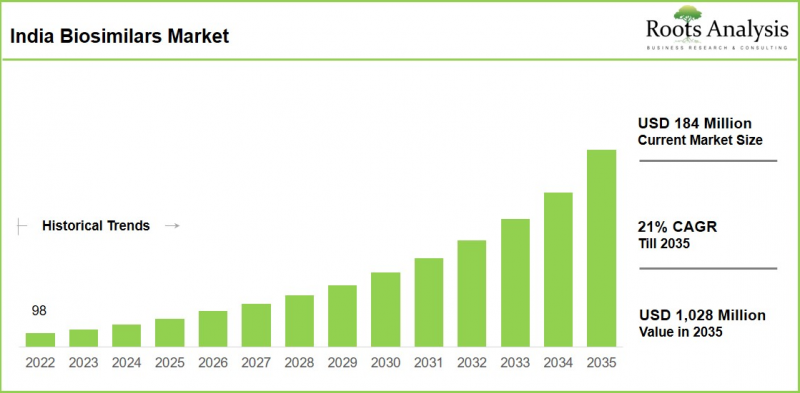
印度生物相似药市场:成长与趋势
预计未来十年,生物相似药市场的成长将主要受以下因素驱动:生物製剂专利鼓励开发与参考生物製剂高度相似的生物相似药。
近年来,生物製剂产业发展迅速,主要得益于慢性病管理疗效的提升。然而,生物製剂的高昂成本带来了巨大的财务和医疗挑战。随着对生物製剂需求的成长,研发人员正在寻求创新方法,以在维持同等安全性和疗效的前提下,开发出更具成本效益的生物製剂,从而优化投资回报。
过去几年,生物相似药研发人员加大了投资和合作力度。此外,监管政策的进步、审批流程的简化以及研究的增加,都为生物相似药的开发提供了支持,包括用于癌症治疗的生物相似药。
预计到2026年,在策略性收购、产品线扩张、监管政策变化和国际合作的推动下,印度生物相似药市场将实现两位数成长。
随着生物相似药市场作为一种经济高效的选择而不断扩张,预计印度的内部研发和外包服务将持续成长。这一趋势有望为生物相似药开发商带来极具吸引力的成长前景。
成长驱动因素:市场扩张的策略推动力
印度生物相似药市场呈现强劲成长势头,这主要得益于多种因素,包括癌症、糖尿病和自体免疫疾病等慢性病盛行率的上升,以及对价格合理的生物製剂替代品的需求不断增长。此外,政府举措,例如中央药品标准控制组织 (CDSCO) 简化监管流程以及生物製剂生产关联激励 (PLI) 计划,也在推动市场成长。此外,赫赛汀 (Herceptin) 和利妥昔单抗 (Rituxan) 等关键药物的专利到期,也使本土製造商能够迅速扩展其产品组合。与全球公司的战略联盟、低成本的生产能力以及熟练的劳动力进一步巩固了印度作为领先出口国的地位。
市场挑战:发展道路上的重大障碍
儘管印度生物相似药市场持续成长,但仍面临诸多挑战,阻碍了其加速普及。高昂的研发成本、需要严格品质控制的复杂生产工艺,以及免疫原性和结构变异性的风险,都增加了中小企业进入该市场的门槛。此外,监管障碍,包括不断变化的指南和需要进行对比临床试验,也延缓了审批进程。来自品牌仿製药的竞争、价格压力以及原厂药公司的专利诉讼等市场准入挑战,也限制了市场成长。
单株抗体:关键市场区隔
目前,单株抗体市场约占印度市场总量的55%。其主导地位主要归功于单株抗体在治疗癌症、类风湿性关节炎和其他自体免疫疾病等慢性疾病方面的广泛应用。然而,预计肽类药物细分市场在预测期内将以更高的复合年增长率成长。
肿瘤学:主导市场区隔
目前,由于癌症负担日益加重,肿瘤学在印度生物相似药市场占了大部分占有率(约40%)。人口老化、生活方式的改变以及诊断技术的进步推动了这一趋势,进而促使人们需要更具成本效益的治疗方法,尤其是昂贵的单株抗体疗法。这为生物相似药开发商提供了极具吸引力的成长机会。此外,血液学细分市场预计在预测期内也将以更高的复合年增长率成长。
本报告分析了印度生物相似药市场,并提供了包括市场规模估算、机会分析、竞争格局和公司概况在内的资讯。
目录
第一章:引言
第二章:研究方法
第三章:市场动态
第四章:宏观经济指标
第五章:摘要整理
第六章:引言
第七章:市场概况
第八章:竞争分析
第九章:公司简介:印度生物相似药市场
- 章节概述
- Avesthagen
- Biocon Biologics
- Biosimilar Sciences印度
- 西普拉
- 克朗兹生物技术
- CuraTeQ 生物製剂
- Enzene Biosciences
- 基因系统
- 格兰马克药厂
- Intas 药厂
第 10 章:成本分析
第 11 章:需求分析
第 12 章:市场影响分析
第 13 章:印度生物相似药市场
第 14 章:按药物类别划分的印度生物相似药市场
第 15 章:按治疗领域划分的印度生物相似药市场
第 16 章:印度生物相似药市场(依生产者类型划分)
第十七章 印度生物相似药市场(依通路划分)
第十八章:结论
第十九章:附录一:表格资料
第二十章:附录二:公司与机构列表
India Biosimilars Market: Overview
As per Roots Analysis, the India biosimilars market is estimated to grow from USD 184 million in the current year to USD 1,028 million by 2035 at a CAGR of 21% during the forecast period, 2026-2035.
India Biosimilars Market: Growth and Trends
The growth of the biosimilars market in the coming decade is projected to be fueled by the expiration of biologics patents, resulting in the development of alternative biosimilars that closely resemble their reference biologics.
In recent times, the biologics sector has experienced significant growth, largely attributed to its improved efficacy in managing chronic illnesses. Nonetheless, the elevated expenses linked to biologics present considerable financial and healthcare challenges. With the increasing demand for biologics, developers are exploring innovative approaches to create more cost-effective biologic products that maintain comparable safety and efficacy profiles to optimize their investment returns.
Over the past few years, the field has seen a rise in investments and cooperative initiatives from the biosimilar developers. Additionally, regulatory progress, more efficient approval processes, and increased research have bolstered the development of biosimilars, including those for oncology.
In 2026, India's biosimilars market demonstrates strong activity characterized by strategic acquisitions, pipeline growth, regulatory changes, and international partnerships, with expected double-digit growth
With the expanding market for biosimilars as a cost-effective option, the operations for in-house development and outsourcing services are anticipated to rise in India. This trend is set to offer appealing growth prospects for developers of biosimilars.
Growth Drivers: Strategic Enablers of Market Expansion
The India biosimilars market experiences robust growth driven by several key factors, including rising prevalence of chronic diseases like cancer, diabetes, and autoimmune disorders and increased demand for affordable biologic alternatives. In addition, government initiatives such as streamlined regulatory pathways via the Central Drugs Standard Control Organization (CDSCO) and incentives under the PLI (Production Linked Incentive) Scheme for biologics also propel market growth. Further, patent expiries of major drugs like Herceptin and Rituxan, enable local manufacturers to expand portfolios rapidly. Strategic partnerships with global firms, low-cost manufacturing capabilities, and a skilled workforce further position India as a leading exporter.
Market Challenges: Critical Barriers Impeding Progress
Challenges persist in the India biosimilars market despite the ongoing market growth, hindering faster adoption. High development costs, complex manufacturing processes requiring stringent quality controls, and risks of immunogenicity or structural variability raise entry barriers for smaller players in this market space. Further, regulatory hurdles, including evolving guidelines and the need for comparative clinical trials, result in delayed approvals. Market access issues, such as competition from branded generics, pricing pressures, and patent litigations from originator companies, also constrain growth.
Monoclonal Antibodies: Leading Market Segment
Currently, monoclonal antibodies segment captures nearly 55% of the overall market share in India. This dominance can be primarily attributed to their extensive use in treating chronic conditions like cancer, rheumatoid arthritis, and other autoimmune disorders. However, the peptide segment is likely to grow at a higher CAGR during the forecast period.
Oncological Disorders: Dominating Market Segment
At present, majority (~40%) of the market share of biosimilars in India is held by oncological disorders, due to the increasing cancer burden. This is further fueled by rising aging population, lifestyle changes, and enhanced diagnostic methods, which need cost-effective treatments, especially for expensive monoclonal antibody therapies. This is likely to offer appealing growth prospects for developers of biosimilars. Further, the hematological disorders segment is likely to grow at a higher CAGR during the forecast period.
India Biosimilars Market: Key Segments
By Drug Class
- Monoclonal Antibodies
- Proteins
- Peptides
- Others
By Therapeutic Area
- Oncological Disorders
- Autoimmune and Inflammatory Disorders
- Hematological Disorders
- Metabolic Disorders
- Other Disorders
By Type of Manufacturer
- Contract Manufacturers
- In-house Developers
By Distribution Channel
- Hospital Pharmacies
- Retail Pharmacies
- Online Pharmacies
Example Players in India Biosimilars Market
- Avesthagen
- Biocon Biologics
- Biosimilar Sciences India
- Cipla
- Clonz Biotech
- CuraTeQ Biologics (Subsidiary of Aurobindo Pharma)
- Enzene Biosciences
- GeneSys
- Glenmark Pharmaceuticals
- Intas Pharmaceuticals
- Jodas Expoim
- Levim Lifetech
- Lupin
- Sayre Therapeutics
- Shilpa Biologicals
- Stelis Biopharma
- VITANE Biologics
- Zydus Cadila
Key Questions Answered in this Report
- How many India biosimilars providers are currently engaged in this market?
- Which are the leading companies in this market?
- Which country dominates the India biosimilars market?
- What are the key trends observed in the India biosimilars market?
- What factors are likely to influence the evolution of this market?
- What are the primary challenges faced by biosimilars providers in India?
- What is the current and future India biosimilars market size?
- What is the CAGR of India biosimilars market?
- How is the current and future market opportunity likely to be distributed across key market segments?
Reasons to Buy this Report
- The report provides a comprehensive market analysis, offering detailed revenue projections of the overall market and its specific sub-segments. This information is valuable to both established market leaders and emerging entrants.
- The report offers stakeholders a comprehensive overview of the market, including key drivers, barriers, opportunities, and challenges. This information empowers stakeholders to stay abreast of market trends and make data-driven decisions to capitalize on growth prospects.
- The report can aid businesses in identifying future opportunities in any sector. It also helps in understanding if those opportunities are worth pursuing.
- The report helps in identifying customer demand by understanding the needs, preferences, and behavior of the target audience in order to tailor products or services effectively.
- The report equips new entrants with requisite information regarding a particular market to help them build successful business strategies.
- The report allows for more effective communication with the audience and in building strong business relations.
Complementary Benefits
- Complimentary PPT Insights Packs
- Complimentary Excel Data Packs for all Analytical Modules in the Report
- 15% Free Content Customization
- Detailed Report Walkthrough Session with Research Team
- Free Updated report if the report is 6-12 months old or older
TABLE OF CONTENTS
1. PREFACE
- 1.1. Introduction
- 1.2. Market Share Insights
- 1.3. Key Market Insights
- 1.4. Report Coverage
- 1.5. Key Questions Answered
- 1.6. Chapter Outlines
2. RESEARCH METHODOLOGY
- 2.1. Chapter Overview
- 2.2. Research Assumptions
- 2.2.1. Market Landscape and Market Trends
- 2.2.2. Market Forecast and Opportunity Analysis
- 2.2.3. Comparative Analysis
- 2.3. Database Building
- 2.3.1. Data Collection
- 2.3.2. Data Validation
- 2.3.3. Data Analysis
- 2.4. Project Methodology
- 2.4.1. Secondary Research
- 2.4.1.1. Annual Reports
- 2.4.1.2. Academic Research Papers
- 2.4.1.3. Company Websites
- 2.4.1.4. Investor Presentations
- 2.4.1.5. Regulatory Filings
- 2.4.1.6. White Papers
- 2.4.1.7. Industry Publications
- 2.4.1.8. Conferences and Seminars
- 2.4.1.9. Government Portals
- 2.4.1.10. Media and Press Releases
- 2.4.1.11. Newsletters
- 2.4.1.12. Industry Databases
- 2.4.1.13. Roots Proprietary Databases
- 2.4.1.14. Paid Databases and Sources
- 2.4.1.15. Social Media Portals
- 2.4.1.16. Other Secondary Sources
- 2.4.2. Primary Research
- 2.4.2.1. Types of Primary Research
- 2.4.2.1.1. Qualitative Research
- 2.4.2.1.2. Quantitative Research
- 2.4.2.1.3. Hybrid Approach
- 2.4.2.2. Advantages of Primary Research
- 2.4.2.3. Techniques for Primary Research
- 2.4.2.3.1. Interviews
- 2.4.2.3.2. Surveys
- 2.4.2.3.3. Focus Groups
- 2.4.2.3.4. Observational Research
- 2.4.2.3.5. Social Media Interactions
- 2.4.2.4. Key Opinion Leaders Considered in Primary Research
- 2.4.2.4.1. Company Executives (CXOs)
- 2.4.2.4.2. Board of Directors
- 2.4.2.4.3. Company Presidents and Vice Presidents
- 2.4.2.4.4. Research and Development Heads
- 2.4.2.4.5. Technical Experts
- 2.4.2.4.6. Subject Matter Experts
- 2.4.2.4.7. Scientists
- 2.4.2.4.8. Doctors and Other Healthcare Providers
- 2.4.2.5. Ethics and Integrity
- 2.4.2.5.1. Research Ethics
- 2.4.2.5.2. Data Integrity
- 2.4.2.1. Types of Primary Research
- 2.4.3. Analytical Tools and Databases
- 2.4.1. Secondary Research
- 2.5. Robust Quality Control
3. MARKET DYNAMICS
- 3.1. Chapter Overview
- 3.2. Forecast Methodology
- 3.2.1. Top-down Approach
- 3.2.2. Bottom-up Approach
- 3.2.3. Hybrid Approach
- 3.3. Market Assessment Framework
- 3.3.1. Total Addressable Market (TAM)
- 3.3.2. Serviceable Addressable Market (SAM)
- 3.3.3. Serviceable Obtainable Market (SOM)
- 3.3.4. Currently Acquired Market (CAM)
- 3.4. Forecasting Tools and Techniques
- 3.4.1. Qualitative Forecasting
- 3.4.2. Correlation
- 3.4.3. Regression
- 3.4.4. Extrapolation
- 3.4.5. Convergence
- 3.4.6. Sensitivity Analysis
- 3.4.7. Scenario Planning
- 3.4.8. Data Visualization
- 3.4.9. Time Series Analysis
- 3.4.10. Forecast Error Analysis
- 3.5. Key Considerations
- 3.5.1. Demographics
- 3.5.2. Government Regulations
- 3.5.3. Reimbursement Scenarios
- 3.5.4. Market Access
- 3.5.5. Supply Chain
- 3.5.6. Industry Consolidation
- 3.5.7. Pandemic / Unforeseen Disruptions Impact
- 3.6. Limitations
4. MACRO-ECONOMIC INDICATORS
- 4.1. Chapter Overview
- 4.2. Market Dynamics
- 4.2.1. Time Period
- 4.2.1.1. Historical Trends
- 4.2.1.2. Current and Forecasted Estimates
- 4.2.2. Currency Coverage
- 4.2.2.1. Major Currencies Affecting the Market
- 4.2.2.2. Factors Affecting Currency Fluctuations on the Industry
- 4.2.2.3. Impact of Currency Fluctuations on the Industry
- 4.2.3. Foreign Currency Exchange Rate
- 4.2.3.1. Impact of Foreign Exchange Rate Volatility on the Market
- 4.2.3.2. Strategies for Mitigating Foreign Exchange Risk
- 4.2.4. Recession
- 4.2.4.1. Assessment of Current Economic Conditions and Potential Impact on the Market
- 4.2.4.2. Historical Analysis of Past Recessions and Lessons Learnt
- 4.2.5. Inflation
- 4.2.5.1. Measurement and Analysis of Inflationary Pressures in the Economy
- 4.2.5.2. Potential Impact of Inflation on the Market Evolution
- 4.2.6. Interest Rates
- 4.2.6.1. Interest Rates and Their Impact on the Market
- 4.2.6.2. Strategies for Managing Interest Rate Risk
- 4.2.7. Commodity Flow Analysis
- 4.2.7.1. Type of Commodity
- 4.2.7.2. Origins and Destinations
- 4.2.7.3. Value and Weights
- 4.2.7.4. Modes of Transportation
- 4.2.8. Global Trade Dynamics
- 4.2.8.1. Import Scenario
- 4.2.8.2. Export Scenario
- 4.2.8.3. Trade Policies
- 4.2.8.4. Strategies for Mitigating the Risks Associated with Trade Barriers
- 4.2.8.5. Impact of Trade Barriers on the Market
- 4.2.9. War Impact Analysis
- 4.2.9.1. Russian-Ukraine War
- 4.2.9.2. Israel-Hamas War
- 4.2.10. COVID Impact / Related Factors
- 4.2.10.1. Global Economic Impact
- 4.2.10.2. Industry-specific Impact
- 4.2.10.3. Government Response and Stimulus Measures
- 4.2.10.4. Future Outlook and Adaptation Strategies
- 4.2.11. Other Indicators
- 4.2.11.1. Fiscal Policy
- 4.2.11.2. Consumer Spending
- 4.2.11.3. Gross Domestic Product (GDP)
- 4.2.11.4. Employment
- 4.2.11.5. Taxes
- 4.2.11.6. Stock Market Performance
- 4.2.11.7. Cross-Border Dynamics
- 4.2.1. Time Period
- 4.3. Conclusion
5. EXECUTIVE SUMMARY
6. INTRODUCTION
- 6.1. Chapter Overview
- 6.2. Overview of Biologics
- 6.3. Overview of Biosimilars and Biobetters
- 6.4. Difference between Innovator Biologics, Biosimilars and Generics
- 6.5. Advantages of Biosimilars
- 6.6. Manufacturing of Biosimilars
- 6.7. Development Timeline of Biosimilars
- 6.8. Future Perspectives
7. MARKET LANDSCAPE
- 7.1. Chapter Overview
- 7.2. Biosimilars: Developers Landscape
- 7.2.1. Analysis by Year of Establishment
- 7.2.2. Analysis by Company Size
- 7.2.3. Analysis by Location of Headquarters (Region)
- 7.2.4. Analysis by Location of Headquarters (Country)
- 7.3. Biosimilars: Overall Market Landscape
- 7.3.1. Analysis by Stage of Development
- 7.3.2. Analysis by Therapeutic Area
- 7.3.3. Analysis by Drug Class
8. COMPANY COMPETITIVENESS ANALYSIS
- 8.1. Chapter Overview
- 8.2. Assumptions and Key Parameters
- 8.3. Methodology
- 8.4. Biosimilars Providers in Japan: Company Competitiveness Analysis
- 8.4.1. Small Biosimilar Developers (Peer Group I)
- 8.4.2. Mid-sized Biosimilar Developers (Peer Group II)
- 8.4.3. Large Biosimilar Developers (Peer Group III)
- 8.5. Capability Benchmarking of top Biosimilar Developers
9. COMPANY PROFILES: INDIA BIOSIMILARS MARKET
- 9.1. Chapter Overview
- 9.2. Avesthagen
- 9.2.1. Company Overview
- 9.2.2. Product Portfolio
- 9.2.3. Financial Information
- 9.2.4. Recent Developments and Future Outlook
- 9.3. Biocon Biologics
- 9.4. Biosimilar Sciences India
- 9.5. Cipla
- 9.6. Clonz Biotech
- 9.7. CuraTeQ Biologics
- 9.8. Enzene Biosciences
- 9.9. GeneSys
- 9.10. Glenmark Pharmaceuticals
- 9.11. Intas Pharmaceuticals
10. COST PRICE ANALYSIS
- 10.1. Chapter Overview
- 10.2. Factors Contributing to High Price of Novel Biologics
- 10.3. Pricing of Biosimilars
- 10.3.1. Price Comparison of Different Biosimilars with its Reference Biologic
- 10.4. Concluding Remarks
11. DEMAND ANALYSIS
- 11.1. Chapter Overview
- 11.2. Key Assumptions and Methodology
- 11.2.1. Global Annual Demand for Biosimilars
- 11.2.1.1. Analysis by Drug Class
- 11.2.1.2. Analysis by Therapeutic Area
- 11.2.1.3. Analysis by Type of Manufacturer
- 11.2.1.4. Analysis by Distribution Channel
- 11.2.1.5. Analysis by Geographical Regions
- 11.2.1. Global Annual Demand for Biosimilars
12. MARKET IMPACT ANALYSIS
- 12.1. Chapter Overview
- 12.2. Market Drivers
- 12.3. Market Restraints
- 12.4. Market Opportunities
- 12.5. Market Challenges
- 12.6. Conclusion
13. INDIA BIOSIMILARS MARKET
- 13.1. Chapter Overview
- 13.2. Key Assumptions and Methodology
- 13.3. Global Biosimilars Market, Historical Trends (Since 2019) and Forecasted Estimates (Till 2035)
- 13.4. Roots Analysis Perspective on Market Growth
- 13.5 Scenario Analysis
- 13.5.1. Conservative Scenario
- 13.5.2. Optimistic Scenario
- 13.6. Key Market Segmentations
14. INDIA BIOSIMILARS MARKET, BY DRUG CLASS
- 14.1. Chapter Overview
- 14.2. Key Assumptions and Methodology
- 14.3. Biosimilars Market: Distribution by Drug Class
- 14.3.1. Biosimilars Market for Monoclonal Antibodies, Historical Trends (since 2019) and Forecasted Estimates (till 2035)
- 14.3.2. Biosimilars Market for Proteins, Historical Trends (since 2019) and Forecasted Estimates (till 2035)
- 14.3.3. Biosimilars Market for Peptides, Historical Trends (since 2019) and Forecasted Estimates (till 2035)
- 14.3.4. Biosimilars Market for Others, Historical Trends (since 2019) and Forecasted Estimates (till 2035)
- 14.4. Data Triangulation and Validation
15. INDIA BIOSIMILARS MARKET, BY THERAPEUTIC AREA
- 15.1. Chapter Overview
- 15.2. Assumptions and Methodology
- 15.3. Biosimilars Market: Distribution by Therapeutic Area
- 15.3.1. Biosimilars Market for Oncological Disorders, Historical Trends (since 2019) and Forecasted Estimates (till 2035)
- 15.3.2. Biosimilars Market for Autoimmune and Inflammatory Disorders, Historical Trends (since 2019) and Forecasted Estimates (till 2035)
- 15.3.3. Biosimilars Market for Hematological Disorders, Historical Trends (since 2019) and Forecasted Estimates (till 2035)
- 15.3.4. Biosimilars Market for Metabolic Disorders, Historical Trends (since 2019) and Forecasted Estimates (till 2035)
- 15.3.5. Biosimilars Market for Other Disorders, Historical Trends (since 2019) and Forecasted Estimates (till 2035)
- 15.4. Data Triangulation and Validation
16. INDIA BIOSIMILARS MARKET, BY TYPE OF MANUFACTURER
- 16.1. Chapter Overview
- 16.2. Assumptions and Methodology
- 16.3. Biosimilars Market: Distribution by Type of Manufacturer
- 16.3.1. Biosimilars Market for Contract Manufacturers, Historical Trends (since 2019) and Forecasted Estimates (till 2035)
- 16.3.2. Biosimilars Market for In-house Developers, Historical Trends (since 2019) and Forecasted Estimates (till 2035)
- 16.4. Data Triangulation and Validation
17. INDIA BIOSIMILARS MARKET, BY DISTRIBUTION CHANNEL
- 17.1. Chapter Overview
- 17.2. Assumptions and Methodology
- 17.3. Biosimilars Market: Distribution by Distribution Channel
- 17.3.1. Biosimilars Market for Hospital Pharmacies, Historical Trends (since 2019) and Forecasted Estimates (till 2035)
- 17.3.2. Biosimilars Market for Retail Pharmacies, Historical Trends (since 2019) and Forecasted Estimates (till 2035)
- 17.3.3. Biosimilars Market for Online Pharmacies, Historical Trends (since 2019) and Forecasted Estimates (till 2035)
- 17.4. Data Triangulation and Validation
18. CONCLUDING REMARKS
19. APPENDIX I: TABULATED DATA
20. APPENDIX II: LIST OF COMPANIES AND ORGANIZATIONS

 生物相似药市场:2026-2032年全球市场预测(依产品类型、治疗领域、给药途径、研发阶段、生产技术、最终用户和分销管道划分)Darbepoetinα市场:2026-2032年全球市场预测,依适应症、给药途径、剂型、通路及最终用户划分。
 单株抗体生物相似药市场规模、份额和成长分析:按产品类型、治疗领域、应用、最终用户、分销管道和地区划分 - 2026-2033 年行业预测
 G-CSF 和 G-CSF 生物相似药市场规模、份额和成长分析:按药物类型、治疗应用、通路和地区划分-2026-2033 年产业预测
 全球生物相似药市场规模、份额、趋势和成长分析报告(2026-2034)
 生物相似药市场规模、份额、趋势及预测(依分子、适应症、生产类型及地区划分),2026-2034年
 生物相似药市场规模、份额和趋势分析报告:按药物类别、适应症、最终用途、地区和细分市场预测(2026-2033 年)人口统计和主题情报市场:按人口统计重点、资料来源类型、分析方法、应用领域、垂直市场和最终用户类型划分,全球预测,2026-2032 年日本生物相似药市场报告:按分子、适应症、生产类型和地区划分(2026-2034年)
 生物相似药市场-全球产业规模、份额、趋势、机会和预测,依适应症、产品、地区和竞争格局划分,2020-2030年预测