


 |
市场调查报告书
商品编码
1993589
收益管理市场(至2035年):依组件、解决方案、服务、部署模式、产业和地区划分:产业趋势和全球预测Revenue Management Market, till 2035: Distribution by Type of Component, Type of Solution, Type of Service, Deployment Mode, Type of Vertical and Geographical Regions: Industry Trends and Global Forecasts |
||||||

收益管理市场展望
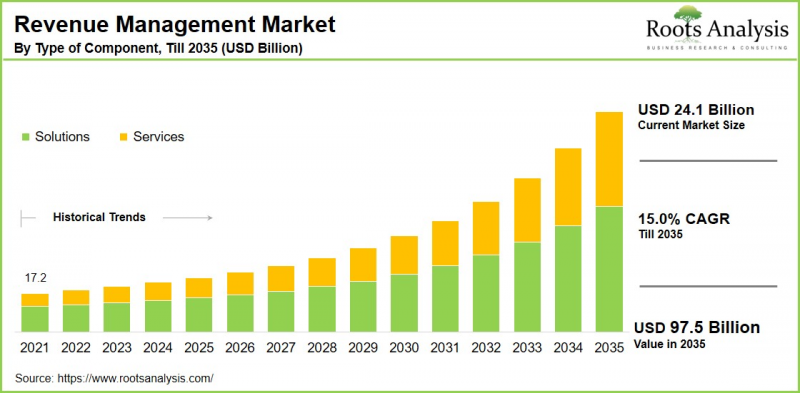
预计到2035年,全球收益管理市场将以 15.0%的年复合成长率成长,从目前的241亿美元成长至 975亿美元。
收益管理已成为现代商业策略的基石,它利用先进的资料分析来预测需求、最佳化定价结构并识别高价值客户群。越来越多的公司采用收益管理解决方案来实施明智的定价策略,这些策略分析历史绩效资料、预测市场趋势,并在提高营运效率的同时最大限度地提高获利能力。随着了解客户行为和快速反应市场波动变得越来越重要,对这些系统的依赖性也进一步增强。
技术进步和全球化提升了收益管理系统(RMS)的作用,使其能够实施动态定价和高级定价演算法,推动收入成长和成本效益。固定成本高、边际成本低的产业(例如饭店、航空、零售和电信)始终处于应用前沿,利用价格分析和库存最佳化来保持竞争力。
在饭店业,收益管理有助于最佳化关键绩效指标(KPI),例如入住率和客户获取成本;而航空公司则利用动态定价和座位库存管理来最大化每次航班的收入。随着即时分析、人工智慧(AI)、机器学习和云端平台整合技术的进步,收益最佳化领域也在不断变革。考虑到以上因素,预计全球收益管理市场在预测期内将显着成长。
高阶主管的策略洞察
推动收益管理市场成长的关键因素
对整合收益最佳化解决方案的认知不断提高,以及对具有竞争力和灵活性的定价策略日益成长的需求,是推动收益管理市场成长的关键因素。企业正日益采用以客户为中心、资料驱动的定价模型,透过分析客户细分、购买模式和行为洞察,提供个人化的定价策略,并改善整体客户体验。此外,零售和电子商务行业的持续成长,以及对云端平台需求的不断增加,预计将在预测期内创造显着的成长机会。此外,旅游业的快速扩张预计也将进一步促进这段时期的市场成长。借助这些趋势并保持竞争优势,各公司正积极推行策略举措,例如建立合作伙伴关係、结盟、产品创新和推出新产品,以巩固市场地位并加速长期成长。
收益管理市场 - 产业竞争格局
当前市场格局的特点是,规模大小不一的公司并存,它们都具备成熟的解决方案交付能力,不受地域限制。值得关注的新兴公司包括 Atomize、Lighthouse 和 Profit Intelligence,它们各自在该领域拥有专业技术。
值得注意的是,约 85%的主要收益管理解决方案供应商提供定价管理服务,且云端部署模式已广泛采用。云端交付之所以受到广泛青睐,是因为其成本效益高、可扩展且灵活,能够帮助企业最大限度地降低基础设施成本。此外,相当一部分市场参与者提供目的是提升营运绩效和加强客户互动策略的託管服务。
收益管理市场新趋势
在收益管理领域,解决方案和服务提供者正积极进行策略活动,例如建立合作伙伴关係、筹集资金以及参加产业会议,以拓展自身能力并巩固市场地位。尤其值得一提的是,服务合约(约占55%)是该领域企业最主要的合作模式。各组织机构正日益建立跨产业合作伙伴关係,以提供包括计费和结算管理、价格最佳化以及通路管理在内的整合服务。
此外,该领域的智慧财产权活动也异常活跃,近年来已提交或註册超过790项专利。这反映了持续的创新和研发投入。尤其值得注意的是,该领域的大多数专利是专利申请(超过80%),其次是已註册专利。有趣的是,业内企业正积极申请该领域的专利。
区域分析 - 北美引领收益管理市场
根据分析,亚太地区收益管理市场今年将占据最大占有率。这主要归功于该地区对创新技术的早期采用和持续发展。这些发展促使收益管理解决方案在航空、医疗保健、零售和饭店等关键产业中广泛应用。此外,该地区对资料驱动决策框架的重视,以及人工智慧和预测分析的融合,也显着加速了对高阶收益最佳化和收益回收解决方案的需求。
收益管理市场面临的主要挑战
收益管理市场面临一些可能阻碍其永续成长的重大挑战。其中一个主要问题是资料复杂性和整合。企业通常难以将来自不同遗留系统的大量结构化和非结构化资料整合到一个统一的平台中。
此外,进阶分析和云端解决方案的高昂初始部署成本和持续维护成本可能会阻碍中小企业采用这些解决方案。对资料隐私、网路安全和合规性的担忧进一步增加了实施的复杂性,尤其是在处理高度敏感客户资讯的行业。此外,收入管理系统的有效性很大程度上取决于资料的准确性和熟练的人员;缺乏分析专业知识会限制其最佳利用。
收益管理市场:主要市场区隔
元件类型
- 解决方案
- 服务
解决方案类型
- 计费和支付
- 通路管理
- 定价管理
- 收益保障与诈欺管理
服务类型
- 託管服务
- 专业服务业务
部署模式
- 云端部署
- 本地部署
依行业划分
- 电信
- 饭店
- 医疗保健
- 银行、金融服务和保险(BFSI)
- 零售与电子商务
- 公共事业业
- 公用事业
- 其他
地区
- 北美洲
- 美国
- 加拿大
- 欧洲
- 英国
- 法国
- 德国
- 西班牙
- 荷兰
- 其他欧洲国家
- 亚太地区
- 印度
- 中国
- 澳洲
- 其他欧洲国家 亚太地区 印度 中国 澳洲 新加坡
- 韩国
- 其他亚太地区国家
- 拉丁美洲
- 巴西
- 哥伦比亚
- 墨西哥
- 其他拉丁美洲国家
- 中东和非洲(MEA)
- UAE
- 以色列
- 沙乌地阿拉伯
- 其他中东和非洲国家
收益管理领域的关键公司市场
- Accenture
- Amdoc
- Cerillion
- Ericsson
- Fiserv
- Huawei
- IdeaS
- Infor
- Netcracker
- Optiva
- Oracle
- RIA Advisory
- Sabre
- SAP
- Workday
- Zuora
收益管理市场:报告范围
本报告对收益管理市场的以下几个方面进行了详细分析:
- 市场规模和机会分析:对收益管理市场进行详细分析,重点关注以下关键市场细分:[A] 组件类型,[B] 解决方案类型,[C] 服务类型,[D] 部署模式,[E] 产业领域,以及 [F] 地区。
- 竞争格局:基于相关参数(例如[A]成立年份、[B]公司规模、[C]总部所在地和[D]所有权结构)对进入收益管理市场的公司进行全面分析。
- 公司简介:提供进入收益管理市场的主要公司的详细简介。提供以下方面的详细资讯:[A]总部所在地、[B]公司规模、[C]企业理念、[D]业务范围、[E]管理团队、[F]联络资讯、[G]财务资讯、[H]业务领域、[I]产品/技术组合、[J]近期发展和未来展望。
- 专利分析:基于相关参数(例如[A]专利类型、[B]专利公开年份、[C]专利年龄和[D]主要公司),对收益管理领域已提交和已註册的专利进行深入分析。
- 最新进展:概述收益管理领域的最新进展,并基于以下相关参数进行分析:[A] 实施年份,[B] 计画类型,[C] 地域分布,以及 [D] 最活跃的参与者。
目录
第一部分:报告概述
第1章 引言
第2章 研究方法
第3章 市场动态
第4章 宏观经济指标
- 章节概要
- 市场动态
- 结论
第二部分:定性洞察
第5章 执行摘要
第6章 引言
- 收益管理概述
- 关键组成部分
- 收益管理解决方案和服务的必要性
- 实际个案收益管理解决方案的影响
- 未来展望
第7章 监理环境
第8章 供应链分析
- 章节概述
- 供应链分析的关键组成部分
- 相关流程和利害关係人
- 主要挑战与因应措施
第三部分:市场概览
第9章 收益管理解决方案/服务提供者市场情势
第10章 企业竞争力分析
- 研究方法与评分标准
- 主要收益管理解决方案/服务提供者比较
- 主要收益管理解决方案/服务提供者
第11章 创业生态系分析
第四部分:企业概况与关键成功策略
第12章 公司概况
- 章节概述
- Accenture
- Amdocs
- Cerillion
- Ericsson
- Fiserv
- Huwaei
- IdeaS
- Infor
- Netcracker
- Optiva
- Oracle
- RIA Advisory
- Sabre
- SAP
- Workday
- Zuora
第13章 获胜的重要策略
第五部分:市场趋势
第14章 市场趋势
- 当前趋势概述
- 对新事物的见解趋势
第15章 专利分析
- 研究范围与方法
- 关键参数
- 收益管理:专利分析
第16章 最新进展
- 章节概要
- 收益管理:近期合作与伙伴关係
- 收益管理:近期融资与投资
第六部分:市场预测与机会分析
第17章 市场影响分析
- 市场驱动因素
- 市场限制因素
- 市场机会
- 市场挑战
第18章 全球收益管理市场
第19章 依组件类型划分的市场机会
第20章 依解决方案类型划分的市场机会
第21章 依服务类型划分的市场机会
第22章 依部署模式划分的市场机会
第23章 依行业划分的市场机会
第24章 依地理区域划分的市场机会
第七部分:区域市场机会分析
第25章 北美市场机会分析
第26章 欧洲市场机会分析
第27章 亚太地区市场机会分析
第28章 中东与非洲市场机会分析
第29章 拉丁美洲市场机会分析美国
第八部分:策略工具
第30章 波特五力模型分析
第31章 个案研究:重组收入管理:聚焦未满足的需求与关键缓解策略
第九部分:其他主管观点
第32章 结论
第十部分:附录
第33章 附录1:表格资料
第34章 附录2:公司与组织清单
Revenue Management Market Outlook
As per Roots Analysis, the global revenue management market size is estimated to grow from USD 24.1 billion in current year to USD 97.5 billion by 2035, at a CAGR of 15.0% during the forecast period, till 2035.
Revenue management has become a cornerstone of modern business strategy, leveraging advanced data analytics to forecast demand, optimize pricing structures, and identify high-value customer segments. Organizations increasingly adopt revenue management solutions to analyze historical performance data, anticipate market trends, and implement informed pricing strategies that maximize profitability while enhancing operational efficiency. The growing emphasis on understanding customer behavior and responding swiftly to market fluctuations has further strengthened reliance on these systems.
Technological advancements and globalization have elevated the role of revenue management systems (RMS), enabling dynamic pricing and the deployment of advanced pricing algorithms that drive revenue growth and cost efficiency. Industries characterized by high fixed costs and low marginal costs (such as hospitality, airlines, retail, and telecommunications), remain at the forefront of adoption, utilizing pricing analytics and inventory optimization to sustain competitiveness.
In hospitality sector, revenue management supports the optimization of key performance indicators, including occupancy rates and customer acquisition costs, while airlines employ dynamic pricing and seat inventory management to maximize revenue per flight. The increasing integration of real-time analytics, artificial intelligence, machine learning, and cloud-based platforms continues to transform the revenue optimization landscape. Considering the above mentioned factors, the global revenue management market is expected to grow significantly during the forecast period.
Strategic Insights for Senior Leaders
Key Drivers Propelling Growth of Revenue Management Market
The increasing awareness of integrated revenue optimization solutions and the growing need for competitive, agile pricing strategies are key factors driving the growth of revenue management market. Organizations are increasingly adopting customer-centric, data-driven pricing models that analyze customer segments, purchasing patterns, and behavioral insights to deliver personalized pricing strategies and enhance overall customer experience. Furthermore, the continued growth of the retail and e-commerce sectors, coupled with the rising demand for cloud-based platforms, is expected to create significant growth opportunities over the forecast period. In addition, the rapid expansion of the travel and tourism industry is anticipated to further contribute to market growth during this period. To leverage these trends and sustain competitive advantage, companies are actively engaging in strategic initiatives (such as partnerships and collaborations, product innovations and launches), to reinforce their market presence and accelerate long-term growth.
Revenue Management Market: Competitive Landscape of Companies in this Industry
The current market landscape is characterized by the presence of both small and large players with established capabilities to deliver their offerings across geographic regions. Prominent emerging players include Atomize, Lighthouse, and Profit Intelligence, each demonstrating specialized expertise within the domain.
Notably, nearly 85% of leading revenue management solution providers offer price management services, with universal adoption of cloud-based deployment models. This widespread preference for cloud delivery is driven by its cost efficiency, scalability, and flexibility, enabling organizations to minimize infrastructure expenditures. Furthermore, a significant proportion of market participants provide managed services to enhance operational performance and strengthen customer engagement strategies.
Emerging Trends in the Revenue Management Market
The revenue management domain is witnessing heightened strategic activity as solution and service providers actively pursue partnerships, secure funding, and participate in industry conferences to expand their capabilities and reinforce their market presence. Notably, service agreements (~55%) is the most prominent partnership model adopted by companies in this domain Organizations are increasingly forming cross-industry alliances to deliver integrated services, including billing and payment management, price optimization, and channel management.
Further, the domain has experienced a notable surge in intellectual property activity, with more than 790 patents filed or granted in recent years, reflecting sustained innovation and research efforts. Notably, the majority of the patents in this domain include patent applications (>80%), followed by granted patents. Interestingly, industry players are more active in patent filing in this domain.
Regional Analysis: North America Lead the Revenue Management Market
According to our analysis, in the current year, the revenue management market in Asia-Pacific captures the largest share. This is due to region's early adoption and continued advancement of innovative technologies. These developments have enabled the widespread implementation of revenue management solutions across major industry verticals, including airlines, healthcare, retail, and hospitality. Additionally, the strong emphasis on data-driven decision-making frameworks, integrated with artificial intelligence and predictive analytics, has significantly accelerated the demand for advanced revenue optimization and recovery solutions within the region.
Key Challenges in Revenue Management Market
The revenue management market faces several critical challenges that may hinder its sustained growth. One of the primary concerns is data complexity and integration, as organizations often struggle to consolidate large volumes of structured and unstructured data from disparate legacy systems into a unified platform.
Additionally, the high initial implementation costs and ongoing maintenance expenses associated with advanced analytics and cloud-based solutions can deter small and mid-sized enterprises from adoption. Concerns related to data privacy, cybersecurity, and regulatory compliance further complicate deployment, particularly in industries handling sensitive customer information. Moreover, the effectiveness of revenue management systems depends heavily on data accuracy and skilled personnel, and a shortage of analytical expertise can limit optimal utilization.
Revenue Management Market: Key Market Segmentation
Type of Component
- Solutions
- Services
Type of Solution
- Billing and Payment
- Channel Management
- Price Management
- Revenue Assurance and Fraud Management
Type of Service
- Managed Services
- Professional Services
Deployment Mode
- Cloud
- On-Premises
Type of Vertical
- Telecom
- Hospitality
- Healthcare
- BFSI
- Retail & E-Commerce
- Public
- Utilities
- Others
Geographical Regions
- North America
- US
- Canada
- Europe
- UK
- France
- Germany
- Spain
- Netherlands
- Rest of Europe
- Asia-Pacific
- India
- China
- Australia
- Singapore
- South Korea
- Rest of Asia-Pacific
- Latin America
- Brazil
- Colombia
- Mexico
- Rest of Latin America
- Middle East and Africa (MEA)
- UAE
- Israel
- Saudi Arabia
- Rest of Middle East and Africa
Example Players in Revenue Management Market
- Accenture
- Amdoc
- Cerillion
- Ericsson
- Fiserv
- Huawei
- IdeaS
- Infor
- Netcracker
- Optiva
- Oracle
- RIA Advisory
- Sabre
- SAP
- Workday
- Zuora
Revenue Management Market: Report Coverage
The report on the revenue management market features insights on various sections, including:
- Market Sizing and Opportunity Analysis: An in-depth analysis of the revenue management market, focusing on key market segments, including [A] type of component, [B] type of solution, [C] type of service, [D] deployment mode, [E] type of vertical, and [F] geographical regions.
- Competitive Landscape: A comprehensive analysis of the companies engaged in the revenue management market, based on several relevant parameters, such as [A] year of establishment, [B] company size, [C] location of headquarters and [D] ownership structure.
- Company Profiles: Elaborate profiles of prominent players engaged in the revenue management market, providing details on [A] location of headquarters, [B] company size, [C] company mission, [D] company footprint, [E] management team, [F] contact details, [G] financial information, [H] operating business segments, [I] product / technology portfolio, [J] recent developments, and an informed future outlook.
- Patent Analysis: An insightful analysis of patents filed / granted in the revenue management domain, based on relevant parameters, including [A] type of patent, [B] patent publication year, [C] patent age and [D] leading players.
- Recent Developments: An overview of the recent developments made in the revenue management domain, along with analysis based on relevant parameters, including [A] year of initiative, [B] type of initiative, [C] geographical distribution and [D] most active players.
Key Questions Answered in this Report
- What is the current and future market size?
- Who are the leading companies in this market?
- What are the growth drivers that are likely to influence the evolution of this market?
- What are the key partnership and funding trends shaping this industry?
- Which region is likely to grow at higher CAGR till 2035?
- How is the current and future market opportunity likely to be distributed across key market segments?
Reasons to Buy this Report
- Detailed Market Analysis: The report provides a comprehensive market analysis, offering detailed revenue projections of the overall market and its specific sub-segments. This information is valuable to both established market leaders and emerging entrants.
- In-depth Analysis of Trends: Stakeholders can leverage the report to gain a deeper understanding of the competitive dynamics within the market. Each report maps ecosystem activity across partnerships, funding, and patent landscapes to reveal growth hotspots and white spaces in the industry.
- Opinion of Industry Experts: The report features extensive interviews and surveys with key opinion leaders and industry experts to validate market trends mentioned in the report.
- Decision-ready Deliverables: The report offers stakeholders with strategic frameworks (Porter's Five Forces, value chain, SWOT), and complimentary Excel / slide packs with customization support.
Additional Benefits
- Complimentary Dynamic Excel Dashboards for Analytical Modules
- Exclusive 15% Free Content Customization
- Personalized Interactive Report Walkthrough with Our Expert Research Team
- Free Report Updates for Versions Older than 6-12 Months
TABLE OF CONTENTS
SECTION I: REPORT OVERVIEW
1. PREFACE
- 1.1. Introduction
- 1.2. Market Share Insights
- 1.3. Key Market Insights
- 1.4. Report Coverage
- 1.5. Key Questions Answered
- 1.6. Chapter Outlines
2. RESEARCH METHODOLOGY
- 2.1. Chapter Overview
- 2.2. Research Assumptions
- 2.2.1. Market Landscape and Market Trends
- 2.2.2. Market Forecast and Opportunity Analysis
- 2.2.3. Comparative Analysis
- 2.3. Database Building
- 2.3.1. Data Collection
- 2.3.2. Data Validation
- 2.3.3. Data Analysis
- 2.4. Project Methodology
- 2.4.1. Secondary Research
- 2.4.1.1. Annual Reports
- 2.4.1.2. Academic Research Papers
- 2.4.1.3. Company Websites
- 2.4.1.4. Investor Presentations
- 2.4.1.5. Regulatory Filings
- 2.4.1.6. White Papers
- 2.4.1.7. Industry Publications
- 2.4.1.8. Conferences and Seminars
- 2.4.1.9. Government Portals
- 2.4.1.10. Media and Press Releases
- 2.4.1.11. Newsletters
- 2.4.1.12. Industry Databases
- 2.4.1.13. Roots Proprietary Databases
- 2.4.1.14. Paid Databases and Sources
- 2.4.1.15. Social Media Portals
- 2.4.1.16. Other Secondary Sources
- 2.4.2. Primary Research
- 2.4.2.1. Types of Primary Research
- 2.4.2.1.1. Qualitative Research
- 2.4.2.1.2. Quantitative Research
- 2.4.2.1.3. Hybrid Approach
- 2.4.2.2. Advantages of Primary Research
- 2.4.2.3. Techniques for Primary Research
- 2.4.2.3.1. Interviews
- 2.4.2.3.2. Surveys
- 2.4.2.3.3. Focus Groups
- 2.4.2.3.4. Observational Research
- 2.4.2.3.5. Social Media Interactions
- 2.4.2.4. Key Opinion Leaders Considered in Primary Research
- 2.4.2.4.1. Company Executives (CXOs)
- 2.4.2.4.2. Board of Directors
- 2.4.2.4.3. Company Presidents and Vice Presidents
- 2.4.2.4.4. Research and Development Heads
- 2.4.2.4.5. Technical Experts
- 2.4.2.4.6. Subject Matter Experts
- 2.4.2.4.7. Scientists
- 2.4.2.4.8. Doctors and Other Healthcare Providers
- 2.4.2.5. Ethics and Integrity
- 2.4.2.5.1. Research Ethics
- 2.4.2.5.2. Data Integrity
- 2.4.2.1. Types of Primary Research
- 2.4.3. Analytical Tools and Databases
- 2.4.1. Secondary Research
- 2.5. Robust Quality Control
3. MARKET DYNAMICS
- 3.1. Chapter Overview
- 3.2. Forecast Methodology
- 3.2.1. Top-down Approach
- 3.2.2. Bottom-up Approach
- 3.2.3. Hybrid Approach
- 3.3. Market Assessment Framework
- 3.3.1. Total Addressable Market (TAM)
- 3.3.2. Serviceable Addressable Market (SAM)
- 3.3.3. Serviceable Obtainable Market (SOM)
- 3.3.4. Currently Acquired Market (CAM)
- 3.4. Forecasting Tools and Techniques
- 3.4.1. Qualitative Forecasting
- 3.4.2. Correlation
- 3.4.3. Regression
- 3.4.4. Extrapolation
- 3.4.5. Convergence
- 3.4.6. Sensitivity Analysis
- 3.4.7. Scenario Planning
- 3.4.8. Data Visualization
- 3.4.9. Time Series Analysis
- 3.4.10. Forecast Error Analysis
- 3.5. Key Considerations
- 3.5.1. Demographics
- 3.5.2. Government Regulations
- 3.5.3. Reimbursement Scenarios
- 3.5.4. Market Access
- 3.5.5. Supply Chain
- 3.5.6. Industry Consolidation
- 3.5.7. Pandemic / Unforeseen Disruptions Impact
- 3.6. Limitations
4. MACRO-ECONOMIC INDICATORS
- 4.1. Chapter Overview
- 4.2. Market Dynamics
- 4.2.1. Time Period
- 4.2.1.1. Historical Trends
- 4.2.1.2. Current and Forecasted Estimates
- 4.2.2. Currency Coverage
- 4.2.2.1. Major Currencies Affecting the Market
- 4.2.2.2. Factors Affecting Currency Fluctuations
- 4.2.2.3. Impact of Currency Fluctuations on the Industry
- 4.2.3. Foreign Currency Exchange Rate
- 4.2.3.1. Impact of Foreign Exchange Rate Volatility on the Market
- 4.2.3.2. Strategies for Mitigating Foreign Exchange Risk
- 4.2.4. Recession
- 4.2.4.1. Assessment of Current Economic Conditions and Potential Impact on the Market
- 4.2.4.2. Historical Analysis of Past Recessions and Lessons Learnt
- 4.2.5. Inflation
- 4.2.5.1. Measurement and Analysis of Inflationary Pressures in the Economy
- 4.2.5.2. Potential Impact of Inflation on the Market Evolution
- 4.2.6. Interest Rates
- 4.2.6.1. Interest Rates and Their Impact on the Market
- 4.2.6.2. Strategies for Managing Interest Rate Risk
- 4.2.7. Commodity Flow Analysis
- 4.2.7.1. Type of Commodity
- 4.2.7.2. Origins and Destinations
- 4.2.7.3. Values and Weights
- 4.2.7.4. Modes of Transportation
- 4.2.8. Global Trade Dynamics
- 4.2.8.1. Import Scenario
- 4.2.8.2. Export Scenario
- 4.2.8.3. Trade Policies
- 4.2.8.4. Strategies for Mitigating the Risks Associated with Trade Barriers
- 4.2.8.5. Impact of Trade Barriers on the Market
- 4.2.9. War Impact Analysis
- 4.2.9.1. Russian-Ukraine War
- 4.2.9.2. Israel-Hamas War
- 4.2.10. COVID Impact / Related Factors
- 4.2.10.1. Global Economic Impact
- 4.2.10.2. Industry-specific Impact
- 4.2.10.3. Government Response and Stimulus Measures
- 4.2.10.4. Future Outlook and Adaptation Strategies
- 4.2.11. Other Indicators
- 4.2.11.1. Fiscal Policy
- 4.2.11.2. Consumer Spending
- 4.2.11.3. Gross Domestic Product (GDP)
- 4.2.11.4. Employment
- 4.2.11.5. Taxes
- 4.2.11.6. Stock Market Performance
- 4.2.11.7. Cross-Border Dynamics
- 4.2.1. Time Period
- 4.3. Conclusion
SECTION II: QUALITATIVE INSIGHTS
5. EXECUTIVE SUMMARY
6. INTRODUCTION
- 6.1. Overview of Revenue Management
- 6.2. Key Components
- 6.3. Need of Revenue Management Solutions and Services
- 6.4. Real-world Impact of Revenue Management Solutions
- 6.5. Future Outlook
7. REGULATORY SCENARIO
8. SUPPLY CHAIN ANALYSIS
- 8.1. Chapter Overview
- 8.2. Core Components of Supply Chain Analysis
- 8.2.1. Key Steps under Primary Activities
- 8.2.2. Key Steps under Support Activities
- 8.3. Processes and Stakeholders Involved
- 8.4. Key Challenges and Mitigation Strategies
SECTION III: MARKET OVERVIEW
9. LEADING REVENUE MANAGEMENT SOLUTION / SERVICE PROVIDERS MARKET LANDSCAPE
- 9.1. Methodology and Key Parameters
- 9.2. Analysis by Year of Establishment
- 9.3. Analysis by Company Size
- 9.4. Analysis by Location of Headquarters
- 9.5. Analysis by Type of Solutions
- 9.6. Analysis by Type of Services
- 9.7. Analysis by Deployment Mode
- 9.8. Analysis by Type of Vertical
10. COMPANY COMPETITIVENESS ANALYSIS
- 10.1. Methodology and Scoring Criteria
- 10.2. Comparison of Leading Revenue Management Solution / Service Providers
- 10.3. Leading Revenue Management Solution / Service Providers
11. STARTUP ECOSYSTEM ANALYSIS
- 11.1. Methodology and Key Parameters
- 11.2. Analysis by Year of Establishment
- 11.3. Analysis by Company Size
- 11.4. Analysis by Location of Headquarters
- 11.5. Analysis by Type of Solutions
- 11.6. Analysis by Type of Services
- 11.7. Analysis by Deployment Mode
- 11.8. Analysis by Type of Vertical
SECTION IV: COMPANY PROFILES AND KEY WINNING STRATEGIES
12. COMPANY PROFILES
- 12.1. Chapter Overview
- 12.2. Accenture
- 12.2.1. Company Details
- 12.2.2. Revenue Management Portfolio
- 12.2.3. Initiatives in the Revenue Management Market
- 12.2.4. Future Outlook
- 12.3. Amdocs
- 12.4. Cerillion
- 12.5. Ericsson
- 12.6. Fiserv
- 12.7. Huwaei
- 12.8. IdeaS
- 12.9. Infor
- 12.10. Netcracker
- 12.11. Optiva
- 12.12. Oracle
- 12.13. RIA Advisory
- 12.14. Sabre
- 12.15. SAP
- 12.16. Workday
- 12.17. Zuora
13. KEY WINNING STRATEGIES
SECTION V: MARKET TRENDS
14. MARKET TRENDS
- 14.1. Overview of Ongoing Trends
- 14.2. Insights on Emerging Trends
15. PATENT ANALYSIS
- 15.1. Scope and Methodology
- 15.2. Key Parameters
- 15.3. Revenue Management: Patent Analysis
- 15.3.1. Analysis by Application Year
- 15.3.2. Analysis by Type of Patent
- 15.3.3. Analysis by Patent Jurisdiction
- 15.3.4. Analysis by Patent Publication Year
- 15.3.5. Analysis by Type of Patent and Patent Publication Year
- 15.3.6. Analysis by Type of Applicant
- 15.3.7. Leading Players: Analysis by Number of Patents
- 15.3.8. Leading Individual Patent Assignees: Analysis by Number of Patents
- 15.3.9. Analysis by Patent Age
- 15.3.10. Patent Valuation
16. RECENT DEVELOPMENTS
- 16.1. Chapter Overview
- 16.2. Revenue Management: Recent Partnerships and Collaborations
- 16.2.1. Analysis by Month of Partnership
- 16.2.2. Analysis by Type of Partnership
- 16.2.3. Analysis by Type of Solution
- 16.2.4. Analysis by Type of Vertical Targeted
- 16.2.5. Intercontinental and Intracontinental Deals
- 16.2. Revenue Management: Recent Funding and Investments
- 16.2.1. Analysis by Funding Activity
- 16.2.2. Analysis by Type of Funding
- 16.2.3. Analysis by Purpose of Funding
- 16.2.4. Most Active Investors: Analysis by Funding Instances
SECTION VI: MARKET FORECAST AND OPPORTUNITY ANALYSIS
17. MARKET IMPACT ANALYSIS
- 17.1. Market Drivers
- 17.2. Market Restraints
- 17.3. Market Opportunities
- 17.4. Market Challenges
18. GLOBAL REVENUE MANAGEMENT MARKET
- 18.1. Key Assumptions and Methodology
- 18.2. Global Revenue Management Market, Historical Trends (Since 2021) and Forecasted Estimates (Till 2035)
- 18.2.1. Scenario Analysis
- 18.2.1.1. Conservative Scenario
- 18.2.1.2. Optimistic Scenario
- 18.2.1. Scenario Analysis
- 18.3. Key Market Segmentations
19. MARKET OPPORTUNITIES BASED ON TYPE OF COMPONENT
- 19.1. Key Assumptions and Methodology
- 19.2. Revenue Management Market, by Type of Component
- 19.2.1. Revenue Management Market for Solutions, Historical Trends (Since 2021) and Forecasted Estimates (Till 2035)
- 19.2.2. Revenue Management Market for Services, Historical Trends (Since 2021) and Forecasted Estimates (Till 2035)
20. MARKET OPPORTUNITIES BASED ON TYPE OF SOLUTION
- 20.1. Key Assumptions and Methodology
- 20.2. Revenue Management Market, by Type of Solution
- 20.2.1. Revenue Management Market for Billing and Payment, Historical Trends (Since 2021) and Forecasted Estimates (Till 2035)
- 20.2.2. Revenue Management Market for Channel Management, Historical Trends (Since 2021) and Forecasted Estimates (Till 2035)
- 20.2.3. Revenue Management Market for Price Management, Historical Trends (Since 2021) and Forecasted Estimates (Till 2035)
- 20.2.4. Revenue Management Market for Revenue Assurance and Fraud Management, Historical Trends (Since 2021) and Forecasted Estimates (Till 2035)
21. MARKET OPPORTUNITIES BASED ON TYPE OF SERVICE
- 21.1. Key Assumptions and Methodology
- 21.2. Revenue Management Market, by Type of Service
- 21.2.1. Revenue Management Market for Managed Services, Historical Trends (Since 2021) and Forecasted Estimates (Till 2035)
- 21.2.2. Revenue Management Market for Professional Services, Historical Trends (Since 2021) and Forecasted Estimates (Till 2035)
22. MARKET OPPORTUNITIES BASED ON DEPLOYMENT MODE
- 22.1. Key Assumptions and Methodology
- 22.2. Revenue Management Market, by Deployment Mode
- 22.2.1. Revenue Management Market for Cloud, Historical Trends (Since 2021) and Forecasted Estimates (Till 2035)
- 22.2.2. Revenue Management Market for On-premises, Historical Trends (Since 2021) and Forecasted Estimates (Till 2035)
23. MARKET OPPORTUNITIES BASED ON TYPE OF VERTICAL
- 23.1. Key Assumptions and Methodology
- 23.2. Revenue Management Market, by Type of Vertical
- 22.2.1. Revenue Management Market for Telecom, Historical Trends (Since 2021) and Forecasted Estimates (Till 2035)
- 23.2.2. Revenue Management Market for Hospitality, Historical Trends (Since 2021) and Forecasted Estimates (Till 2035)
- 23.2.3. Revenue Management Market for Healthcare, Historical Trends (Since 2021) and Forecasted Estimates (Till 2035)
- 23.2.4. Revenue Management Market for BFSI, Historical Trends (Since 2021) and Forecasted Estimates (Till 2035)
- 23.2.5. Revenue Management Market for Retail and E-commerce, Historical Trends (Since 2021) and Forecasted Estimates (Till 2035)
- 23.2.6. Revenue Management Market for Public, Historical Trends (Since 2021) and Forecasted Estimates (Till 2035)
- 23.2.7. Revenue Management Market for Utilities, Historical Trends (Since 2021) and Forecasted Estimates (Till 2035)
- 23.2.8. Revenue Management Market for Other Industries, Historical Trends (Since 2021) and Forecasted Estimates (Till 2035)
24. MARKET OPPORTUNITIES BASED ON GEOGRAPHICAL REGIONS
- 24.1. Key Assumptions and Methodology
- 24.2. Revenue Management Market, by Geographical Regions
- 24.2.1. Revenue Management Market in North America, Historical Trends (Since 2021) and Forecasted Estimates (Till 2035)
- 24.2.2. Revenue Management Market in Europe, Historical Trends (Since 2021) and Forecasted Estimates (Till 2035)
- 24.2.3. Revenue Management Market in Asia-Pacific, Historical Trends (Since 2021) and Forecasted Estimates (Till 2035)
- 24.2.4. Revenue Management Market in Middle East and Africa, Historical Trends (Since 2021) and Forecasted Estimates (Till 2035)
- 24.2.5. Revenue Management Market in Latin America, Historical Trends (Since 2021) and Forecasted Estimates (Till 2035)
- 24.3. Revenue Management Market, by Geographical Regions: Market Dynamics Assessment
- 24.3.1. Market Movement Analysis
- 24.3.2. Penetration Growth (P-G) Matrix
SECTION VII: MARKET OPPORTUNITY ANALYSIS WITHIN GEOGRAPHICAL REGIONS**
25. MARKET OPPORTUNITY ANALYSIS: NORTH AMERICA
- 25.1. Revenue Management Market in North America: Distribution by Type of Component
- 25.1.1. Revenue Management Market in North America for Solution, Historical Trends (Since 2021) and Forecasted Estimates (Till 2035)
- 25.1.2. Revenue Management Market in North America for Service, Historical Trends (Since 2021) and Forecasted Estimates (Till 2035)
- 25.2. Revenue Management Market in North America: Distribution by Type of Solution
- 25.2.1. Revenue Management Market in North America for Billing and Payment, Historical Trends (Since 2021) and Forecasted Estimates (Till 2035)
- 25.2.2. Revenue Management Market in North America for Channel Management, Historical Trends (Since 2021) and Forecasted Estimates (Till 2035)
- 25.2.3. Revenue Management Market in North America for Price Management, Historical Trends (Since 2021) and Forecasted Estimates (Till 2035)
- 25.2.4. Revenue Management Market in North America for Risk Assurance and Financial Management, Historical Trends (Since 2021) and Forecasted Estimates (Till 2035)
- 25.3. Revenue Management Market in North America: Distribution by Type of Service
- 25.3.1. Revenue Management Market in North America for Managed Services, Historical Trends (Since 2021) and Forecasted Estimates (Till 2035)
- 25.3.2. Revenue Management Market in North America for Professional Services, Historical Trends (Since 2021) and Forecasted Estimates (Till 2035)
- 25.4. Revenue Management Market in North America: Distribution by Deployment Mode
- 25.4.1. Revenue Management Market in North America for Cloud, Historical Trends (Since 2021) and Forecasted Estimates (Till 2035)
- 25.4.2. Revenue Management Market in North America for On-premises, Historical Trends (Since 2021) and Forecasted Estimates (Till 2035)
- 25.5. Revenue Management Market in North America: Distribution by Type of Vertical
- 25.5.1. Revenue Management Market in North America for Telecom, Historical Trends (Since 2021) and Forecasted Estimates (Till 2035)
- 25.5.2. Revenue Management Market in North America for Hospitality, Historical Trends (Since 2021) and Forecasted Estimates (Till 2035)
- 25.5.3. Revenue Management Market in North America for Healthcare, Historical Trends (Since 2021) and Forecasted Estimates (Till 2035)
- 25.5.4. Revenue Management Market in North America for BFSI, Historical Trends (Since 2021) and Forecasted Estimates (Till 2035)
- 25.5.5. Revenue Management Market in North America for Retail and E-commerce, Historical Trends (Since 2021) and Forecasted Estimates (Till 2035)
- 25.5.6. Revenue Management Market in North America for Utilities, Historical Trends (Since 2021) and Forecasted Estimates (Till 2035)
- 25.5.7. Revenue Management Market in North America for Public, Historical Trends (Since 2021) and Forecasted Estimates (Till 2035)
- 25.5.8. Revenue Management Market in North America for Other Industries, Historical Trends (Since 2021) and Forecasted Estimates (Till 2035)
26. MARKET OPPORTUNITY ANALYSIS: EUROPE
- 26.1. Revenue Management Market in Europe: Distribution by Type of Component
- 26.1.1. Revenue Management Market in Europe for Solution, Historical Trends (Since 2021) and Forecasted Estimates (Till 2035)
- 26.1.2. Revenue Management Market in Europe for Service, Historical Trends (Since 2021) and Forecasted Estimates (Till 2035)
- 26.2. Revenue Management Market in Europe: Distribution by Type of Solution
- 26.2.1. Revenue Management Market in Europe for Billing and Payment, Historical Trends (Since 2021) and Forecasted Estimates (Till 2035)
- 26.2.2. Revenue Management Market in Europe for Channel Management, Historical Trends (Since 2021) and Forecasted Estimates (Till 2035)
- 26.2.3. Revenue Management Market in Europe for Price Management, Historical Trends (Since 2021) and Forecasted Estimates (Till 2035)
- 26.2.4. Revenue Management Market in Europe for Risk Assurance and Financial Management, Historical Trends (Since 2021) and Forecasted Estimates (Till 2035)
- 26.3. Revenue Management Market in Europe: Distribution by Type of Service
- 26.3.1. Revenue Management Market in Europe for Managed Services, Historical Trends (Since 2021) and Forecasted Estimates (Till 2035)
- 26.3.2. Revenue Management Market in Europe for Professional Services, Historical Trends (Since 2021) and Forecasted Estimates (Till 2035)
- 26.4. Revenue Management Market in Europe: Distribution by Deployment Mode
- 26.4.1. Revenue Management Market in Europe for Cloud, Historical Trends (Since 2021) and Forecasted Estimates (Till 2035)
- 26.4.2. Revenue Management Market in Europe for On-premises, Historical Trends (Since 2021) and Forecasted Estimates (Till 2035)
- 26.5. Revenue Management Market in Europe: Distribution by Type of Vertical
- 26.5.1. Revenue Management Market in Europe for Telecom, Historical Trends (Since 2021) and Forecasted Estimates (Till 2035)
- 26.5.2. Revenue Management Market in Europe for Hospitality, Historical Trends (Since 2021) and Forecasted Estimates (Till 2035)
- 26.5.3. Revenue Management Market in Europe for Healthcare, Historical Trends (Since 2021) and Forecasted Estimates (Till 2035)
- 26.5.4. Revenue Management Market in Europe for BFSI, Historical Trends (Since 2021) and Forecasted Estimates (Till 2035)
- 26.5.5. Revenue Management Market in Europe for Retail and E-commerce, Historical Trends (Since 2021) and Forecasted Estimates (Till 2035)
- 26.5.6. Revenue Management Market in Europe for Utilities, Historical Trends (Since 2021) and Forecasted Estimates (Till 2035)
- 26.5.7. Revenue Management Market in Europe for Public, Historical Trends (Since 2021) and Forecasted Estimates (Till 2035)
- 26.5.8. Revenue Management Market in Europe for Other Industries, Historical Trends (Since 2021) and Forecasted Estimates (Till 2035)
27. MARKET OPPORTUNITY ANALYSIS: ASIA PACIFIC
- 27.1. Revenue Management Market in Asia Pacific: Distribution by Type of Component
- 27.1.1. Revenue Management Market in Asia Pacific for Solution, Historical Trends (Since 2021) and Forecasted Estimates (Till 2035)
- 27.1.2. Revenue Management Market in Asia Pacific for Service, Historical Trends (Since 2021) and Forecasted Estimates (Till 2035)
- 27.2. Revenue Management Market in Asia Pacific: Distribution by Type of Solution
- 27.2.1. Revenue Management Market in Asia Pacific for Billing and Payment, Historical Trends (Since 2021) and Forecasted Estimates (Till 2035)
- 27.2.2. Revenue Management Market in Asia Pacific for Channel Management, Historical Trends (Since 2021) and Forecasted Estimates (Till 2035)
- 27.2.3. Revenue Management Market in Asia Pacific for Price Management, Historical Trends (Since 2021) and Forecasted Estimates (Till 2035)
- 27.2.4. Revenue Management Market in Asia Pacific for Risk Assurance and Financial Management, Historical Trends (Since 2021) and Forecasted Estimates (Till 2035)
- 27.3. Revenue Management Market in Asia Pacific: Distribution by Type of Service
- 27.3.1. Revenue Management Market in Asia Pacific for Managed Services, Historical Trends (Since 2021) and Forecasted Estimates (Till 2035)
- 27.3.2. Revenue Management Market in Asia Pacific for Professional Services, Historical Trends (Since 2021) and Forecasted Estimates (Till 2035)
- 27.4. Revenue Management Market in Asia Pacific: Distribution by Deployment Mode
- 27.4.1. Revenue Management Market in Asia Pacific for Cloud, Historical Trends (Since 2021) and Forecasted Estimates (Till 2035)
- 27.4.2. Revenue Management Market in Asia Pacific for On-premises, Historical Trends (Since 2021) and Forecasted Estimates (Till 2035)
- 27.5. Revenue Management Market in Asia Pacific: Distribution by Type of Vertical
- 27.5.1. Revenue Management Market in Asia Pacific for Telecom, Historical Trends (Since 2021) and Forecasted Estimates (Till 2035)
- 27.5.2. Revenue Management Market in Asia Pacific for Hospitality, Historical Trends (Since 2021) and Forecasted Estimates (Till 2035)
- 27.5.3. Revenue Management Market in Asia Pacific for Healthcare, Historical Trends (Since 2021) and Forecasted Estimates (Till 2035)
- 27.5.4. Revenue Management Market in Asia Pacific for BFSI, Historical Trends (Since 2021) and Forecasted Estimates (Till 2035)
- 27.5.5. Revenue Management Market in Asia Pacific for Retail and E-commerce, Historical Trends (Since 2021) and Forecasted Estimates (Till 2035)
- 27.5.6. Revenue Management Market in Asia Pacific for Utilities, Historical Trends (Since 2021) and Forecasted Estimates (Till 2035)
- 27.5.7. Revenue Management Market in Asia Pacific for Public, Historical Trends (Since 2021) and Forecasted Estimates (Till 2035)
- 27.5.8. Revenue Management Market in Asia Pacific for Other Industries, Historical Trends (Since 2021) and Forecasted Estimates (Till 2035)
28. MARKET OPPORTUNITY ANALYSIS: MIDDLE EAST AND AFRICA
- 28.1. Revenue Management Market in Middle East and Africa: Distribution by Type of Component
- 28.1.1. Revenue Management Market in Middle East and Africa for Solution, Historical Trends (Since 2021) and Forecasted Estimates (Till 2035)
- 28.1.2. Revenue Management Market in Middle East and Africa for Service, Historical Trends (Since 2021) and Forecasted Estimates (Till 2035)
- 28.2. Revenue Management Market in Middle East and Africa: Distribution by Type of Solution
- 28.2.1. Revenue Management Market in Middle East and Africa for Billing and Payment, Historical Trends (Since 2021) and Forecasted Estimates (Till 2035)
- 28.2.2. Revenue Management Market in Middle East and Africa for Channel Management, Historical Trends (Since 2021) and Forecasted Estimates (Till 2035)
- 28.2.3. Revenue Management Market in Middle East and Africa for Price Management, Historical Trends (Since 2021) and Forecasted Estimates (Till 2035)
- 28.2.4. Revenue Management Market in Middle East and Africa for Risk Assurance and Financial Management, Historical Trends (Since 2021) and Forecasted Estimates (Till 2035)
- 28.3. Revenue Management Market in Middle East and Africa: Distribution by Type of Service
- 28.3.1. Revenue Management Market in Middle East and Africa for Managed Services, Historical Trends (Since 2021) and Forecasted Estimates (Till 2035)
- 28.3.2. Revenue Management Market in Middle East and Africa for Professional Services, Historical Trends (Since 2021) and Forecasted Estimates (Till 2035)
- 28.4. Revenue Management Market in Middle East and Africa: Distribution by Deployment Mode
- 28.4.1. Revenue Management Market in Middle East and Africa for Cloud, Historical Trends (Since 2021) and Forecasted Estimates (Till 2035)
- 28.4.2. Revenue Management Market in Middle East and Africa for On-premises, Historical Trends (Since 2021) and Forecasted Estimates (Till 2035)
- 28.5. Revenue Management Market in Middle East and Africa: Distribution by Type of Vertical
- 28.5.1. Revenue Management Market in Middle East and Africa for Telecom, Historical Trends (Since 2021) and Forecasted Estimates (Till 2035)
- 28.5.2. Revenue Management Market in Middle East and Africa for Hospitality, Historical Trends (Since 2021) and Forecasted Estimates (Till 2035)
- 28.5.3. Revenue Management Market in Middle East and Africa for Healthcare, Historical Trends (Since 2021) and Forecasted Estimates (Till 2035)
- 28.5.4. Revenue Management Market in Middle East and Africa for BFSI, Historical Trends (Since 2021) and Forecasted Estimates (Till 2035)
- 28.5.5. Revenue Management Market in Middle East and Africa for Retail and E-commerce, Historical Trends (Since 2021) and Forecasted Estimates (Till 2035)
- 28.5.6. Revenue Management Market in Middle East and Africa for Utilities, Historical Trends (Since 2021) and Forecasted Estimates (Till 2035)
- 28.5.7. Revenue Management Market in Middle East and Africa for Public, Historical Trends (Since 2021) and Forecasted Estimates (Till 2035)
- 28.5.8. Revenue Management Market in Middle East and Africa for Other Industries, Historical Trends (Since 2021) and Forecasted Estimates (Till 2035)
29. MARKET OPPORTUNITY ANALYSIS: LATIN AMERICA
- 29.1. Revenue Management Market in Latin America: Distribution by Type of Component
- 29.1.1. Revenue Management Market in Latin America for Solution, Historical Trends (Since 2021) and Forecasted Estimates (Till 2035)
- 29.1.2. Revenue Management Market in Latin America for Service, Historical Trends (Since 2021) and Forecasted Estimates (Till 2035)
- 29.2. Revenue Management Market in Latin America: Distribution by Type of Solution
- 29.2.1. Revenue Management Market in Latin America for Billing and Payment, Historical Trends (Since 2021) and Forecasted Estimates (Till 2035)
- 29.2.2. Revenue Management Market in Latin America for Channel Management, Historical Trends (Since 2021) and Forecasted Estimates (Till 2035)
- 29.2.3. Revenue Management Market in Latin America for Price Management, Historical Trends (Since 2021) and Forecasted Estimates (Till 2035)
- 29.2.4. Revenue Management Market in Latin America for Risk Assurance and Financial Management, Historical Trends (Since 2021) and Forecasted Estimates (Till 2035)
- 29.3. Revenue Management Market in Latin America: Distribution by Type of Service
- 29.3.1. Revenue Management Market in Latin America for Managed Services, Historical Trends (Since 2021) and Forecasted Estimates (Till 2035)
- 29.3.2. Revenue Management Market in Latin America for Professional Services, Historical Trends (Since 2021) and Forecasted Estimates (Till 2035)
- 29.4. Revenue Management Market in Latin America: Distribution by Deployment Mode
- 29.4.1. Revenue Management Market in Latin America for Cloud, Historical Trends (Since 2021) and Forecasted Estimates (Till 2035)
- 29.4.2. Revenue Management Market in Latin America for On-premises, Historical Trends (Since 2021) and Forecasted Estimates (Till 2035)
- 29.5. Revenue Management Market in Latin America: Distribution by Type of Vertical
- 29.5.1. Revenue Management Market in Latin America for Telecom, Historical Trends (Since 2021) and Forecasted Estimates (Till 2035)
- 29.5.2. Revenue Management Market in Latin America for Hospitality, Historical Trends (Since 2021) and Forecasted Estimates (Till 2035)
- 29.5.3. Revenue Management Market in Latin America for Healthcare, Historical Trends (Since 2021) and Forecasted Estimates (Till 2035)
- 29.5.4. Revenue Management Market in Latin America for BFSI, Historical Trends (Since 2021) and Forecasted Estimates (Till 2035)
- 29.5.5. Revenue Management Market in Latin America for Retail and E-commerce, Historical Trends (Since 2021) and Forecasted Estimates (Till 2035)
- 29.5.6. Revenue Management Market in Latin America for Utilities, Historical Trends (Since 2021) and Forecasted Estimates (Till 2035)
- 29.5.7. Revenue Management Market in Latin America for Public, Historical Trends (Since 2021) and Forecasted Estimates (Till 2035)
- 29.5.8. Revenue Management Market in Latin America for Other Industries, Historical Trends (Since 2021) and Forecasted Estimates (Till 2035)
- *Detailed information on Section VII is available in the Excel Data Packs shared along with the report**
SECTION VIII: STRATEGIC TOOLS
30. PORTER'S FIVE FORCES ANALYSIS
- 30.1. Chapter Overview
- 30.2. Significance of Porter's Five Forces Analysis
- 30.3. Porter's Five Forces
- 30.3.1. Methodology
- 30.3.2. Threats to New Entrants
- 30.3.3. Bargaining Power of Buyers
- 30.3.4. Bargaining Power of RMS Solution Providers
- 30.3.5. Threat of Substitute Products
- 30.3.6. Rivalry among Existing Competitors
- 30.3.7. Harvey Ball Analysis
31. CASE STUDY: REVENUE MANAGEMENT REINVENTED: FOCUS ON UNMET NEEDS AND KEY MITIGATION STRATEGIES
- 31.1. Evolution of Revenue Management
- 31.2. Key Historical Events in the Revenue Management Market
- 31.3. Key Verticals Targeted by Revenue Management Solution / Service Providers
- 31.4. Current Revenue Management Practices across Key Industries
- 31.4.1. BFSI Industry
- 31.4.2. Healthcare Industry
- 31.4.3. Hospitality Industry
- 31.4.4. Retail and E-commerce Industry
- 31.4.5. Public Industry
- 31.4.6. Utilities Industry
- 31.4.7. Logistics and Transportation Industry
- 31.4.8. IT and Tele-communication Industry
SECTION IX: OTHER EXECUTIVE INSIGHTS
32. CONCLUSION
SECTION X: APPENDICES
33. APPENDIX I: TABULATED DATA
34. APPENDIX II: LIST OF COMPANIES AND ORGANIZATIONS

 2026-2030年全球医疗保健收入週期管理(RCM)软体市场
 2026年全球捆绑支付管理软体市场报告
 收入週期管理市场分析及预测(至2035年):按类型、产品类型、服务、技术、组件、应用、最终用户、模组、部署类型和功能划分
 全球收入週期管理市场规模、份额、趋势和成长分析报告(2026-2034年)
 2026-2034年按类型、组件、部署类型、最终用户和地区分類的收入週期管理市场规模、份额、趋势和预测
 收入週期管理市场-全球产业规模、份额、趋势、机会和预测:按部署方式、功能、最终用户、地区和竞争格局划分,2021-2031年
 收入週期管理服务市场:2026-2032年全球预测(按服务类型、部署类型、组织规模和最终用户划分)医疗保健收入週期管理市场 - 2026-2031 年预测日本收入週期管理市场报告(按类型、组件、部署方式、最终用户和地区划分,2026-2034 年)
 收入週期管理市场规模、份额和成长分析(按类型、产品/服务、最终用户、产品和服务以及地区划分)-2026-2033年产业预测