


 |
市场调查报告书
商品编码
1797796
护肤成分市场机会、成长动力、产业趋势分析及 2025 - 2034 年预测Skincare Ingredients Market Opportunity, Growth Drivers, Industry Trend Analysis, and Forecast 2025 - 2034 |
||||||

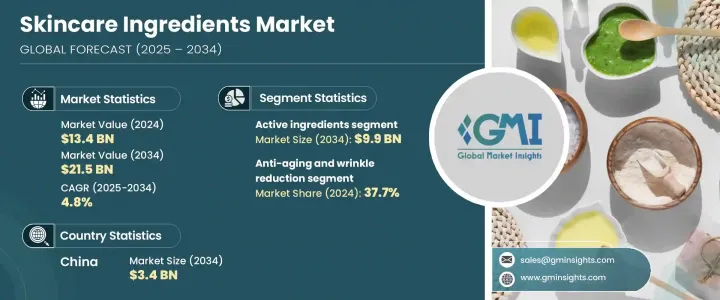
2024年,全球护肤成分市场规模达134亿美元,预计2034年将以4.8%的复合年增长率成长,达到215亿美元。这一增长主要源于人们对皮肤健康的日益关注、消费者意识的提升,以及已开发市场和新兴市场对更天然、清洁标籤护肤配方的日益偏好。对满足个人化护肤需求的高端多功能产品的需求,也推动了这一成长。此外,强调成分透明度的清洁美容运动,也持续影响产品开发。
如今,超过60%的新产品都带有「无添加」或极简成分等宣称,这使得成分透明度成为市场成长的重要驱动力。数位化消费者的崛起也意味着消费者对化妆品成分的关注度不断提升,越来越重视安全且经临床验证的配方。
| 市场范围 | |
|---|---|
| 起始年份 | 2024 |
| 预测年份 | 2025-2034 |
| 起始值 | 134亿美元 |
| 预测值 | 215亿美元 |
| 复合年增长率 | 4.8% |
此外,韩妆和日妆潮流的影响力日益增强,引发了护肤成分的创新浪潮,两者均强调使用独特、尖端的活性成分。这些趋势促进了强效成分的开发和应用,这些成分通常源自天然,并得到先进科学研究的支持,吸引了全球消费者的注意。这种将创新活性成分融入产品的趋势不仅影响配方趋势,也促使品牌更加重视所用成分的功效和永续性。因此,各大品牌正在加大研发投入,以提供符合不同消费族群特定护肤需求的创新解决方案。
2024年,活性成分细分市场产值达到62亿美元,预计2034年将以4.8%的复合年增长率成长。活性成分是护肤配方的基石,在皮肤健康、外观和抗衰老方面带来显着的益处。抗氧化剂和维生素(如维生素C、E和阿魏酸)等关键成分备受追捧,尤其因为它们具有潜在的保护和焕活功效。稳定化和封装技术的进步推动了对这些成分的需求。这促使人们投入大量研发精力,以增强其功效并抵御污染等环境压力,这也激发了人们对抗老化配方的新兴趣。
2024年,抗老和祛皱产品占了37.7%的市场。受对抗衰老迹象产品需求不断增长的推动,该领域已成为行业中最大的类别。精华液约占抗老产品销售的42%,因其高浓度的活性成分而特别受欢迎。随着消费者对污染和紫外线对皮肤健康影响的认识不断加深,对保护性和修復性配方的需求也日益增长。含有抗氧化剂和胜肽的产品尤其受欢迎,这些成分能够有效抵抗环境损害,并促进肌肤年轻亮泽。
2024年,中国护肤成分市场规模达21亿美元,预计复合年增长率为5%。 「中国美妆」趋势的成长,以及对本土传统中药成分的重视,正在推动这一增长。人参和珍珠粉等天然成分的使用日益普及,尤其是在寻求地道、符合当地文化的护肤产品的消费者中。此外,在CSAR规则等不断发展的监管框架的推动下,对永续性和成分透明度的日益重视,刺激了对绿色化学和生物技术的投资。小红书和直播等电商平台目前约占美妆销售额的10%,它们也加速采用创新成分,进而进一步促进市场的成长和认知度。
护肤成分市场的领先公司包括德之馨股份有限公司 (Symrise AG)、亚什兰公司 (Ashland Inc.)、赢创工业股份有限公司 (Evonik Industries AG)、巴斯夫股份有限公司 (BASF SE) 和禾大国际 (Croda International)。这些公司持续推动创新,始终走在市场趋势的前沿,专注于成分开发、永续性和以客户为中心的解决方案,以保持竞争优势。为了巩固其在护肤成分市场的地位,各公司正专注于创新、永续性和以消费者为中心的产品开发。关键策略包括开发天然、清洁标籤成分,以满足市场对环保安全产品日益增长的需求。许多公司正在大力投资研发新型活性成分,以解决老化、色素沉淀和环境压力等特定皮肤问题。与化妆品品牌建立策略合作伙伴关係以及在亚洲等新兴市场不断扩张也是扩大其市场影响力的关键。
目录
第一章:方法论与范围
第二章:执行摘要
第三章:行业洞察
- 产业生态系统分析
- 供应商概况
- 利润率
- 每个阶段的增值
- 影响价值链的因素
- 中断
- 产业衝击力
- 成长动力
- 产业陷阱与挑战
- 市场机会
- 成长潜力分析
- 监管格局
- 北美洲
- 欧洲
- 亚太地区
- 拉丁美洲
- 中东和非洲
- 波特的分析
- PESTEL分析
- 价格趋势
- 按地区
- 按类型
- 未来市场趋势
- 技术和创新格局
- 当前的技术趋势
- 新兴技术
- 专利态势
- 贸易统计(註:仅提供重点国家的贸易统计)
- 主要进口国
- 主要出口国
- 永续性和环境方面
- 永续实践
- 减少废弃物的策略
- 生产中的能源效率
- 环保倡议
- 碳足迹考量
第四章:竞争格局
- 介绍
- 公司市占率分析
- 按地区
- 北美洲
- 欧洲
- 亚太地区
- 拉丁美洲
- MEA
- 按地区
- 公司矩阵分析
- 主要市场参与者的竞争分析
- 竞争定位矩阵
- 关键进展
- 併购
- 伙伴关係与合作
- 新产品发布
- 扩张计划
第五章:市场估计与预测:按类型,2021 - 2034 年
- 主要趋势
- 活性成分
- 抗衰老剂
- 类视黄醇及其衍生物
- 胜肽和蛋白质
- α-羟基酸(AHAS)
- β-羟基酸(BHAS)
- 保湿剂
- 玻尿酸
- 神经酰胺
- 甘油和保湿剂
- 紫外线防护剂
- 化学紫外线过滤器
- 物理紫外线过滤器
- 亮肤剂
- 维生素C及其衍生物
- 烟碱酰胺
- 曲酸
- 痤疮治疗剂
- 抗衰老剂
- 功能性成分
- 乳化剂
- 界面活性剂
- 增稠剂和流变改质剂
- 润肤剂
- 调理剂
- 防腐剂
- 传统防腐剂
- 对羟基苯甲酸酯
- 苯氧乙醇
- 天然防腐剂
- 多功能防腐剂
- 传统防腐剂
- 特殊食材
- 植物萃取物
- 海洋衍生成分
- 生物技术衍生成分
- 益生菌和益生元
第六章:市场估计与预测:按来源,2021 - 2034 年
- 主要趋势
- 天然和有机成分
- 植物萃取物
- 海洋衍生成分
- 矿物质成分
- 经过认证的有机成分
- 合成成分
- 实验室合成的化合物
- 与天然成分相同的成分
- 石化衍生成分
- 生物技术衍生成分
- 发酵衍生成分
- 细胞培养衍生成分
- 酵素生产的成分
- 升级再造和再利用的原料
- 农业废弃物衍生
- 食品工业副产品
- 海洋废弃物利用
第七章:市场估计与预测:按应用,2021 - 2034 年
- 主要趋势
- 抗老化和减少皱纹
- 乳霜和精华液
- 眼部护理产品
- 颈部和胸部产品
- 保湿补水
- 日常保湿霜
- 强效补水护理
- 隔夜修復产品
- 防晒
- 日常防晒产品
- 高防护防晒霜
- 晒后护理
- 痤疮和瑕疵治疗
- 局部治疗
- 日常痤疮护理
- 痤疮后修復
- 亮肤和色素沉着
- 暗斑修正液
- 整体亮白产品
- 黄褐斑治疗
- 敏感肌肤保养
- 温和清洁
- 屏障修復
- 减少发红
- 专业应用
- 药妆品
- 男士护肤
- 婴儿和儿童产品
第八章:市场估计与预测:按配销通路,2021 - 2034 年
- 主要趋势
- 直销
- 製造商直接向品牌
- 技术销售团队
- 大客户管理
- 分销商和批发商
- 区域经销商
- 特用化学品分销商
- 多线经销商
- 线上B2B平台
- 专业原料市场
- 化学品交易平台
- 直接製造商门户
- 贸易展览会
- 化妆品行业活动
- 区域贸易展览会
- 虚拟展览平台
第九章:市场估计与预测:按地区,2021 - 2034 年
- 主要趋势
- 北美洲
- 我们
- 加拿大
- 欧洲
- 德国
- 英国
- 法国
- 西班牙
- 义大利
- 欧洲其他地区
- 亚太地区
- 中国
- 印度
- 日本
- 澳洲
- 韩国
- 亚太其他地区
- 拉丁美洲
- 巴西
- 墨西哥
- 阿根廷
- 拉丁美洲其他地区
- 中东和非洲
- 沙乌地阿拉伯
- 南非
- 阿联酋
- 中东和非洲其他地区
第十章:公司简介
- BASF SE
- Croda International Plc
- Dow Inc.
- DSM-Firmenich
- Estee Lauder Companies Inc.
- Evonik Industries AG
- Givaudan SA
- Henkel AG & Co. KGaA
- Lonza Group AG
- L'Oreal SA
- Procter & Gamble Company
- Shiseido Company Limited
- Solvay SA
- Symrise AG
- Unilever PLC
The Global Skincare Ingredients Market was valued at USD 13.4 billion in 2024 and is estimated to grow at a CAGR of 4.8% to reach USD 21.5 billion by 2034. This expansion is driven by an increasing focus on skin health, rising consumer awareness, and the growing preference for more natural, clean-label skincare formulations in both developed and emerging markets. The demand for premium, multi-functional products that cater to personalized skincare needs is fueling this growth. Additionally, the clean beauty movement, with an emphasis on ingredient transparency, continues to shape product development.
Over 60% of new product launches now feature claims such as "free-from" or minimalist ingredients, making ingredient transparency a significant driver of market growth. The rise in digital-savvy consumers also means more attention is given to cosmetic ingredients, with a growing emphasis on safe, clinically backed formulations.
| Market Scope | |
|---|---|
| Start Year | 2024 |
| Forecast Year | 2025-2034 |
| Start Value | $13.4 Billion |
| Forecast Value | $21.5 Billion |
| CAGR | 4.8% |
Furthermore, the growing influence of K-beauty and J-beauty trends has sparked a wave of innovation in skincare ingredients, with both movements emphasizing the use of unique, cutting-edge actives. These trends have encouraged the development and adoption of potent ingredients, often derived from nature and supported by advanced scientific research, which have captured the attention of consumers globally. This shift towards incorporating innovative actives into products is not only influencing formulation trends but also pushing brands to focus on the efficacy and sustainability of the ingredients used. As a result, brands are investing more in research and development to bring forward novel solutions that align with the specific skincare needs of diverse consumer groups.
The active ingredients segment generated USD 6.2 billion in 2024 and is projected to grow at a CAGR of 4.8% through 2034. Active ingredients are the cornerstone of skincare formulations, providing measurable benefits in terms of skin health, appearance, and anti-aging effects. Key ingredients like antioxidants and vitamins (such as Vitamin C, E, and ferulic acid) have become highly sought-after, especially due to their potential protective and rejuvenating properties. The demand for these ingredients is supported by advances in stabilization and encapsulation technologies. This has led to significant research and development efforts to enhance their efficacy and protect against environmental stressors such as pollution, which has also sparked new interest in anti-aging formulations.
In 2024, the anti-aging and wrinkle reduction segment held a 37.7% share. This segment has become the largest category in the industry, driven by the rising demand for products that combat the visible signs of aging. Serums, which make up around 42% of the volume in the anti-aging segment, are particularly popular due to their high concentrations of active ingredients. As consumer awareness of the effects of pollution and UV rays on skin health continues to grow, the demand for protective and reparative formulations is increasing. Products containing antioxidants and peptides are particularly in demand, with these ingredients offering protective benefits against environmental damage and promoting youthful, radiant skin.
China Skincare Ingredients Market was valued at USD 2.1 billion in 2024 and is projected to grow at a CAGR of 5%. The growth of the "C-Beauty" trend, with a focus on indigenous, Traditional Chinese Medicine (TCM)-inspired ingredients, is driving this expansion. The use of naturally sourced ingredients like ginseng and pearl powder is gaining popularity, particularly among consumers seeking authentic, culturally relevant skincare options. Additionally, the increasing emphasis on sustainability and ingredient transparency, driven by evolving regulatory frameworks such as the CSAR rules, has spurred investment in green chemistry and biotech. E-commerce platforms, such as Xiaohongshu and livestreaming, which now account for approximately 10% of beauty sales, are also accelerating the adoption of innovative ingredients, thereby further boosting the market's growth and awareness.
The leading companies in the skincare ingredients market include Symrise AG, Ashland Inc., Evonik Industries AG, BASF SE, and Croda International. These players continue to drive innovation and remain at the forefront of market trends, focusing on ingredient development, sustainability, and customer-centric solutions to maintain their competitive positions. To strengthen their presence in the skincare ingredients market, companies are focusing on innovation, sustainability, and consumer-centric product development. Key strategies include the development of natural, clean-label ingredients that align with the growing demand for environmentally responsible and safe products. Many firms are investing heavily in research and development to create new actives that address specific skin concerns like aging, pigmentation, and environmental stress. Strategic partnerships with cosmetic brands and a growing presence in emerging markets such as Asia are also key to expanding their market footprint.
Table of Contents
Chapter 1 Methodology & Scope
- 1.1 Market scope and definition
- 1.2 Research design
- 1.2.1 Research approach
- 1.2.2 Data collection methods
- 1.3 Data mining sources
- 1.3.1 Global
- 1.3.2 Regional/Country
- 1.4 Base estimates and calculations
- 1.4.1 Base year calculation
- 1.4.2 Key trends for market estimation
- 1.5 Primary research and validation
- 1.5.1 Primary sources
- 1.6 Forecast model
- 1.7 Research assumptions and limitations
Chapter 2 Executive Summary
- 2.1 Industry 3600 synopsis
- 2.2 Key market trends
- 2.2.1 Regional
- 2.2.2 Product
- 2.2.3 End Use
- 2.3 TAM Analysis, 2025-2034
- 2.4 CXO perspectives: Strategic imperatives
- 2.4.1 Executive decision points
- 2.4.2 Critical success factors
- 2.5 Future Outlook and Strategic Recommendations
Chapter 3 Industry Insights
- 3.1 Industry ecosystem analysis
- 3.1.1 Supplier Landscape
- 3.1.2 Profit Margin
- 3.1.3 Value addition at each stage
- 3.1.4 Factor affecting the value chain
- 3.1.5 Disruptions
- 3.2 Industry impact forces
- 3.2.1 Growth drivers
- 3.2.2 Industry pitfalls and challenges
- 3.2.3 Market opportunities
- 3.3 Growth potential analysis
- 3.4 Regulatory landscape
- 3.4.1 North America
- 3.4.2 Europe
- 3.4.3 Asia Pacific
- 3.4.4 Latin America
- 3.4.5 Middle East & Africa
- 3.5 Porter's analysis
- 3.6 PESTEL analysis
- 3.6.1 Technology and Innovation landscape
- 3.6.2 Current technological trends
- 3.6.3 Emerging technologies
- 3.7 Price trends
- 3.7.1 By region
- 3.7.2 By type
- 3.8 Future market trends
- 3.9 Technology and Innovation landscape
- 3.9.1 Current technological trends
- 3.9.2 Emerging technologies
- 3.10 Patent Landscape
- 3.11 Trade statistics (Note: the trade statistics will be provided for key countries only)
- 3.11.1 Major importing countries
- 3.11.2 Major exporting countries
- 3.12 Sustainability and Environmental Aspects
- 3.12.1 Sustainable Practices
- 3.12.2 Waste Reduction Strategies
- 3.12.3 Energy Efficiency in Production
- 3.12.4 Eco-friendly Initiatives
- 3.13 Carbon Footprint Considerations
Chapter 4 Competitive Landscape, 2024
- 4.1 Introduction
- 4.2 Company market share analysis
- 4.2.1 By region
- 4.2.1.1 North America
- 4.2.1.2 Europe
- 4.2.1.3 Asia Pacific
- 4.2.1.4 LATAM
- 4.2.1.5 MEA
- 4.2.1 By region
- 4.3 Company matrix analysis
- 4.4 Competitive analysis of major market players
- 4.5 Competitive positioning matrix
- 4.6 Key developments
- 4.6.1 Mergers & acquisitions
- 4.6.2 Partnerships & collaborations
- 4.6.3 New Product Launches
- 4.7 Expansion Plans
Chapter 5 Market Estimates and Forecast, By Type, 2021 - 2034 (USD Billion) (Tons)
- 5.1 Key trends
- 5.2 Active ingredients
- 5.2.1 Anti-aging agents
- 5.2.1.1 Retinoids and derivatives
- 5.2.1.2 Peptides and proteins
- 5.2.1.3 Alpha hydroxy acids (AHAS)
- 5.2.1.4 Beta hydroxy acids (BHAS)
- 5.2.2 Moisturizing agents
- 5.2.2.1 Hyaluronic acid
- 5.2.2.2 Ceramides
- 5.2.2.3 Glycerin and humectants
- 5.2.3 UV protection agents
- 5.2.3.1 Chemical UV filters
- 5.2.3.2 Physical UV filters
- 5.2.4 Skin brightening agents
- 5.2.4.1 Vitamin C and derivatives
- 5.2.4.2 Niacinamide
- 5.2.4.3 Kojic acid
- 5.2.5 Acne treatment agents
- 5.2.1 Anti-aging agents
- 5.3 Functional ingredients
- 5.3.1 Emulsifiers
- 5.3.2 Surfactants
- 5.3.3 Thickeners and rheology modifiers
- 5.3.4 Emollients
- 5.3.5 Conditioning agents
- 5.4 Preservatives
- 5.4.1 Traditional preservatives
- 5.4.1.1 Parabens
- 5.4.1.2 Phenoxyethanol
- 5.4.2 Natural preservatives
- 5.4.3 Multifunctional preservatives
- 5.4.1 Traditional preservatives
- 5.5 Specialty ingredients
- 5.5.1 Botanical extracts
- 5.5.2 Marine-derived ingredients
- 5.5.3 Biotechnology-derived ingredients
- 5.5.4 Probiotics and prebiotics
Chapter 6 Market Estimates and Forecast, By Source, 2021 - 2034 (USD Billion) (Tons)
- 6.1 Key trends
- 6.2 Natural and organic ingredients
- 6.2.1 Plant-based extracts
- 6.2.2 Marine-derived ingredients
- 6.2.3 Mineral-based ingredients
- 6.2.4 Certified organic ingredients
- 6.3 Synthetic ingredients
- 6.3.1 Laboratory-synthesized compounds
- 6.3.2 Nature-identical ingredients
- 6.3.3 Petrochemical-derived ingredients
- 6.4 Biotechnology-derived ingredients
- 6.4.1 Fermentation-derived ingredients
- 6.4.2 Cell culture-derived ingredients
- 6.4.3 Enzymatically-produced ingredients
- 6.5 Upcycled and circular ingredients
- 6.5.1 Agricultural waste-derived
- 6.5.2 Food industry by-products
- 6.5.3 Marine waste utilization
Chapter 7 Market Estimates and Forecast, By Application, 2021 - 2034 (USD Billion) (Tons)
- 7.1 Key trends
- 7.1.1 Anti-aging and wrinkle reduction
- 7.1.2 Face creams and serums
- 7.1.3 Eye care products
- 7.1.4 Neck and decolletage products
- 7.2 Moisturizing and hydration
- 7.2.1 Daily moisturizers
- 7.2.2 Intensive hydration treatments
- 7.2.3 Overnight repair products
- 7.3 Sun protection
- 7.3.1 Daily SPF products
- 7.3.2 High protection sunscreens
- 7.3.3 After-sun care
- 7.4 Acne and blemish treatment
- 7.4.1 Spot treatments
- 7.4.2 Daily acne care
- 7.4.3 Post-acne repair
- 7.5 Skin brightening and pigmentation
- 7.5.1 Dark spot correctors
- 7.5.2 Overall brightening products
- 7.5.3 Melasma treatment
- 7.6 Sensitive skin care
- 7.6.1 Gentle cleansing
- 7.6.2 Barrier repair
- 7.6.3 Redness reduction
- 7.7 Specialty applications
- 7.7.1 Dermocosmetics
- 7.7.2 Men's skincare
- 7.7.3 Baby and children's products
Chapter 8 Market Estimates and Forecast, By Distribution Channel, 2021 - 2034 (USD Billion) (Tons)
- 8.1 Key trends
- 8.2 Direct sales
- 8.2.1 Manufacturer to brand direct
- 8.2.2 Technical sales teams
- 8.2.3 Key account management
- 8.3 Distributors and wholesalers
- 8.3.1 Regional distributors
- 8.3.2 Specialty chemical distributors
- 8.3.3 Multi-line distributors
- 8.4 Online B2B platforms
- 8.4.1 Specialized ingredient marketplaces
- 8.4.2 Chemical trading platforms
- 8.4.3 Direct manufacturer portals
- 8.5 Trade shows and exhibitions
- 8.5.1 In-cosmetics events
- 8.5.2 Regional trade shows
- 8.5.3 Virtual exhibition platforms
Chapter 9 Market Estimates and Forecast, By Region, 2021 - 2034 (USD Billion) (Tons)
- 9.1 Key trends
- 9.2 North America
- 9.2.1 U.S.
- 9.2.2 Canada
- 9.3 Europe
- 9.3.1 Germany
- 9.3.2 UK
- 9.3.3 France
- 9.3.4 Spain
- 9.3.5 Italy
- 9.3.6 Rest of Europe
- 9.4 Asia Pacific
- 9.4.1 China
- 9.4.2 India
- 9.4.3 Japan
- 9.4.4 Australia
- 9.4.5 South Korea
- 9.4.6 Rest of Asia Pacific
- 9.5 Latin America
- 9.5.1 Brazil
- 9.5.2 Mexico
- 9.5.3 Argentina
- 9.5.4 Rest of Latin America
- 9.6 Middle East and Africa
- 9.6.1 Saudi Arabia
- 9.6.2 South Africa
- 9.6.3 UAE
- 9.6.4 Rest of Middle East and Africa
Chapter 10 Company Profiles
- 10.1 BASF SE
- 10.2 Croda International Plc
- 10.3 Dow Inc.
- 10.4 DSM-Firmenich
- 10.5 Estee Lauder Companies Inc.
- 10.6 Evonik Industries AG
- 10.7 Givaudan SA
- 10.8 Henkel AG & Co. KGaA
- 10.9 Lonza Group AG
- 10.10 L'Oreal S.A.
- 10.11 Procter & Gamble Company
- 10.12 Shiseido Company Limited
- 10.13 Solvay SA
- 10.14 Symrise AG
- 10.15 Unilever PLC

 洁面霜市场:依产品形态、肤质、年龄层、性别、价格范围、应用领域、包装类型、成分类型和分销管道划分-全球预测,2026-2032年
 2026-2030年全球青少年个人护理产品市场
 基于微生物组的护肤疗法市场分析及预测(至2035年):按类型、产品、服务、技术、应用、最终用户、形式、材料类型和安装类型划分护肤品市场分析及预测(至2035年):类型、产品类型、技术、应用、剂型、材料类型、最终用户、功能、解决方案护肤市场分析及预测(至2035年):依类型、产品类型、服务、技术、应用、剂型、最终用户、功能、材料类型及解决方案划分
 眼霜市场机会、成长要素、产业趋势分析及2026年至2035年预测。
 全球护肤油市场规模、份额、趋势和成长分析报告:2026-2034年全球护肤美容保养精华液市场规模、份额、趋势及成长分析报告(2026-2034)全球爽肤水市场规模、份额、趋势及成长分析报告(2026-2034年)全球营养美容品市场规模、份额、趋势和成长分析报告(2026-2034)