


 |
市场调查报告书
商品编码
1858842
以营养基因体学为基础的个人化补充剂市场机会、成长驱动因素、产业趋势分析及预测(2025-2034年)Nutrigenomics-Based Personalized Supplements Market Opportunity, Growth Drivers, Industry Trend Analysis, and Forecast 2025 - 2034 |
||||||

2024 年全球基于营养基因组学的个人化补充剂市场价值为 16 亿美元,预计到 2034 年将以 15.8% 的复合年增长率增长至 67 亿美元。
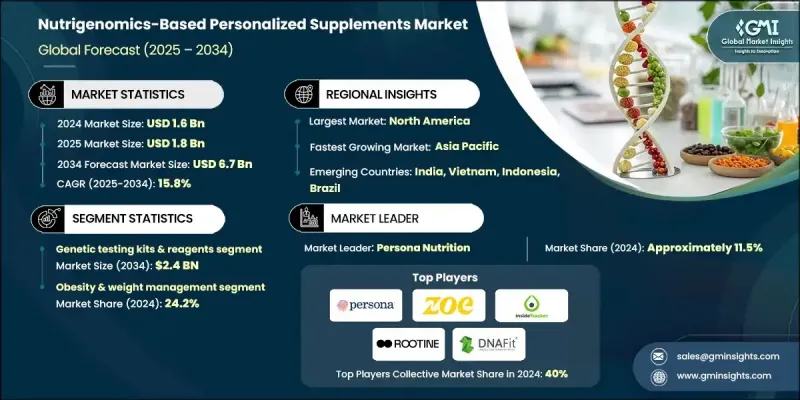
这一显着增长得益于基因组学的突破、人工智慧诊断技术的日益普及以及预防性健康解决方案的兴起。在DNA分析和数位健康平台的支持下,个人化营养正日益成为主流,因为注重健康的消费者正在寻求量身定制的健康策略。定序成本的降低和家用基因检测的日益普及正在加速这些个人化解决方案的推广。随着基因素养的提高和意识的增强,消费者越来越倾向于使用基于个人基因图谱提供客製化营养补充剂的平台。这种转变正在推动对直接面向消费者的营养基因组学服务的需求,并为以数位化为先导的营养补充剂公司创造新的商机。此外,利用人工智慧和机器学习技术解读DNA标记的创新倡议,使企业能够提供精准的营养配方,并透过行动整合和即时分析提升用户体验。
| 市场范围 | |
|---|---|
| 起始年份 | 2024 |
| 预测年份 | 2025-2034 |
| 起始值 | 16亿美元 |
| 预测值 | 67亿美元 |
| 复合年增长率 | 15.8% |
到2024年,基因检测试剂盒和试剂市场将占据35%的份额。这一主导地位源自于基因资料在实现精准个人化方面所扮演的核心角色。如果没有基因组资讯的收集和分析,就无法设计个人化的营养干预措施。微阵列平台、唾液检测试剂盒和SNP特异性检测板的改进,使得这些工具更容易取得,也更方便使用者在家中使用。这些进步正在推动更广泛的消费群体接受这些检测方法,并为高度客製化的健康策略奠定基础。
2024年,肥胖和体重管理领域占了24.2%的市场份额,成为该领域的主要应用方向。这主要受全球肥胖症盛行率不断上升的影响,全球已有超过10亿成年人受到肥胖症的困扰。随着越来越多的消费者转向以科学为依据的解决方案,营养基因组学因其能够透过基因标记精准识别代谢效率低下问题而备受关注。透过评估与脂肪储存、能量利用和食慾调节相关的关键变异,营养补充品品牌能够提供高度针对性的干预措施,帮助使用者根据自身独特的生理特征更好地管理体重。
预计到2024年,美国基于营养基因体学的个人化营养补充品市场规模将达到4.976亿美元。美国在该领域处于领先地位,这得益于其对消费者基因学的早期应用、先进的医疗保健基础设施以及蓬勃发展的健康文化。无论是老牌企业还是新兴新创公司,都在透过将基因科学与数位营养平台结合来推动创新。竞争激烈的市场环境以及消费者对科技驱动型健康解决方案日益增长的兴趣,正助力美国成为全球个人化营养补充品领域的领导者。
全球营养基因组学个人化营养补充品市场的主要参与者包括GenoPalate、Rootine、myDNA、Nutrigenomix、Persona Nutrition、Zoe、InsideTracker、Elysium Health、DNAfit和Sun Genomics。为了在营养基因组学个人化营养补充品市场站稳脚跟,各公司正致力于将先进的基因解读工具与人工智慧和机器学习技术结合。许多公司正透过数位化平台和订阅模式拓展产品线,提供持续的健康监测和个人化营养方案。与基因检测公司和数位健康公司的策略合作,有助于营养补充品品牌提升个人化方案的精准度。此外,各公司还在投资开发用户友好的应用程式和平台,用于追踪生物特征数据、饮食习惯和补充剂服用情况,从而提高用户的长期参与度。
目录
第一章:方法论与范围
第二章:执行概要
第三章:行业洞察
- 产业生态系分析
- 供应商格局
- 利润率
- 每个阶段的价值增加
- 影响价值链的因素
- 中断
- 产业影响因素
- 成长驱动因素
- 产业陷阱与挑战
- 市场机会
- 成长潜力分析
- 监管环境
- 北美洲
- 欧洲
- 亚太地区
- 拉丁美洲
- 中东和非洲
- 波特的分析
- PESTEL 分析
- 价格趋势
- 按地区
- 按类型
- 未来市场趋势
- 技术与创新格局
- 当前技术趋势
- 新兴技术
- 专利格局
- 贸易统计
- 主要进口国
- 主要出口国
(註:贸易统计仅针对重点国家提供)
- 永续性和环境方面
- 永续实践
- 减少废弃物策略
- 生产中的能源效率
- 环保倡议
- 碳足迹考量
第四章:竞争格局
- 介绍
- 公司市占率分析
- 按地区
- 北美洲
- 欧洲
- 亚太地区
- 拉丁美洲
- MEA
- 按地区
- 公司矩阵分析
- 主要市场参与者的竞争分析
- 竞争定位矩阵
- 关键进展
- 併购
- 合作伙伴关係与合作
- 新产品发布
- 扩张计划
第五章:市场估算与预测:依类型划分,2021-2034年
- 主要趋势
- 基因检测试剂盒及试剂
- 靶向SNP面板
- 全基因组定序
- 药物基因组学检测
- 表观遗传分析
- 人工智慧辅助口译平台
- 多组学整合平台
- 预测分析引擎
- 临床决策支援系统
- 消费者行动应用
- 个人化营养补充品配方
- 精准维生素和矿物质
- 标靶营养保健品
- 基于微生物组的益生菌
- 效能最佳化公式
第六章:市场估算与预测:依应用领域划分,2021-2034年
- 主要趋势
- 肥胖与体重管理
- 代谢基因变异分析
- 食慾调节优化
- 饮食反应个人化
- 运动和生活方式建议
- 心血管健康
- 脂质代谢优化
- 发炎反应管理
- 膳食脂肪反应个人化
- 同型半胱胺酸代谢支持
- 糖尿病与代谢紊乱
- 葡萄糖代谢优化
- 增强胰岛素敏感性
- 碳水化合物反应个人化
- 预防糖尿病併发症
- 运动营养与运动表现
- 肌肉成分优化
- 能量代谢增强
- 恢復与压力反应
- 损伤预防与復健
- 整体健康与长寿
- 老化与细胞健康
- 免疫系统优化
- 认知功能增强
- 压力反应管理
第七章:市场估算与预测:依最终用途划分,2021-2034年
- 主要趋势
- 直接面向消费者的平台
- 综合多组学提供者
- 专业测试服务
- 以补充剂为先的品牌
- 订阅盒模式
- 医疗保健提供者管道
- 初级保健整合
- 专科诊所和功能医学
- 医院系统和医疗网络
- 註册营养师和营养师
- 企业健康计划
- 大型企业计划
- 中型企业雇主福利
- 健康计划整合
- 职场健康供应商
- 零售与电子商务
- 连锁药局
- 健康食品零售商
- 通用电子商务平台
- 专业零售店
第八章:市场估算与预测:依地区划分,2021-2034年
- 主要趋势
- 北美洲
- 我们
- 加拿大
- 欧洲
- 德国
- 英国
- 法国
- 西班牙
- 义大利
- 欧洲其他地区
- 亚太地区
- 中国
- 印度
- 日本
- 澳洲
- 韩国
- 亚太其他地区
- 拉丁美洲
- 巴西
- 墨西哥
- 阿根廷
- 拉丁美洲其他地区
- 中东和非洲
- 沙乌地阿拉伯
- 南非
- 阿联酋
- 中东和非洲其他地区
第九章:公司简介
- AKESOgen
- Baze
- Care/of
- DNAfit
- Elysium Health
- Fitgenes
- GenoPalate
- Habit
- Helix
- InsideTracker
- LifeNome
- myDNA
- Nutrigenomix
- Onegevity
- Persona Nutrition
- Rootine
- Sun Genomics
- Vitagene
- WellnessFX
- Zoe
- Others
The Global Nutrigenomics-Based Personalized Supplements Market was valued at USD 1.6 billion in 2024 and is estimated to grow at a CAGR of 15.8% to reach USD 6.7 billion by 2034.
This significant growth is driven by breakthroughs in genomic science, the increasing use of AI-based diagnostics, and the rising shift toward preventive health solutions. Personalized nutrition, supported by DNA analysis and digital health platforms, is becoming increasingly mainstream as health-conscious consumers seek tailored wellness strategies. The reduced cost of sequencing and growing availability of at-home genetic testing are accelerating the adoption of these personalized solutions. As genetic literacy improves and awareness spreads, consumers are becoming more engaged with platforms that offer customized supplements based on individual genetic profiles. This shift is fueling demand for direct-to-consumer nutrigenomics services and creating new business opportunities for digital-first supplement companies. Additionally, innovation across platforms using AI and machine learning for interpreting DNA markers is enabling companies to deliver precise nutritional formulas while also enhancing the user experience through mobile integration and real-time analytics.
| Market Scope | |
|---|---|
| Start Year | 2024 |
| Forecast Year | 2025-2034 |
| Start Value | $1.6 Billion |
| Forecast Value | $6.7 Billion |
| CAGR | 15.8% |
The genetic testing kits and reagents segment held a 35% share in 2024. This dominance stems from the central role genetic data plays in enabling accurate personalization. Without collecting and analyzing genomic information, personalized nutrition interventions cannot be designed. Improvements in microarray platforms, saliva-based test kits, and SNP-specific panels are making these tools more accessible and user-friendly for home use. These advancements are pushing wider adoption across a broader consumer base, laying the groundwork for highly tailored health strategies.
The obesity and weight management segment held a 24.2% share in 2024, emerging as the leading application area within the space. This is largely influenced by the rising global prevalence of obesity, which affects more than a billion adults worldwide. As more consumers turn to science-backed solutions, nutrigenomics is gaining attention for its ability to pinpoint metabolic inefficiencies through genetic markers. By evaluating key variants linked to fat storage, energy usage, and appetite regulation, supplement brands are offering highly targeted interventions to help users better manage weight based on their unique biology.
U.S. Nutrigenomics-Based Personalized Supplements Market generated USD 497.6 million in 2024. The United States leads this space due to its early embrace of consumer genetics, advanced healthcare infrastructure, and a thriving wellness culture. Both established players and emerging startups are driving innovation by merging genetic science with digital nutrition platforms. The competitive ecosystem and growing consumer interest in tech-driven health solutions are helping shape the U.S. as a global leader in personalized supplementation.
Key companies operating in the Global Nutrigenomics-Based Personalized Supplements Market include GenoPalate, Rootine, myDNA, Nutrigenomix, Persona Nutrition, Zoe, InsideTracker, Elysium Health, DNAfit, and Sun Genomics. To establish a strong foothold in the nutrigenomics-based personalized supplements market, companies are focusing on integrating advanced genetic interpretation tools with AI and machine learning technologies. Many are expanding their product offerings through digital platforms and subscription-based models that provide continuous health monitoring and tailored nutrition. Strategic collaborations with genetic testing firms and digital health companies allow supplement brands to enhance personalization accuracy. Companies are also investing in user-friendly apps and platforms that track biometrics, dietary habits, and supplement adherence, improving long-term engagement.
Table of Contents
Chapter 1 Methodology & Scope
- 1.1 Market scope and definition
- 1.2 Research design
- 1.2.1 Research approach
- 1.2.2 Data collection methods
- 1.3 Data mining sources
- 1.3.1 Global
- 1.3.2 Regional/Country
- 1.4 Base estimates and calculations
- 1.4.1 Base year calculation
- 1.4.2 Key trends for market estimation
- 1.5 Primary research and validation
- 1.5.1 Primary sources
- 1.6 Forecast model
- 1.7 Research assumptions and limitations
Chapter 2 Executive Summary
- 2.1 Industry 360° synopsis
- 2.2 Key market trends
- 2.2.1 Regional
- 2.2.2 Type
- 2.2.3 Application
- 2.2.4 End Use
- 2.3 TAM Analysis, 2025-2034
- 2.4 CXO perspectives: Strategic imperatives
- 2.4.1 Executive decision points
- 2.4.2 Critical success factors
- 2.5 Future Outlook and Strategic Recommendations
Chapter 3 Industry Insights
- 3.1 Industry ecosystem analysis
- 3.1.1 Supplier Landscape
- 3.1.2 Profit Margin
- 3.1.3 Value addition at each stage
- 3.1.4 Factor affecting the value chain
- 3.1.5 Disruptions
- 3.2 Industry impact forces
- 3.2.1 Growth drivers
- 3.2.2 Industry pitfalls and challenges
- 3.2.3 Market opportunities
- 3.3 Growth potential analysis
- 3.4 Regulatory landscape
- 3.4.1 North America
- 3.4.2 Europe
- 3.4.3 Asia Pacific
- 3.4.4 Latin America
- 3.4.5 Middle East & Africa
- 3.5 Porter's analysis
- 3.6 PESTEL analysis
- 3.7 Price trends
- 3.7.1 By region
- 3.7.2 By type
- 3.8 Future market trends
- 3.9 Technology and Innovation landscape
- 3.9.1 Current technological trends
- 3.9.2 Emerging technologies
- 3.10 Patent Landscape
- 3.11 Trade statistics
- 3.11.1 Major importing countries
- 3.11.2 Major exporting countries
( Note: the trade statistics will be provided for key countries only)
- 3.12 Sustainability and Environmental Aspects
- 3.12.1 Sustainable Practices
- 3.12.2 Waste Reduction Strategies
- 3.12.3 Energy Efficiency in Production
- 3.12.4 Eco-friendly Initiatives
- 3.13 Carbon Footprint Considerations
Chapter 4 Competitive Landscape, 2024
- 4.1 Introduction
- 4.2 Company market share analysis
- 4.2.1 By region
- 4.2.1.1 North America
- 4.2.1.2 Europe
- 4.2.1.3 Asia Pacific
- 4.2.1.4 LATAM
- 4.2.1.5 MEA
- 4.2.1 By region
- 4.3 Company matrix analysis
- 4.4 Competitive analysis of major market players
- 4.5 Competitive positioning matrix
- 4.6 Key developments
- 4.6.1 Mergers & acquisitions
- 4.6.2 Partnerships & collaborations
- 4.6.3 New Product Launches
- 4.7 Expansion Plans
Chapter 5 Market Estimates and Forecast, By Type, 2021 - 2034 (USD Million)
- 5.1 Key trends
- 5.2 Genetic testing kits & reagents
- 5.2.1 Targeted SNP panels
- 5.2.2 Whole genome sequencing
- 5.2.3 Pharmacogenomic testing
- 5.2.4 Epigenetic analysis
- 5.3 AI-powered interpretation platforms
- 5.3.1 Multi-omics integration platforms
- 5.3.2 Predictive analytics engines
- 5.3.3 Clinical decision support systems
- 5.3.4 Consumer mobile applications
- 5.4 Personalized supplement formulations
- 5.4.1 Precision vitamins & minerals
- 5.4.2 Targeted nutraceuticals
- 5.4.3 Microbiome-informed probiotics
- 5.4.4 Performance optimization formulas
Chapter 6 Market Estimates and Forecast, By Application, 2021 - 2034 (USD Million)
- 6.1 Key trends
- 6.2 Obesity & weight management
- 6.2.1 Metabolic gene variants analysis
- 6.2.2 Appetite regulation optimization
- 6.2.3 Dietary response personalization
- 6.2.4 Exercise & lifestyle recommendations
- 6.3 Cardiovascular health
- 6.3.1 Lipid metabolism optimization
- 6.3.2 Inflammation response management
- 6.3.3 Dietary fat response personalization
- 6.3.4 Homocysteine metabolism support
- 6.4 Diabetes & metabolic disorders
- 6.4.1 Glucose metabolism optimization
- 6.4.2 Insulin sensitivity enhancement
- 6.4.3 Carbohydrate response personalization
- 6.4.4 Diabetic complication prevention
- 6.5 Sports nutrition & performance
- 6.5.1 Muscle composition optimization
- 6.5.2 Energy metabolism enhancement
- 6.5.3 Recovery & stress response
- 6.5.4 Injury prevention & rehabilitation
- 6.6 General wellness & longevity
- 6.6.1 Aging & cellular health
- 6.6.2 Immune system optimization
- 6.6.3 Cognitive function enhancement
- 6.6.4 Stress response management
Chapter 7 Market Estimates and Forecast, By End Use, 2021 - 2034 (USD Million)
- 7.1 Key trends
- 7.2 Direct-to-consumer platforms
- 7.2.1 Comprehensive multi-omics providers
- 7.2.2 Specialized testing services
- 7.2.3 Supplement-first brands
- 7.2.4 Subscription box models
- 7.3 Healthcare provider channel
- 7.3.1 Primary care integration
- 7.3.2 Specialty clinics & functional medicine
- 7.3.3 Hospital systems & health networks
- 7.3.4 Registered dietitians & nutritionists
- 7.3.5 Corporate wellness programs
- 7.3.6 Large enterprise programs
- 7.3.7 Mid-market employer benefits
- 7.3.8 Health plan integration
- 7.3.9 Workplace wellness vendors
- 7.4 Retail & e-commerce
- 7.4.1 Pharmacy chains
- 7.4.2 Health food retailers
- 7.4.3 General e-commerce platforms
- 7.4.4 Specialty retail locations
Chapter 8 Market Estimates and Forecast, By Region, 2021 - 2034 (USD Million)
- 8.1 Key trends
- 8.2 North America
- 8.2.1 U.S.
- 8.2.2 Canada
- 8.3 Europe
- 8.3.1 Germany
- 8.3.2 UK
- 8.3.3 France
- 8.3.4 Spain
- 8.3.5 Italy
- 8.3.6 Rest of Europe
- 8.4 Asia Pacific
- 8.4.1 China
- 8.4.2 India
- 8.4.3 Japan
- 8.4.4 Australia
- 8.4.5 South Korea
- 8.4.6 Rest of Asia Pacific
- 8.5 Latin America
- 8.5.1 Brazil
- 8.5.2 Mexico
- 8.5.3 Argentina
- 8.5.4 Rest of Latin America
- 8.6 Middle East and Africa
- 8.6.1 Saudi Arabia
- 8.6.2 South Africa
- 8.6.3 UAE
- 8.6.4 Rest of Middle East and Africa
Chapter 9 Company Profiles
- 9.1 AKESOgen
- 9.2 Baze
- 9.3 Care/of
- 9.4 DNAfit
- 9.5 Elysium Health
- 9.6 Fitgenes
- 9.7 GenoPalate
- 9.8 Habit
- 9.9 Helix
- 9.10 InsideTracker
- 9.11 LifeNome
- 9.12 myDNA
- 9.13 Nutrigenomix
- 9.14 Onegevity
- 9.15 Persona Nutrition
- 9.16 Rootine
- 9.17 Sun Genomics
- 9.18 Vitagene
- 9.19 WellnessFX
- 9.20 Zoe
- 9.21 Others

 2026-2034年全球膳食补充剂契约製造市场规模、份额、趋势和成长分析报告全球膳食补充剂市场规模、份额、趋势和成长分析报告(2026-2034)
 营养补充品市场-全球产业规模、份额、趋势、机会和预测:按成分、剂型、用途、分销管道、最终用户、地区和竞争格局划分,2021-2031年
 内在美与健康个人护理市场预测至2032年:按产品类型、通路、消费者群体和地区分類的全球分析
 膳食补充剂市场规模、份额和成长分析(按类型、剂型、功能、配方类型、目标消费者、价格分布、分销管道和地区划分)—产业预测(2026-2033 年)
 膳食补充剂市场按成分、形式、用途、最终用户、分销管道和地区划分
 营养补充品的全球市场:市场规模·占有率·趋势,产业分析 (各类型·不同形状·各用途·各流通管道·各最终用途·各地区),未来预测 (2025年~2034年)
 全球营养食品市场:按原料采购/品质、技术、类型、使用方法、目标消费者、功能、分销管道、地区 - 预测至 2029 年
 营养补充品市场评估:依产品、剂型、口味、应用、最终用户、通路、地区、机会、预测,2017-2031年
 欧洲膳食补充剂市场规模和预测、区域份额、趋势和成长机会分析报告范围:按类型、形式、配销通路和国家/地区