


 |
市场调查报告书
商品编码
1871156
气凝胶市场机会、成长驱动因素、产业趋势分析及预测(2025-2034年)Aerogels Market Opportunity, Growth Drivers, Industry Trend Analysis, and Forecast 2025 - 2034 |
||||||

2024 年全球气凝胶市场价值为 12 亿美元,预计到 2034 年将以 16% 的复合年增长率增长至 49 亿美元。
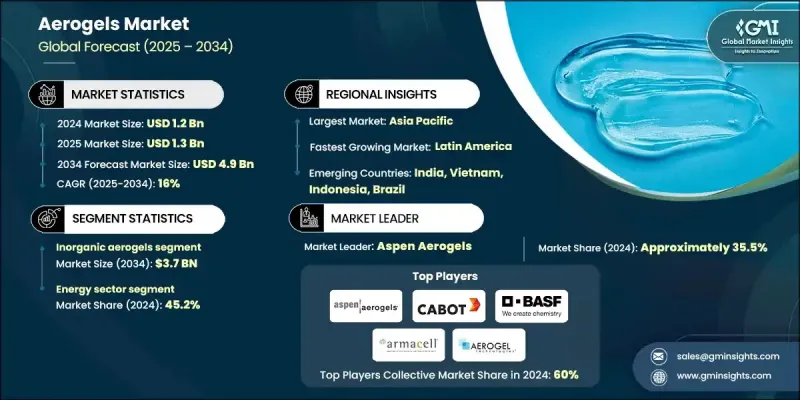
由于其在能源密集产业和电动车电池安全应用领域的日益广泛应用,气凝胶产业正获得显着发展。製造流程的不断进步提高了生产效率并降低了总体成本,进一步推动了市场扩张。诸如常压干燥 (APD) 和增材製造等技术缩短了生产时间并简化了设备要求,提高了可扩展性和成本效益。这些进步正在促进气凝胶在各行业中取代传统绝缘材料。由于气凝胶在极低和极高温度下均能保持卓越的隔热性能,终端用户越来越多地采用柔性毯状气凝胶,这种材料具有安装快捷、可重复使用和长期成本优势等优点。气凝胶独特的性能、轻质结构、高孔隙率和低导热係数是其快速占领市场的关键。凭藉其耐久性、高性能和永续性,气凝胶正成为全球工业和能源基础设施的首选绝缘解决方案。
| 市场范围 | |
|---|---|
| 起始年份 | 2024 |
| 预测年份 | 2025-2034 |
| 起始值 | 12亿美元 |
| 预测值 | 49亿美元 |
| 复合年增长率 | 16% |
随着越来越多的终端用户因其卓越的性能和效率优势而采用气凝胶,气凝胶产业持续扩张。在能源和工业应用领域,柔性气凝胶毯已成为首选,其厚度比传统保温材料薄五倍,同时安装速度更快,防潮性能更佳。这些特性有助于降低腐蚀风险,并提高长期可靠性。在生产方面,常压干燥已成为超临界干燥和冷冻干燥方法的经济高效且可扩展的替代方案,可将加工时间缩短 50% 以上,并实现低于 0.03 W/m*K 的导热係数。这项技术变革推动了面向大型商业和建筑应用的经济型气凝胶产品的开发。
2024年,无机气凝胶市占率达79.3%。其受欢迎程度主要得益于其卓越的材料性能,例如超低导热係数(常温常压下为12-30 mW/m*K)和超过95%的孔隙率。这些特性使其适用于炼油厂、液化天然气系统和配电网路等场所的低温和高温隔热需求。常压干燥和辅助发泡技术的进步也提高了加工效率,降低了对高成本高压釜的依赖。因此,在安全性、可靠性和长使用寿命比初始成本更重要的工业应用中,无机气凝胶仍然是首选解决方案。
2024年,能源领域占了45.2%的市场。此领域涵盖石油天然气、电力和液化天然气等产业,持续树立影响全球气凝胶应用性能的标准。在能源设施中,气凝胶毯可显着减少保温层厚度,从而加快安装速度并防止水分积聚。这有助于实现切实的营运成本节约,包括大幅降低热力系统的能源损耗和维护成本。液化天然气接收站和海底管道等大型专案进一步证明了气凝胶在极端条件下的价值,在这些条件下,热效率和耐火性至关重要。
2024年美国气凝胶市场规模为4.459亿美元,预计到2034年将达到17亿美元,复合年增长率(CAGR)为15.8%。北美在全球市场占据领先地位,这得益于气凝胶隔热材料在炼油厂、液化天然气设施和电动车等领域的广泛应用。美国拥有强大的技术基础设施、研究合作伙伴关係以及政府支持的创新项目,这些项目致力于改善生产方法和开发高性能隔热解决方案。这些措施持续推动商业化进程,并巩固了北美在全球气凝胶产业的领先地位。
全球气凝胶市场的主要参与者包括巴斯夫公司 (BASF SE)、Enersens SAS、阿姆斯壮国际公司 (Armacell International SA)、Blueshift Materials Inc.、卡博特公司 (Cabot Corporation)、Active Aerogels、Thermablok Aerogel、Nano High-Tech Co Ltd、Svenska Aerogelp、Greenal Aerogel Technologies、JVaks Aerogel、Butass. (Guangdong Alison Hi-Tech Co Ltd) 和 Aerogel Technologies LLC。气凝胶市场的领导者正着力于生产创新、成本优化和策略扩张,以巩固其全球地位。各公司正投资于可扩展的常压干燥技术,以降低生产复杂性并提高产量效率。与能源、汽车和建筑业的合作有助于拓展应用领域,并推动高成长产业的应用。
目录
第一章:方法论与范围
第二章:执行概要
第三章:行业洞察
- 产业生态系分析
- 供应商格局
- 利润率
- 每个阶段的价值增加
- 影响价值链的因素
- 中断
- 产业影响因素
- 成长驱动因素
- 产业陷阱与挑战
- 市场机会
- 成长潜力分析
- 监管环境
- 北美洲
- 欧洲
- 亚太地区
- 拉丁美洲
- 中东和非洲
- 波特的分析
- PESTEL 分析
- 价格趋势
- 按地区
- 副产品
- 未来市场趋势
- 技术与创新格局
- 当前技术趋势
- 新兴技术
- 专利格局
- 贸易统计
- 主要进口国
- 主要出口国(註:仅提供重点国家的贸易统计)
- 永续性和环境方面
- 永续实践
- 减少废弃物策略
- 生产中的能源效率
- 环保倡议
- 碳足迹考量
第四章:竞争格局
- 介绍
- 公司市占率分析
- 按地区
- 北美洲
- 欧洲
- 亚太地区
- 拉丁美洲
- MEA
- 按地区
- 公司矩阵分析
- 主要市场参与者的竞争分析
- 竞争定位矩阵
- 关键进展
- 併购
- 合作伙伴关係与合作
- 新产品发布
- 扩张计划
第五章:市场估算与预测:依产品划分,2021-2034年
- 主要趋势
- 无机气凝胶
- 二氧化硅气凝胶
- 氧化铝气凝胶
- 二氧化钛气凝胶
- 碳气凝胶
- 结晶气凝胶
- 有机聚合物气凝胶
- 聚酰亚胺气凝胶
- 聚氨酯气凝胶
- 聚脲气凝胶
- 间苯二酚-甲醛气凝胶
- 混合/复合气凝胶
- 纤维增强气凝胶
- 聚合物交联气凝胶
- 不透明气凝胶
第六章:市场估算与预测:依形式划分,2021-2034年
- 主要趋势
- 灵活形式
- 气凝胶毯
- 气凝胶胶带
- 气凝胶包裹
- 刚性形式
- 气凝胶板
- 气凝胶单体
- 气凝胶板
- 颗粒形式
- 气凝胶粉末
- 气凝胶珠
- 气凝胶微球
第七章:市场估计与预测:依温度范围划分,2021-2034年
- 主要趋势
- -196°C 至 -50°C(低温应用)
- -50°C 至 200°C(环境温度应用)
- 200°C 至 1200°C(高温应用)
第八章:市场估算与预测:依最终用途产业划分,2021-2034年
- 主要趋势
- 能源领域
- 石油和天然气
- 发电
- 液化天然气和天然气处理
- 运输
- 汽车
- 航太与国防
- 海洋
- 铁路运输
- 建筑与基础设施
- 住宅大楼
- 商业建筑
- 工业建筑
- 工业製造
- 化学加工
- 食品饮料加工
- 製药
第九章:市场估计与预测:依地区划分,2021-2034年
- 主要趋势
- 北美洲
- 我们
- 加拿大
- 欧洲
- 德国
- 英国
- 法国
- 西班牙
- 义大利
- 欧洲其他地区
- 亚太地区
- 中国
- 印度
- 日本
- 澳洲
- 韩国
- 亚太其他地区
- 拉丁美洲
- 巴西
- 墨西哥
- 阿根廷
- 拉丁美洲其他地区
- 中东和非洲
- 沙乌地阿拉伯
- 南非
- 阿联酋
- 中东和非洲其他地区
第十章:公司简介
- Active Aerogels
- Aerogel Technologies LLC
- Airglass AB
- Armacell International SA
- Aspen Aerogels Inc
- BASF SE
- Blueshift Materials Inc
- Cabot Corporation
- Enersens SAS
- Green Earth Aerogel Technologies
- Guangdong Alison Hi-Tech Co Ltd
- Jios Aerogel Corporation
- Nano High-Tech Co Ltd
- Svenska Aerogel AB
- Thermablok Aerogel
- Others
The Global Aerogels Market was valued at USD 1.2 Billion in 2024 and is estimated to grow at a CAGR of 16% to reach USD 4.9 Billion by 2034.
The industry is gaining significant traction due to its growing use in energy-intensive sectors and electric vehicle battery safety applications. Continuous advancements in manufacturing processes are enabling higher production efficiency and lowering overall costs, further driving market expansion. Technologies such as ambient pressure drying (APD) and additive manufacturing are reducing production time and simplifying equipment requirements, improving scalability and cost-effectiveness. These advancements are facilitating the replacement of traditional insulation materials with aerogels across industries. Because aerogels maintain superior thermal performance across both extremely low and high temperatures, end-users are increasingly adopting flexible blanket formats that provide faster installation, reusability, and long-term cost advantages. The material's unique properties, lightweight structure, high porosity, and low thermal conductivity are key to its rapid market penetration. With their combination of durability, performance, and sustainability, aerogels are emerging as a preferred insulation solution for industrial and energy infrastructure worldwide.
| Market Scope | |
|---|---|
| Start Year | 2024 |
| Forecast Year | 2025-2034 |
| Start Value | $1.2 Billion |
| Forecast Value | $4.9 Billion |
| CAGR | 16% |
The aerogels industry continues to expand as more end-users adopt it for its strong performance and efficiency advantages. In energy and industrial applications, flexible aerogel blankets have become the preferred choice, offering up to five times thinner profiles compared to conventional insulation while providing faster installation and enhanced moisture resistance. These properties help reduce corrosion risks and improve long-term reliability. On the production front, ambient pressure drying has become a cost-effective and scalable alternative to supercritical and freeze-drying methods, delivering processing-time reductions of over 50% and achieving sub-0.03 W/m*K thermal conductivities. This technological shift supports the development of affordable aerogel products designed for large-scale commercial and building applications.
The inorganic aerogels segment held 79.3% share in 2024. Their popularity is driven by exceptional material properties, such as ultra-low thermal conductivity (ranging between 12-30 mW/m*K at ambient conditions) and porosity levels above 95%. These features make them suitable for both cryogenic and high-temperature insulation requirements across refineries, liquefied natural gas systems, and power distribution networks. Advances in ambient pressure drying and assisted foaming have also improved processing efficiency, lowering dependency on high-cost autoclaves. As a result, inorganic aerogels remain the preferred solution in industrial applications where safety, reliability, and long service life outweigh initial costs.
The energy segment held a 45.2% share in 2024. The sector spanning oil and gas, power, and LNG industries continues to set performance standards that influence aerogel adoption globally. In energy facilities, aerogel blankets help reduce insulation thickness by several multiples, enabling faster installation and preventing moisture buildup. This contributes to tangible operational savings, including significant reductions in energy losses and maintenance costs across thermal systems. Large-scale projects in LNG terminals and subsea pipelines further demonstrate the value of aerogels in extreme conditions where thermal efficiency and fire resistance are critical.
U.S. Aerogels Market generated USD 445.9 million in 2024 and is forecasted to reach USD 1.7 Billion by 2034, growing at a CAGR of 15.8%. North America leads the global market, supported by the wide adoption of aerogel insulation across refineries, LNG facilities, and electric vehicle applications. The U.S. benefits from strong technological infrastructure, research partnerships, and government-backed innovation programs focused on improving production methods and developing high-performance insulation solutions. These initiatives continue to drive commercialization and reinforce the region's dominance in the global aerogels industry.
Major companies active in the Global Aerogels Market include BASF SE, Enersens SAS, Armacell International S.A., Blueshift Materials Inc., Cabot Corporation, Active Aerogels, Thermablok Aerogel, Nano High-Tech Co Ltd, Svenska Aerogel AB, Green Earth Aerogel Technologies, Jios Aerogel Corporation, Airglass AB, Aspen Aerogels Inc., Guangdong Alison Hi-Tech Co Ltd, and Aerogel Technologies LLC. Leading players in the aerogels market are emphasizing production innovation, cost optimization, and strategic expansion to strengthen their global presence. Companies are investing in scalable ambient pressure drying technologies to reduce manufacturing complexity and achieve higher yield efficiency. Partnerships with energy, automotive, and construction sectors are helping expand application areas and drive adoption in high-growth industries.
Table of Contents
Chapter 1 Methodology & Scope
- 1.1 Market scope and definition
- 1.2 Research design
- 1.2.1 Research approach
- 1.2.2 Data collection methods
- 1.3 Data mining sources
- 1.3.1 Global
- 1.3.2 Regional/Country
- 1.4 Base estimates and calculations
- 1.4.1 Base year calculation
- 1.4.2 Key trends for market estimation
- 1.5 Primary research and validation
- 1.5.1 Primary sources
- 1.6 Forecast model
- 1.7 Research assumptions and limitations
Chapter 2 Executive Summary
- 2.1 Industry 3600 synopsis
- 2.2 Key market trends
- 2.2.1 Regional
- 2.2.2 Product
- 2.2.3 Form
- 2.2.4 Temperature range
- 2.2.5 End use industry
- 2.3 TAM Analysis, 2025-2034
- 2.4 CXO perspectives: Strategic imperatives
- 2.4.1 Executive decision points
- 2.4.2 Critical success factors
- 2.5 Future Outlook and Strategic Recommendations
Chapter 3 Industry Insights
- 3.1 Industry ecosystem analysis
- 3.1.1 Supplier Landscape
- 3.1.2 Profit Margin
- 3.1.3 Value addition at each stage
- 3.1.4 Factor affecting the value chain
- 3.1.5 Disruptions
- 3.2 Industry impact forces
- 3.2.1 Growth drivers
- 3.2.2 Industry pitfalls and challenges
- 3.2.3 Market opportunities
- 3.3 Growth potential analysis
- 3.4 Regulatory landscape
- 3.4.1 North America
- 3.4.2 Europe
- 3.4.3 Asia Pacific
- 3.4.4 Latin America
- 3.4.5 Middle East & Africa
- 3.5 Porter's analysis
- 3.6 PESTEL analysis
- 3.7 Price trends
- 3.7.1 By region
- 3.7.2 By product
- 3.8 Future market trends
- 3.9 Technology and Innovation landscape
- 3.9.1 Current technological trends
- 3.9.2 Emerging technologies
- 3.10 Patent Landscape
- 3.11 Trade statistics
- 3.11.1 Major importing countries
- 3.11.2 Major exporting countries ( Note: the trade statistics will be provided for key countries only)
- 3.12 Sustainability and Environmental Aspects
- 3.12.1 Sustainable Practices
- 3.12.2 Waste Reduction Strategies
- 3.12.3 Energy Efficiency in Production
- 3.12.4 Eco-friendly Initiatives
- 3.13 Carbon Footprint Considerations
Chapter 4 Competitive Landscape, 2024
- 4.1 Introduction
- 4.2 Company market share analysis
- 4.2.1 By region
- 4.2.1.1 North America
- 4.2.1.2 Europe
- 4.2.1.3 Asia Pacific
- 4.2.1.4 LATAM
- 4.2.1.5 MEA
- 4.2.1 By region
- 4.3 Company matrix analysis
- 4.4 Competitive analysis of major market players
- 4.5 Competitive positioning matrix
- 4.6 Key developments
- 4.6.1 Mergers & acquisitions
- 4.6.2 Partnerships & collaborations
- 4.6.3 New Product Launches
- 4.6.4 Expansion Plans
Chapter 5 Market Estimates and Forecast, By Product, 2021 - 2034 (USD Million) (Tons)
- 5.1 Key trends
- 5.2 Inorganic aerogels
- 5.2.1 Silica aerogels
- 5.2.2 Alumina aerogels
- 5.2.3 Titania aerogels
- 5.2.4 Carbon aerogels
- 5.2.5 Crystalline aerogels
- 5.3 Organic polymer aerogels
- 5.3.1 Polyimide aerogels
- 5.3.2 Polyurethane aerogels
- 5.3.3 Polyurea aerogels
- 5.3.4 Resorcinol-formaldehyde aerogels
- 5.4 Hybrid/composite aerogels
- 5.4.1 Fiber-reinforced aerogels
- 5.4.2 Polymer-crosslinked aerogels
- 5.4.3 Opacified aerogels
Chapter 6 Market Estimates and Forecast, By Form, 2021 - 2034 (USD Million) (Tons)
- 6.1 Key trends
- 6.2 Flexible forms
- 6.2.1 Aerogel blankets
- 6.2.2 Aerogel tapes
- 6.2.3 Aerogel wraps
- 6.3 Rigid forms
- 6.3.1 Aerogel panels
- 6.3.2 Aerogel monoliths
- 6.3.3 Aerogel boards
- 6.4 Particulate forms
- 6.4.1 Aerogel powders
- 6.4.2 Aerogel beads
- 6.4.3 Aerogel microspheres
Chapter 7 Market Estimates and Forecast, By Temperature Range, 2021 - 2034 (USD Million) (Tons)
- 7.1 Key trends
- 7.2 -196°c to -50°c (Cryogenic applications)
- 7.3 -50°c to 200°c (Ambient temperature applications)
- 7.4 200°c to 1200°c (High-temperature applications)
Chapter 8 Market Estimates and Forecast, By End Use Industry, 2021 - 2034 (USD Million) (Tons)
- 8.1 Key trends
- 8.2 Energy sector
- 8.2.1 Oil & gas
- 8.2.2 Power generation
- 8.2.3 LNG & gas processing
- 8.3 Transportation
- 8.3.1 Automotive
- 8.3.2 Aerospace & defense
- 8.3.3 Marine
- 8.3.4 Rail transportation
- 8.4 Construction & infrastructure
- 8.4.1 Residential buildings
- 8.4.2 Commercial buildings
- 8.4.3 Industrial buildings
- 8.5 Industrial manufacturing
- 8.5.1 Chemical processing
- 8.5.2 Food & beverage processing
- 8.5.3 Pharmaceuticals
Chapter 9 Market Estimates and Forecast, By Region, 2021 - 2034 (USD Million) (Tons)
- 9.1 Key trends
- 9.2 North America
- 9.2.1 U.S.
- 9.2.2 Canada
- 9.3 Europe
- 9.3.1 Germany
- 9.3.2 UK
- 9.3.3 France
- 9.3.4 Spain
- 9.3.5 Italy
- 9.3.6 Rest of Europe
- 9.4 Asia Pacific
- 9.4.1 China
- 9.4.2 India
- 9.4.3 Japan
- 9.4.4 Australia
- 9.4.5 South Korea
- 9.4.6 Rest of Asia Pacific
- 9.5 Latin America
- 9.5.1 Brazil
- 9.5.2 Mexico
- 9.5.3 Argentina
- 9.5.4 Rest of Latin America
- 9.6 Middle East and Africa
- 9.6.1 Saudi Arabia
- 9.6.2 South Africa
- 9.6.3 UAE
- 9.6.4 Rest of Middle East and Africa
Chapter 10 Company Profiles
- 10.1 Active Aerogels
- 10.2 Aerogel Technologies LLC
- 10.3 Airglass AB
- 10.4 Armacell International S.A.
- 10.5 Aspen Aerogels Inc
- 10.6 BASF SE
- 10.7 Blueshift Materials Inc
- 10.8 Cabot Corporation
- 10.9 Enersens SAS
- 10.10 Green Earth Aerogel Technologies
- 10.11 Guangdong Alison Hi-Tech Co Ltd
- 10.12 Jios Aerogel Corporation
- 10.13 Nano High-Tech Co Ltd
- 10.14 Svenska Aerogel AB
- 10.15 Thermablok Aerogel
- 10.16 Others

 气凝胶市场:按类型、形态、应用和最终用途产业划分-2026-2032年全球市场预测
 气凝胶市场规模、份额、趋势和预测:按类型、形态、加工方法、应用和地区划分,2026-2034年
 2026年全球气凝胶市场报告
 全球二氧化硅气凝胶市场:市场规模、占有率、成长率、产业分析、依类型、应用和地区划分的分析以及未来预测(2026-2034)
 全球热解凝胶绝缘材料市场按产品类型、材料成分、形态、应用、最终用途产业、分销管道和地区划分-市场规模、产业趋势、机会分析和预测(2026-2035年)
 气凝胶市场-全球产业规模、份额、趋势、机会及预测(按类型、形态、加工、应用、地区和竞争格局划分),2021-2031年二氧化硅气凝胶市场按产品类型、形态、干燥方法、应用和最终用途产业划分-2026-2032年全球预测二氧化硅气凝胶毯市场按产品类型、分销管道、终端用户产业和应用划分-2026-2032年全球预测气凝胶保温毯市场按形态、原料类型、最终用户、应用和分销管道划分-2026-2032年全球预测全球气凝胶市场:市场规模、占有率、成长率、产业分析、依类型、应用和地区划分的分析以及未来预测(2026-2034)