


 |
市场调查报告书
商品编码
1876555
穿戴式汗液分析设备市场机会、成长驱动因素、产业趋势分析及预测(2025-2034年)Wearable Sweat Analysis Device Market Opportunity, Growth Drivers, Industry Trend Analysis, and Forecast 2025 - 2034 |
||||||

2024 年全球穿戴式汗液分析设备市场价值为 5,920 万美元,预计到 2034 年将以 33.6% 的复合年增长率增长至 11 亿美元。
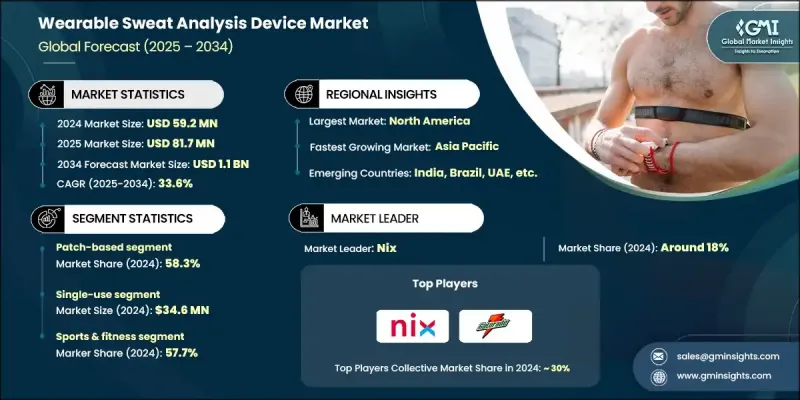
受非侵入式诊断工具需求成长、穿戴式科技在健身和医疗保健领域日益普及以及感测器小型化技术的重大进步的推动,市场正经历快速成长。柔性电子、奈米材料和微流控系统的发展提高了基于汗液的监测设备的精度、舒适性和整合度。这些创新使得感测器能够嵌入小型贴片或轻巧的可穿戴设备中,同时保持高资料准确性和性能。凭藉同时分析多种生物标记的能力,这些设备在消费者健康追踪和临床诊断方面变得越来越重要。个人化、即时健康洞察和资料连接性的结合,使汗液分析穿戴式装置成为现代医疗保健和运动表现监测领域的变革性工具。随着技术的进步,这些设备的易用性、准确性和经济性有望进一步加速其在全球健身、医疗和研究领域的应用。
| 市场范围 | |
|---|---|
| 起始年份 | 2024 |
| 预测年份 | 2025-2034 |
| 起始值 | 5920万美元 |
| 预测值 | 11亿美元 |
| 复合年增长率 | 33.6% |
穿戴式汗液感测器在运动健身领域的日益普及是推动市场扩张的最强劲动力之一。运动员和健身爱好者依靠这些设备在训练或比赛期间评估水分含量、电解质平衡和疲劳程度。随着全球活跃人群数量的不断增长,此类先进穿戴装置的普及率持续攀升。这些设备不仅能够提供运动表现的洞察,还能在预防脱水和优化恢復方案方面发挥关键作用。
2024年,贴片式设备市占率达58.3%。这些柔性、可贴附于皮肤的可穿戴设备内建微流控通道和生化感测器,能够即时分析汗液成分。其轻盈的一次性设计使其成为运动和医疗环境中短期监测的理想选择。除了提供即时资料外,许多此类贴片还提供视觉指示器和无线连接功能,可与行动健康应用程式无缝同步。这些设备的简便性和舒适性使其在寻求快速且方便的运动表现追踪解决方案的消费者中广受欢迎。
2024年,可重复使用型汗液监测器市占率达41.7%。这些耐用型设备专为长期使用而设计,通常整合到智慧型穿戴装置中,例如腕带、臂带和头带。它们配备了强大的感测器系统,能够在多个训练阶段持续监测汗水情况。其持久耐用和资料可靠性使其非常适合用于慢性病管理、专业运动训练和远距医疗监测。
2024年,北美穿戴式汗液分析设备市占率达到70.4%,预计2034年将维持强劲成长。该地区的领先地位源于消费者的高度认知、蓬勃发展的健康科技新创企业生态系统以及对研发创新的大力投入。先进的医疗基础设施和预防性健康技术的广泛应用进一步推动了市场扩张。穿戴式汗液感测器在运动、健康和医疗领域的应用日益普及,反映了北美对个人化和数据驱动型健康监测的高度重视。
全球穿戴式汗液分析设备市场的主要参与者包括 Epicore Biosystems、FLOWBIO、佳得乐、hDrop、Nix、Onalabs 和 Xsensio。这些公司致力于创新、合作和整合,以提升自身的竞争力。许多公司加大研发投入,开发灵敏度更高、电池续航力更长、生物相容性更好的感测器。与运动品牌、医疗机构和科技公司建立策略合作伙伴关係,有助于加速产品验证和市场渗透。此外,各公司也着重以使用者为中心的设计,在确保即时生物标誌物追踪准确性的同时,提升产品的舒适度、美观性和易用性。
目录
第一章:方法论与范围
第二章:执行概要
第三章:行业洞察
- 产业生态系分析
- 产业影响因素
- 成长驱动因素
- 对穿戴式个人化健康监测设备的需求不断增长
- 感测器小型化技术进步
- 体育健身产业的采用率不断提高
- 对非侵入性诊断的需求激增
- 产业陷阱与挑战
- 临床验证有限及准确性问题
- 监理复杂性和审批挑战
- 机会
- 多分析物感测器的开发
- 与数位健康平台集成
- 成长驱动因素
- 成长潜力分析
- 监管环境
- 北美洲
- 欧洲
- 技术与创新格局
- 当前技术趋势
- 新兴技术
- 投资和融资情况
- 汗液生物标记概况
- 永续材料创新
- 新进入者的市场进入策略
- 波特的分析
- PESTEL 分析
- 差距分析
- 未来市场趋势
第四章:竞争格局
- 介绍
- 公司矩阵分析
- 公司市占率分析
- 全球的
- 北美洲
- 欧洲
- 主要市场参与者的竞争分析
- 竞争定位矩阵
- 关键进展
- 併购
- 合作伙伴关係与合作
- 新产品发布
- 扩张计划
第五章:市场估算与预测:依产品类型划分,2021-2034年
- 主要趋势
- 基于补丁
- 穿戴式装置
第六章:市场估算与预测:依类别划分,2021-2034年
- 主要趋势
- 一次使用
- 可重复使用的
第七章:市场估计与预测:依应用领域划分,2021-2034年
- 主要趋势
- 运动与健身
- 医疗保健与临床
- 消费者健康
第八章:市场估算与预测:依地区划分,2021-2034年
- 主要趋势
- 北美洲
- 我们
- 加拿大
- 欧洲
- 德国
- 英国
- 法国
- 西班牙
- 义大利
- 荷兰
- 亚太地区
- 中国
- 日本
- 印度
- 澳洲
- 韩国
- 世界其他地区
第九章:公司简介
- Epicore Biosystems
- FLOWBIO
- Gatorade
- hDrop
- Nix
- Onalabs
- Xsensio
The Global Wearable Sweat Analysis Device Market was valued at USD 59.2 million in 2024 and is estimated to grow at a CAGR of 33.6% to reach USD 1.1 billion by 2034.
The market is experiencing rapid growth driven by increasing demand for non-invasive diagnostic tools, growing adoption of wearable technology in fitness and healthcare, and major advancements in sensor miniaturization. The development of flexible electronics, nanomaterials, and microfluidic systems has enhanced the precision, comfort, and integration of sweat-based monitoring devices. These innovations have made it possible for sensors to be embedded into compact patches or lightweight wearables while maintaining high data accuracy and performance. With their ability to analyze multiple biomarkers simultaneously, these devices are becoming increasingly relevant for both consumer wellness tracking and clinical diagnostics. The combination of personalization, real-time health insights, and data connectivity is positioning sweat analysis wearables as a transformative tool in modern healthcare and sports performance monitoring. As technology evolves, the usability, accuracy, and affordability of these devices are expected to further accelerate their global adoption across fitness, medical, and research applications.
| Market Scope | |
|---|---|
| Start Year | 2024 |
| Forecast Year | 2025-2034 |
| Start Value | $59.2 Million |
| Forecast Value | $1.1 Billion |
| CAGR | 33.6% |
The growing use of wearable sweat sensors in the sports and fitness sector is one of the strongest drivers of market expansion. Athletes and fitness enthusiasts rely on these devices to assess hydration levels, electrolyte balance, and fatigue during workouts or competitions. With a rising number of active individuals globally, the adoption of such advanced wearables continues to surge. These devices not only provide insights into physical performance but also play a key role in preventing dehydration and optimizing recovery routines.
The patch-based devices segment held a 58.3% share in 2024. These flexible, skin-mounted wearables feature microfluidic channels and biochemical sensors that analyze sweat composition in real time. Their lightweight, disposable design makes them ideal for short-term monitoring in both athletic and medical environments. In addition to providing real-time data, many of these patches offer visual indicators and wireless connectivity for seamless synchronization with mobile health applications. The simplicity and comfort of these devices have made them highly popular among consumers seeking quick and convenient performance tracking solutions.
The reusable segment held a 41.7% share in 2024. Designed for long-term use, these durable devices are commonly integrated into smart wearables like wristbands, armbands, and headbands. Equipped with robust sensor systems, they are capable of continuous sweat monitoring across multiple sessions. Their long-lasting nature and data reliability make them well-suited for chronic disease management, professional sports training, and telehealth-based remote monitoring.
North America Wearable Sweat Analysis Device Market held 70.4% share in 2024 and is expected to maintain strong growth through 2034. The region's leadership stems from high consumer awareness, a thriving health tech startup ecosystem, and heavy investment in research and innovation. The advanced healthcare infrastructure and widespread adoption of preventive health technologies further support market expansion. Wearable sweat sensors are increasingly embraced across sports, wellness, and medical applications, reflecting North America's strong emphasis on personalized and data-driven health monitoring.
Prominent players in the Global Wearable Sweat Analysis Device Market include Epicore Biosystems, FLOWBIO, Gatorade, hDrop, Nix, Onalabs, and Xsensio. Companies in the Wearable Sweat Analysis Device Market are focusing on innovation, collaboration, and integration to enhance their competitive standing. Many are investing in R&D to develop sensors with higher sensitivity, longer battery life, and better biocompatibility. Strategic partnerships with sports brands, medical institutions, and technology firms help accelerate product validation and market penetration. Firms are also emphasizing user-centric design to improve comfort, aesthetics, and usability while ensuring accurate real-time biomarker tracking.
Table of Contents
Chapter 1 Methodology and Scope
- 1.1 Market scope and definition
- 1.2 Research design
- 1.2.1 Research approach
- 1.2.2 Data collection methods
- 1.3 Data mining sources
- 1.3.1 Global
- 1.3.2 Regional/Country
- 1.4 Base estimates and calculations
- 1.4.1 Base year calculation
- 1.4.2 Key trends for market estimation
- 1.5 Primary research and validation
- 1.5.1 Primary sources
- 1.6 Forecast model
- 1.7 Research assumptions and limitations
Chapter 2 Executive Summary
- 2.1 Industry 360° synopsis
- 2.2 Key market trends
- 2.2.1 Regional trends
- 2.2.2 Product type trends
- 2.2.3 Category trends
- 2.2.4 Application trends
- 2.3 CXO perspectives: Strategic imperatives
- 2.3.1 Key decision points for industry executives
- 2.3.2 Critical success factors for market players
- 2.4 Future outlook and strategic recommendations
Chapter 3 Industry Insights
- 3.1 Industry ecosystem analysis
- 3.2 Industry impact forces
- 3.2.1 Growth drivers
- 3.2.1.1 Rising demand for wearable personalized health monitoring devices
- 3.2.1.2 Technological advancements in sensor miniaturization
- 3.2.1.3 Increasing adoption in the sports & fitness industry
- 3.2.1.4 Surging demand for non-invasive diagnostics
- 3.2.2 Industry pitfalls and challenges
- 3.2.2.1 Limited clinical validation & accuracy concerns
- 3.2.2.2 Regulatory complexity & approval challenges
- 3.2.3 Opportunities
- 3.2.3.1 Development of multi-analyte sensors
- 3.2.3.2 Integration with digital health platforms
- 3.2.1 Growth drivers
- 3.3 Growth potential analysis
- 3.4 Regulatory landscape
- 3.4.1 North America
- 3.4.2 Europe
- 3.5 Technology and innovation landscape
- 3.5.1 Current technological trends
- 3.5.2 Emerging technologies
- 3.6 Investment and funding scenario
- 3.7 Sweat biomarker landscape
- 3.8 Sustainable material innovation
- 3.9 Market entry strategies for new players
- 3.10 Porter's analysis
- 3.11 PESTEL analysis
- 3.12 Gap analysis
- 3.13 Future market trends
Chapter 4 Competitive Landscape, 2024
- 4.1 Introduction
- 4.2 Company matrix analysis
- 4.3 Company market share analysis
- 4.3.1 Global
- 4.3.2 North America
- 4.3.3 Europe
- 4.4 Competitive analysis of major market players
- 4.5 Competitive positioning matrix
- 4.6 Key developments
- 4.6.1 Mergers & acquisitions
- 4.6.2 Partnerships & collaborations
- 4.6.3 New product launches
- 4.6.4 Expansion plans
Chapter 5 Market Estimates and Forecast, By Product Type, 2021 - 2034 ($ Mn)
- 5.1 Key trends
- 5.2 Patch-based
- 5.3 Wearable device
Chapter 6 Market Estimates and Forecast, By Category, 2021 - 2034 ($ Mn)
- 6.1 Key trends
- 6.2 Single-use
- 6.3 Reusable
Chapter 7 Market Estimates and Forecast, By Application, 2021 - 2034 ($ Mn)
- 7.1 Key trends
- 7.2 Sports & fitness
- 7.3 Healthcare & clinical
- 7.4 Consumer wellness
Chapter 8 Market Estimates and Forecast, By Region, 2021 - 2034 ($ Mn)
- 8.1 Key trends
- 8.2 North America
- 8.2.1 U.S.
- 8.2.2 Canada
- 8.3 Europe
- 8.3.1 Germany
- 8.3.2 UK
- 8.3.3 France
- 8.3.4 Spain
- 8.3.5 Italy
- 8.3.6 Netherlands
- 8.4 Asia Pacific
- 8.4.1 China
- 8.4.2 Japan
- 8.4.3 India
- 8.4.4 Australia
- 8.4.5 South Korea
- 8.5 Rest of the World
Chapter 9 Company Profiles
- 9.1 Epicore Biosystems
- 9.2 FLOWBIO
- 9.3 Gatorade
- 9.4 hDrop
- 9.5 Nix
- 9.6 Onalabs
- 9.7 Xsensio

 皮肤分析系统市场:按核心技术、测量参数、应用和最终用户划分-2026-2032年全球市场预测心率监测器市场:依产品类型、技术、最终用户、通路划分,全球预测(2026-2032年)3D步态和运动分析系统市场(按组件、最终用户、技术、应用、部署模式和通路划分),全球预测(2026-2032)
 心率监测器市场规模、份额和成长分析:按产品类型、最终用户、应用和地区划分 - 2026-2033 年产业预测
 人工智慧病理分析系统市场规模、份额和成长分析:按组件、技术、部署模式、用例、最终用途和地区划分-产业预测(2026-2033 年)
 2026年全球心率监测设备市场报告呼吸频率监测仪市场按产品类型、最终用户、技术、应用、连接方式和分销管道划分,全球预测(2026-2032年)
 全球心率监测器市场:市场规模、占有率、成长率、产业分析、依类型、应用和地区划分的分析以及未来预测(2026-2034)
 人工智慧病理分析系统市场机会、成长驱动因素、产业趋势分析及预测(2025-2034年)
 全球心率变异性监测市场:预测至 2032 年—按产品类型、讯号处理、连接方式、技术、应用、最终用户和地区进行分析