


 |
市场调查报告书
商品编码
1885796
纺织品回收市场机会、成长驱动因素、产业趋势分析及预测(2025-2034年)Textile to Textile Recycling Market Opportunity, Growth Drivers, Industry Trend Analysis, and Forecast 2025 - 2034 |
||||||

2024 年全球纺织品回收市场价值为 28 亿美元,预计到 2034 年将以 24.9% 的复合年增长率增长至 448 亿美元。
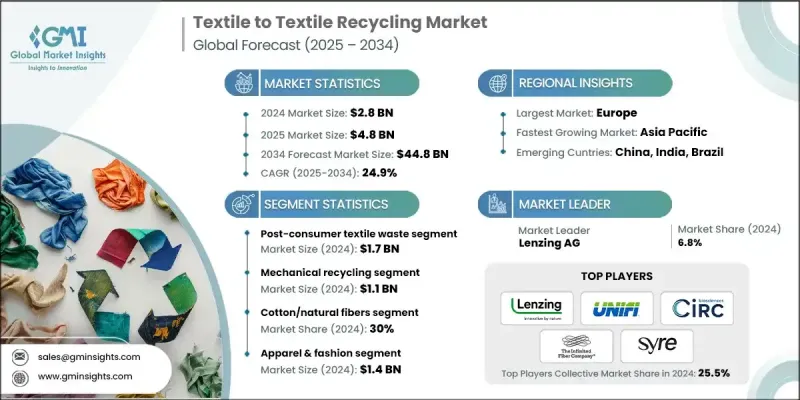
市场加速发展得益于区块链赋能的数位产品护照和嵌入式纤维识别技术的快速整合,这些技术增强了可追溯性并实现了更精准的分类。这些数位系统使回收商能够高精度地验证纤维类型、追踪材料来源并监控生命週期资料,在某些情况下还能支援即时决策。它们的应用提高了回收材料的质量,减少了污染,并确保符合欧洲不断发展的循环纺织品法规。随着永续发展期望的不断提高,全球品牌正越来越多地采用这些技术来提升供应链责任感并满足监管要求。同时,化学和酵素法回收製程的商业化程度也日益提高,能够将复杂的纺织混合物分解成适用于高品质再生材料的纤维成分。随着企业与大型服装製造商建立合作关係并扩大产能,这些创新技术正从试点阶段过渡到工业规模营运。
| 市场范围 | |
|---|---|
| 起始年份 | 2024 |
| 预测年份 | 2025-2034 |
| 起始值 | 28亿美元 |
| 预测值 | 448亿美元 |
| 复合年增长率 | 24.9% |
2024年,消费后纺织品废料市场规模将达17亿美元,约占纺织品回收原料总量的60%。这一主导地位主要得益于废弃服装数量的增加、回收管道的拓展以及支持循环时尚体系的政策倡议。
2024 年,服装和时尚产业规模达到 14 亿美元,这得益于全球服装品牌对永续发展的坚定承诺,以及整个产业主流和特色服装类别中再生纤维的日益普及。
2024年,北美纺织品回收市场规模预计将达7.41亿美元,占全球市场份额的26%。鼓励生产者延伸责任制的政策发展,以及零售商与回收企业之间合作的加强,正在推动该地区更完善的收集、分类和回收基础设施的建设。
参与纺织品回收市场的主要公司包括 Ambercycle Inc.、Boer Group Recycling Solutions BV、Circ Inc.、Ecotex Germany GmbH、Evrnu SPC、FABSCRAP Inc.、Grasim Industries Limited(Birla Cellulose)、Infinited Fiber Company Oy、Lenzing AGSAN Corporation(Birla Cellulose)、CortSole Corporation SA(IRARE) Corporation(WAPnz Corporation) Recycling International Ltd 和 Unifi Inc.。领先企业正透过大力投资先进的回收技术来巩固其市场地位,这些技术能够将混纺和难以回收的材料加工成高品质的再生纤维。许多公司正透过与全球服装製造商建立合资企业和长期合作关係,从试点营运过渡到全面的工业化生产,从而扩大生产规模。企业也正在进一步整合数位化追踪工具,例如嵌入式纤维标记和基于区块链的资料系统,以增强可追溯性并满足合规性要求。
目录
第一章:方法论与范围
第二章:执行概要
第三章:行业洞察
- 产业生态系分析
- 供应商格局
- 利润率
- 每个阶段的价值增加
- 影响价值链的因素
- 中断
- 产业影响因素
- 成长驱动因素
- 产业陷阱与挑战
- 市场机会
- 成长潜力分析
- 监管环境
- 北美洲
- 欧洲
- 亚太地区
- 拉丁美洲
- 中东和非洲 (MEA)
- 波特的分析
- PESTEL 分析
- 价格趋势
- 按地区
- 按原料来源
- 未来市场趋势
- 技术与创新格局
- 当前技术趋势
- 新兴技术
- 专利格局
- 贸易统计(HS编码)
- 主要进口国
- 主要出口国
- 永续性和环境方面
- 永续实践
- 减少废弃物策略
- 生产中的能源效率
- 环保倡议
- 碳足迹考量
第四章:竞争格局
- 介绍
- 公司市占率分析
- 按地区
- 北美洲
- 欧洲
- 亚太地区
- 拉丁美洲
- MEA
- 按地区
- 公司矩阵分析
- 主要市场参与者的竞争分析
- 竞争定位矩阵
- 关键进展
- 併购
- 合作伙伴关係与合作
- 新产品发布
- 扩张计划
第五章:市场估算与预测:依原料来源划分,2021-2034年
- 主要趋势
- 消费后纺织废料
- 消费前工业废料
- 混合纺织废料流
第六章:市场估算与预测:依技术类型划分,2021-2034年
- 主要趋势
- 机械回收
- 化学回收
- 生物/酵素回收
- 混合/组合技术
第七章:市场估算与预测:依纤维类型划分,2021-2034年
- 主要趋势
- 聚酯/合成纤维
- 棉/天然纤维
- 混纺织物
- 特种纤维
第八章:市场估算与预测:依应用领域划分,2021-2034年
- 主要趋势
- 服装与时尚
- 工业纺织品
- 家用纺织品
- 汽车纺织品
- 非织物应用
第九章:市场估计与预测:依地区划分,2021-2034年
- 主要趋势
- 北美洲
- 我们
- 加拿大
- 欧洲
- 德国
- 英国
- 法国
- 西班牙
- 义大利
- 欧洲其他地区
- 亚太地区
- 中国
- 印度
- 日本
- 澳洲
- 韩国
- 亚太其他地区
- 拉丁美洲
- 巴西
- 墨西哥
- 阿根廷
- 拉丁美洲其他地区
- 中东和非洲
- 沙乌地阿拉伯
- 南非
- 阿联酋
- 中东和非洲其他地区
第十章:公司简介
- Ambercycle Inc
- Boer Group Recycling Solutions BV
- Circ Inc
- Ecotex Germany GmbH
- Evrnu SPC
- FABSCRAP Inc
- Grasim Industries Limited (Birla Cellulose)
- Infinited Fiber Company Oy
- Lenzing AG
- Martex Fiber Southern Corporation
- Procotex Corporation SA
- RE&UP (SANKO Group)
- SYRE AB
- Textile Recycling International Ltd
- Unifi Inc
The Global Textile to Textile Recycling Market was valued at USD 2.8 billion in 2024 and is estimated to grow at a CAGR of 24.9% to reach USD 44.8 billion by 2034.
Market acceleration is driven by the rapid integration of blockchain-enabled digital product passports and embedded fiber identification technologies that enhance traceability and enable more accurate sorting. These digital systems allow recyclers to validate fiber type, track material origins, and monitor lifecycle data with high precision, supporting real-time decision-making in some instances. Their adoption improves the quality of recovered materials, reduces contamination, and ensures alignment with evolving circular textile regulations in Europe. As sustainability expectations grow, global brands are increasingly adopting these technologies to improve supply-chain accountability and meet regulatory expectations. At the same time, chemical and enzymatic recycling processes are achieving greater commercial maturity, offering the ability to break down complex textile blends into fiber components suitable for high-quality regenerated materials. These innovations are now transitioning from pilot stages into industrial-scale operations as companies secure partnerships with major apparel manufacturers and expand production capacity.
| Market Scope | |
|---|---|
| Start Year | 2024 |
| Forecast Year | 2025-2034 |
| Start Value | $2.8 Billion |
| Forecast Value | $44.8 Billion |
| CAGR | 24.9% |
The post-consumer textile waste segment accounted for USD 1.7 billion in 2024, representing roughly 60% of the total feedstock in textile-to-textile recycling. This dominant share is influenced by increased volumes of discarded garments, broader collection channels, and policy-driven initiatives supporting circular fashion systems.
The apparel and fashion segment reached USD 1.4 billion in 2024, benefiting from strong sustainability commitments among global clothing brands and rising incorporation of recycled fibers into mainstream and specialty apparel categories across the industry.
North America Textile to Textile Recycling Market generated USD 741 million in 2024, contributing 26% share. Policy developments encouraging extended producer responsibility programs, along with increased collaboration between retailers and recycling firms, are supporting stronger collection, sorting, and recovery infrastructure throughout the region.
Key companies participating in the Textile to Textile Recycling Market include Ambercycle Inc., Boer Group Recycling Solutions BV, Circ Inc., Ecotex Germany GmbH, Evrnu SPC, FABSCRAP Inc., Grasim Industries Limited (Birla Cellulose), Infinited Fiber Company Oy, Lenzing AG, Martex Fiber Southern Corporation, Procotex Corporation SA, RE&UP (SANKO Group), SYRE AB, Textile Recycling International Ltd, and Unifi Inc. Leading companies are strengthening their presence by investing heavily in advanced recycling technologies capable of processing blended and hard-to-recycle materials into high-quality regenerated fibers. Many firms are scaling production by transitioning from pilot operations to full industrial facilities through joint ventures and long-term collaborations with global apparel manufacturers. Businesses are further integrating digital tracking tools, such as embedded fiber markers and blockchain-enabled data systems, to enhance traceability and meet compliance demands.
Table of Contents
Chapter 1 Methodology & Scope
- 1.1 Market scope and definition
- 1.2 Research design
- 1.2.1 Research approach
- 1.2.2 Data collection methods
- 1.3 Data mining sources
- 1.3.1 Global
- 1.3.2 Regional/Country
- 1.4 Base estimates and calculations
- 1.4.1 Base year calculation
- 1.4.2 Key trends for market estimation
- 1.5 Primary research and validation
- 1.5.1 Primary sources
- 1.6 Forecast model
- 1.7 Research assumptions and limitations
Chapter 2 Executive Summary
- 2.1 Industry 360° synopsis
- 2.2 Key market trends
- 2.2.1 Regional
- 2.2.2 Feedstock source
- 2.2.3 Technology type
- 2.2.4 Fiber type
- 2.2.5 Application
- 2.3 TAM Analysis, 2025-2034
- 2.4 CXO perspectives: Strategic imperatives
- 2.4.1 Executive decision points
- 2.4.2 Critical success factors
- 2.5 Future Outlook and Strategic Recommendations
Chapter 3 Industry Insights
- 3.1 Industry ecosystem analysis
- 3.1.1 Supplier landscape
- 3.1.2 Profit margin
- 3.1.3 Value addition at each stage
- 3.1.4 Factor affecting the value chain
- 3.1.5 Disruptions
- 3.2 Industry impact forces
- 3.2.1 Growth drivers
- 3.2.2 Industry pitfalls and challenges
- 3.2.3 Market opportunities
- 3.3 Growth potential analysis
- 3.4 Regulatory landscape
- 3.4.1 North America
- 3.4.2 Europe
- 3.4.3 Asia Pacific
- 3.4.4 Latin America
- 3.4.5 Middle East & Africa (MEA)
- 3.5 Porter's analysis
- 3.6 PESTEL analysis
- 3.7 Price trends
- 3.7.1 By region
- 3.7.2 By feedstock source
- 3.8 Future market trends
- 3.9 Technology and innovation landscape
- 3.9.1 Current technological trends
- 3.9.2 Emerging technologies
- 3.10 Patent landscape
- 3.11 Trade statistics (HS code)
- 3.11.1 Major importing countries
- 3.11.2 Major exporting countries
- 3.12 Sustainability and environmental aspects
- 3.12.1 Sustainable practices
- 3.12.2 Waste reduction strategies
- 3.12.3 Energy efficiency in production
- 3.12.4 Eco-friendly initiatives
- 3.13 Carbon footprint consideration
Chapter 4 Competitive Landscape, 2024
- 4.1 Introduction
- 4.2 Company market share analysis
- 4.2.1 By region
- 4.2.1.1 North America
- 4.2.1.2 Europe
- 4.2.1.3 Asia Pacific
- 4.2.1.4 LATAM
- 4.2.1.5 MEA
- 4.2.1 By region
- 4.3 Company matrix analysis
- 4.4 Competitive analysis of major market players
- 4.5 Competitive positioning matrix
- 4.6 Key developments
- 4.6.1 Mergers & acquisitions
- 4.6.2 Partnerships & collaborations
- 4.6.3 New product launches
- 4.6.4 Expansion plans
Chapter 5 Market Estimates and Forecast, By Feedstock Source, 2021-2034 (USD Billion & Tons)
- 5.1 Key trends
- 5.2 Post-consumer textile waste
- 5.3 Pre-consumer industrial waste
- 5.4 Mixed textile waste streams
Chapter 6 Market Estimates and Forecast, By Technology Type, 2021-2034 (USD Billion & Tons)
- 6.1 Key trends
- 6.2 Mechanical recycling
- 6.3 Chemical recycling
- 6.4 Biological/enzymatic recycling
- 6.5 Hybrid/combined technologies
Chapter 7 Market Estimates and Forecast, By Fiber Type, 2021-2034 (USD Billion & Tons)
- 7.1 Key trends
- 7.2 Polyester/synthetic fibers
- 7.3 Cotton/natural fibers
- 7.4 Blended textiles
- 7.5 Specialty fibers
Chapter 8 Market Estimates and Forecast, By Application, 2021-2034 (USD Billion & Tons)
- 8.1 Key trends
- 8.2 Apparel & fashion
- 8.3 Industrial textiles
- 8.4 Home textiles
- 8.5 Automotive textiles
- 8.6 Non-woven applications
Chapter 9 Market Estimates and Forecast, By Region, 2021-2034 (USD Billion & Tons)
- 9.1 Key trends
- 9.2 North America
- 9.2.1 U.S.
- 9.2.2 Canada
- 9.3 Europe
- 9.3.1 Germany
- 9.3.2 UK
- 9.3.3 France
- 9.3.4 Spain
- 9.3.5 Italy
- 9.3.6 Rest of Europe
- 9.4 Asia Pacific
- 9.4.1 China
- 9.4.2 India
- 9.4.3 Japan
- 9.4.4 Australia
- 9.4.5 South Korea
- 9.4.6 Rest of Asia Pacific
- 9.5 Latin America
- 9.5.1 Brazil
- 9.5.2 Mexico
- 9.5.3 Argentina
- 9.5.4 Rest of Latin America
- 9.6 Middle East and Africa
- 9.6.1 Saudi Arabia
- 9.6.2 South Africa
- 9.6.3 UAE
- 9.6.4 Rest of Middle East and Africa
Chapter 10 Company Profiles
- 10.1 Ambercycle Inc
- 10.2 Boer Group Recycling Solutions BV
- 10.3 Circ Inc
- 10.4 Ecotex Germany GmbH
- 10.5 Evrnu SPC
- 10.6 FABSCRAP Inc
- 10.7 Grasim Industries Limited (Birla Cellulose)
- 10.8 Infinited Fiber Company Oy
- 10.9 Lenzing AG
- 10.10 Martex Fiber Southern Corporation
- 10.11 Procotex Corporation SA
- 10.12 RE&UP (SANKO Group)
- 10.13 SYRE AB
- 10.14 Textile Recycling International Ltd
- 10.15 Unifi Inc

 纺织品回收市场预测至2034年:按材料、技术、工艺、应用、最终用户和地区分類的全球分析
 纺织品回收市场报告:按产品类型、纺织废弃物、分销管道、最终用途和地区划分(2026-2034 年)
 按产品类型、组织规模、产业、部署类型和分销管道分類的文本型AIGC市场-全球预测,2026-2032年纺织品回收设备市场(按设备类型、技术、材料类型、应用、最终用户和分销管道划分)-2026-2032年全球预测日本纺织品回收市场报告(按产品类型、纺织废料、配销通路、最终用户和地区划分,2026-2034年)
 纺织品回收市场机会、成长要素、产业趋势分析及2026年至2035年预测
 纺织品回收市场规模、份额和成长分析(按废弃物类型、材料、来源、製程和地区划分)-2026-2033年产业预测纺织品回收市场预测至2032年:按材料、来源、製程、最终用户和地区分類的全球分析全球纺织废弃物建筑材料市场:预测(至 2032 年)—按来源、废弃物类型、回收流程、材料类型、应用、树脂类型、应用和地区进行分析
 全球纺织品回收市场(按来源、纺织废弃物、工艺、分销管道、最终用途行业和地区划分)- 预测至 2030 年