


 |
市场调查报告书
商品编码
1913457
纺织品回收市场机会、成长要素、产业趋势分析及2026年至2035年预测Textile Recycling Market Opportunity, Growth Drivers, Industry Trend Analysis, and Forecast 2026 - 2035 |
||||||

全球纺织品回收市场预计到 2025 年价值 14 亿美元,到 2035 年达到 85 亿美元,年复合成长率为 19.3%。
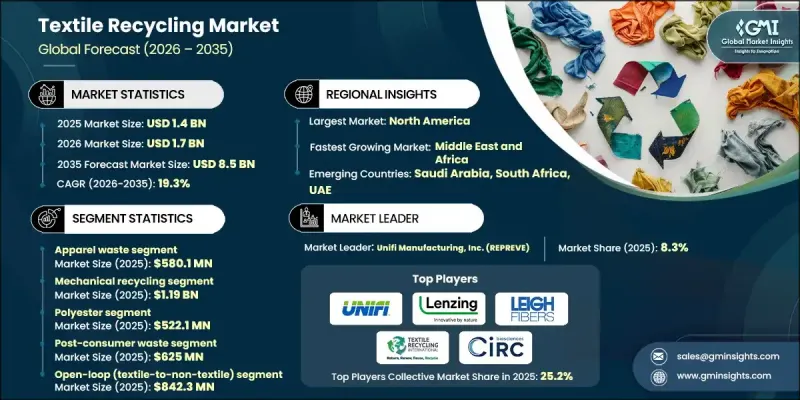
全球供应链日益关注环境影响、资源保护和减少废弃物,推动了市场成长。纺织品回收专注于废弃纺织材料的回收和再加工,从而减少掩埋量和纺织品生产对环境的影响。对消费模式和产品生命週期的日益关注,正在加速纺织品价值链中回收方法的普及。透过回收和再生延长纺织材料的使用寿命,有助于减少对原生原料的依赖,符合循环经济的目标。然而,市场仍面临结构性挑战,包括材料复杂性、污染问题和收集基础设施不足。废弃纺织品数量的不断增长,推动了对扩充性、高效回收系统的需求。随着製造商、零售商和政府不断推动永续性倡议,纺织品回收正成为长期环境策略的关键组成部分,从而支持已开发经济体和新兴经济体的市场成长。
| 市场覆盖范围 | |
|---|---|
| 开始年份 | 2025 |
| 预测年份 | 2026-2035 |
| 起始值 | 14亿美元 |
| 预测金额 | 85亿美元 |
| 复合年增长率 | 19.3% |
据估计,到2025年,服装废弃物市场规模将达到5.801亿美元。虽然高废弃率显着促进了可回收材料的供应,但其他纺织废弃物的数量、密度和更换频率各不相同。这些废弃物来源共同影响原料供应,并对整体市场加工需求产生影响。
预计2025年,机械回收市场规模将达11.9亿美元。由于其成本效益高、操作简便且与现有基础设施相容,这种方法持续受到关注。在材料分离较为复杂、回收优先顺序不同的地区,其他回收方法也不断发展。
北美纺织品回收市场预计将从2025年的5.067亿美元增长到2035年的29亿美元,主要得益于人们日益增强的可持续永续性意识、法规结构以及对先进分类和回收技术的投资。高消费水准和企业环保措施也持续推动该地区的市场需求。
目录
第一章调查方法和范围
第二章执行摘要
第三章业界考察
- 生态系分析
- 供应商情况
- 利润率
- 每个阶段的附加价值
- 影响价值链的因素
- 中断
- 产业影响因素
- 司机
- 对再生纤维材料的需求
- 回收领域的技术发展
- 纺织废弃物产生量增加
- 产业潜在风险与挑战
- 纺织材料的复杂性
- 回收过程高成本
- 市场机会
- 纤维到纤维的回收技术
- 数位化和智慧分类系统
- 二次原物料市场的成长
- 司机
- 成长潜力分析
- 监管环境
- 北美洲
- 欧洲
- 亚太地区
- 拉丁美洲
- 中东和非洲
- 波特五力分析
- PESTEL 分析
- 科技与创新趋势
- 当前技术趋势
- 新兴技术
- 价格趋势
- 按地区
- 按来源
- 未来市场趋势
- 科技与创新趋势
- 当前技术趋势
- 新兴技术
- 专利趋势
- 贸易统计(HS编码)(註:仅提供主要国家的贸易统计)
- 主要进口国
- 主要出口国
- 永续性和环境方面
- 永续努力
- 减少废弃物策略
- 生产中的能源效率
- 环保倡议
- 考虑到碳足迹
第四章 竞争情势
- 介绍
- 公司市占率分析
- 按地区
- 北美洲
- 欧洲
- 亚太地区
- 拉丁美洲
- 中东和非洲
- 按地区
- 企业矩阵分析
- 主要市场公司的竞争分析
- 竞争定位矩阵
- 重大进展
- 併购
- 伙伴关係与合作
- 新产品发布
- 扩张计划
5. 2022-2035年按来源分類的市场估计与预测
- 服装废弃物
- 家居布置废弃物
- 家具和室内装潢废弃物
- 地毯和地板材料废弃物
- 工业和技术纺织品
- 擦拭材料
第六章 依製程分類的市场估算与预测,2022-2035年
- 机械回收
- 化学回收
- 生物和酶促循环
- 热解回收
第七章 按材料类型分類的市场估算与预测,2022-2035年
- 聚酯纤维
- 棉布
- 尼龙和聚酰胺
- 羊毛
- 黏胶纤维和人造丝(纤维素纤维)
- 丙烯酸纤维
- 混纺纤维
- 其他纤维素纤维
第八章 依废弃物类型分類的市场估算与预测,2022-2035年
- 消费前废弃物
- 消费后废弃物
- 工业废弃物
第九章 依回收类型分類的市场估算与预测,2022-2035年
- 闭合迴路(纤维到纤维/纤维产品到纤维产品)
- 开放回路(纺织品转化为非纺织品)
第十章 依最终用途分類的市场估计与预测,2022-2035年
- 服装/布料和家具布料
- 家居布置
- 建筑/施工
- 汽车/运输设备
- 工业的
- 医疗和防护设备
- 其他的
第十一章 2022-2035年各地区市场估计与预测
- 北美洲
- 美国
- 加拿大
- 墨西哥
- 欧洲
- 德国
- 英国
- 法国
- 西班牙
- 义大利
- 其他欧洲地区
- 亚太地区
- 中国
- 印度
- 日本
- 澳洲
- 韩国
- 亚太其他地区
- 拉丁美洲
- 巴西
- 墨西哥
- 阿根廷
- 其他拉丁美洲地区
- 中东和非洲
- 沙乌地阿拉伯
- 南非
- 阿拉伯聯合大公国
- 其他中东和非洲地区
第十二章:公司简介
- BLS Ecotech
- Circ
- Fibersort
- iinouiio Recycled Textiles
- Leigh Fibers, LLC
- Lenzing AG
- Martex Fiber/ReVive Fiber
- Patagonia, Inc.(Worn Wear Program)
- Refiberd
- Renewcell AB(Circulose)
- RE TEXTIL Deutschland
- Textile Recycling International(TRI Group)
- Unifi Manufacturing, Inc.(REPREVE)
- Worn Again Technologies Ltd
- Worn Again Technologies Ltd
The Global Textile Recycling Market was valued at USD 1.4 billion in 2025 and is estimated to grow at a CAGR of 19.3% to reach USD 8.5 billion by 2035.
Market growth is driven by rising concern over environmental impact, resource conservation, and waste reduction across global supply chains. Textile recycling focuses on the recovery and reprocessing of discarded textile materials to reduce landfill volumes and lower the ecological footprint of textile production. Increasing scrutiny of consumption patterns and product life cycles is accelerating the adoption of recycling practices across the textile value chain. Extending the usable life of textile materials through recovery and regeneration supports reduced reliance on virgin inputs and aligns with circular economy goals. However, the market continues to face structural challenges related to material complexity, contamination issues, and insufficient collection infrastructure. The growing volume of discarded textiles has intensified the need for scalable and efficient recycling systems. As sustainability commitments strengthen among manufacturers, retailers, and governments, textile recycling is becoming a critical component of long-term environmental strategies, supporting market growth across both developed and emerging economies.
| Market Scope | |
|---|---|
| Start Year | 2025 |
| Forecast Year | 2026-2035 |
| Start Value | $1.4 Billion |
| Forecast Value | $8.5 Billion |
| CAGR | 19.3% |
The apparel waste segment reached USD 580.1 million during 2025. High disposal rates contribute significantly to recyclable material availability, while other textile waste streams differ in volume, density, and replacement frequency. Together, these waste sources shape feedstock supply and influence processing requirements across the market.
The mechanical recycling segment accounted for USD 1.19 billion in 2025. This approach continues to gain traction due to cost efficiency, operational simplicity, and compatibility with existing infrastructure. Alternative recovery methods are also expanding where material separation is more complex and recovery priorities differ.
North America Textile Recycling Market is projected to grow from USD 506.7 million in 2025 to USD 2.9 billion by 2035, supported by strong sustainability awareness, regulatory frameworks, and investment in advanced sorting and recycling technologies. High consumption levels and corporate environmental commitments continue to shape regional demand.
Key companies operating in the Global Textile Recycling Market include Lenzing AG, Renewcell AB, Unifi Manufacturing, Inc., Leigh Fibers, LLC, Martex Fiber, RE TEXTIL Deutschland, Worn Again Technologies Ltd, Textile Recycling International, BLS Ecotech, Patagonia, Inc., Circ, Fibersort, iinouiio Recycled Textiles, and Refiberd. Companies in the Global Textile Recycling Market are strengthening their position through technology innovation, strategic partnerships, and supply chain integration. Many are investing in advanced sorting and processing systems to improve material recovery efficiency and output quality. Collaborations with brands and manufacturers help secure consistent feedstock and long-term demand. Geographic expansion enables access to new waste streams and regional policy incentives. Firms are also focusing on traceability, transparency, and certification to meet sustainability expectations from regulators and customers.
Table of Contents
Chapter 1 Methodology & Scope
- 1.1 Market scope and definition
- 1.2 Research design
- 1.2.1 Research approach
- 1.2.2 Data collection methods
- 1.3 Data mining sources
- 1.3.1 Global
- 1.3.2 Regional/Country
- 1.4 Base estimates and calculations
- 1.4.1 Base year calculation
- 1.4.2 Key trends for market estimation
- 1.5 Primary research and validation
- 1.5.1 Primary sources
- 1.6 Forecast model
- 1.7 Research assumptions and limitations
Chapter 2 Executive Summary
- 2.1 Industry 360° synopsis
- 2.2 Key market trends
- 2.2.1 Source
- 2.2.2 Process
- 2.2.3 Material Type
- 2.2.4 Waste Type
- 2.2.5 Recycling Type
- 2.2.6 End Use
- 2.2.7 Regional
- 2.3 TAM Analysis, 2025-2035
- 2.4 CXO perspectives: Strategic imperatives
- 2.4.1 Executive decision points
- 2.4.2 Critical success factors
- 2.5 Future outlook and strategic recommendations
Chapter 3 Industry Insights
- 3.1 Industry ecosystem analysis
- 3.1.1 Supplier landscape
- 3.1.2 Profit margin
- 3.1.3 Value addition at each stage
- 3.1.4 Factor affecting the value chain
- 3.1.5 Disruptions
- 3.2 Industry impact forces
- 3.2.1 Growth drivers
- 3.2.1.1 Demand for recycled textile materials
- 3.2.1.2 Technological development in recycling
- 3.2.1.3 Increase in textile waste generation
- 3.2.2 Industry pitfalls and challenges
- 3.2.2.1 Complexity of textile materials
- 3.2.2.2 High cost of recycling processes
- 3.2.3 Market opportunities
- 3.2.3.1 Fiber-to-fiber recycling technologies
- 3.2.3.2 Digitalization and smart sorting systems
- 3.2.3.3 Growth of secondary raw material markets
- 3.2.1 Growth drivers
- 3.3 Growth potential analysis
- 3.4 Regulatory landscape
- 3.4.1 North America
- 3.4.2 Europe
- 3.4.3 Asia Pacific
- 3.4.4 Latin America
- 3.4.5 Middle East & Africa
- 3.5 Porter's analysis
- 3.6 PESTEL analysis
- 3.7 Technology and innovation landscape
- 3.7.1 Current technological trends
- 3.7.2 Emerging technologies
- 3.8 Price trends
- 3.8.1 By region
- 3.8.2 By source
- 3.9 Future market trends
- 3.10 Technology and innovation landscape
- 3.10.1 Current technological trends
- 3.10.2 Emerging technologies
- 3.11 Patent landscape
- 3.12 Trade statistics (HS code) (Note: the trade statistics will be provided for key countries only)
- 3.12.1 Major importing countries
- 3.12.2 Major exporting countries
- 3.13 Sustainability and environmental aspects
- 3.13.1 Sustainable practices
- 3.13.2 Waste reduction strategies
- 3.13.3 Energy efficiency in production
- 3.13.4 Eco-friendly initiatives
- 3.14 Carbon footprint consideration
Chapter 4 Competitive Landscape, 2025
- 4.1 Introduction
- 4.2 Company market share analysis
- 4.2.1 By region
- 4.2.1.1 North America
- 4.2.1.2 Europe
- 4.2.1.3 Asia Pacific
- 4.2.1.4 LATAM
- 4.2.1.5 MEA
- 4.2.1 By region
- 4.3 Company matrix analysis
- 4.4 Competitive analysis of major market players
- 4.5 Competitive positioning matrix
- 4.6 Key developments
- 4.6.1 Mergers & acquisitions
- 4.6.2 Partnerships & collaborations
- 4.6.3 New product launches
- 4.6.4 Expansion plans
Chapter 5 Market Estimates and Forecast, By Source, 2022-2035 (USD Billion) (Kilo Tons)
- 5.1 Key trends
- 5.2 Apparel waste
- 5.3 Home furnishing waste
- 5.4 Furniture & upholstery waste
- 5.5 Carpet & floor covering waste
- 5.6 Industrial & technical textiles
- 5.7 Wiping materials
Chapter 6 Market Estimates and Forecast, By Process, 2022-2035 (USD Billion) (Kilo Tons)
- 6.1 Key trends
- 6.2 Mechanical recycling
- 6.3 Chemical recycling
- 6.4 Biological & enzymatic recycling
- 6.5 Thermal recycling
Chapter 7 Market Estimates and Forecast, By Material Type, 2022-2035 (USD Billion) (Kilo Tons)
- 7.1 Key trends
- 7.2 Polyester
- 7.3 Cotton
- 7.4 Nylon & polyamide
- 7.5 Wool
- 7.6 Viscose & rayon (cellulosic fibers)
- 7.7 Acrylic
- 7.8 Blended textiles
- 7.9 Other cellulosic fibers
Chapter 8 Market Estimates and Forecast, By Waste Type, 2022-2035 (USD Billion) (Kilo Tons)
- 8.1 Key trends
- 8.2 Pre-consumer waste
- 8.3 Post-consumer waste
- 8.4 Post-industrial waste
Chapter 9 Market Estimates and Forecast, By Recycling Type, 2022-2035 (USD Billion) (Kilo Tons)
- 9.1 Key trends
- 9.2 Closed-loop (fiber-to-fiber / textile-to-textile)
- 9.3 Open-loop (textile-to-non-textile)
Chapter 10 Market Estimates and Forecast, By End Use, 2022-2035 (USD Billion) (Kilo Tons)
- 10.1 Key trends
- 10.2 Apparel/ Fabrics & upholstery
- 10.3 Home furnishing
- 10.4 Building & construction
- 10.5 Automotive & transportation
- 10.6 Industrial
- 10.7 Medical & protective equipment
- 10.8 Others
Chapter 11 Market Estimates and Forecast, By Region, 2022-2035 (USD Billion) (Kilo Tons)
- 11.1 Key trends
- 11.2 North America
- 11.2.1 U.S.
- 11.2.2 Canada
- 11.2.3 Mexico
- 11.3 Europe
- 11.3.1 Germany
- 11.3.2 UK
- 11.3.3 France
- 11.3.4 Spain
- 11.3.5 Italy
- 11.3.6 Rest of Europe
- 11.4 Asia Pacific
- 11.4.1 China
- 11.4.2 India
- 11.4.3 Japan
- 11.4.4 Australia
- 11.4.5 South Korea
- 11.4.6 Rest of Asia Pacific
- 11.5 Latin America
- 11.5.1 Brazil
- 11.5.2 Mexico
- 11.5.3 Argentina
- 11.5.4 Rest of Latin America
- 11.6 Middle East and Africa
- 11.6.1 Saudi Arabia
- 11.6.2 South Africa
- 11.6.3 UAE
- 11.6.4 Rest of Middle East and Africa
Chapter 12 Company Profiles
- 12.1 BLS Ecotech
- 12.2 Circ
- 12.3 Fibersort
- 12.4 iinouiio Recycled Textiles
- 12.5 Leigh Fibers, LLC
- 12.6 Lenzing AG
- 12.7 Martex Fiber / ReVive Fiber
- 12.8 Patagonia, Inc. (Worn Wear Program)
- 12.9 Refiberd
- 12.10 Renewcell AB (Circulose)
- 12.11 RE TEXTIL Deutschland
- 12.12 Textile Recycling International (TRI Group)
- 12.13 Unifi Manufacturing, Inc. (REPREVE)
- 12.14 Worn Again Technologies Ltd
- 12.15 Worn Again Technologies Ltd

 纺织品回收市场预测至2034年:按材料、技术、工艺、应用、最终用户和地区分類的全球分析
 纺织品回收市场报告:按产品类型、纺织废弃物、分销管道、最终用途和地区划分(2026-2034 年)
 按产品类型、组织规模、产业、部署类型和分销管道分類的文本型AIGC市场-全球预测,2026-2032年纺织品回收设备市场(按设备类型、技术、材料类型、应用、最终用户和分销管道划分)-2026-2032年全球预测日本纺织品回收市场报告(按产品类型、纺织废料、配销通路、最终用户和地区划分,2026-2034年)
 纺织品回收市场规模、份额和成长分析(按废弃物类型、材料、来源、製程和地区划分)-2026-2033年产业预测
 纺织品回收市场机会、成长驱动因素、产业趋势分析及预测(2025-2034年)纺织品回收市场预测至2032年:按材料、来源、製程、最终用户和地区分類的全球分析全球纺织废弃物建筑材料市场:预测(至 2032 年)—按来源、废弃物类型、回收流程、材料类型、应用、树脂类型、应用和地区进行分析
 全球纺织品回收市场(按来源、纺织废弃物、工艺、分销管道、最终用途行业和地区划分)- 预测至 2030 年