


 |
市场调查报告书
商品编码
1885830
生物基平台化学品市场机会、成长驱动因素、产业趋势分析及预测(2025-2034年)Bio-Based Platform Chemicals Market Opportunity, Growth Drivers, Industry Trend Analysis, and Forecast 2025 - 2034 |
||||||

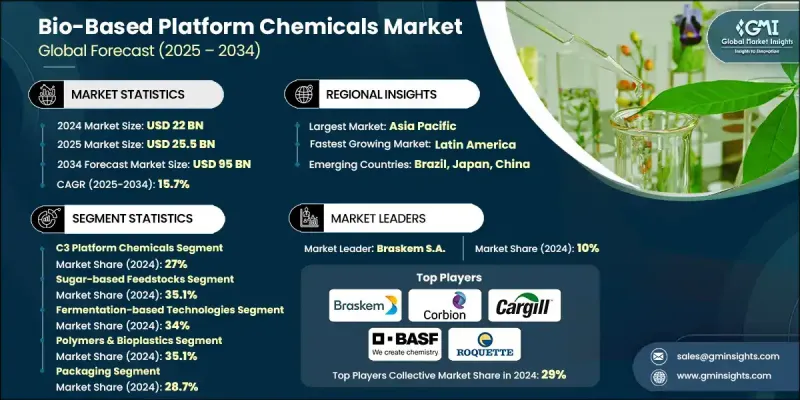
2024 年全球生物基平台化学品市场价值为 220 亿美元,预计到 2034 年将以 15.7% 的复合年增长率成长至 950 亿美元。
向永续发展的转型和技术的快速发展,使得这些生物基化学构件从一个相对较小的类别跃升为重要的工业优先事项。该领域的扩张速度远超传统化学品市场,显示其对脱碳努力和循环经济模式的影响力日益增强,而这些模式又受到不断演变的政策框架和日益提高的企业永续发展目标的影响。随着投资的加速和生物质供应的改善,成熟的发酵过程使得生产规模化程度更高。成长模式分布广泛:亚太地区受惠于丰富的资源,欧洲得益于完善的监管体系,而北美则凭藉着充足的原料供应而发展迅速。 C3基分子、醣类衍生原料和生物基材料等关键领域正被众多产业所接受,从聚合物到高价值特种用途。除了商业上的强劲势头,与化石基化学品相比,这些产品还能显着降低碳排放强度,使其成为未来低碳製造路径的重要组成部分。
| 市场范围 | |
|---|---|
| 起始年份 | 2024 |
| 预测年份 | 2025-2034 |
| 起始值 | 220亿美元 |
| 预测值 | 950亿美元 |
| 复合年增长率 | 15.7% |
2024年,C3衍生平台化学品市占率达到27%,预计2034年将以15.1%的复合年增长率成长。此类别受益于高度发展的发酵过程以及与下游化学合成路线的广泛相容性。这些路线支援生产各种材料,广泛应用于包装、纺织和高性能应用等领域。丰富的原料来源和工业规模的生产能力相结合,巩固了该类别作为生物基材料开发基石的地位。
2024年,醣类原料市占率达35.1%,预计2025年至2034年将以14.8%的复合年增长率成长。其主导地位得益于长期完善的加工基础设施以及与发酵技术的紧密结合。高糖含量和成熟的生产规模化能力也持续巩固了其在产业中的地位。然而,人们对土地利用以及与粮食系统潜在重迭的担忧日益加剧,这正逐步推动人们对下一代原料的兴趣。木质纤维素原料,包括农业和林业残余物以及专用能源作物,正作为替代原料涌现,旨在为生物基化学品生产的长期供应稳定性提供支持。
2024年,北美生物基平台化学品市场占据25.9%的市场份额,并正经历显着扩张。该地区成熟的农业网络和丰富的木质纤维素资源,以及强大的生物乙醇产业,为扩大生物基化学品生产规模创造了机会。持续的研究计画和政府扶持计画正在加速技术进步,而气候政策和清洁能源激励措施则吸引了投资,并促进了更广泛的商业化应用。
全球生物基平台化学品市场的主要参与者包括 Braskem SA、Corbion NV、Cargill, Incorporated、BASF SE、Roquette Freres、DuPont de Nemours, Inc.、Genomatica, Inc.、Evonik Industries AG、Avantium NV、Mitsubishi Chemical Holdings Corporation、Royal DSM 实体、PTT Global T检视这些公司正透过旨在扩大技术能力、确保可靠的原料管道和加速商业化部署的策略来巩固其市场地位。许多公司正与研究机构建立合作关係,以推进新的转化技术并提高製程收率。对大型生物炼製厂的投资和原料来源的多元化正在增强供应的韧性。一些企业也与包装、聚合物和特种化学品领域的製造商签订长期供应协议,以确保市场需求的稳定。
目录
第一章:方法论与范围
第二章:执行概要
第三章:行业洞察
- 产业生态系分析
- 供应商格局
- 利润率
- 每个阶段的价值增加
- 影响价值链的因素
- 中断
- 产业影响因素
- 成长驱动因素
- 严格的永续发展要求和碳中和目标
- 消费者对生物基和可生物降解产品的需求
- 合成生物学和代谢工程的技术进步
- 产业陷阱与挑战
- 与石油化学产品相比,生产成本高昂
- 原料波动性和物流挑战
- 市场机会
- 木质素加值利用及其在芳香平台化学品的应用
- C1 气体利用( CO₂ 、CO、 CH₄ )透过气体发酵
- 成长驱动因素
- 成长潜力分析
- 监管环境
- 北美洲
- 欧洲
- 亚太地区
- 拉丁美洲
- 中东和非洲
- 波特的分析
- PESTEL 分析
- 价格趋势
- 按地区
- 依产品类型
- 未来市场趋势
- 技术与创新格局
- 当前技术趋势
- 新兴技术
- 专利格局
- 贸易统计(HS编码)(註:仅提供重点国家的贸易统计资料)
- 主要进口国
- 主要出口国
- 永续性和环境方面
- 永续实践
- 减少废弃物策略
- 生产中的能源效率
- 环保倡议
- 碳足迹考量
第四章:竞争格局
- 介绍
- 公司市占率分析
- 按地区
- 北美洲
- 欧洲
- 亚太地区
- 拉丁美洲
- MEA
- 按地区
- 公司矩阵分析
- 主要市场参与者的竞争分析
- 竞争定位矩阵
- 关键进展
- 併购
- 合作伙伴关係与合作
- 新产品发布
- 扩张计划
第五章:市场估算与预测:依产品类型划分,2021-2034年
- 主要趋势
- C2平台化学品
- 生物乙烯
- 生物乙醇
- 生物乙二醇
- C3平台化学品
- 乳酸
- 1,3-丙二醇(1,3-PDO)
- 3-羟基丙酸(3-HPA)
- C4平台化学品
- 琥珀酸
- 1,4-丁二醇(BDO)
- 正丁醇
- C5平台化学品
- 糠醛
- 异戊二烯
- 戊二酸
- 尸胺
- δ-戊内酰胺
- 1,5-戊二醇
- C6平台化学品
- 2,5-呋喃二甲酸(FDCA)
- 己二酸
- 顺式,顺式-黏康酸
- 己内酰胺
- 1,6-己二胺(HMDA)
- 其他平台化学品
- 乙酰丙酸
- 衣康酸
- 生物甘油
- 5-羟甲基糠醛(5-HMF)
第六章:市场估算与预测:依原料类型划分,2021-2034年
- 主要趋势
- 糖基原料
- C6糖(玉米、甘蔗、甜菜)
- C5/C6混合糖(木质纤维素水解)
- 木质纤维素生物质
- 农业残余物
- 森林资源
- 植物油和脂质
- 植物油
- 废弃脂质
- 油籽(第二茬)
- C1气体和合成气
- 二氧化碳( CO₂ )
- 一氧化碳 (CO) 和合成气
- 甲烷( CH₄ )和甲醇
- 废物流
- 都市固体废弃物(MSW)
- 工业有机废弃物
- 塑胶垃圾
- 藻类
- 微藻
- 大型藻类
第七章:市场估算与预测:依生产技术划分,2021-2034年
- 主要趋势
- 基于发酵的技术
- 微生物发酵
- 整合生物加工(CBP)
- 合成生物学与代谢工程
- 基于CRISPR/Cas的应变工程
- 路径工程
- 高通量筛选与定向进化
- 酵素转化
- 酵素水解
- 酵素解聚
- 催化与化学转化
- 酸/碱催化
- 金属催化
- 热化学转化
- 热解
- 气化
- 混合化学生物学途径的应用
第八章:市场估算与预测:依应用领域划分,2021-2034年
- 主要趋势
- 聚合物和生物塑料
- 聚乳酸(PLA)
- 聚羟基脂肪酸酯(PHA)
- 聚丁二酸丁二醇酯(PBS)
- 聚呋喃甲酸乙二醇酯(PEF)
- 生物聚乙烯(Bio-PE)
- 其他生物塑胶(Bio-PET、Bio-PA、Bio-PP)
- 溶剂
- 药品和营养保健品
- 化妆品及个人护理
- 油漆、涂料、油墨和染料
- 界面活性剂和洗涤剂
- 黏合剂和密封剂
- 润滑剂
- 纺织品和纤维
第九章:市场估算与预测:依最终用途划分,2021-2034年
- 主要趋势
- 包装
- 汽车
- 纺织品和服装
- 建筑材料
- 农业
- 医药与医疗保健
- 餐饮
- 个人护理及化妆品
- 活力
第十章:市场估计与预测:依地区划分,2021-2034年
- 主要趋势
- 北美洲
- 我们
- 加拿大
- 欧洲
- 德国
- 英国
- 法国
- 西班牙
- 义大利
- 欧洲其他地区
- 亚太地区
- 中国
- 印度
- 日本
- 澳洲
- 韩国
- 亚太其他地区
- 拉丁美洲
- 巴西
- 墨西哥
- 阿根廷
- 拉丁美洲其他地区
- 中东和非洲
- 沙乌地阿拉伯
- 南非
- 阿联酋
- 中东和非洲其他地区
第十一章:公司简介
- Braskem SA
- Corbion NV
- Cargill, Incorporated
- BASF SE
- Roquette Freres
- DuPont de Nemours, Inc.
- Genomatica, Inc.
- Evonik Industries AG
- Avantium NV
- Mitsubishi Chemical Holdings Corporation
- Royal DSM NV
- PTT Global Chemical Public Company Limited
- Novozymes A/S
The Global Bio-Based Platform Chemicals Market was valued at USD 22 billion in 2024 and is estimated to grow at a CAGR of 15.7% to reach USD 95 billion by 2034.
The transition toward sustainability and rapid advances in technology have shifted these bio-derived chemical building blocks from a relatively small category to a significant industrial priority. The sector is expanding at a pace far above that of conventional chemical markets, signaling its growing influence on decarbonization efforts and circular-economy models shaped by evolving policy frameworks and escalating corporate sustainability targets. As investments accelerate and biomass availability improves, production is becoming more scalable through established fermentation practices. Growth patterns are widely distributed, with Asia Pacific benefiting from strong resource availability, Europe supported by structured regulations, and North America advancing through substantial feedstock supply. Key segments such as C3-based molecules, sugar-derived inputs, and bio-oriented materials are gaining acceptance in multiple industries, from polymers to high-value specialty uses. Beyond commercial momentum, these products contribute meaningful reductions in carbon intensity compared with fossil-derived chemicals, positioning them as essential components of future low-carbon manufacturing pathways.
| Market Scope | |
|---|---|
| Start Year | 2024 |
| Forecast Year | 2025-2034 |
| Start Value | $22 Billion |
| Forecast Value | $95 Billion |
| CAGR | 15.7% |
The C3-derived platform chemicals segment held 27% share in 2024 and is forecast to grow at a 15.1% CAGR through 2034. This category benefits from highly developed fermentation processes and broad compatibility with downstream chemical pathways. These routes support the creation of a wide variety of materials used in sectors such as packaging, textiles, and performance applications. The combination of readily available feedstock sources and industrial-scale production capabilities strengthens the position of this segment as a cornerstone of bio-oriented material development.
The sugar-derived feedstocks segment captured a 35.1% share in 2024 and is projected to grow at a CAGR of 14.8% from 2025 to 2034. Their dominance is supported by a longstanding processing infrastructure and strong alignment with fermentation-based technologies. High sugar content and proven production scalability continue to reinforce their role in the industry. However, rising concerns over land use and potential overlap with food systems are gradually accelerating interest in next-generation feedstocks. Lignocellulosic inputs, including agricultural and forestry residues as well as dedicated energy crops, emerging as alternatives aimed at supporting long-term supply stability for bio-based chemical production.
North America Bio-Based Platform Chemicals Market held a 25.9% share in 2024 and is experiencing significant expansion. The region's established agricultural networks and abundant lignocellulosic material, combined with a strong bioethanol sector, are creating opportunities to scale bio-based chemical manufacturing. Ongoing research initiatives and supportive government programs are accelerating technological advances, while climate-driven policies and clean-energy incentives are attracting investment and enabling broader commercialization.
Major companies active in the Global Bio-Based Platform Chemicals Market include Braskem S.A., Corbion N.V., Cargill, Incorporated, BASF SE, Roquette Freres, DuPont de Nemours, Inc., Genomatica, Inc., Evonik Industries AG, Avantium N.V., Mitsubishi Chemical Holdings Corporation, Royal DSM N.V., PTT Global Chemical Public Company Limited, and Novozymes A/S. Companies in the Bio-Based Platform Chemicals Market are strengthening their positions through strategies designed to expand technological capacity, secure reliable feedstock channels, and accelerate commercial deployment. Many firms are forming partnerships with research institutions to advance new conversion technologies and improve process yields. Investments in large-scale biorefineries and diversification of feedstock sources are enhancing supply resilience. Several players are also entering into long-term supply agreements with manufacturers in packaging, polymers, and specialty sectors to ensure consistent market demand.
Table of Contents
Chapter 1 Methodology & Scope
- 1.1 Market scope and definition
- 1.2 Research design
- 1.2.1 Research approach
- 1.2.2 Data collection methods
- 1.3 Data mining sources
- 1.3.1 Global
- 1.3.2 Regional/Country
- 1.4 Base estimates and calculations
- 1.4.1 Base year calculation
- 1.4.2 Key trends for market estimation
- 1.5 Primary research and validation
- 1.5.1 Primary sources
- 1.6 Forecast model
- 1.7 Research assumptions and limitations
Chapter 2 Executive Summary
- 2.1 Industry 360° synopsis
- 2.2 Key market trends
- 2.2.1 Regional
- 2.2.2 Product Type
- 2.2.3 Feedstock Type
- 2.2.4 Production Technology
- 2.2.5 Application
- 2.2.6 End Use
- 2.3 TAM Analysis, 2025-2034
- 2.4 CXO perspectives: Strategic imperatives
- 2.4.1 Executive decision points
- 2.4.2 Critical success factors
- 2.5 Future Outlook and Strategic Recommendations
Chapter 3 Industry Insights
- 3.1 Industry ecosystem analysis
- 3.1.1 Supplier landscape
- 3.1.2 Profit margin
- 3.1.3 Value addition at each stage
- 3.1.4 Factor affecting the value chain
- 3.1.5 Disruptions
- 3.2 Industry impact forces
- 3.2.1 Growth drivers
- 3.2.1.1 Stringent sustainability mandates & carbon neutrality targets
- 3.2.1.2 Consumer demand for bio-based & biodegradable products
- 3.2.1.3 Technological advances in synthetic biology & metabolic engineering
- 3.2.2 Industry pitfalls and challenges
- 3.2.2.1 High production costs vs. petrochemicals
- 3.2.2.2 Feedstock variability & logistics challenges
- 3.2.3 Market opportunities
- 3.2.3.1 Lignin valorization for aromatic platform chemicals
- 3.2.3.2 C1 Gas utilization (CO2, CO, CH4) via gas fermentation
- 3.2.1 Growth drivers
- 3.3 Growth potential analysis
- 3.4 Regulatory landscape
- 3.4.1 North America
- 3.4.2 Europe
- 3.4.3 Asia Pacific
- 3.4.4 Latin America
- 3.4.5 Middle East & Africa
- 3.5 Porter's analysis
- 3.6 PESTEL analysis
- 3.7 Price trends
- 3.7.1 By region
- 3.7.2 By Product type
- 3.8 Future market trends
- 3.9 Technology and Innovation landscape
- 3.9.1 Current technological trends
- 3.9.2 Emerging technologies
- 3.10 Patent Landscape
- 3.11 Trade statistics (HS code)( Note: the trade statistics will be provided for key countries only)
- 3.11.1 Major importing countries
- 3.11.2 Major exporting countries
- 3.12 Sustainability and environmental aspects
- 3.12.1 Sustainable practices
- 3.12.2 Waste reduction strategies
- 3.12.3 Energy efficiency in production
- 3.12.4 Eco-friendly initiatives
- 3.13 Carbon footprint consideration
Chapter 4 Competitive Landscape, 2024
- 4.1 Introduction
- 4.2 Company market share analysis
- 4.2.1 By region
- 4.2.1.1 North America
- 4.2.1.2 Europe
- 4.2.1.3 Asia Pacific
- 4.2.1.4 LATAM
- 4.2.1.5 MEA
- 4.2.1 By region
- 4.3 Company matrix analysis
- 4.4 Competitive analysis of major market players
- 4.5 Competitive positioning matrix
- 4.6 Key developments
- 4.6.1 Mergers & acquisitions
- 4.6.2 Partnerships & collaborations
- 4.6.3 New Product Launches
- 4.6.4 Expansion Plans
Chapter 5 Market Estimates and Forecast, By Product Type, 2021-2034 (USD Billion) (Kilo Tons)
- 5.1 Key trends
- 5.2 C2 platform chemicals
- 5.2.1 Bio-ethylene
- 5.2.2 Bio-ethanol
- 5.2.3 Bio-ethylene glycol
- 5.3 C3 platform chemicals
- 5.3.1 Lactic acid
- 5.3.2 1,3-propanediol (1,3-PDO)
- 5.3.3 3-hydroxypropionic acid (3-HPA)
- 5.4 C4 platform chemicals
- 5.4.1 Succinic acid
- 5.4.2 1,4-butanediol (BDO)
- 5.4.3 N-butanol
- 5.5 C5 platform chemicals
- 5.5.1 Furfural
- 5.5.2 Isoprene
- 5.5.3 Glutaric acid
- 5.5.4 Cadaverine
- 5.5.5 δ-Valerolactam
- 5.5.6 1,5-pentanediol
- 5.6 C6 platform chemicals
- 5.6.1 2,5-furandicarboxylic acid (FDCA)
- 5.6.2 Adipic acid
- 5.6.3 Cis,cis-muconic acid
- 5.6.4 Caprolactam
- 5.6.5 1,6-hexamethylenediamine (HMDA)
- 5.7 Other platform chemicals
- 5.7.1 Levulinic acid
- 5.7.2 Itaconic acid
- 5.7.3 Bio-glycerol
- 5.7.4 5-hydroxymethylfurfural (5-HMF)
Chapter 6 Market Estimates and Forecast, By Feedstock Type, 2021-2034 (USD Billion) (Kilo Tons)
- 6.1 Key trends
- 6.2 Sugar-based feedstocks
- 6.2.1 C6 sugars (corn, sugarcane, sugar beet)
- 6.2.2 C5/C6 mixed sugars (lignocellulosic hydrolysis)
- 6.3 Lignocellulosic biomass
- 6.3.1 Agricultural residues
- 6.3.2 Forest resources
- 6.4 Plant-based oils & lipids
- 6.4.1 Vegetable oils
- 6.4.2 Waste lipids
- 6.4.3 Oilseeds (second-crop)
- 6.5 C1 gases & syngas
- 6.5.1 Carbon dioxide (Co2)
- 6.5.2 Carbon monoxide (CO) & syngas
- 6.5.3 Methane (CH4) & methanol
- 6.6 Waste streams
- 6.6.1 Municipal solid waste (MSW)
- 6.6.2 Industrial organic waste
- 6.6.3 Plastic waste
- 6.7 Algae
- 6.7.1 Microalgae
- 6.7.2 Macroalgae
Chapter 7 Market Estimates and Forecast, By Production Technology, 2021-2034 (USD Billion) (Kilo Tons)
- 7.1 Key trends
- 7.2 Fermentation-based technologies
- 7.2.1 Microbial fermentation
- 7.2.2 Consolidated bioprocessing (CBP)
- 7.3 Synthetic biology & metabolic engineering
- 7.3.1 CRISPR/Cas-based strain engineering
- 7.3.2 Pathway engineering
- 7.3.3 High-throughput screening & directed evolution
- 7.4 Enzymatic conversion
- 7.4.1 Enzymatic hydrolysis
- 7.4.2 Enzymatic depolymerization
- 7.5 Catalytic & chemical conversion
- 7.5.1 Acid/base catalysis
- 7.5.2 Metal catalysis
- 7.6 Thermochemical conversion
- 7.6.1 Pyrolysis
- 7.6.2 Gasification
- 7.7 Hybrid chemo-biological routes applications
Chapter 8 Market Estimates and Forecast, By Application, 2021-2034 (USD Billion) (Kilo Tons)
- 8.1 Key trends
- 8.2 Polymers & bioplastics
- 8.2.1 Polylactic acid (PLA)
- 8.2.2 Polyhydroxyalkanoates (PHA)
- 8.2.3 Polybutylene succinate (PBS)
- 8.2.4 Polyethylene furanoate (PEF)
- 8.2.5 Bio-polyethylene (Bio-PE)
- 8.2.6 Other bioplastics (Bio-PET, Bio-PA, Bio-PP)
- 8.3 Solvents
- 8.4 Pharmaceuticals & nutraceuticals
- 8.5 Cosmetics & personal care
- 8.6 Paints, coatings, inks & dyes
- 8.7 Surfactants & detergents
- 8.8 Adhesives & sealants
- 8.9 Lubricants
- 8.10 Textiles & fibers
Chapter 9 Market Estimates and Forecast, By End Use, 2021-2034 (USD Billion) (Kilo Tons)
- 9.1 Key trends
- 9.2 Packaging
- 9.3 Automotive
- 9.4 Textiles & apparel
- 9.5 Construction & building materials
- 9.6 Agriculture
- 9.7 Pharmaceuticals & healthcare
- 9.8 Food & beverage
- 9.9 Personal care & cosmetics
- 9.10 Energy
Chapter 10 Market Estimates and Forecast, By Region, 2021-2034 (USD Billion) (Kilo Tons)
- 10.1 Key trends
- 10.2 North America
- 10.2.1 U.S.
- 10.2.2 Canada
- 10.3 Europe
- 10.3.1 Germany
- 10.3.2 UK
- 10.3.3 France
- 10.3.4 Spain
- 10.3.5 Italy
- 10.3.6 Rest of Europe
- 10.4 Asia Pacific
- 10.4.1 China
- 10.4.2 India
- 10.4.3 Japan
- 10.4.4 Australia
- 10.4.5 South Korea
- 10.4.6 Rest of Asia Pacific
- 10.5 Latin America
- 10.5.1 Brazil
- 10.5.2 Mexico
- 10.5.3 Argentina
- 10.5.4 Rest of Latin America
- 10.6 Middle East and Africa
- 10.6.1 Saudi Arabia
- 10.6.2 South Africa
- 10.6.3 UAE
- 10.6.4 Rest of Middle East and Africa
Chapter 11 Company Profiles
- 11.1 Braskem S.A.
- 11.2 Corbion N.V.
- 11.3 Cargill, Incorporated
- 11.4 BASF SE
- 11.5 Roquette Freres
- 11.6 DuPont de Nemours, Inc.
- 11.7 Genomatica, Inc.
- 11.8 Evonik Industries AG
- 11.9 Avantium N.V.
- 11.10 Mitsubishi Chemical Holdings Corporation
- 11.11 Royal DSM N.V.
- 11.12 PTT Global Chemical Public Company Limited
- 11.13 Novozymes A/S

 生物基增塑剂市场机会、成长要素、产业趋势分析及2026年至2035年预测。
 PLA塑胶市场按形态、等级、製造流程、应用和最终用途产业划分-2026-2032年全球预测有机甜菜根粉市场按类型、包装形式、消费者年龄层、应用和分销管道划分-全球预测(2026-2032 年)生物基大宗化学品市场(依化学品类型、原料生物质、生产製程及最终用途产业划分)-2026-2032年全球预测生物基平台化学品市场(按应用、最终用途产业、原料、产品类型和製程技术)-2025-2032 年全球预测
 生物基平台化学品市场-全球产业规模、份额、趋势、机会和预测(按产品、地区和竞争细分,2020-2030 年)
 2025-2033年生物基平台化学品市场报告(依化学品、原料、最终用途产业及地区)
 生物为基础平台用化学品的全球市场,规模,占有率,趋势,产业分析报告:各产品,各应用领域,各地区 - 市场预测,2025年~2034年
 生物基平台化学品市场规模、份额和趋势分析报告:2025-2033 年产品、地区和细分市场预测
 生物基平台化学品市场规模、份额及成长分析(按来源、类型、产品、最终用途和地区)-2025-2032 年产业预测