


 |
市场调查报告书
商品编码
1885845
女性健康消费品市场机会、成长驱动因素、产业趋势分析及预测(2025-2034年)Womens Health Consumer Products Market Opportunity, Growth Drivers, Industry Trend Analysis, and Forecast 2025 - 2034 |
||||||

2024 年全球女性健康消费品市场价值 420 亿美元,预计到 2034 年将以 5% 的复合年增长率增长至 682 亿美元。
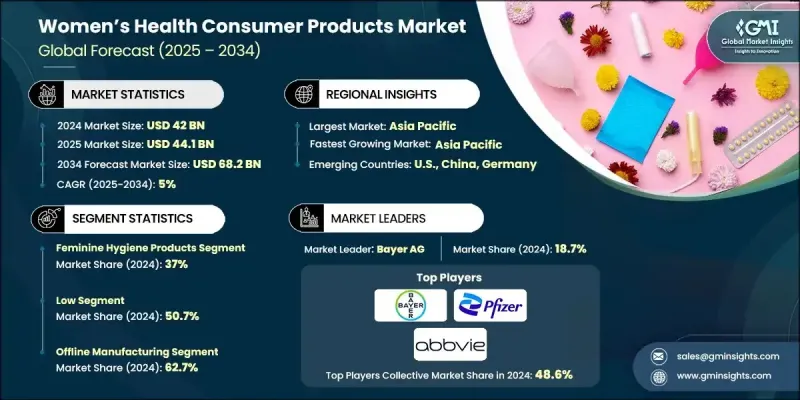
此估值涵盖了透过医院药局、独立药局、药局和线上零售平台销售的处方药和非处方女性健康产品。市场成长受人口结构变化、预防保健日益重视、健康素养提高以及鼓励产品更广泛供应的监管框架不断完善等因素的影响。新兴地区(尤其是亚太地区)收入成长和城市化发展进一步支撑了这一上升趋势,这些地区对专业化和高品质健康解决方案的需求持续增强。市场规模反映了不同地区在定价、医疗服务可近性和购买行为方面的差异。北美和欧洲由于较高的健康意识和完善的医疗保健体系,人均支出较高;而拉丁美洲、中东和非洲以及亚太地区的市场则随着基础设施的改善和健康意识的提高而快速扩张。这些因素共同推动了全球市场的持续长期成长。
| 市场范围 | |
|---|---|
| 起始年份 | 2024 |
| 预测年份 | 2025-2034 |
| 起始值 | 420亿美元 |
| 预测值 | 682亿美元 |
| 复合年增长率 | 5% |
2024年,女性卫生用品市占率达到37%,预计2025年至2034年间将以5.2%的复合年增长率成长。此类别涵盖经期护理和私密卫生用品,由于其持续的补充週期和日常卫生用品的必需性,仍保持着市场主导地位。材料和设计的进步不断提升产品安全性、舒适性和环保性,以满足消费者的需求。
2024年,低价女性健康产品市占率达到50.75%,预计将以5.2%的复合年增长率成长。此细分市场涵盖广泛使用的个人健康用品、维生素、补充剂和日常卫生用品。由于这些产品购买频率高,价格实惠仍是关键因素,尤其是在发展中经济体和注重成本的消费者群体中,因此该细分市场保持领先地位。
2024年,北美女性健康消费品市占率达到26.4%,预计到2034年将以5.2%的复合年增长率成长。高消费水准、强大的医疗保健体系和有利的监管环境是该地区保持领先地位的关键因素。北美仍是女性健康科技创新的中心,预计2024年,全球超过33%的女性健康科技企业将落脚北美。其中约20%的企业专注于怀孕和哺乳期解决方案,使该领域成为推动区域成长的最重要因素之一。
活跃于女性健康消费品市场的关键企业包括雅培实验室、安进、安丽全球、拜耳、宝洁、Ferring製药、GNC控股、康宝莱营养、强生、默克、雀巢、辉瑞、三得利控股、梯瓦製药和喜马拉雅药品公司。领导企业正透过拓展营养健康、荷尔蒙平衡、生殖健康和日常卫生用品等产品组合,巩固其在女性健康消费品市场的地位。许多公司正加大研发投入,推出以科学为依据的配方、清洁标籤成分和个人化解决方案,以满足消费者日益增长的预防保健需求。包括远距医疗整合、行动应用程式和定向线上管道在内的数位化互动策略,正在提升品牌知名度和可及性。此外,各公司也透过与药局、电商平台和医疗服务供应商合作,扩大分销管道,触及更广泛的客户群。
目录
第一章:方法论与范围
第二章:执行概要
第三章:行业洞察
- 产业生态系分析
- 供应商格局
- 利润率
- 每个阶段的价值增加
- 影响价值链的因素
- 产业影响因素
- 成长驱动因素
- 女性健康和慢性疾病发生率不断上升
- 科技进步与数位健康/女性健康科技
- 提高公众意识和支持性政策/政府倡议
- 产业陷阱与挑战
- 污名、文化和取得障碍
- 监管、研究和临床试验的差距
- 资料隐私、产品类别片段化与成本压力
- 机会
- 女性科技和数位健康解决方案的扩展
- 对预防性和整体健康产品的需求不断增长
- 新兴经济体和细分市场中尚未开发的市场
- 成长驱动因素
- 成长潜力分析
- 未来市场趋势
- 技术与创新格局
- 当前技术趋势
- 新兴技术
- 价格趋势
- 按地区
- 依产品类型
- 监管环境
- 标准和合规要求
- 区域监理框架
- 波特的分析
- PESTEL 分析
- 消费者行为分析
- 购买模式
- 偏好分析
- 消费者行为的区域差异
- 电子商务对购买决策的影响
第四章:竞争格局
- 介绍
- 公司市占率分析
- 按地区
- 公司矩阵分析
- 主要市场参与者的竞争分析
- 竞争定位矩阵
- 关键进展
- 併购
- 合作伙伴关係与合作
- 新产品发布
- 扩张计划
第五章:市场估算与预测:依产品类型划分,2021-2034年
- 主要趋势
- 女性卫生用品
- 卫生棉
- 卫生棉条
- 月经杯
- 护垫
- 其他的
- 孕期及产后护理产品
- 怀孕维生素
- 孕妇装
- 妊娠纹霜
- 孕期补充剂
- 性健康产品
- 避孕药
- 润滑剂
- 私密健康产品
- 营养及膳食补充品
- 其他个人护理产品(护肤品、头髮护理产品和保健产品)
第六章:市场估计与预测:依年龄组别划分(2021-2034年)
- 主要趋势
- 青少年和年轻成年人
- 成年人
- 中老年女性
第七章:市场估计与预测:依价格划分,2021-2034年
- 主要趋势
- 低的
- 中等的
- 高的
第八章:市场估算与预测:依配销通路划分,2021-2034年
- 主要趋势
- 线上平台
- 电子商务平台(亚马逊、Flipkart 等)
- 品牌网站和订阅盒
- 女性健康产品的行动应用程式
- 线下零售
- 超市和大型超市
- 药局和药局
- 专业健康与保健商店
第九章:市场估计与预测:依地区划分,2021-2034年
- 主要趋势
- 北美洲
- 我们
- 加拿大
- 欧洲
- 英国
- 德国
- 法国
- 义大利
- 西班牙
- 俄罗斯
- 亚太地区
- 中国
- 印度
- 日本
- 澳洲
- 韩国
- 拉丁美洲
- 巴西
- 墨西哥
- 阿根廷
- MEA
- 阿联酋
- 南非
- 沙乌地阿拉伯
第十章:公司简介
- Abbott Laboratories
- Amgen
- Amway Global
- Bayer
- Blackmores
- Ferring Pharmaceuticals
- GNC Holdings
- Herbalife Nutrition
- Johnson & Johnson
- Merck & Co.
- Nestle
- Pfizer
- Suntory Holdings
- Teva Pharmaceutical Industries
- The Himalaya Drug Company
The Global Womens Health Consumer Products Market was valued at USD 42 billion in 2024 and is estimated to grow at a CAGR of 5% to reach USD 68.2 billion by 2034.
The valuation includes both prescription-based and over-the-counter women's health products sold through hospital pharmacies, independent pharmacies, drug stores, and digital retail platforms. Market growth is shaped by shifting demographics, rising focus on preventive care, increasing health literacy, and evolving regulatory frameworks that encourage wider product availability. The upward trend is further supported by rising incomes and urban development in emerging regions, particularly across the Asia Pacific, where demand for specialized and high-quality health solutions continues to strengthen. Market sizing reflects regional differences in pricing, access to care, and purchasing behaviors. North America and Europe demonstrate higher per-capita spending due to strong awareness levels and well-established healthcare systems, while markets in Latin America, the Middle East & Africa, and Asia Pacific are expanding rapidly as infrastructure improves and awareness broadens. Together, these dynamics contribute to consistent, long-term growth worldwide.
| Market Scope | |
|---|---|
| Start Year | 2024 |
| Forecast Year | 2025-2034 |
| Start Value | $42 Billion |
| Forecast Value | $68.2 Billion |
| CAGR | 5% |
The feminine hygiene products segment held a 37% share in 2024 and is forecast to grow at a CAGR of 5.2% during 2025-2034. This category includes menstrual care and intimate hygiene items and remains dominant due to constant replenishment cycles and the essential nature of routine hygiene products. Advances in materials and design continue to emphasize safety, comfort, and environmentally mindful solutions for consumers.
The low-price women's health products segment accounted for a 50.75% share in 2024 and is expected to grow at a CAGR of 5.2%. This segment encompasses widely used personal health items, vitamins, supplements, and everyday hygiene products. It maintains its leading share because many of these goods are purchased frequently, and affordability remains a critical factor, particularly in developing economies and among cost-conscious consumers.
North America Womens Health Consumer Products Market captured 26.4% share in 2024 and is projected to grow at a CAGR of 5.2% through 2034. High spending levels, strong healthcare systems, and supportive regulatory environments contribute to the region's leadership position. The area remains a hub for women's health technology innovation, with more than 33% of global femtech ventures based there in 2024. Approximately 20% of these ventures focus on pregnancy and nursing solutions, making this segment one of the most significant contributors to regional growth.
Key companies active in the Womens Health Consumer Products Market include Abbott Laboratories, Amgen, Amway Global, Bayer, Blackmores, Ferring Pharmaceuticals, GNC Holdings, Herbalife Nutrition, Johnson & Johnson, Merck & Co., Nestle, Pfizer, Suntory Holdings, Teva Pharmaceutical Industries, and The Himalaya Drug Company. Leading companies are strengthening their Womens Health Consumer Products Market presence by expanding product portfolios across nutritional health, hormonal wellness, reproductive care, and daily hygiene categories. Many firms are investing in R&D to introduce science-backed formulations, clean-label ingredients, and personalized solutions that align with rising consumer interest in preventive health. Digital engagement strategies, including telehealth integration, mobile apps, and targeted online channels, are improving brand visibility and accessibility. Companies are also widening distribution through partnerships with pharmacies, e-commerce platforms, and healthcare providers to reach a broader customer base.
Table of Contents
Chapter 1 Methodology and Scope
- 1.1 Market scope and definition
- 1.2 Research design
- 1.2.1 Research approach
- 1.3 Data collection methods
- 1.4 Data mining sources
- 1.4.1 Global
- 1.4.2 Regional/Country
- 1.5 Base estimates and calculations
- 1.5.1 Base year calculation
- 1.5.2 Key trends for market estimation
- 1.6 Primary research and validation
- 1.6.1 Primary sources
- 1.7 Forecast model
- 1.8 Research assumptions and limitations
Chapter 2 Executive Summary
- 2.1 Industry 360° synopsis
- 2.2 Key market trends
- 2.2.1 Regional
- 2.2.2 Product type
- 2.2.3 Age group
- 2.2.4 Price
- 2.2.5 Distribution channel
- 2.3 CXO perspectives: strategic imperatives
- 2.3.1 Key decision points for industry executives
- 2.3.2 Critical success factors for market players
- 2.4 Future outlook and strategic recommendations
Chapter 3 Industry Insights
- 3.1 Industry ecosystem analysis
- 3.1.1 Supplier landscape
- 3.1.2 Profit margin
- 3.1.3 Value addition at each stage
- 3.1.4 Factors affecting the value chain
- 3.2 Industry impact forces
- 3.2.1 Growth drivers
- 3.2.1.1 Growing incidence of women’s health and chronic conditions
- 3.2.1.2 Advancements in technology & digital health / femtech
- 3.2.1.3 Increasing awareness and supportive policy/government initiatives
- 3.2.2 Industry pitfalls & challenges
- 3.2.2.1 Stigma, cultural & access barriers
- 3.2.2.2 Regulatory, research and clinical trial gaps
- 3.2.2.3 Data privacy, fragmenting product categories, and cost pressures
- 3.2.3 Opportunities
- 3.2.3.1 Expansion of femtech and digital health solutions
- 3.2.3.2 Rising demand for preventive and holistic wellness products
- 3.2.3.3 Untapped markets in emerging economies and niche segments
- 3.2.1 Growth drivers
- 3.3 Growth potential analysis
- 3.4 Future market trends
- 3.5 Technology and innovation landscape
- 3.5.1 Current technological trends
- 3.5.2 Emerging technologies
- 3.6 Price trends
- 3.6.1 By region
- 3.6.2 By Product type
- 3.7 Regulatory landscape
- 3.7.1 standards and compliance requirements
- 3.7.2 Regional regulatory frameworks
- 3.8 Porter's analysis
- 3.9 PESTEL analysis
- 3.10 Consumer behavior analysis
- 3.10.1 Purchasing patterns
- 3.10.2 Preference analysis
- 3.10.3 Regional variations in consumer behavior
- 3.10.4 Impact of e-commerce on buying decisions
Chapter 4 Competitive Landscape, 2024
- 4.1 Introduction
- 4.2 Company market share analysis
- 4.2.1 By region
- 4.2.1.1 North America
- 4.2.1.2 Europe
- 4.2.1.3 Asia Pacific
- 4.2.1.4 Latin America
- 4.2.1.5 Middle East and Africa
- 4.2.1 By region
- 4.3 Company matrix analysis
- 4.4 Competitive analysis of major market players
- 4.5 Competitive positioning matrix
- 4.6 Key developments
- 4.6.1 Mergers & acquisitions
- 4.6.2 Partnerships & collaborations
- 4.6.3 New Product Launches
- 4.6.4 Expansion Plans
Chapter 5 Market Estimates & Forecast, By Product Type, 2021 - 2034 ($Bn, Thousand Units)
- 5.1 Key trends
- 5.2 Feminine hygiene products
- 5.2.1 Sanitary napkins
- 5.2.2 Tampons
- 5.2.3 Menstrual cups
- 5.2.4 Panty liners
- 5.2.5 Others
- 5.3 Maternity & pregnancy care products
- 5.3.1 Prenatal vitamins
- 5.3.2 Maternity wear
- 5.3.3 Stretch mark creams
- 5.3.4 Pregnancy supplements
- 5.4 Sexual wellness products
- 5.4.1 Contraceptives
- 5.4.2 Lubricants
- 5.4.3 Intimate health products
- 5.5 Nutritional & dietary supplements
- 5.6 Other personal care products (skincare, hair care, and wellness products)
Chapter 6 Market Estimates & Forecast, By Age Group 2021 - 2034 ($Bn, Thousand Units)
- 6.1 Key trends
- 6.2 Teenagers & young adults
- 6.3 Adults
- 6.4 Middle-aged & older women
Chapter 7 Market Estimates & Forecast, By Price, 2021 - 2034 ($Bn, Thousand Units)
- 7.1 Key trends
- 7.2 Low
- 7.3 Medium
- 7.4 High
Chapter 8 Market Estimates & Forecast, By Distribution channel, 2021 - 2034 ($Bn, Thousand Units)
- 8.1 Key trends
- 8.2 Online platforms
- 8.2.1 E-commerce marketplaces (Amazon, Flipkart, etc.)
- 8.2.2 Brand websites & subscription boxes
- 8.2.3 Mobile apps for Women’s health products
- 8.3 Offline retail
- 8.3.1 Supermarkets & hypermarkets
- 8.3.2 Pharmacies & drugstores
- 8.3.3 Specialty health & wellness stores
Chapter 9 Market Estimates & Forecast, By Region, 2021 - 2034 ($Bn, Thousand Units)
- 9.1 Key trends
- 9.2 North America
- 9.2.1 U.S.
- 9.2.2 Canada
- 9.3 Europe
- 9.3.1 UK
- 9.3.2 Germany
- 9.3.3 France
- 9.3.4 Italy
- 9.3.5 Spain
- 9.3.6 Russia
- 9.4 Asia Pacific
- 9.4.1 China
- 9.4.2 India
- 9.4.3 Japan
- 9.4.4 Australia
- 9.4.5 South Korea
- 9.5 Latin America
- 9.5.1 Brazil
- 9.5.2 Mexico
- 9.5.3 Argentina
- 9.6 MEA
- 9.6.1 UAE
- 9.6.2 South Africa
- 9.6.3 Saudi Arabia
Chapter 10 Company Profiles
- 10.1 Abbott Laboratories
- 10.2 Amgen
- 10.3 Amway Global
- 10.4 Bayer
- 10.5 Blackmores
- 10.6 Ferring Pharmaceuticals
- 10.7 GNC Holdings
- 10.8 Herbalife Nutrition
- 10.9 Johnson & Johnson
- 10.10 Merck & Co.
- 10.11 Nestle
- 10.12 Pfizer
- 10.13 Suntory Holdings
- 10.14 Teva Pharmaceutical Industries
- 10.15 The Himalaya Drug Company

 全球女性健康照护市场规模、份额、趋势和成长分析报告(2026-2034)
 女性健康照护市场分析及预测(至2035年):依类型、产品类型、服务、技术、应用、最终使用者、设备、功能及解决方案划分全球女性健康治疗市场规模、份额、趋势和成长分析报告(2026-2034)
 全球女性用荷尔蒙平衡和经期健康产品市场预测(至2032年):按产品、配方、成分类型、分销管道、应用、最终用户和地区划分
 女性健康市场-全球产业规模、份额、趋势、机会及预测(按药物、应用、地区和竞争格局划分,2021-2031年)女性健康照护市场-全球产业规模、份额、趋势、机会和预测:按药物、应用、地区和竞争格局划分,2021-2031年全球孕产妇健康治疗市场:市场规模、占有率、成长率、产业分析、依类型、应用和地区划分的考量因素以及未来预测(2026-2034)
 日本女性健康市场报告(按年龄组类型、应用、配销通路和地区划分,2026-2034 年)
 女性健康治疗市场规模、份额和成长分析(按年龄、药物、通路、应用和地区划分)-2026-2033年产业预测女性健康领域六大成长机会(2025 年)