


 |
市场调查报告书
商品编码
1885853
牛肉蛋白水解物市场机会、成长驱动因素、产业趋势分析及预测(2025-2034年)Beef Protein Hydrolysates Market Opportunity, Growth Drivers, Industry Trend Analysis, and Forecast 2025 - 2034 |
||||||

2024 年全球牛肉蛋白水解物市场价值为 1.417 亿美元,预计到 2034 年将以 4.8% 的复合年增长率增长至 2.287 亿美元。
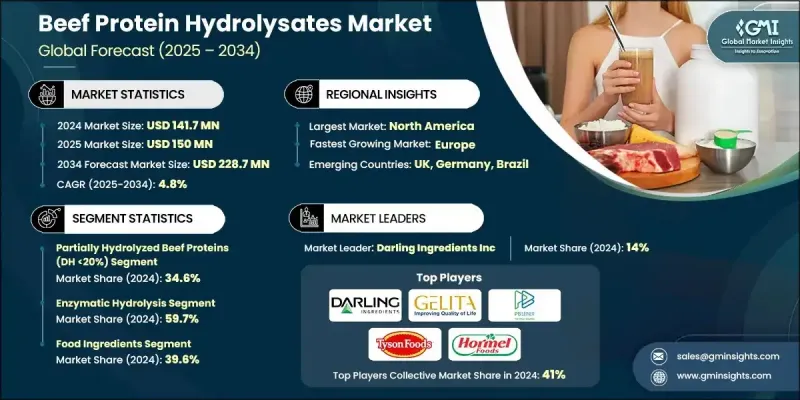
胜肽萃取、发酵管理和分析技术的进步,使得牛肉水解物的生产更加精准、稳定,且生物活性成分含量也得到了验证。色谱技术和多组学整合技术的改进,在满足监管要求的同时,也促进了产品的标准化。同时,数位化营养平台开始将基于水解物的资讯融入个人化饮食计画中。这种科学创新、个人化营养和清洁标籤概念的融合,正在加速其在人类和动物健康领域的应用。此成分吸收迅速、消化率高,且胺基酸组成丰富,使其在运动营养、功能性食品和动物饲料领域具有极高的应用价值。与大豆或乳製品等传统蛋白质来源相比,生产商正利用这些特性开发出感官品质较佳、营养性能更强、且不含过敏原的水解物。
| 市场范围 | |
|---|---|
| 起始年份 | 2024 |
| 预测年份 | 2025-2034 |
| 起始值 | 1.417亿美元 |
| 预测值 | 2.287亿美元 |
| 复合年增长率 | 4.8% |
水解度为 20% 的部分水解牛肉蛋白在 2024 年占据了 34.6% 的市场份额,预计到 2034 年将以 4.4% 的复合年增长率增长。其应用范围的扩大与那些在不影响风味或质地的前提下提供辅助消化益处的配方有关,这使得它们非常适合用于一般保健、儿科营养以及需要温和水解且具有消费者喜爱的感官特性的功能性食品。
2024年,酵素水解领域占据59.7%的市场份额,预计2025年至2034年将以4.6%的复合年增长率成长。此方法之所以保持主导地位,是因为它能够生产目标胜肽结构,保持清洁标籤的完整性,并提供高生物活性。其低温加工有助于保留营养价值并增强有益的功能特性,包括抗氧化、代谢和抗菌作用,使其成为高端功能性食品、运动营养、临床应用和个人化饮食解决方案的关键所在。
由于市场对先进营养保健品和功能性成分的需求不断增长,预计到2024年,欧洲牛肉蛋白水解物市场规模将达到4,290万美元。牛肉蛋白水解物因其易于消化、符合「清洁标籤」理念以及适用于强调高品质蛋白质来源且不含添加剂的特殊膳食,而备受欧洲消费者和生产商的青睐。
牛肉蛋白水解物市场的主要参与者包括:达令原料公司 (Darling Ingredients Inc.)、吉利达股份公司 (Gelita AG)、泰森德洛集团 (Tessenderlo Group,原PB Leiner集团)、泰森食品公司 (Tyson Foods Inc.)、荷美尔食品公司 (Hormel Foods Corporation)、鲁塞尔洛公司 (Rousselot Inc.) (Sonac,原达令原料公司)、CTH公司 (CTH,原达令原料公司)、史密斯菲尔德食品公司 (Smithfield Foods Inc.)、特种蛋白加工商、生物活性胜肽开发商、永续加工公司、区域饲料原料供应商、新兴技术公司以及合约製造组织。这些公司采取多种策略来巩固其竞争优势。许多公司正大力投资先进的酵素技术,以开发功能更完善、更优质的胜肽谱。透过升级加工设施扩大产能,可以满足不断增长的全球需求,并提高供应链的韧性。此外,各公司也正在调整产品组合,以符合清洁标籤和无过敏原的趋势,从而确保透明度并满足消费者的期望。
目录
第一章:方法论与范围
第二章:执行概要
第三章:行业洞察
- 产业生态系分析
- 供应商格局
- 利润率
- 每个阶段的价值增加
- 影响价值链的因素
- 中断
- 产业影响因素
- 成长驱动因素
- 对清洁标籤蛋白质原料的需求日益增长
- 日益重视永续肉类加工
- 营养保健品和功能性食品应用日益增长
- 产业陷阱与挑战
- BSE/TSE 安全隐患与监管限制
- 高昂的处理成本和技术复杂性
- 市场机会
- 用于健康应用的生物活性胜肽开发
- 动物饲料和宠物食品领域的扩张
- 成长驱动因素
- 成长潜力分析
- 监管环境
- 北美洲
- 欧洲
- 亚太地区
- 拉丁美洲
- 中东和非洲
- 波特的分析
- PESTEL 分析
- 价格趋势
- 按地区
- 依产品类型
- 未来市场趋势
- 技术与创新格局
- 当前技术趋势
- 新兴技术
- 专利格局
- 贸易统计(HS编码)(註:仅提供重点国家的贸易统计资料)
- 主要进口国
- 主要出口国
- 永续性和环境方面
- 永续实践
- 减少废弃物策略
- 生产中的能源效率
- 环保倡议
- 碳足迹考量
第四章:竞争格局
- 介绍
- 公司市占率分析
- 按地区
- 北美洲
- 欧洲
- 亚太地区
- 拉丁美洲
- MEA
- 按地区
- 公司矩阵分析
- 主要市场参与者的竞争分析
- 竞争定位矩阵
- 关键进展
- 併购
- 合作伙伴关係与合作
- 新产品发布
- 扩张计划
第五章:市场估算与预测:依产品类型划分,2021-2034年
- 主要趋势
- 部分水解牛肉蛋白(Dh <20%)
- 中度水解牛肉蛋白(水解度 20-60%)
- 深度水解牛肉蛋白(Dh >60%)
- 牛胶原蛋白胜肽(分子量<3 kDa)
第六章:市场估算与预测:依製造流程划分,2021-2034年
- 主要趋势
- 酵素水解
- 基于Alcalase的加工
- 基于Protamex的加工
- 基于木瓜蛋白酶的加工
- 化学水解
- 酸水解法
- 碱性水解法
- 热解
- 高压处理
- 微波辅助水解
- 混合处理技术
- 酵素化学联合方法
- 顺序处理方法
第七章:市场估计与预测:依最终用途应用划分,2021-2034年
- 主要趋势
- 食品原料
- 增味剂和味觉调节剂
- 蛋白质强化和营养增强
- 加工肉製品
- 烘焙和糖果应用
- 动物饲料和宠物食品
- 牲畜饲料添加剂
- 水产养殖饲料应用
- 宠物食品适口性增强剂
- 特种动物营养
- 营养保健品和膳食补充剂
- 运动营养产品
- 临床营养应用
- 关节健康与活动能力补充剂
- 血糖控制与代谢健康
- 化妆品及个人护理
- 抗衰老配方
- 皮肤健康应用
- 护髮产品
- 伤口癒合和生物医学用途
第八章:市场估算与预测:依地区划分,2021-2034年
- 主要趋势
- 北美洲
- 我们
- 加拿大
- 欧洲
- 德国
- 英国
- 法国
- 西班牙
- 义大利
- 欧洲其他地区
- 亚太地区
- 中国
- 印度
- 日本
- 澳洲
- 韩国
- 亚太其他地区
- 拉丁美洲
- 巴西
- 墨西哥
- 阿根廷
- 拉丁美洲其他地区
- 中东和非洲
- 沙乌地阿拉伯
- 南非
- 阿联酋
- 中东和非洲其他地区
第九章:公司简介
- Darling Ingredients Inc
- Gelita AG
- Tessenderlo Group (PB Leiner)
- Tyson Foods Inc
- Hormel Foods Corporation
- Rousselot (Darling Ingredients)
- Sonac (Darling Ingredients)
- CTH (Darling Ingredients)
- Smithfield Foods Inc
- Specialty Protein Processors
- Bioactive Peptide Developers
- Sustainable Processing Companies
- Regional Feed Ingredient Suppliers
- Emerging Technology Companies
- Contract Manufacturing Organizations
The Global Beef Protein Hydrolysates Market was valued at USD 141.7 million in 2024 and is estimated to grow at a CAGR of 4.8% to reach USD 228.7 million by 2034.
Advancements in peptide extraction, fermentation management, and analytical profiling are enabling the production of beef-derived hydrolysates with greater precision, consistency, and verified bioactive content. Improvements in chromatography and integrated multi-omics technologies support standardization while meeting regulatory expectations. At the same time, digital nutrition platforms are beginning to incorporate hydrolysate-based insights into personalized dietary plans. This merging of scientific innovation, individualized nutrition, and clean-label preference is accelerating adoption across both human and animal health sectors. The ingredient's rapid absorption, high digestibility, and strong amino acid profile make it valuable for sports nutrition, functional foods, and animal feed applications. Manufacturers are leveraging these attributes to develop hydrolysates with improved sensory qualities, enhanced nutritional performance, and allergen-free positioning compared to traditional protein sources like soy or dairy.
| Market Scope | |
|---|---|
| Start Year | 2024 |
| Forecast Year | 2025-2034 |
| Start Value | $141.7 Million |
| Forecast Value | $228.7 Million |
| CAGR | 4.8% |
The partially hydrolyzed beef proteins, characterized by a degree of hydrolysis of 20%, accounted for a 34.6% share in 2024 and are expected to grow at a CAGR of 4.4% through 2034. Their expanding use is tied to formulations that provide supportive digestive benefits without compromising flavor or texture, which makes them well-suited for general wellness, pediatric nutrition, and functional food products requiring mild hydrolysis with consumer-friendly sensory characteristics.
The enzymatic hydrolysis segment held a 59.7% share in 2024 and is projected to grow at a CAGR of 4.6% from 2025 to 2034. This approach remains dominant due to its capacity to produce targeted peptide structures, maintain clean-label integrity, and deliver high bioactivity. Its low-temperature processing helps preserve nutritional value and enhance beneficial functional properties, including antioxidant, metabolic, and antimicrobial effects, making it essential for premium functional foods, sports nutrition, clinical applications, and personalized dietary solutions.
Europe Beef Protein Hydrolysates Market generated USD 42.9 million in 2024, owing to the shifting toward advanced nutraceuticals and functional ingredients. Beef protein hydrolysates appeal to European consumers and manufacturers because of their digestibility, favorable clean-label perception, and suitability for specialized diets that emphasize high-quality protein sources without unwanted additives.
Major companies operating in the Beef Protein Hydrolysates Market include Darling Ingredients Inc., Gelita AG, Tessenderlo Group (PB Leiner), Tyson Foods Inc., Hormel Foods Corporation, Rousselot (Darling Ingredients), Sonac (Darling Ingredients), CTH (Darling Ingredients), Smithfield Foods Inc., Specialty Protein Processors, Bioactive Peptide Developers, Sustainable Processing Companies, Regional Feed Ingredient Suppliers, Emerging Technology Companies, and Contract Manufacturing Organizations. Companies active in the Beef Protein Hydrolysates Market adopt a variety of strategies to reinforce their competitive positioning. Many are investing heavily in advanced enzymatic technologies to develop more refined peptide profiles with enhanced functional benefits. Expanding production capacity through upgraded processing facilities supports rising global demand and improves supply-chain resilience. Firms are also aligning product portfolios with clean-label and allergen-free trends, ensuring transparency and meeting consumer expectations.
Table of Contents
Chapter 1 Methodology & Scope
- 1.1 Market scope and definition
- 1.2 Research design
- 1.2.1 Research approach
- 1.2.2 Data collection methods
- 1.3 Data mining sources
- 1.3.1 Global
- 1.3.2 Regional/Country
- 1.4 Base estimates and calculations
- 1.4.1 Base year calculation
- 1.4.2 Key trends for market estimation
- 1.5 Primary research and validation
- 1.5.1 Primary sources
- 1.6 Forecast model
- 1.7 Research assumptions and limitations
Chapter 2 Executive Summary
- 2.1 Industry 360° synopsis
- 2.2 Key market trends
- 2.2.1 Regional
- 2.2.2 Product type
- 2.2.3 Manufacturing Process
- 2.2.4 Application
- 2.3 TAM Analysis, 2025-2034
- 2.4 CXO perspectives: Strategic imperatives
- 2.4.1 Executive decision points
- 2.4.2 Critical success factors
- 2.5 Future Outlook and Strategic Recommendations
Chapter 3 Industry Insights
- 3.1 Industry ecosystem analysis
- 3.1.1 Supplier landscape
- 3.1.2 Profit margin
- 3.1.3 Value addition at each stage
- 3.1.4 Factor affecting the value chain
- 3.1.5 Disruptions
- 3.2 Industry impact forces
- 3.2.1 Growth drivers
- 3.2.1.1 Growing demand for clean label protein ingredients
- 3.2.1.2 Increasing focus on sustainable meat processing
- 3.2.1.3 Rising nutraceutical & functional food applications
- 3.2.2 Industry pitfalls and challenges
- 3.2.2.1 BSE/TSE safety concerns & regulatory restrictions
- 3.2.2.2 High processing costs & technical complexity
- 3.2.3 Market opportunities
- 3.2.3.1 Bioactive peptide development for health applications
- 3.2.3.2 Expansion in animal feed & pet food segments
- 3.2.1 Growth drivers
- 3.3 Growth potential analysis
- 3.4 Regulatory landscape
- 3.4.1 North America
- 3.4.2 Europe
- 3.4.3 Asia Pacific
- 3.4.4 Latin America
- 3.4.5 Middle East & Africa
- 3.5 Porter's analysis
- 3.6 PESTEL analysis
- 3.7 Price trends
- 3.7.1 By region
- 3.7.2 By product type
- 3.8 Future market trends
- 3.9 Technology and Innovation landscape
- 3.9.1 Current technological trends
- 3.9.2 Emerging technologies
- 3.10 Patent Landscape
- 3.11 Trade statistics (HS code) ( Note: the trade statistics will be provided for key countries only)
- 3.11.1 Major importing countries
- 3.11.2 Major exporting countries
- 3.12 Sustainability and environmental aspects
- 3.12.1 Sustainable practices
- 3.12.2 Waste reduction strategies
- 3.12.3 Energy efficiency in production
- 3.12.4 Eco-friendly initiatives
- 3.13 Carbon footprint consideration
Chapter 4 Competitive Landscape, 2024
- 4.1 Introduction
- 4.2 Company market share analysis
- 4.2.1 By region
- 4.2.1.1 North America
- 4.2.1.2 Europe
- 4.2.1.3 Asia Pacific
- 4.2.1.4 LATAM
- 4.2.1.5 MEA
- 4.2.1 By region
- 4.3 Company matrix analysis
- 4.4 Competitive analysis of major market players
- 4.5 Competitive positioning matrix
- 4.6 Key developments
- 4.6.1 Mergers & acquisitions
- 4.6.2 Partnerships & collaborations
- 4.6.3 New Product Launches
- 4.6.4 Expansion Plans
Chapter 5 Market Estimates and Forecast, By Product Type, 2021-2034 (USD Million) (Kilo Tons)
- 5.1 Key trends
- 5.2 Partially hydrolyzed beef proteins (Dh <20%)
- 5.3 Moderately hydrolyzed beef proteins (Dh 20-60%)
- 5.4 Extensively hydrolyzed beef proteins (Dh >60%)
- 5.5 Beef collagen peptides (molecular weight <3 Kda)
Chapter 6 Market Estimates and Forecast, By Manufacturing Process, 2021-2034 (USD Million) (Kilo Tons)
- 6.1 Key trends
- 6.2 Enzymatic hydrolysis
- 6.2.1 Alcalase-based processing
- 6.2.2 Protamex-based processing
- 6.2.3 Papain-based processing
- 6.3 Chemical hydrolysis
- 6.3.1 Acid hydrolysis methods
- 6.3.2 Alkaline hydrolysis methods
- 6.4 Thermal hydrolysis
- 6.4.1 High pressure processing
- 6.4.2 Microwave-assisted hydrolysis
- 6.5 Hybrid processing technologies
- 6.5.1 Combined enzymatic-chemical methods
- 6.5.2 Sequential processing approaches
Chapter 7 Market Estimates and Forecast, By End Use Application, 2021-2034 (USD Million) (Kilo Tons)
- 7.1 Key trends
- 7.2 Food ingredients
- 7.2.1 Flavor enhancers & taste modulators
- 7.2.2 Protein fortification & nutritional enhancement
- 7.2.3 Processed meat products
- 7.2.4 Bakery & confectionery applications
- 7.3 Animal feed & pet food
- 7.3.1 Livestock feed supplements
- 7.3.2 Aquaculture feed applications
- 7.3.3 Pet food palatability enhancers
- 7.3.4 Specialty animal nutrition
- 7.4 Nutraceutical & dietary supplements
- 7.4.1 Sports nutrition products
- 7.4.2 Clinical nutrition applications
- 7.4.3 Joint health & mobility supplements
- 7.4.4 Glucose control & metabolic health
- 7.5 Cosmetics & personal care
- 7.5.1 Anti-aging formulations
- 7.5.2 Skin health applications
- 7.5.3 Hair care products
- 7.5.4 Wound healing & biomedical uses
Chapter 8 Market Estimates and Forecast, By Region, 2021-2034 (USD Million) (Kilo Tons)
- 8.1 Key trends
- 8.2 North America
- 8.2.1 U.S.
- 8.2.2 Canada
- 8.3 Europe
- 8.3.1 Germany
- 8.3.2 UK
- 8.3.3 France
- 8.3.4 Spain
- 8.3.5 Italy
- 8.3.6 Rest of Europe
- 8.4 Asia Pacific
- 8.4.1 China
- 8.4.2 India
- 8.4.3 Japan
- 8.4.4 Australia
- 8.4.5 South Korea
- 8.4.6 Rest of Asia Pacific
- 8.5 Latin America
- 8.5.1 Brazil
- 8.5.2 Mexico
- 8.5.3 Argentina
- 8.5.4 Rest of Latin America
- 8.6 Middle East and Africa
- 8.6.1 Saudi Arabia
- 8.6.2 South Africa
- 8.6.3 UAE
- 8.6.4 Rest of Middle East and Africa
Chapter 9 Company Profiles
- 9.1 Darling Ingredients Inc
- 9.2 Gelita AG
- 9.3 Tessenderlo Group (PB Leiner)
- 9.4 Tyson Foods Inc
- 9.5 Hormel Foods Corporation
- 9.6 Rousselot (Darling Ingredients)
- 9.7 Sonac (Darling Ingredients)
- 9.8 CTH (Darling Ingredients)
- 9.9 Smithfield Foods Inc
- 9.10 Specialty Protein Processors
- 9.11 Bioactive Peptide Developers
- 9.12 Sustainable Processing Companies
- 9.13 Regional Feed Ingredient Suppliers
- 9.14 Emerging Technology Companies
- 9.15 Contract Manufacturing Organizations

 山竹萃取物市场报告:趋势、预测和竞争分析(至2031年)
 犬类护理服务市场规模、占有率、成长及全球产业分析:依类型、应用和地区划分的洞察与预测(2024-2032 年)蓝靛果粉市场报告:2031 年趋势、预测与竞争分析