


 |
市场调查报告书
商品编码
1885892
电子垃圾回收市场机会、成长驱动因素、产业趋势分析及预测(2025-2034年)Electronic Waste Recycling Market Opportunity, Growth Drivers, Industry Trend Analysis, and Forecast 2025 - 2034 |
||||||

2024 年全球电子垃圾回收市场价值为 701 亿美元,预计到 2034 年将以 13.5% 的复合年增长率成长至 2,519 亿美元。
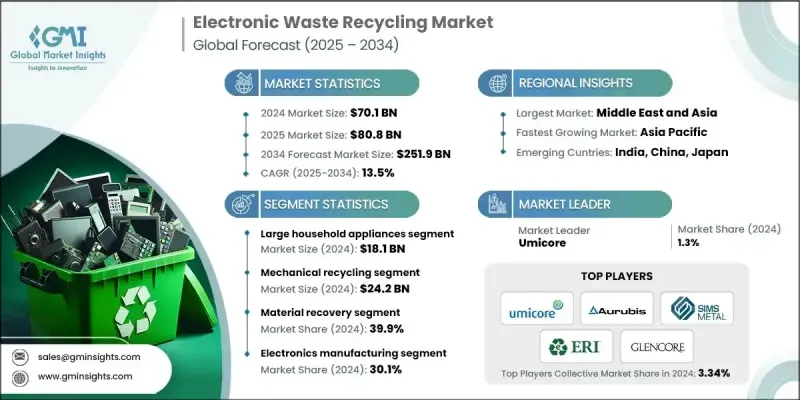
该市场涵盖了从废弃电子产品中提取、处理和回收有价值材料的组织。这些产品包括消费性电子产品、家用电器和电池等,回收过程有助于环境保护、减少浪费,并促进塑胶、铜、金和铝等资源的再利用。该行业包含多个阶段,包括设备拆解、材料分类、资源回收和负责任的废弃物处理,所有环节均符合永续发展原则和监管标准。全球电子产品使用量持续成长,推动了对先进高效回收方法的需求。多个地区的政府正在加强监管框架,以限制不当处置行为并支持合法的回收工作。随着企业和消费者对电子垃圾环境影响的认知不断提高,参与正规回收计画的人数也持续攀升。此外,回收资源的经济价值也为废弃物管理和回收公司提供了强大的经济动力。
| 市场范围 | |
|---|---|
| 起始年份 | 2024 |
| 预测年份 | 2025-2034 |
| 起始值 | 701亿美元 |
| 预测值 | 2519亿美元 |
| 复合年增长率 | 13.5% |
2024年,大型家用电器市场规模将达181亿美元。其市场主导地位得益于频繁的产品更换週期以及消费者对环保废弃物处理方案日益增长的偏好。资讯科技和电信设备市场紧随其后,这主要得益于设备的快速更新换代和持续的技术升级,从而产生大量可回收的材料。
预计到2024年,机械回收市场规模将达242亿美元。该方法能够有效率、大规模地从各种电子产品中回收金属和塑胶。湿式冶金製程因其能够透过环保的萃取方法生产高纯度金属而发展迅速,而火法冶金製程仍是处理复杂废物流的重要选择,它可以透过高温处理来实现这一目标。
2024年,美国电子垃圾回收市场规模预计将达141亿美元。北美市场的成长得益于政府严格的垃圾处理政策和企业对永续发展的承诺。科技的快速普及加速了笔记型电脑、伺服器、行动装置及相关设备的报废週期,增加了对回收能力的需求。人们日益认识到从废弃电子产品中回收稀土元素、黄金和白银等金属所带来的环境和经济效益,这也进一步推动了市场扩张。
参与电子垃圾回收市场的主要公司包括美国电池技术公司(American Battery Technology Company)、Aurubis、Boliden、电子回收国际公司(Electronic Recyclers International)、嘉能可回收公司(Glencore Recycling)、Redwood Materials、Retriev Technologies、Sims Management、Stena Metall、TES(科技、Redwood Materials(技术、与世界)。该市场中的公司正透过扩大处理能力和投资先进的回收技术来提高材料回收率,从而巩固其竞争地位。许多企业正在整合自动化和人工智慧驱动的分类系统,以提高营运效率并减少回收过程中的污染。各公司也正在与製造商、零售商和市政当局签订长期供应协议,以确保稳定的进料量。产品创新着重于开发更清洁、更节能的萃取方法,以便从复杂的电子废弃物中回收高价值金属。
目录
第一章:方法论与范围
第二章:执行概要
第三章:行业洞察
- 产业生态系分析
- 供应商格局
- 利润率
- 每个阶段的价值增加
- 影响价值链的因素
- 中断
- 产业影响因素
- 成长驱动因素
- 电子垃圾产生量不断增加
- 日益增强的环保意识
- 有价值的材料回收
- 产业陷阱与挑战
- 高初始投资
- 复杂产品组成
- 市场机会
- 技术进步
- 开发电动车电池专用回收技术
- 与循环经济倡议的融合
- 成长驱动因素
- 成长潜力分析
- 监管环境
- 北美洲
- 欧洲
- 亚太地区
- 拉丁美洲
- 中东和非洲
- 波特的分析
- PESTEL 分析
- 技术与创新格局
- 当前技术趋势
- 新兴技术
- 价格趋势
- 按地区
- 依产品类型
- 未来市场趋势
- 技术与创新格局
- 当前技术趋势
- 新兴技术
- 专利格局
- 贸易统计(HS编码)(註:仅提供重点国家的贸易统计资料)
- 主要进口国
- 主要出口国
- 永续性和环境方面
- 永续实践
- 减少废弃物策略
- 生产中的能源效率
- 环保倡议
- 碳足迹考量
第四章:竞争格局
- 介绍
- 公司市占率分析
- 按地区
- 北美洲
- 欧洲
- 亚太地区
- 拉丁美洲
- MEA
- 按地区
- 公司矩阵分析
- 主要市场参与者的竞争分析
- 竞争定位矩阵
- 关键进展
- 併购
- 合作伙伴关係与合作
- 新产品发布
- 扩张计划
第五章:市场估算与预测:依产品类型划分,2021-2034年
- 主要趋势
- 大型家用电器
- 小型家用电器
- 资讯科技和电信设备
- 消费性电子产品
- 照明设备
- 电动汽车电池
第六章:市场估计与预测:依技术划分,2021-2034年
- 主要趋势
- 机械回收
- 湿式冶金工艺
- 火法冶金加工
- 手动拆卸
- 先进的分选技术
第七章:市场估计与预测:依应用领域划分,2021-2034年
- 主要趋势
- 材料回收
- 贵金属回收
- 稀土元素提取
- 贱金属回收
- 组件翻新
- 测试和维修流程
- 二手市场分析
- 安全处置
- 危险物质管理
- 垃圾掩埋场转移策略
- 二次原料生产
- 高纯度金属生产
- 製造集成
- 能量回收
- 垃圾发电
- 不可回收组分管理
第八章:市场估算与预测:依最终用途产业划分,2021-2034年
- 主要趋势
- 电子製造
- 金属加工与冶炼
- 废弃物管理服务
- 政府和市政当局
- 企业/商业
- 汽车产业
第九章:市场估计与预测:依地区划分,2021-2034年
- 主要趋势
- 北美洲
- 我们
- 加拿大
- 墨西哥
- 欧洲
- 德国
- 英国
- 法国
- 西班牙
- 义大利
- 欧洲其他地区
- 亚太地区
- 中国
- 印度
- 日本
- 澳洲
- 韩国
- 亚太其他地区
- 拉丁美洲
- 巴西
- 墨西哥
- 阿根廷
- 拉丁美洲其他地区
- 中东和非洲
- 沙乌地阿拉伯
- 南非
- 阿联酋
- 中东和非洲其他地区
第十章:公司简介
- American Battery Technology Company
- Aurubis
- Boliden
- Electronic Recyclers International
- Glencore Recycling
- Redwood Materials
- Retriev Technologies
- Sims Metal Management
- Stena Metall
- TES (Technology, Environment & Services)
- Umicore
- Veolia
The Global Electronic Waste Recycling Market was valued at USD 70.1 billion in 2024 and is estimated to grow at a CAGR of 13.5% to reach USD 251.9 billion by 2034.
The market includes organizations involved in the collection, treatment, and recovery of valuable materials extracted from discarded electronic products. These items range from consumer electronics to appliances and batteries, and the recycling process supports environmental protection, waste reduction, and the recirculation of resources such as plastics, copper, gold, and aluminum. The industry encompasses several stages, including breakdown of devices, material sorting, resource recovery, and responsible waste handling, all aligned with sustainability principles and regulatory standards. Global electronics usage continues to rise, fueling the need for advanced and efficient recycling methods. Governments across multiple regions are strengthening their regulatory frameworks to limit improper disposal practices and support legitimate recycling efforts. As businesses and consumers become more aware of the environmental impact of e-waste, participation in formal recycling programs continues to climb. Additionally, the financial value of reclaimed resources presents a strong economic incentive for waste management and recovery companies.
| Market Scope | |
|---|---|
| Start Year | 2024 |
| Forecast Year | 2025-2034 |
| Start Value | $70.1 Billion |
| Forecast Value | $251.9 Billion |
| CAGR | 13.5% |
The large household appliances segment generated USD 18.1 billion in 2024. Their dominance is supported by frequent product replacement cycles and a growing preference for environmentally responsible disposal solutions. IT and telecommunications equipment follow closely, driven by rapid device turnover and constant technological upgrades that generate significant volumes of reusable materials.
The mechanical recycling segment reached USD 24.2 billion in 2024. This method supports efficient, large-scale recovery of metals and plastics from a broad range of electronic products. Hydrometallurgical processing is gaining momentum due to its ability to produce high-purity metal outputs through eco-friendly extraction methods, while pyrometallurgical processing remains an important choice for handling complex waste streams through high-temperature treatment.
U.S. Electronic Waste Recycling Market was valued at USD 14.1 billion in 2024. Growth in North America is supported by stringent government policies on waste disposal and corporate commitments to sustainability. High adoption rates of technology result in accelerated disposal cycles for laptops, servers, mobile devices, and related equipment, thereby increasing the demand for recycling capacity. Rising awareness of the environmental and financial benefits associated with recovering metals such as rare earth elements, gold, and silver from outdated electronics further contributes to market expansion.
Major companies participating in the Electronic Waste Recycling Market include American Battery Technology Company, Aurubis, Boliden, Electronic Recyclers International, Glencore Recycling, Redwood Materials, Retriev Technologies, Sims Metal Management, Stena Metall, TES (Technology, Environment & Services), Umicore, and Veolia. Companies in this market are strengthening their competitive positions by expanding processing capacity and investing in advanced recycling technologies that improve material recovery rates. Many organizations are integrating automation and AI-driven sorting systems to boost operational efficiency and reduce contamination during the recycling process. Firms are also securing long-term supply agreements with manufacturers, retailers, and municipalities to ensure steady input volumes. Product innovation focuses on developing cleaner, more energy-efficient extraction methods capable of reclaiming high-value metals from complex electronic waste.
Table of Contents
Chapter 1 Methodology & Scope
- 1.1 Market scope and definition
- 1.2 Research design
- 1.2.1 Research approach
- 1.2.2 Data collection methods
- 1.3 Data mining sources
- 1.3.1 Global
- 1.3.2 Regional/Country
- 1.4 Base estimates and calculations
- 1.4.1 Base year calculation
- 1.4.2 Key trends for market estimation
- 1.5 Primary research and validation
- 1.5.1 Primary sources
- 1.6 Forecast model
- 1.7 Research assumptions and limitations
Chapter 2 Executive Summary
- 2.1 Industry 360° synopsis
- 2.2 Key market trends
- 2.2.1 Product type
- 2.2.2 Technology
- 2.2.3 Application
- 2.2.4 End Use industry
- 2.2.5 Regional
- 2.3 TAM Analysis, 2025-2034
- 2.4 CXO perspectives: Strategic imperatives
- 2.4.1 Executive decision points
- 2.4.2 Critical success factors
- 2.5 Future outlook and strategic recommendations
Chapter 3 Industry Insights
- 3.1 Industry ecosystem analysis
- 3.1.1 Supplier landscape
- 3.1.2 Profit margin
- 3.1.3 Value addition at each stage
- 3.1.4 Factor affecting the value chain
- 3.1.5 Disruptions
- 3.2 Industry impact forces
- 3.2.1 Growth drivers
- 3.2.1.1 Rising e-waste generation
- 3.2.1.2 Growing environmental awareness
- 3.2.1.3 Valuable material recovery
- 3.2.2 Industry pitfalls and challenges
- 3.2.2.1 High initial investment
- 3.2.2.2 Complex product composition
- 3.2.3 Market opportunities
- 3.2.3.1 Technological advancements
- 3.2.3.2 Development of specialized recycling for EV batteries
- 3.2.3.3 Integration with circular economy initiatives
- 3.2.1 Growth drivers
- 3.3 Growth potential analysis
- 3.4 Regulatory landscape
- 3.4.1 North America
- 3.4.2 Europe
- 3.4.3 Asia Pacific
- 3.4.4 Latin America
- 3.4.5 Middle East & Africa
- 3.5 Porter's analysis
- 3.6 PESTEL analysis
- 3.7 Technology and innovation landscape
- 3.7.1 Current technological trends
- 3.7.2 Emerging technologies
- 3.8 Price trends
- 3.8.1 By region
- 3.8.2 By product type
- 3.9 Future market trends
- 3.10 Technology and innovation landscape
- 3.10.1 Current technological trends
- 3.10.2 Emerging technologies
- 3.11 Patent landscape
- 3.12 Trade statistics (HS code) ( Note: the trade statistics will be provided for key countries only)
- 3.12.1 Major importing countries
- 3.12.2 Major exporting countries
- 3.13 Sustainability and environmental aspects
- 3.13.1 Sustainable practices
- 3.13.2 Waste reduction strategies
- 3.13.3 Energy efficiency in production
- 3.13.4 Eco-friendly initiatives
- 3.14 Carbon footprint consideration
Chapter 4 Competitive Landscape, 2024
- 4.1 Introduction
- 4.2 Company market share analysis
- 4.2.1 By region
- 4.2.1.1 North America
- 4.2.1.2 Europe
- 4.2.1.3 Asia Pacific
- 4.2.1.4 LATAM
- 4.2.1.5 MEA
- 4.2.1 By region
- 4.3 Company matrix analysis
- 4.4 Competitive analysis of major market players
- 4.5 Competitive positioning matrix
- 4.6 Key developments
- 4.6.1 Mergers & acquisitions
- 4.6.2 Partnerships & collaborations
- 4.6.3 New product launches
- 4.6.4 Expansion plans
Chapter 5 Market Estimates and Forecast, By Product Type, 2021-2034 (USD Billion) (Kilo Tons)
- 5.1 Key trends
- 5.2 Large household appliances
- 5.3 Small household appliances
- 5.4 IT & telecommunications equipment
- 5.5 Consumer electronics
- 5.6 Lighting equipment
- 5.7 Electric vehicle batteries
Chapter 6 Market Estimates and Forecast, By Technology, 2021-2034 (USD Billion) (Kilo Tons)
- 6.1 Key trends
- 6.2 Mechanical recycling
- 6.3 Hydrometallurgical processing
- 6.4 Pyrometallurgical processing
- 6.5 Manual disassembly
- 6.6 Advanced sorting technologies
Chapter 7 Market Estimates and Forecast, By Application, 2021-2034 (USD Billion) (Kilo Tons)
- 7.1 Key trends
- 7.2 Material recovery
- 7.2.1 Precious metals recovery
- 7.2.2 Rare earth elements extraction
- 7.2.3 Base metals recovery
- 7.3 Component refurbishment
- 7.3.1 Testing & repair processes
- 7.3.2 Resale market analysis
- 7.4 Safe disposal
- 7.4.1 Hazardous substance management
- 7.4.2 Landfill diversion strategies
- 7.5 Secondary raw material production
- 7.5.1 High-purity metal production
- 7.5.2 Manufacturing integration
- 7.6 Energy recovery
- 7.6.1 Waste-to-energy
- 7.6.2 Non-recyclable fraction management
Chapter 8 Market Estimates and Forecast, By End Use Industry, 2021-2034 (USD Billion) (Kilo Tons)
- 8.1 Key trends
- 8.2 Electronics manufacturing
- 8.3 Metal processing & smelting
- 8.4 Waste management services
- 8.5 Government & municipalities
- 8.6 Corporate/commercial
- 8.7 Automotive industry
Chapter 9 Market Estimates and Forecast, By Region, 2021-2034 (USD Billion) (Kilo Tons)
- 9.1 Key trends
- 9.2 North America
- 9.2.1 U.S.
- 9.2.2 Canada
- 9.2.3 Mexico
- 9.3 Europe
- 9.3.1 Germany
- 9.3.2 UK
- 9.3.3 France
- 9.3.4 Spain
- 9.3.5 Italy
- 9.3.6 Rest of Europe
- 9.4 Asia Pacific
- 9.4.1 China
- 9.4.2 India
- 9.4.3 Japan
- 9.4.4 Australia
- 9.4.5 South Korea
- 9.4.6 Rest of Asia Pacific
- 9.5 Latin America
- 9.5.1 Brazil
- 9.5.2 Mexico
- 9.5.3 Argentina
- 9.5.4 Rest of Latin America
- 9.6 Middle East and Africa
- 9.6.1 Saudi Arabia
- 9.6.2 South Africa
- 9.6.3 UAE
- 9.6.4 Rest of Middle East and Africa
Chapter 10 Company Profiles
- 10.1 American Battery Technology Company
- 10.2 Aurubis
- 10.3 Boliden
- 10.4 Electronic Recyclers International
- 10.5 Glencore Recycling
- 10.6 Redwood Materials
- 10.7 Retriev Technologies
- 10.8 Sims Metal Management
- 10.9 Stena Metall
- 10.10 TES (Technology, Environment & Services)
- 10.11 Umicore
- 10.12 Veolia

 2026-2030年全球电子废弃物回收市场
 2026年全球贵金属电子废弃物回收市场报告2026年全球电子废弃物回收再利用服务市场报告
 电子垃圾回收再利用服务市场:依来源地和地区划分
 2026-2034年全球贵金属电子废弃物回收市场规模、份额、趋势及成长分析报告
 日本电子废弃物回收市场:规模、份额、趋势和预测:按材料、来源和地区划分,2026-2034年
 贵金属回收服务市场(按回收金属类型、製程、客户类型、纯度等级、技术、产能、最终用途产业、分销管道和应用划分),全球预测,2026-2032年
 电子废弃物回收和资源回收市场预测至2032年:按废弃物类型、材料类型、服务类型、技术、最终用户和地区分類的全球分析电子垃圾回收市场预测至2032年:按服务类型、材质、电子垃圾来源、回收方法、最终用户和地区分類的全球分析2032 年电子废弃物来源市场预测:按组件、部署模式、公司规模、技术、应用、最终用户和地区进行的全球分析