


 |
市场调查报告书
商品编码
1885893
电信API市场机会、成长驱动因素、产业趋势分析及预测(2025-2034年)Telecom API Market Opportunity, Growth Drivers, Industry Trend Analysis, and Forecast 2025 - 2034 |
||||||

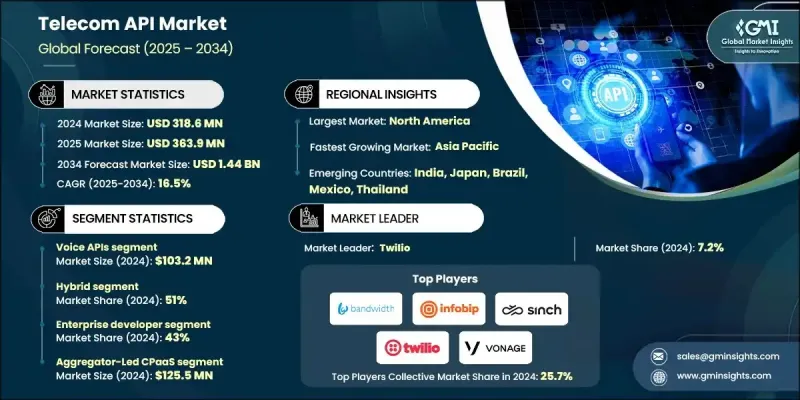
2024 年全球电信 API 市场价值为 3.186 亿美元,预计到 2034 年将以 16.5% 的复合年增长率增长至 14.4 亿美元。
向独立组网的 5G 网路转型正在重塑通讯环境,使营运商能够从硬体密集型系统转向基于 API 构建的云端原生平台。随着 5G 提供更高速度,营运商可以透过赋能开发者和企业的服务,推出支援新型收入模式的功能。各行各业的组织都在进行基础设施现代化改造,并采用 API 驱动的架构,以支援即时通讯、统一数位管道,并利用人工智慧实现互动自动化,从而获得更个人化的服务。电信 API 支援可扩展的通讯流,并增强全通路客户互动。通讯平台即服务 (CPaaS) 的兴起使企业无需部署自有基础设施即可整合可程式通讯工具。随着先进的 AI 功能变得更加易用,企业可以简化工作流程、降低营运成本,并创建深度客製化的使用者互动体验。
| 市场范围 | |
|---|---|
| 起始年份 | 2024 |
| 预测年份 | 2025-2034 |
| 起始值 | 3.186亿美元 |
| 预测值 | 14.4亿美元 |
| 复合年增长率 | 16.5% |
2024年,语音API市场规模预计将达到1.032亿美元,开发者可透过RESTful介面发起、接收、路由、录製和管理呼叫,而无需维护电信系统。这些API使企业能够控制与呼叫相关的任务,从而支援客户互动、身份验证流程、提醒和警报。随着企业将语音功能嵌入现有系统、将传统呼叫中心迁移到云端环境以及应用人工智慧增强功能(例如智慧识别和情感评估),市场需求将持续成长。
预计到2024年,企业开发人员将占据43%的市场。这些团队负责建立内部和外部集成,将API与客户支援、工作流程和通讯管理系统连接起来。持续的数位转型以及人工智慧支援的低程式码和无程式码工具的日益普及,是推动该细分市场成长的主要因素。
2024年,美国电信API市场占86%的份额,市场规模达9,370万美元。美国营运商正优先考虑以安全为核心建构的电信API框架。包括联邦网路安全指令在内的监管要求,促使企业采用能够强化身分验证、网路监控、合规措施和零信任原则的API,从而提升了企业需求。
活跃于电信API市场的公司包括Bandwidth、Telesign、Sinch、AT&T、诺基亚、Twilio、Infobip、Plivo、Vonage和MessageBird。电信API市场的关键参与者正透过强调平台可扩展性、更深入的企业整合和高级安全功能的策略来扩大其市场份额。许多公司正在加强与云端供应商的合作,以拓宽部署选项并提升全球覆盖范围。各公司也致力于透过提供精简的工具包、完善的文件和灵活的定价模式来提升开发者体验。持续投资于人工智慧驱动的智慧技术,例如自动化意图处理和预测分析,有助于公司提升其API的价值。此外,供应商也正在积极拓展区域市场、强化合规框架并采用模组化产品路线图,以满足不断变化的企业需求并维持强大的竞争优势。
目录
第一章:方法论
- 市场范围和定义
- 研究设计
- 研究方法
- 资料收集方法
- 资料探勘来源
- 全球的
- 地区/国家
- 基准估算和计算
- 基准年计算
- 市场估算的关键趋势
- 初步研究和验证
- 原始资料
- 预报
- 研究假设和局限性
第二章:执行概要
第三章:行业洞察
- 产业生态系分析
- 供应商格局
- 利润率分析
- 成本结构
- 每个阶段的价值增加
- 影响价值链的因素
- 中断
- 产业影响因素
- 成长驱动因素
- 全球电信合作
- 开发者生态系成长
- 5G独立扩展
- 增强安全性和身份验证
- 加速数位转型
- 产业陷阱与挑战
- 监理复杂性
- 整合挑战
- 市场机会
- 新企业服务
- 跨网路创新
- 人工智慧和分析集成
- 全球开发者市场
- 成长驱动因素
- 成长潜力分析
- 监管环境
- 波特的分析
- PESTEL 分析
- 技术与创新格局
- 目前技术
- 新兴技术
- 专利分析
- 定价分析
- 按交易(每次 API 呼叫)定价
- 分级捆绑定价
- 基于使用量的定价模式
- 收益分成安排
- 免费增值模式和开发者激励计划
- 企业合约结构
- 区域定价差异
- 关键市场缺口及产品创新因应措施
- 分散的多运营商 API 访问
- 缺乏标准化的网路API规范
- 开发者体验不佳、入职流程不顺畅
- 即时防诈骗能力有限
3.10.5. 5G货币化模式不足
- 跨境API联合与漫游
- 缺乏人工智慧原生电信API
- 用例分析及产业影响
- 金融服务和银行业用例
- 医疗保健和远距医疗应用案例
- 零售和电子商务用例
- 製造业和工业物联网应用案例
- 交通运输与汽车应用案例
- 媒体与娱乐应用案例
- 智慧城市和公共部门用例
- 物流与供应链应用案例
- API交易量
第四章:竞争格局
- 介绍
- 公司市占率分析
- 北美洲
- 欧洲
- 亚太地区
- 拉丁美洲
- MEA
- 主要市场参与者的竞争分析
- 竞争定位矩阵
- 战略展望矩阵
- 重要新闻和倡议
- 併购
- 合作伙伴关係与合作
- 新产品发布
- 扩张计划和资金
第五章:市场估算与预测:依通讯服务划分,2021-2034年
- 主要趋势
- 嗓音
- 讯息传递
- 影片
第六章:市场估算与预测:依部署方式划分,2021-2034年
- 主要趋势
- 杂交种
- 多云端
- 本地部署
第七章:市场估算与预测:依最终用途划分,2021-2034年
- 主要趋势
- 企业开发者
- 内部电信开发人员
- 合作伙伴开发商
- 长尾开发者
第八章:市场估算与预测:依商业模式划分,2021-2034年
- 主要趋势
- 直接载体暴露
- 聚合器主导的CPaaS
- 平台即服务 (PaaS)
第九章:市场估计与预测:依地区划分,2021-2034年
- 主要趋势
- 北美洲
- 我们
- 加拿大
- 欧洲
- 德国
- 英国
- 法国
- 义大利
- 西班牙
- 北欧
- 荷兰
- 俄罗斯
- 亚太地区
- 中国
- 印度
- 日本
- 澳新银行
- 新加坡
- 泰国
- 越南
- 韩国
- 拉丁美洲
- 巴西
- 墨西哥
- 阿根廷
- MEA
- 南非
- 沙乌地阿拉伯
- 阿联酋
第十章:公司简介
- 全球参与者
- AT&T
- Ericsson
- Infobip
- MessageBird
- Microsoft (Azure Communication Services)
- Nokia
- Plivo
- Sinch
- Telesign
- Twilio
- Vonage
- 区域玩家
- Bandwidth
- Deutsche Telekom
- Orange
- Reliance Jio Infocomm
- Singtel
- Telnyx
- 新兴参与者和颠覆者
- Aduna Global
- Bridge Alliance
- Enstream (JT Global)
- Google Cloud
- Syniverse Technologies
- Tech Mahindra
- Wipro
The Global Telecom API Market was valued at USD 318.6 million in 2024 and is estimated to grow at a CAGR of 16.5% to reach USD 1.44 billion by 2034.
The transition toward standalone 5G networks is reshaping the communications environment, enabling operators to move from hardware-heavy systems to cloud-native platforms built around APIs. With 5G delivering higher speeds, providers can introduce capabilities that support new revenue models through services that empower developers and enterprises. Organizations across multiple sectors are modernizing infrastructure and adopting API-driven architectures to support real-time communication, unify digital channels, and automate interactions with AI for greater personalization. Telecom APIs support scalable communication flows and enhance omnichannel customer engagement. The rise of Communications Platform as a Service (CPaaS) allows businesses to integrate programmable communication tools without deploying their own infrastructure. With advanced AI-based functions becoming more accessible, companies can streamline workflows, lower operational costs, and create deeply customized user interactions.
| Market Scope | |
|---|---|
| Start Year | 2024 |
| Forecast Year | 2025-2034 |
| Start Value | $318.6 Million |
| Forecast Value | $1.44 Billion |
| CAGR | 16.5% |
The voice APIs generated USD 103.2 million in 2024, enabling developers to initiate, receive, route, record, and manage calls through RESTful interfaces without maintaining telecom systems. These APIs allow companies to control call-related tasks that support customer interactions, authentication processes, reminders, and alerts. Demand continues to climb as enterprises embed voice into existing systems, transition traditional contact centers to cloud environments, and apply AI-powered enhancements such as intelligent recognition and sentiment evaluation.
The enterprise developers segment held a 43% share in 2024. These teams build both internal and external integrations to connect APIs with systems that manage customer support, workflows, and communications. Segment growth is strongly influenced by ongoing digital transformation and rising adoption of low-code and no-code tools supported by AI.
United States Telecom API Market held an 86% share in 2024 and generated USD 93.7 million. Operators in the country are prioritizing telecom API frameworks built with security at their core. Regulatory expectations, including federal cybersecurity directives, are prompting the adoption of APIs that reinforce identity validation, network monitoring, compliance measures, and zero-trust principles, which is strengthening enterprise demand.
Companies active in the Telecom API Market include Bandwidth, Telesign, Sinch, AT&T, Nokia, Twilio, Infobip, Plivo, Vonage, and MessageBird. Key players in the Telecom API Market are expanding their presence through strategies that emphasize platform scalability, deeper enterprise integration, and advanced security capabilities. Many are strengthening partnerships with cloud providers to broaden deployment options and improve global reach. Firms are also focusing on enhancing developer experience by offering streamlined toolkits, robust documentation, and flexible pricing models. Continuous investment in AI-driven intelligence, such as automated intent handling and predictive analytics, helps companies elevate the value of their APIs. Additionally, providers are pursuing regional expansion, strengthening compliance frameworks, and adopting modular product roadmaps to meet evolving enterprise requirements and maintain a strong competitive position.
Table of Contents
Chapter 1 Methodology
- 1.1 Market scope and definition
- 1.2 Research design
- 1.2.1 Research approach
- 1.2.2 Data collection methods
- 1.3 Data mining sources
- 1.3.1 Global
- 1.3.2 Regional/Country
- 1.4 Base estimates and calculations
- 1.4.1 Base year calculation
- 1.4.2 Key trends for market estimation
- 1.5 Primary research and validation
- 1.5.1 Primary sources
- 1.6 Forecast
- 1.7 Research assumptions and limitations
Chapter 2 Executive Summary
- 2.1 Industry 3600 synopsis, 2021 - 2034
- 2.2 Key market trends
- 2.2.1 Communication service
- 2.2.2 Deployment
- 2.2.3 End use
- 2.2.4 Business model
- 2.2.5 Regional
- 2.3 TAM Analysis, 2026-2034
- 2.4 CXO perspectives: Strategic imperatives
- 2.4.1 Executive decision points
- 2.4.2 Critical success factors
- 2.5 Future outlook and strategic recommendations
Chapter 3 Industry Insights
- 3.1 Industry ecosystem analysis
- 3.1.1 Supplier landscape
- 3.1.2 Profit margin analysis
- 3.1.3 Cost structure
- 3.1.4 Value addition at each stage
- 3.1.5 Factor affecting the value chain
- 3.1.6 Disruptions
- 3.2 Industry impact forces
- 3.2.1 Growth drivers
- 3.2.1.1 Global telco collaboration
- 3.2.1.2 Developer ecosystem growth
- 3.2.1.3 5g standalone expansion
- 3.2.1.4 Enhanced security & identity verification
- 3.2.1.5 Accelerated digital transformation
- 3.2.2 Industry pitfalls and challenges
- 3.2.2.1 Regulatory complexity
- 3.2.2.2 Integration challenges
- 3.2.3 Market opportunities
- 3.2.3.1 New enterprise services
- 3.2.3.2 Cross-network innovation
- 3.2.3.3 Ai and analytics integration
- 3.2.3.4 Global developer marketplace
- 3.2.1 Growth drivers
- 3.3 Growth potential analysis
- 3.4 Regulatory landscape
- 3.4.1 North America
- 3.4.2 Europe
- 3.4.3 Asia Pacific
- 3.4.4 Latin America
- 3.4.5 Middle east and Africa
- 3.5 Porter's analysis
- 3.6 PESTEL analysis
- 3.7 Technology and Innovation landscape
- 3.7.1 Current technology
- 3.7.2 Emerging technology
- 3.8 Patent analysis
- 3.9 Pricing analysis
- 3.9.1 Transactional (per-api-call) pricing
- 3.9.2 Tiered bundle pricing
- 3.9.3 Usage-based pricing models
- 3.9.4 Revenue-sharing arrangements
- 3.9.5 Freemium & developer incentive programs
- 3.9.6 Enterprise contract structures
- 3.9.7 Regional pricing variations
- 3.10 Critical market gaps & product innovation response
- 3.10.1 Fragmented multi-operator API access
- 3.10.2 Lack of standardized network API specifications
- 3.10.3 Poor developer experience and onboarding friction
- 3.10.4 Limited real-time fraud prevention capabilities
3.10.5. Insufficient 5 G monetization models
- 3.10.6 Cross-border API federation and roaming
- 3.10.7 Lack of AI-native telecom APIs
- 3.11 Use case analysis & sector impact
- 3.11.1 Financial services & banking use cases
- 3.11.2 Healthcare & telemedicine use cases
- 3.11.3 Retail & e-commerce use cases
- 3.11.4 Manufacturing & industrial IoT use cases
- 3.11.5 Transportation & automotive use cases
- 3.11.6 Media & entertainment use cases
- 3.11.7 Smart cities & public sector use cases
- 3.11.8 Logistics & supply chain use cases
- 3.12 API transaction volume
Chapter 4 Competitive Landscape, 2024
- 4.1 Introduction
- 4.2 Company market share analysis
- 4.2.1 North America
- 4.2.2 Europe
- 4.2.3 Asia Pacific
- 4.2.4 LATAM
- 4.2.5 MEA
- 4.3 Competitive analysis of major market players
- 4.4 Competitive positioning matrix
- 4.5 Strategic outlook matrix
- 4.6 Key news and initiatives
- 4.6.1 Mergers & acquisitions
- 4.6.2 Partnerships & collaborations
- 4.6.3 New Product Launches
- 4.6.4 Expansion Plans and funding
Chapter 5 Market Estimates & Forecast, By Communication Service, 2021 - 2034 ($Mn)
- 5.1 Key trends
- 5.2 Voice
- 5.3 Messaging
- 5.4 Video
Chapter 6 Market Estimates & Forecast, By Deployment, 2021 - 2034 ($Mn)
- 6.1 Key trends
- 6.2 Hybrid
- 6.3 Multi-Cloud
- 6.4 On-Premises
Chapter 7 Market Estimates & Forecast, By End Use, 2021 - 2034 ($Mn)
- 7.1 Key trends
- 7.2 Enterprise Developer
- 7.3 Internal Telecom Developer
- 7.4 Partner Developer
- 7.5 Long-Tail Developer
Chapter 8 Market Estimates & Forecast, By Business Model, 2021 - 2034 ($Mn)
- 8.1 Key trends
- 8.2 Direct Carrier Exposure
- 8.3 Aggregator-Led CPaaS
- 8.4 Platform-as-a-Service (PaaS)
Chapter 9 Market Estimates & Forecast, By Region, 2021 - 2034 ($Mn)
- 9.1 Key trends
- 9.2 North America
- 9.2.1 US
- 9.2.2 Canada
- 9.3 Europe
- 9.3.1 Germany
- 9.3.2 UK
- 9.3.3 France
- 9.3.4 Italy
- 9.3.5 Spain
- 9.3.6 Nordics
- 9.3.7 Netherlands
- 9.3.8 Russia
- 9.4 Asia Pacific
- 9.4.1 China
- 9.4.2 India
- 9.4.3 Japan
- 9.4.4 ANZ
- 9.4.5 Singapore
- 9.4.6 Thailand
- 9.4.7 Vietnam
- 9.4.8 South Korea
- 9.5 Latin America
- 9.5.1 Brazil
- 9.5.2 Mexico
- 9.5.3 Argentina
- 9.6 MEA
- 9.6.1 South Africa
- 9.6.2 Saudi Arabia
- 9.6.3 UAE
Chapter 10 Company Profiles
- 10.1 Global Players
- 10.1.1 AT&T
- 10.1.2 Ericsson
- 10.1.3 Infobip
- 10.1.4 MessageBird
- 10.1.5 Microsoft (Azure Communication Services)
- 10.1.6 Nokia
- 10.1.7 Plivo
- 10.1.8 Sinch
- 10.1.9 Telesign
- 10.1.10 Twilio
- 10.1.11 Vonage
- 10.2 Regional Players
- 10.2.1 Bandwidth
- 10.2.2 Deutsche Telekom
- 10.2.3 Orange
- 10.2.4 Reliance Jio Infocomm
- 10.2.5 Singtel
- 10.2.6 Telnyx
- 10.3 Emerging players and disruptors
- 10.3.1 Aduna Global
- 10.3.2 Bridge Alliance
- 10.3.3 Enstream (JT Global)
- 10.3.4 Google Cloud
- 10.3.5 Syniverse Technologies
- 10.3.6 Tech Mahindra
- 10.3.7 Wipro

 全球通讯API市场规模、份额、趋势和成长分析报告(2026-2034年)
 电信API市场规模、份额和成长分析(按API类型、部署模式、最终用户、功能和地区划分)-2026-2033年产业预测
 电信API安全市场预测至2032年:按组件、API领域、安全功能、组织规模、网路类型、最终用户和地区分類的全球分析
 电信API - 全球市场份额和排名、总收入和需求预测(2025-2031年)
 2025 年至 2033 年电信 API 市场规模、份额、趋势和预测(按类型、用户类型、部署、行业垂直和地区)全球通讯API整合市场:预测至2032年-按API类型、部署模式、经营模式、最终用户和地区分類的分析
 电信 API 市场 - 全球产业规模、份额、趋势、机会和预测,按 API 类型、部署模式、最终用户、地区和竞争细分,2020-2030 年预测
 电讯领域API:市场占有率分析、产业趋势、统计数据和成长预测(2025-2030)电信 API 市场:预测(2025-2030 年)
 全球通讯API 市场:市场规模、市场份额、趋势分析(按最终用户、按类型、按地区)、展望和未来预测(2025-2032 年)