


 |
市场调查报告书
商品编码
1892777
代发货市场机会、成长驱动因素、产业趋势分析及预测(2026-2035年)Dropshipping Market Opportunity, Growth Drivers, Industry Trend Analysis, and Forecast 2026 - 2035 |
||||||

2025 年全球代发货市场价值为 2,907 亿美元,预计到 2035 年将以 20.6% 的复合年增长率增长至 1.84 兆美元。
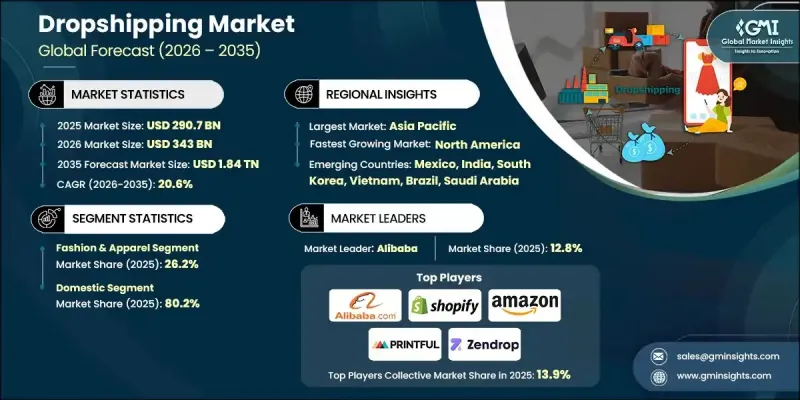
市场快速成长的驱动力在于低成本社群媒体广告的普及,这使得中小企业能够以极低的成本向精准的目标受众推广产品。平台提供各种工具,帮助企业优化广告效果、追踪用户互动并即时调整策略,进而提高曝光率和转换率。超过27%的零售商目前采用代发货模式进行订单履行,因为它无需维护库存,同时还能灵活更新产品目录并丰富产品种类。此模式的获利能力(潜在利润率可达10-15%)吸引了许多新进入者,因为它降低了财务风险并实现了快速扩张。电商平台和独立网店也能从代发货模式中获益,改善现金流,并仅在客户下单时才发货。
| 市场范围 | |
|---|---|
| 起始年份 | 2025 |
| 预测年份 | 2026-2035 |
| 起始值 | 2907亿美元 |
| 预测值 | 1.84兆美元 |
| 复合年增长率 | 20.6% |
预计到2025年,时尚服饰品类将占据26.2%的市场份额,这主要得益于时尚产品在线销售时所展现的视觉吸引力和多样性。电子产品也贡献显着,这得益于全球统一标准和频繁的产品升级。其他成长快速的类别包括家居厨房用品、美容及个人护理用品、健康与保健用品、玩具及婴幼儿用品以及体育用品,所有这些品类都受益于电子商务的日益普及。
预计到2025年,国内市场将占据80.2%的份额,因为本地物流能够确保更快的配送速度、更便捷的退货流程和更简单的支付方式。然而,跨境代出货模式正在加速发展,这得益于物流的改善和国际产品通路的拓展,使得全球营运对商家而言越来越有吸引力。
预计到2025年,美国代发货市场规模将达482亿美元。先进的数位基础设施、高普及率的电子商务、广泛的互联网和智慧型手机使用以及安全的数位支付生态系统,都为市场成长提供了支持。此外,美国市场也受惠于强大的物流网路和良好的营商环境,这使得小型企业能够快速启动代发货业务,并充分利用成熟的电子商务平台。
目录
第一章:方法论
第二章:执行概要
第三章:行业洞察
- 产业生态系分析
- 供应商格局
- 利润率
- 成本结构
- 每个阶段的价值增加
- 影响价值链的因素
- 中断
- 产业影响因素
- 成长驱动因素
- 创业门槛低
- 全球电子商务的成长
- 社交电商和行动购物的兴起
- 跨境电子商务的扩张
- 产业陷阱与挑战
- 海外供应商出货时间较长
- 供应商可靠性问题
- 市场机会
- 利基市场与微利基市场目标定位
- 国内/区域供应商网络
- B2B代出货成长
- 影响者驱动的商业整合
- 成长驱动因素
- 成长潜力分析
- 监管环境
- 北美洲
- 欧洲
- 亚太地区
- 拉丁美洲
- 中东和非洲
- 波特的分析
- PESTEL 分析
- 技术与创新格局
- 当前技术趋势
- 新兴技术
- 技术路线图与演进
- 技术采纳生命週期分析
- 价格趋势
- 按地区
- 副产品
- 专利分析
- 产业生态系及价值链分析
- 供应商/批发商层
- 平台/技术层
- 商家/零售商层
- 物流/履行层
- 终端消费者层
- 客户人口统计和行为分析
- 年龄分布
- 收入水平和支出模式
- 代发货客户的地理分布
- 购物频率和平均订单金额
- 行销管道和客户获取策略
- 付费广告格局
- Facebook 和 Instagram 广告
- Google广告
- 有机行销策略
- 区域商业模式差异及趋势
- 北美代出货市场动态
- 欧洲代出货的特点
- 亚太地区代出货趋势
- 拉丁美洲代出货的挑战与机会
- 中东和非洲的新兴模式
- 支付方式与金融科技整合
- 信用卡和金融卡
- 数位钱包
- 先买后付 (BNPL) 解决方案
- 新兴市场的货到付款 (COD)
- 品质控制和客户服务模式
- 代发货业务中的品质保证挑战
- 检验服务和第三方审核员
- 客户服务基础设施
- 退货和退款管理
- 争议解决与拒付管理
- 品牌、包装与顾客体验
- 自有品牌和定製品牌趋势
- 客製化包装解决方案
- 产品摄影与视觉陈列
- 店铺设计与使用者体验 (UX) 优化
- 品牌故事叙述与差异化策略
- 季节性趋势和需求模式
- 假期季节的影响
- 返校季
- 夏季购物模式
- 类别特定季节性
- 区域性节庆及文化活动
- 关税与贸易政策分析
- 2025年美国关税调整及最低限额取消
- 对成本结构的影响
- HS编码分类挑战
- 海关清关程序及延误
- 区域贸易协定的影响
- 供应链与物流分析
- 全球供应商网络
- 仓储和物流基础设施
- 最后一公里配送挑战
- 快递服务成长
- 逆向物流与退货管理
- 行动商务和设备趋势
- 行动端与桌面端购物模式
- 行动应用与行动网页的表现对比
- 渐进式 Web 应用 (PWA) 的采用
- 最佳情况
第四章:竞争格局
- 介绍
- 公司市占率分析
- 北美洲
- 欧洲
- 亚太地区
- 拉丁美洲
- MEA
- 主要市场参与者的竞争分析
- 竞争定位矩阵
- 战略展望矩阵
- 关键进展
- 併购
- 合作伙伴关係与合作
- 新产品发布
- 扩张计划和资金
- 供应商选择标准
第五章:市场估算与预测:依产品划分,2022-2035年
- 电子
- 时尚与服装
- 贵金属及珠宝
- 衣服
- 鞋类
- 其他的
- 居家与厨房
- 美容及个人护理
- 健康与保健
- 玩具和婴儿用品
- 体育用品
- 其他的
- 食品和饮料
- 汽车及汽车配件
- 家具及家居用品
- 嗜好与DIY
- 媒体
第六章:市场估算与预测:依目的地划分,2022-2035年
- 国内的
- 国际的
第七章:市场估算与预测:依商业模式划分,2022-2035年
- B2C
- B2B
- 中小企业
- 大型企业
- C2C
第八章:市场估算与预测:依销售管道划分,2022-2035年
- 网路市集
- 品牌电商商店
- 社群电商平台
第九章:市场估计与预测:依地区划分,2022-2035年
- 北美洲
- 我们
- 加拿大
- 欧洲
- 德国
- 英国
- 法国
- 义大利
- 西班牙
- 俄罗斯
- 北欧
- 比荷卢经济联盟
- 亚太地区
- 中国
- 印度
- 日本
- 韩国
- 澳新银行
- 新加坡
- 马来西亚
- 印尼
- 越南
- 泰国
- 拉丁美洲
- 巴西
- 墨西哥
- 阿根廷
- 哥伦比亚
- MEA
- 南非
- 沙乌地阿拉伯
- 阿联酋
第十章:公司简介
- 全球公司
- Shopify
- Amazon
- eBay
- Alibaba
- BigCommerce
- WooCommerce
- Etsy
- Walmart
- 区域公司
- SaleHoo
- Doba
- Wholesale2B
- DropCommerce
- Trendsi
- 新兴公司
- Spocket
- CJdropshipping
- DSers
- Modalyst
- Zendrop
- AutoDS
- Syncee
- Printful
- Printify
- Gelato
- SPOD
The Global Dropshipping Market was valued at USD 290.7 billion in 2025 and is estimated to grow at a CAGR of 20.6% to reach USD 1.84 trillion by 2035.
The market's rapid growth is fueled by the accessibility of cost-effective social media advertising, which allows small and medium-sized enterprises to promote products to highly targeted audiences at minimal expense. Platforms provide tools to optimize ad performance, track engagement, and refine strategies in real time, increasing visibility and conversion rates. Over 27% of retailers now use dropshipping for order fulfillment, as it eliminates the need to maintain inventory while offering flexibility to update product catalogs and diversify offerings. The model's profitability, with potential profit margins of 10-15%, attracts new entrants by reducing financial risk and enabling rapid expansion. E-commerce platforms and independent online stores benefit from dropshipping by improving cash flow and offering products only when customers place orders.
| Market Scope | |
|---|---|
| Start Year | 2025 |
| Forecast Year | 2026-2035 |
| Start Value | $290.7 Billion |
| Forecast Value | $1.84 Trillion |
| CAGR | 20.6% |
The fashion & apparel segment held a 26.2% share in 2025, driven by the visual appeal and variety that fashion products offer online. Electronics also contribute significantly due to global standards and frequent product upgrades. Other rising categories include Home & Kitchen, Beauty & Personal Care, Health & Wellness, Toys & Baby, and Sporting Goods, all of which are benefiting from growing e-commerce adoption.
The domestic segment held an 80.2% share in 2025, as local fulfillment ensures faster delivery, easier returns, and simple payment processes. However, cross-border dropshipping is accelerating, supported by improved logistics and broader access to international products, making global operations increasingly attractive for merchants.
U.S. Dropshipping Market reached USD 48.2 billion in 2025. Growth is supported by advanced digital infrastructure, high e-commerce adoption, widespread internet and smartphone use, and a secure digital payment ecosystem. The U.S. market also benefits from strong logistics networks and a business-friendly environment, enabling small businesses to launch dropshipping ventures quickly while leveraging established e-commerce platforms.
Key players in the Global Dropshipping Market include Amazon, Spocket, Shopify, Printful, DSers, Zendrop, SaleHoo, Alibaba, AutoDS, and CJ Dropshipping. Companies in the Dropshipping Market are adopting multiple strategies to strengthen their foothold. They are expanding product catalogs and supplier networks to offer a wider variety of items and reduce stockout risks. Strategic partnerships with e-commerce platforms and logistics providers improve delivery speed, tracking, and overall service quality. Investing in digital marketing, especially targeted social media advertising, enhances visibility and conversion rates. Automation tools for order processing, inventory tracking, and customer support are being implemented to improve operational efficiency. Businesses are also leveraging analytics and AI to forecast demand, optimize pricing, and tailor offerings to regional markets.
Table of Contents
Chapter 1 Methodology
- 1.1 Market scope and definition
- 1.2 Research design
- 1.2.1 Research approach
- 1.2.2 Data collection methods
- 1.3 Data mining sources
- 1.3.1 Global
- 1.3.2 Regional/Country
- 1.4 Base estimates and calculations
- 1.4.1 Base year calculation
- 1.4.2 Key trends for market estimation
- 1.5 Primary research and validation
- 1.5.1 Primary sources
- 1.6 Forecast
- 1.7 Research assumptions and limitations
Chapter 2 Executive Summary
- 2.1 Industry 3600 synopsis
- 2.2 Key market trends
- 2.2.1 Regional
- 2.2.2 Product
- 2.2.3 Destination
- 2.2.4 Business model
- 2.2.5 Sales channel
- 2.3 TAM analysis, 2026-2035
- 2.4 CXO perspectives: Strategic imperatives
- 2.4.1 Executive decision points
- 2.4.2 Critical success factors
- 2.5 Future outlook and recommendations
Chapter 3 Industry Insights
- 3.1 Industry ecosystem analysis
- 3.1.1 Supplier landscape
- 3.1.2 Profit margin
- 3.1.3 Cost structure
- 3.1.4 Value addition at each stage
- 3.1.5 Factor affecting the value chain
- 3.1.6 Disruptions
- 3.2 Industry impact forces
- 3.2.1 Growth drivers
- 3.2.1.1 Low barrier to entry for entrepreneurs
- 3.2.1.2 Growth of global e-commerce
- 3.2.1.3 Rise of social commerce & mobile shopping
- 3.2.1.4 Expansion of cross-border E-commerce
- 3.2.2 Industry pitfalls and challenges
- 3.2.2.1 Long shipping times from overseas suppliers
- 3.2.2.2 Supplier reliability issues
- 3.2.3 Market opportunities
- 3.2.3.1 Niche & micro-niche market targeting
- 3.2.3.2 Domestic/regional supplier networks
- 3.2.3.3 B2B dropshipping growth
- 3.2.3.4 Influencer-driven commerce integration
- 3.2.1 Growth drivers
- 3.3 Growth potential analysis
- 3.4 Regulatory landscape
- 3.4.1 North America
- 3.4.2 Europe
- 3.4.3 Asia Pacific
- 3.4.4 Latin America
- 3.4.5 Middle East & Africa
- 3.5 Porter's analysis
- 3.6 PESTEL analysis
- 3.7 Technology and innovation landscape
- 3.7.1 Current technological trends
- 3.7.2 Emerging technologies
- 3.7.3 Technology roadmaps & evolution
- 3.7.4 Technology adoption lifecycle analysis
- 3.8 Price trends
- 3.8.1 By region
- 3.8.2 By product
- 3.9 Patent analysis
- 3.10 Industry ecosystem & value chain analysis
- 3.10.1 Supplier/wholesaler layer
- 3.10.2 Platform/technology layer
- 3.10.3 Merchant/retailer layer
- 3.10.4 Logistics/fulfillment layer
- 3.10.5 End-consumer layer
- 3.11 Customer demographics & behavior analysis
- 3.11.1 Age distribution
- 3.11.2 Income levels & spending patterns
- 3.11.3 Geographic distribution of dropshipping customers
- 3.11.4 Shopping frequency & average order value
- 3.12 Marketing channels & customer acquisition strategies
- 3.12.1 Paid advertising landscape
- 3.12.2 Facebook & Instagram ads
- 3.12.3 Google ads
- 3.12.4 Organic marketing strategies
- 3.13 Regional business model variations & trends
- 3.13.1 North America dropshipping dynamics
- 3.13.2 Europe dropshipping characteristics
- 3.13.3 Asia-Pacific dropshipping trends
- 3.13.4 Latin America dropshipping challenges & opportunities
- 3.13.5 Middle East & Africa emerging patterns
- 3.14 Payment methods & fintech integration
- 3.14.1 Credit & debit cards
- 3.14.2 Digital wallets
- 3.14.3 Buy now pay later (BNPL) solutions
- 3.14.4 Cash on delivery (COD) in emerging markets
- 3.15 Quality control & customer service models
- 3.15.1 Quality assurance challenges in dropshipping
- 3.15.2 Inspection services & third-party auditors
- 3.15.3 Customer service infrastructure
- 3.15.4 Returns & refunds management
- 3.15.5 Dispute resolution & chargeback management
- 3.16 Branding, packaging & customer experience
- 3.16.1 Private labeling & custom branding trends
- 3.16.2 Custom packaging solutions
- 3.16.3 Product photography & visual merchandising
- 3.16.4 Store design & user experience (UX) optimization
- 3.16.5 Brand storytelling & differentiation strategies
- 3.17 Seasonal trends & demand patterns
- 3.17.1 Holiday season impact
- 3.17.2 Back-to-school season
- 3.17.3 Summer shopping patterns
- 3.17.4 Category-specific seasonality
- 3.17.5 Regional festival & cultural events
- 3.18 Tariff & trade policy analysis
- 3.18.1. 2025 U.S. tariff changes & de minimis elimination
- 3.18.2 Impact on cost structure
- 3.18.3 HS code classification challenges
- 3.18.4 Customs clearance procedures & delays
- 3.18.5 Regional trade agreements impact
- 3.19 Supply chain & logistics analysis
- 3.19.1 Global supplier networks
- 3.19.2 Warehouse & fulfillment infrastructure
- 3.19.3 Last-mile delivery challenges
- 3.19.4 Express delivery services growth
- 3.19.5 Reverse logistics & returns management
- 3.20 Mobile commerce & device trends
- 3.20.1 Mobile vs desktop shopping patterns
- 3.20.2 Mobile app vs mobile web performance
- 3.20.3 Progressive web apps (PWAs) adoption
- 3.21 Best case scenarios
Chapter 4 Competitive Landscape, 2025
- 4.1 Introduction
- 4.2 Company market share analysis
- 4.2.1 North America
- 4.2.2 Europe
- 4.2.3 Asia Pacific
- 4.2.4 LATAM
- 4.2.5 MEA
- 4.3 Competitive analysis of major market players
- 4.4 Competitive positioning matrix
- 4.5 Strategic outlook matrix
- 4.6 Key developments
- 4.6.1 Mergers & acquisitions
- 4.6.2 Partnerships & collaborations
- 4.6.3 New product launches
- 4.6.4 Expansion plans and funding
- 4.7 Vendor selection criteria
Chapter 5 Market Estimates & Forecast, By Product, 2022 - 2035 ($Mn, Number of Orders)
- 5.1 Key trends
- 5.2 Electronics
- 5.3 Fashion & apparel
- 5.3.1 Precious metal & jewelry
- 5.3.2 Clothes
- 5.3.3 Footwear
- 5.3.4 Others
- 5.4 Home & kitchen
- 5.5 Beauty & personal care
- 5.6 Health & wellness
- 5.7 Toys & baby products
- 5.8 Sporting goods
- 5.9 Others
- 5.9.1 Food & beverages
- 5.9.2 Automotive & car accessories
- 5.9.3 Furniture & home furnishings
- 5.9.4 Hobby & DIY
- 5.9.5 Media
Chapter 6 Market Estimates & Forecast, By Destination, 2022 - 2035 ($Mn, Number of Orders)
- 6.1 Key trends
- 6.2 Domestic
- 6.3 International
Chapter 7 Market Estimates & Forecast, By Business Model, 2022 - 2035 ($Mn, Number of Orders)
- 7.1 Key trends
- 7.2 B2C
- 7.3 B2B
- 7.3.1 SMEs
- 7.3.2 Large enterprises
- 7.4 C2C
Chapter 8 Market Estimates & Forecast, By Sales Channel, 2022 - 2035 ($Mn, Number of Orders)
- 8.1 Key trends
- 8.2 Online marketplaces
- 8.3 Branded e-commerce stores
- 8.4 Social commerce platforms
Chapter 9 Market Estimates & Forecast, By Region, 2022 - 2035 ($Mn, Number of Orders)
- 9.1 Key trends
- 9.2 North America
- 9.2.1 US
- 9.2.2 Canada
- 9.3 Europe
- 9.3.1 Germany
- 9.3.2 UK
- 9.3.3 France
- 9.3.4 Italy
- 9.3.5 Spain
- 9.3.6 Russia
- 9.3.7 Nordics
- 9.3.8 Benelux
- 9.4 Asia Pacific
- 9.4.1 China
- 9.4.2 India
- 9.4.3 Japan
- 9.4.4 South Korea
- 9.4.5 ANZ
- 9.4.6 Singapore
- 9.4.7 Malaysia
- 9.4.8 Indonesia
- 9.4.9 Vietnam
- 9.4.10 Thailand
- 9.5 Latin America
- 9.5.1 Brazil
- 9.5.2 Mexico
- 9.5.3 Argentina
- 9.5.4 Colombia
- 9.6 MEA
- 9.6.1 South Africa
- 9.6.2 Saudi Arabia
- 9.6.3 UAE
Chapter 10 Company Profiles
- 10.1 Global companies
- 10.1.1 Shopify
- 10.1.2 Amazon
- 10.1.3 eBay
- 10.1.4 Alibaba
- 10.1.5 BigCommerce
- 10.1.6 WooCommerce
- 10.1.7 Etsy
- 10.1.8 Walmart
- 10.2 Regional companies
- 10.2.1 SaleHoo
- 10.2.2 Doba
- 10.2.3. Wholesale2B
- 10.2.4 DropCommerce
- 10.2.5 Trendsi
- 10.3 Emerging companies
- 10.3.1 Spocket
- 10.3.2 CJdropshipping
- 10.3.3 DSers
- 10.3.4 Modalyst
- 10.3.5 Zendrop
- 10.3.6 AutoDS
- 10.3.7 Syncee
- 10.3.8 Printful
- 10.3.9 Printify
- 10.3.10 Gelato
- 10.3.11 SPOD

 代发货市场分析及预测(至2035年):按类型、产品类型、服务、技术、组件、应用、部署类型、最终用户和解决方案划分
 代发货市场-全球产业规模、份额、趋势、机会、预测:按目的地、产品、地区和竞争对手划分,2021-2031年
 日本代发货市场规模、份额、趋势及预测(按产品、产品类型、应用及地区划分),2026-2034年
 按产品、类型、目的地、销售管道、经营模式和地区分類的代发货市场规模、份额和成长分析 - 产业预测,2026-2033年
 直销市场:2025-2030 年全球预测(按产品类型、地区、客户类型、销售管道、业务规模和交付方式)
 印度的代发货市场评估:各产品类型,目的地,各用途,各地区,机会及预测,2019年度~2033年度
 2032 年直销市场预测:按产品、平台、经营模式、销售管道、支付方式、最终用户和地区进行的全球分析
 全球直销市场:市场规模、市场占有率、趋势、产业分析(依产品、商业模式、平台类型和地区)、未来预测(2025-2034年)
 直销全球市场 2024-2028
 直销全球市场