


 |
市场调查报告书
商品编码
1892782
车载导航系统市场机会、成长驱动因素、产业趋势分析及预测(2026-2035年)In-dash Navigation System Market Opportunity, Growth Drivers, Industry Trend Analysis, and Forecast 2026 - 2035 |
||||||

2025 年全球车载导航系统市场价值为 165 亿美元,预计到 2035 年将以 10.4% 的复合年增长率成长至 428 亿美元。
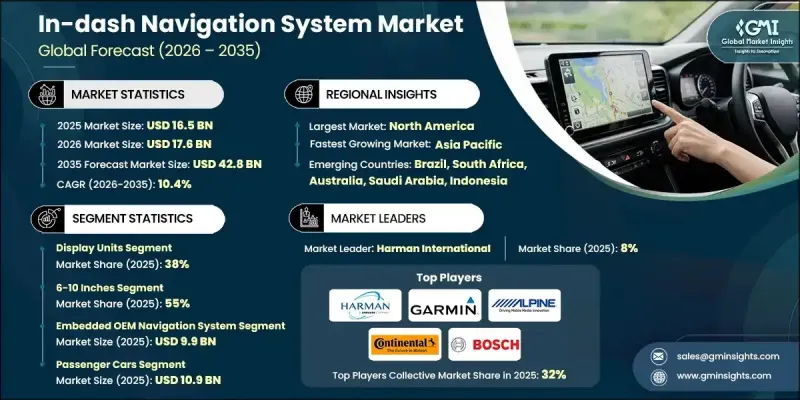
智慧型手机导航应用与原厂OEM导航系统的融合推动了市场扩张,使导航功能在包括入门级和经济型车型在内的各个细分市场中都更加普及。消费者正日益将导航工具视为车辆的标配功能,即便这些嵌入式系统不如领先汽车製造商的高阶产品先进。大尺寸显示器、扩增实境抬头显示器和多区域驾驶舱整合等技术创新正在提升使用者体验,并推动各车型类别采用更先进的导航解决方案。现代系统拥有更快的地图渲染速度、更大的记忆体和储存容量以及更低的眩光,从而提供无缝融合资讯娱乐和导航功能的介面。消费者对互联性、便利性和车内互动体验的日益增长的期望,以及智慧语音助理和连网汽车服务的日益普及,也在推动市场成长。
| 市场范围 | |
|---|---|
| 起始年份 | 2025 |
| 预测年份 | 2026-2035 |
| 起始值 | 165亿美元 |
| 预测值 | 428亿美元 |
| 复合年增长率 | 10.4% |
2025年,显示单元细分市场占据了38%的市场份额,预计从2026年到2035年将以11.6%的复合年增长率成长。大尺寸、高解析度显示器正成为导航和资讯娱乐的首选介面,提供更快的反应时间和更好的可视性。
2025年,6吋以下的小尺寸显示器市占率为19.9%,预计到2034年将以11%的复合年增长率成长,这主要得益于入门级车型和商用车对仪錶板空间的需求。这些紧凑型系统越来越依赖智慧型手机投影技术,例如Android Auto和Apple CarPlay,以高效地提供导航功能,而无需更大的嵌入式萤幕。
预计2025年,美国车载导航系统市场规模将达39亿美元。美国市场的成长得益于互联服务、语音控制和整合资讯娱乐功能在标准车辆配置中的广泛应用,这些功能提升了驾驶的便利性和参与度。汽车製造商正在将先进的导航技术融入车辆,以满足消费者对安全性、连结性和娱乐性日益增长的需求。
目录
第一章:方法论与范围
第二章:执行概要
第三章:行业洞察
- 产业生态系分析
- 供应商格局
- 零件製造商
- 地图和软体供应商
- 售后经销网络
- 最终用途
- 成本结构
- 利润率
- 每个阶段的价值增加
- 垂直整合趋势
- 颠覆者
- 供应商格局
- 对力的影响
- 成长驱动因素
- 提高车辆互联性和云端采用率
- 先进的资讯娱乐和驾驶舱趋势
- 电动汽车与ADAS集成
- 监管和安全标准
- 产业陷阱与挑战
- 高昂的系统成本
- 网路安全和隐私问题
- 市场机会
- 人工智慧与预测导航
- 智慧型手机和应用程式投影系统
- 成长驱动因素
- 技术趋势与创新生态系统
- 目前技术
- 配备车载地图和GNSS接收器的OEM导航系统
- 智慧型手机投影平台
- 透过4G/5G远端资讯处理技术实现即时路况的连网导航
- 数位仪錶板 + HUD 导航集成
- 新兴技术
- 透过进阶HUD实现扩增实境(AR)导航迭加
- 网域控制器/基于高效能运算的导航运行SDV架构
- 高清地图驱动的ADAS和车道级导航,用于自动驾驶
- 混合卫星+5G导航连接,实现不间断覆盖
- 目前技术
- 成长潜力分析
- 监管环境
- 美国国家公路交通安全管理局 (NHTSA) 驾驶分心驾驶指南
- ISO 26262 功能安全要求
- 资料隐私法规
- 联合国条例
- 区域监管比较
- 北美洲
- 欧洲
- 亚太
- 拉丁美洲
- 中东和非洲
- 波特的分析
- PESTEL 分析
- 专利分析
- AR-HUD 与眼动追踪专利
- 人工智慧和机器学习专利
- V2X通讯专利
- 主要参与者的专利组合分析
- 专利诉讼与授权格局
- 成本細項分析
- 价格趋势
- OEM与售后市场定价动态
- 组件成本趋势和学习曲线
- 订阅和服务收入模式
- 价格弹性分析
- 透过技术降低成本的路线图
- 风险评估与缓解策略
- 技术过时风险
- 半导体短缺风险
- 不断变化的监管要求
- 价格压力和利润率侵蚀
- 产品线及研发路线图
- 产品开发流程分析
- 主要参与者的技术路线图
- 研发重点领域及投资重点
- 合作研发计划
- 永续性和环境方面
- 导航系统的碳足迹
- 循环经济战略
- 永续导航功能
- 企业永续发展倡议
- 气候变迁对航行的影响
- 市场采纳与渗透分析
- 技术采纳曲线分析
- 各区域的渗透率
- 按车辆细分市场分類的渗透率
- 功能采纳分析
- 采用加速策略
- 用例分析及应用场景
- 用例框架及选择标准
- 系统需求和整合点
- 支付系统集成
- 用例比较矩阵
- 客户旅程与体验地图
- 客户细分与用户画像
- 客户需求和痛点
- 客户旅程图
- 行为分析与使用模式
- 风险评估与风险矩阵
- 软体品质和可靠性风险
- 资料隐私和GDPR合规风险
- 单一来源供应商风险
- 风险优先矩阵
- 情境规划与敏感度分析
- 情境规划框架
- 基本状况
- 监管影响敏感性
- 新进入者和商业模式
第四章:竞争格局
- 介绍
- 公司市占率分析
- 北美洲
- 欧洲
- 亚太
- 拉丁美洲
- 中东和非洲
- 竞争定位矩阵
- 战略展望矩阵
- 关键进展
- 併购
- 合作伙伴关係与合作
- 新产品发布
- 扩张计划和资金
- 高端定位策略
- 竞争分析与独特卖点
第五章:市场估算与预测:依组件划分,2022-2035年
- 显示单元
- 控制模组
- 天线模组
- 线束
第六章:市场估算与预测:依技术划分,2022-2035年
- 嵌入式OEM导航系统
- 智慧型手机整合导航平台
- 互联云端导航系统
- 仪錶板+HUD整合导航
- 网域控制器和驾驶舱高效能运算整合导航
第七章:市场估计与预测:依地图划分,2022-2035年
- QR 图
- 3D地图
第八章:市场估算与预测:依萤幕尺寸划分,2022-2035年
- 小于6英寸
- 6-10英寸
- 超过10英寸
第九章:市场估价与预测:依车辆类型划分,2022-2035年
- 搭乘用车
- SUV
- 轿车
- 掀背车
- 商用车辆
- 低容量性状
- MCV
- C型肝炎
第十章:市场估价与预测:依销售管道划分,2022-2035年
- OEM
- 售后市场
第十一章:市场估计与预测:按地区划分,2022-2035年
- 北美洲
- 我们
- 加拿大
- 欧洲
- 英国
- 德国
- 法国
- 义大利
- 西班牙
- 比利时
- 荷兰
- 瑞典
- 俄罗斯
- 亚太地区
- 中国
- 印度
- 日本
- 澳洲
- 新加坡
- 韩国
- 越南
- 印尼
- 拉丁美洲
- 巴西
- 墨西哥
- 阿根廷
- MEA
- 南非
- 沙乌地阿拉伯
- 阿联酋
第十二章:公司简介
- 全球参与者
- Continental
- HARMAN International
- Panasonic
- Garmin
- Robert Bosch
- Denso
- Hyundai Mobis
- Mitsubishi Electric
- Delphi Technologies
- DXC Technology Company
- Region players
- Alpine Electronics
- Pioneer
- Clarion
- Visteon
- Valeo
- LG Electronics
- JVCKENWOOD
- Marelli
- Desay SV Automotive
- 新兴玩家
- Aisin
- Luxoft
- NNG Software
- Preh Car Connect
- Dynavin
- Vinland
The Global In-dash Navigation System Market was valued at USD 16.5 billion in 2025 and is estimated to grow at a CAGR of 10.4% to reach USD 42.8 billion by 2035.
The market expansion is fueled by the integration of smartphone-based navigation apps with factory-installed OEM navigation systems, making navigation more accessible across vehicle segments, including entry-level and budget models. Consumers are increasingly adopting navigation tools as standard vehicle features, even if the embedded systems are less advanced than premium offerings from leading automakers. Technological innovations, such as large-format displays, augmented reality heads-up displays, and multi-zone cockpit integration, are enhancing user experience and driving adoption of sophisticated navigation solutions across all vehicle categories. Modern systems now offer faster map rendering, better memory and storage capacities, and reduced glare, providing a seamless interface that merges infotainment and navigation functionalities. Rising consumer expectations for connectivity, convenience, and in-vehicle engagement are also propelling market growth, alongside the increasing popularity of smart voice assistants and connected car services.
| Market Scope | |
|---|---|
| Start Year | 2025 |
| Forecast Year | 2026-2035 |
| Start Value | $16.5 Billion |
| Forecast Value | $42.8 Billion |
| CAGR | 10.4% |
The display units segment held a 38% share in 2025 and is expected to grow at a CAGR of 11.6% from 2026 to 2035. Large-format, high-resolution displays are becoming the preferred interface for navigation and infotainment, offering faster response times and improved visibility.
The smaller displays under 6" segment held a 19.9% share in 2025, expected to grow at 11% CAGR through 2034, driven by entry-level and commercial vehicles where dashboard space is limited. These compact systems increasingly rely on smartphone projection technologies, such as Android Auto and Apple CarPlay, to provide navigation functionality efficiently without requiring larger embedded screens.
United States In-dash Navigation System Market reached USD 3.9 billion in 2025. Growth in the U.S. market is supported by widespread adoption of connected services, voice-activated controls, and integrated infotainment features in standard vehicle offerings, enhancing driver convenience and engagement. Automakers are embedding advanced navigation technologies to meet rising consumer expectations for safety, connectivity, and entertainment.
Key players in the Global In-dash Navigation System Market include Alpine Electronics, Continental, Delphi Technologies, Denso, DXC Technology Company, Garmin, Harman International, JVCKENWOOD, Pioneer, and Robert Bosch. Companies in the Global In-dash Navigation System Market are focusing on strategies such as continuous R&D to introduce faster, more intuitive, and high-resolution display systems. Partnerships with automakers allow for deeper integration of navigation and infotainment features. Firms are also enhancing smartphone compatibility, voice control, and augmented reality functionalities to differentiate products. Expanding after-sales support, leveraging direct and digital sales channels, and targeting emerging markets are key strategies to boost market penetration. Investments in software updates, cloud-based navigation, and connected services strengthen brand loyalty and provide recurring revenue streams, helping companies solidify their position in an increasingly competitive industry.
Table of Contents
Chapter 1 Methodology & Scope
- 1.1 Research design
- 1.1.1 Research approach
- 1.1.2 Data collection methods
- 1.2 Base estimates and calculations
- 1.2.1 Base year calculation
- 1.2.2 Key trends for market estimates
- 1.3 Forecast
- 1.4 Primary research and validation
- 1.5 Some of the primary sources
- 1.6 Data mining sources
- 1.6.1 Secondary
- 1.6.1.1 Paid Sources
- 1.6.1.2 Public Sources
- 1.6.1.3 Sources, by region
- 1.6.1 Secondary
- 1.7 Inclusion & Exclusion
Chapter 2 Executive Summary
- 2.1 Industry 360° synopsis
- 2.2 Key market trends
- 2.2.1 Regional
- 2.2.2 Component
- 2.2.3 Technology
- 2.2.4 Map
- 2.2.5 Screen Size
- 2.2.6 Vehicle
- 2.2.7 Sales Channel
- 2.3 TAM Analysis, 2026-2035
- 2.4 CXO perspectives: Strategic imperatives
- 2.4.1 Key decision points for industry executives
- 2.4.2 Critical success factors for market players
- 2.5 Future outlook and strategic recommendations
Chapter 3 Industry Insights
- 3.1 Industry ecosystem analysis
- 3.1.1 Supplier landscape
- 3.1.1.1 Component manufacturers
- 3.1.1.2 Mapping & Software Providers
- 3.1.1.3 Aftermarket Distribution Networks
- 3.1.1.4 End use
- 3.1.2 Cost structure
- 3.1.3 Profit margin
- 3.1.4 Value addition at each stage
- 3.1.5 Vertical integration trends
- 3.1.6 Disruptors
- 3.1.1 Supplier landscape
- 3.2 Impact on forces
- 3.2.1 Growth drivers
- 3.2.1.1 Increasing vehicle connectivity & cloud adoption
- 3.2.1.2 Advanced infotainment & cockpit trends
- 3.2.1.3 EV & ADAS integration
- 3.2.1.4 Regulatory & safety standards
- 3.2.2 Industry pitfalls & challenges
- 3.2.2.1 high system costs
- 3.2.2.2 cybersecurity & privacy concerns
- 3.2.3 Market opportunities
- 3.2.3.1 AI & predictive navigation
- 3.2.3.2 Smartphone & app projection systems
- 3.2.1 Growth drivers
- 3.3 Technology trends & innovation ecosystem
- 3.3.1 Current technologies
- 3.3.1.1 OEM navigation systems with onboard maps and GNSS receivers
- 3.3.1.2 Smartphone projection platforms
- 3.3.1.3 Connected navigation with real-time traffic via 4G/5G telematics
- 3.3.1.4 Digital instrument cluster + HUD navigation integration
- 3.3.2 Emerging technologies
- 3.3.2.1 Augmented reality (AR) navigation overlays via advanced HUDs
- 3.3.2.2 Domain controller / HPC-based navigation running SDV architectures
- 3.3.2.3 HD map-powered ADAS and lane-level navigation for autonomous driving
- 3.3.2.4 Hybrid satellite + 5G navigation connectivity for uninterrupted coverage
- 3.3.1 Current technologies
- 3.4 Growth potential analysis
- 3.5 Regulatory landscape
- 3.5.1 NHTSA driver distraction guidelines
- 3.5.2 ISO 26262 functional safety requirements
- 3.5.3 Data privacy regulations
- 3.5.4 UN regulations
- 3.5.5 Regional regulatory comparison
- 3.5.5.1 North America
- 3.5.5.2 Europe
- 3.5.5.3 Asia-Pacific
- 3.5.5.4 Latin America
- 3.5.5.5 Middle East & Africa
- 3.6 Porter's analysis
- 3.7 PESTEL analysis
- 3.8 Patent analysis
- 3.8.1 AR-HUD & Eye-Tracking patents
- 3.8.2 AI & Machine Learning patents
- 3.8.3 V2X communication patents
- 3.8.4 Patent portfolio analysis by key players
- 3.8.5 Patent litigation & licensing landscape
- 3.9 Cost breakdown analysis
- 3.10 Price trends
- 3.10.1 OEM vs Aftermarket pricing dynamics
- 3.10.2 Component cost trends & learning curves
- 3.10.3 Subscription & service revenue models
- 3.10.4 Price elasticity analysis
- 3.10.5 Cost-down roadmaps by technology
- 3.11 Risk assessment & mitigation strategies
- 3.11.1 Technology obsolescence risk
- 3.11.2 Semiconductor shortage risk
- 3.11.3 Changing regulatory requirements
- 3.11.4 Pricing pressure & margin erosion
- 3.12 Product Pipeline & R&D Roadmap
- 3.12.1 Product development pipeline analysis
- 3.12.2 Technology roadmap by key players
- 3.12.3 R&D focus areas & investment priorities
- 3.12.4 Collaborative R&D initiatives
- 3.13 Sustainability and environmental aspects
- 3.13.1 Carbon footprint of navigation systems
- 3.13.2 Circular economic strategies
- 3.13.3 Sustainable navigation features
- 3.13.4 Corporate sustainability initiatives
- 3.13.5 Climate change impact on navigation
- 3.14 Market adoption & penetration analysis
- 3.14.1 Technology adoption curve analysis
- 3.14.2 Penetration rates by region
- 3.14.3 Penetration rates by vehicle segment
- 3.14.4 Feature adoption analysis
- 3.14.5 Adoption acceleration strategies
- 3.15 Use case analysis & application scenarios
- 3.15.1 Use case framework & selection criteria
- 3.15.2 System requirements & integration points
- 3.15.3 Payment system integration
- 3.15.4 Use case comparison matrix
- 3.16 Customer Journey & Experience Mapping
- 3.16.1 Customer segmentation & personas
- 3.16.2 Customer needs & pain points
- 3.16.3 Customer journey mapping
- 3.16.4 Behavioral analysis & usage patterns
- 3.17 Risk assessment & risk matrix
- 3.17.1 Software quality & reliability risk
- 3.17.2 Data privacy & GDPR compliance risk
- 3.17.3 Single-source supplier risk
- 3.17.4 Risk prioritization matrix
- 3.18 Scenario planning & sensitivity analysis
- 3.18.1 Scenario planning framework
- 3.18.2 Base case scenario
- 3.18.3 Regulatory impact sensitivity
- 3.18.4 New entrants & business models
Chapter 4 Competitive Landscape, 2025
- 4.1 Introduction
- 4.2 Company market share analysis
- 4.2.1 North America
- 4.2.2 Europe
- 4.2.3 Asia-Pacific
- 4.2.4 Latin America
- 4.2.5 Middle East & Africa
- 4.3 Competitive positioning matrix
- 4.4 Strategic outlook matrix
- 4.5 Key developments
- 4.5.1 Mergers & acquisitions
- 4.5.2 Partnerships & collaborations
- 4.5.3 New product launches
- 4.5.4 Expansion plans and funding
- 4.6 Premium positioning strategies
- 4.7 Competitive analysis and USPs
Chapter 5 Market Estimates & Forecast, By Component, 2022 - 2035 ($Bn)
- 5.1 Key trends
- 5.2 Display Unit
- 5.3 Control Module
- 5.4 Antenna Module
- 5.5 Wiring Harness
Chapter 6 Market Estimates & Forecast, By Technology, 2022 - 2035 ($Bn, units)
- 6.1 Key trends
- 6.2 Embedded OEM navigation systems
- 6.3 Smartphone-integrated navigation platforms
- 6.4 Connected & cloud-based navigation systems
- 6.5 Instrument cluster + HUD integrated navigation
- 6.6 Domain controller & cockpit HPC integrated navigation
Chapter 7 Market Estimates & Forecast, By Map, 2022 - 2035 ($Bn, units)
- 7.1 Key trends
- 7.2 2D Maps
- 7.3 3D Maps
Chapter 8 Market Estimates & Forecast, By Screen Size, 2022 - 2035 ($Bn, units)
- 8.1 Key trends
- 8.2 Less Than 6 Inches
- 8.3 6-10 Inches
- 8.4 More Than 10 Inches
Chapter 9 Market Estimates & Forecast, By Vehicle, 2022 - 2035 ($Bn, units)
- 9.1 Key trends
- 9.2 Passenger Cars
- 9.2.1 SUV
- 9.2.2 Sedan
- 9.2.3 Hatchback
- 9.3 Commercial Vehicles
- 9.3.1 LCV
- 9.3.2 MCV
- 9.3.3 HCV
Chapter 10 Market Estimates & Forecast, By Sales Channel, 2022 - 2035 ($Bn, units)
- 10.1 Key trends
- 10.2 OEM
- 10.3 Aftermarket
Chapter 11 Market Estimates & Forecast, By Region, 2022 - 2035 ($Bn, units)
- 11.1 North America
- 11.1.1 US
- 11.1.2 Canada
- 11.2 Europe
- 11.2.1 UK
- 11.2.2 Germany
- 11.2.3 France
- 11.2.4 Italy
- 11.2.5 Spain
- 11.2.6 Belgium
- 11.2.7 Netherlands
- 11.2.8 Sweden
- 11.2.9 Russia
- 11.3 Asia Pacific
- 11.3.1 China
- 11.3.2 India
- 11.3.3 Japan
- 11.3.4 Australia
- 11.3.5 Singapore
- 11.3.6 South Korea
- 11.3.7 Vietnam
- 11.3.8 Indonesia
- 11.4 Latin America
- 11.4.1 Brazil
- 11.4.2 Mexico
- 11.4.3 Argentina
- 11.5 MEA
- 11.5.1 South Africa
- 11.5.2 Saudi Arabia
- 11.5.3 UAE
Chapter 12 Company Profiles
- 12.1 Global players
- 12.1.1 Continental
- 12.1.2 HARMAN International
- 12.1.3 Panasonic
- 12.1.4 Garmin
- 12.1.5 Robert Bosch
- 12.1.6 Denso
- 12.1.7 Hyundai Mobis
- 12.1.8 Mitsubishi Electric
- 12.1.9 Delphi Technologies
- 12.1.10 DXC Technology Company
- 12.2 Region players
- 12.2.1 Alpine Electronics
- 12.2.2 Pioneer
- 12.2.3 Clarion
- 12.2.4 Visteon
- 12.2.5 Valeo
- 12.2.6 LG Electronics
- 12.2.7 JVCKENWOOD
- 12.2.8 Marelli
- 12.2.9 Desay SV Automotive
- 12.3 Emerging players
- 12.3.1 Aisin
- 12.3.2 Luxoft
- 12.3.3 NNG Software
- 12.3.4 Preh Car Connect
- 12.3.5 Dynavin
- 12.3.6 Vinland

 汽车导航系统市场:全球市场分析、市场规模、市场份额及2026年至2033年预测,依导航方法、应用、车辆类型、设备、组件、国家及地区划分。
 全球车载导航系统市场规模、份额、趋势和成长分析报告(2026-2034)
 汽车导航系统市场 - 全球产业规模、份额、趋势、机会、预测:按类别、车辆类型、地区和竞争格局分類的需求,2021-2031年全球汽车导航系统市场:依车辆类型、系统类型、显示类型、技术、应用和地区划分的分析—市场规模、行业趋势、主要参与者、发展趋势、机会分析和预测(2026-2035 年)
 汽车GPS模组市场规模、份额及成长分析(按类型、应用和地区划分)-产业预测(2026-2033年)
 全球汽车GPS模组市场可携式导航设备市场:未来预测(2025-2030)全球汽车GPS导航系统市场车载导航系统市场(按组件、按技术、按车辆类型、按销售管道、按国家和地区)- 2025 年至 2032 年的行业分析、市场规模、市场份额和预测全球道路援助保险市场