


 |
市场调查报告书
商品编码
1892783
智慧戒指市场机会、成长驱动因素、产业趋势分析及预测(2026-2035年)Smart Rings Market Opportunity, Growth Drivers, Industry Trend Analysis, and Forecast 2026 - 2035 |
||||||

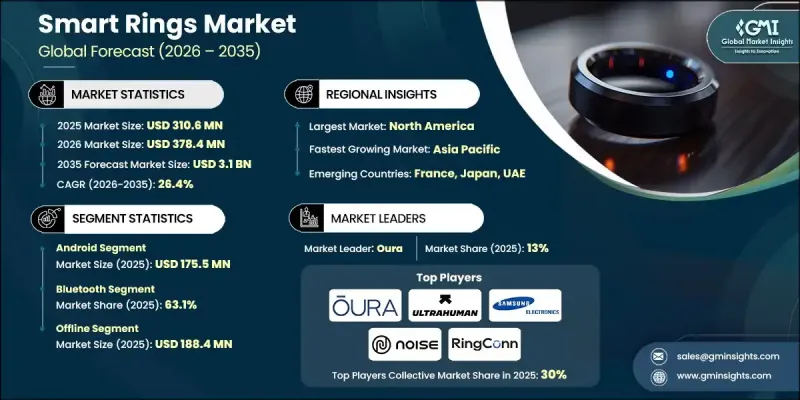
2025 年全球智慧戒指市场价值为 3.106 亿美元,预计到 2035 年将以 26.4% 的复合年增长率增长至 31 亿美元。
智慧戒指将时尚与先进技术完美融合,透过整合感测器和连接功能,为用户提供多种实用功能。这些设备可以追踪关键健康指标、管理通知,甚至进行非接触式支付。智慧型手机、平板电脑和其他连网装置的普及,以及人们对穿戴式健康监测技术(例如心率和睡眠模式追踪)日益增长的兴趣,共同推动了智慧戒指市场的扩张。全球事件加速了对非接触式支付解决方案的需求,进一步促进了产业成长,尤其是在正在快速转型为无现金交易的新兴经济体。然而,高昂的设备成本以及来自智慧手錶和健身追踪器等更成熟的可穿戴设备的竞争,对智慧戒指的广泛普及构成了挑战。儘管如此,随着消费者对多功能穿戴装置的认知度不断提高,智慧戒指市场仍在持续成长。
| 市场范围 | |
|---|---|
| 起始年份 | 2025 |
| 预测年份 | 2026-2035 |
| 起始值 | 3.106亿美元 |
| 预测值 | 31亿美元 |
| 复合年增长率 | 26.4% |
预计到2025年,安卓市场规模将达到1.755亿美元,主要得益于安卓设备全球用户群的持续成长。安卓装置与穿戴式科技的广泛相容性,加上多样化的价格选择和透过第三方应用程式提供的丰富客製化选项,促进了中低收入消费者对安卓装置的接受度。
预计到2025年,线下销售额将达到1.884亿美元,显示实体店的重要性仍不容忽视。这些管道让消费者在购买前亲身查看和体验智慧戒指,而成熟的零售网路也为线下分销的强劲表现做出了贡献。
亚太地区智慧戒指市场预计到2025年将占据21.8%的市场份额,主要得益于中国和印度等国政府积极推动数位转型。鼓励数位化和技术融合的政策正在激发消费者对穿戴式装置的兴趣,为智慧戒指製造商创造了巨大的发展机会。
目录
第一章:方法论与范围
第二章:执行概要
第三章:行业洞察
- 产业生态系分析
- 供应商格局
- 利润率
- 每个阶段的价值增加
- 影响价值链的因素
- 产业影响因素
- 成长驱动因素
- 健康意识日益增强
- 技术进步
- 智慧型手机普及
- 产业陷阱与挑战
- 高昂的拥有成本
- 无显示回馈
- 机会
- 非接触式支付和身份验证
- 人工智慧驱动的个性化洞察
- 成长驱动因素
- 成长潜力分析
- 未来市场趋势
- 技术与创新格局
- 当前技术趋势
- 新兴技术
- 价格趋势
- 按地区
- 透过作业系统
- 监管环境
- 标准和合规要求
- 区域监理框架
- 认证标准
- 波特的分析
- PESTEL 分析
第四章:竞争格局
- 介绍
- 公司市占率分析
- 按地区
- 公司矩阵分析
- 主要市场参与者的竞争分析
- 竞争定位矩阵
- 关键进展
- 併购
- 合作伙伴关係与合作
- 新产品发布
- 扩张计划
第五章:市场估算与预测:依作业系统划分,2022-2035年
- 安卓
- iOS
第六章:市场估算与预测:依技术划分,2022-2035年
- 蓝牙
- NFC
第七章:市场估算与预测:依消费群体划分,2022-2035年
- 男人
- 女性
- 男女通用的
第八章:市场估算与预测:依价格区间划分,2022-2035年
- 低的
- 中等的
- 高的
第九章:市场估算与预测:依配销通路划分,2022-2035年
- 在线的
- 电子商务
- 品牌网站
- 离线
- 超市
- 专卖店
- 其他(百货公司等)
第十章:市场估计与预测:依地区划分,2022-2035年
- 北美洲
- 我们
- 加拿大
- 欧洲
- 德国
- 英国
- 法国
- 义大利
- 西班牙
- 亚太地区
- 中国
- 日本
- 印度
- 澳洲
- 韩国
- 拉丁美洲
- 巴西
- 墨西哥
- 阿根廷
- 中东和非洲
- 南非
- 沙乌地阿拉伯
- 阿联酋
第十一章:公司简介
- Amazfit
- Boat
- Circular
- Colmi
- Fitbit
- Garmin
- Go2Sleep
- Movano Health
- Noise
- Oura
- RingConn
- Samsung Electronics
- Sky Labs
- Ultrahuman
- Xiaomi
The Global Smart Rings Market was valued at USD 310.6 million in 2025 and is estimated to grow at a CAGR of 26.4% to reach USD 3.1 billion by 2035.
Smart rings merge style with advanced technology, offering users a variety of functionalities through integrated sensors and connectivity features. These devices allow tracking of key health metrics, managing notifications, and even performing contactless payments. Market expansion is being driven by the widespread adoption of smartphones, tablets, and other connected devices, alongside growing interest in wearable technology for health monitoring, such as tracking heart rate and sleep patterns. The increasing demand for contactless payment solutions, accelerated by global events, has further fueled industry growth, particularly in emerging economies that are rapidly transitioning toward cashless transactions. However, high device costs and competition from more established wearable alternatives, including smartwatches and fitness trackers, present challenges to broader adoption. Despite this, the market continues to grow as consumer awareness of multifunctional wearables increases.
| Market Scope | |
|---|---|
| Start Year | 2025 |
| Forecast Year | 2026-2035 |
| Start Value | $310.6 Million |
| Forecast Value | $3.1 Billion |
| CAGR | 26.4% |
The android segment reached USD 175.5 million by 2025, driven by the growing global user base of Android devices. The wide compatibility of Android devices with wearable technology, combined with diverse pricing and extensive customization options via third-party applications, has encouraged adoption among lower and middle-income consumers.
The offline sales segment reached USD 188.4 million in 2025, demonstrating the continued importance of brick-and-mortar stores. These channels allow consumers to physically examine and experience smart rings before purchasing, while established retail networks contribute to the strong performance of offline distribution.
Asia Pacific Smart Rings Market held 21.8% share in 2025, due to proactive government initiatives promoting digital adoption in countries like China and India. Policies encouraging digitalization and technology integration are driving consumer interest in wearable devices, creating significant opportunities for smart ring manufacturers.
Key players in the Global Smart Rings Market include Bellabeat, Kerv Wearables, Moen Smart Ring, Noise, Fujitsu, Boat, Circular Ring, Ultrahuman, Logbar, Sleepon Ring, Sky Labs, McLear Ltd., Moodmetric, and Oura. Companies in the Smart Rings Market strengthen their position by investing in product innovation, introducing rings with enhanced health tracking, long battery life, and multifunctional capabilities. Expanding global distribution networks, including online marketplaces and retail partnerships, helps improve accessibility. Firms focus on user experience by integrating seamless connectivity with smartphones and offering customizable features. Strategic collaborations with technology and payment service providers enhance the functionality of their devices. Marketing campaigns highlighting health benefits and digital payment convenience, along with participation in technology expos and regional promotions, are key tactics to increase market visibility and drive adoption.
Table of Contents
Chapter 1 Methodology and Scope
- 1.1 Market scope and definition
- 1.2 Research design
- 1.2.1 Research approach
- 1.2.2 Data collection methods
- 1.3 Data mining sources
- 1.3.1 Global
- 1.3.2 Regional/Country
- 1.4 Base estimates and calculations
- 1.4.1 Base year calculation
- 1.4.2 Key trends for market estimation
- 1.5 Primary research and validation
- 1.5.1 Primary sources
- 1.6 Forecast model
- 1.7 Research assumptions and limitations
Chapter 2 Executive Summary
- 2.1 Industry 360° synopsis
- 2.2 Key market trends
- 2.2.1 Regional
- 2.2.2 Operating system
- 2.2.3 Technology
- 2.2.4 Consumer group
- 2.2.5 Price range
- 2.2.6 Distribution channel
- 2.3 CXO perspectives: Strategic imperatives
- 2.3.1 Key decision points for industry executives
- 2.3.2 Critical success factors for market players
- 2.4 Future outlook and strategic recommendations
Chapter 3 Industry Insights
- 3.1 Industry ecosystem analysis
- 3.1.1 Supplier landscape
- 3.1.2 Profit margin
- 3.1.3 Value addition at each stage
- 3.1.4 Factor affecting the value chain
- 3.2 Industry impact forces
- 3.2.1 Growth drivers
- 3.2.1.1 Rising health and wellness awareness
- 3.2.1.2 Technological advancements
- 3.2.1.3 Smartphone ubiquity
- 3.2.2 Industry pitfalls & challenges
- 3.2.2.1 High cost of ownership
- 3.2.2.2 No display feedback
- 3.2.3 Opportunities
- 3.2.3.1 Contactless payments & authentication
- 3.2.3.2 AI-driven personalized insights
- 3.2.1 Growth drivers
- 3.3 Growth potential analysis
- 3.4 Future market trends
- 3.5 Technology and innovation landscape
- 3.5.1 Current technological trends
- 3.5.2 Emerging technologies
- 3.6 Price trends
- 3.6.1 By Region
- 3.6.2 By Operating system
- 3.7 Regulatory landscape
- 3.7.1 Standards and compliance requirements
- 3.7.2 Regional regulatory frameworks
- 3.7.3 Certification standards
- 3.8 Porter's analysis
- 3.9 PESTEL analysis
Chapter 4 Competitive Landscape, 2025
- 4.1 Introduction
- 4.2 Company market share analysis
- 4.2.1 By region
- 4.2.1.1 North America
- 4.2.1.2 Europe
- 4.2.1.3 Asia Pacific
- 4.2.1.4 Latin America
- 4.2.1.5 Middle East and Africa
- 4.2.1 By region
- 4.3 Company matrix analysis
- 4.4 Competitive analysis of major market players
- 4.5 Competitive positioning matrix
- 4.6 Key developments
- 4.6.1 Mergers & acquisitions
- 4.6.2 Partnerships & collaborations
- 4.6.3 New product launches
- 4.6.4 Expansion plans
Chapter 5 Market Estimates and Forecast, By Operating System, 2022 - 2035 (USD Million) (Thousand Units)
- 5.1 Key trends
- 5.2 Android
- 5.3 iOS
Chapter 6 Market Estimates and Forecast, By Technology, 2022 - 2035 (USD Million) (Thousand Units)
- 6.1 Key trends
- 6.2 Bluetooth
- 6.3 NFC
Chapter 7 Market Estimates and Forecast, By Consumer Group, 2022 - 2035 (USD Million) (Thousand Units)
- 7.1 Key trends
- 7.2 Men
- 7.3 Women
- 7.4 Unisex
Chapter 8 Market Estimates and Forecast, By Price Range, 2022 - 2035 (USD Million) (Thousand Units)
- 8.1 Key trends
- 8.2 Low
- 8.3 Medium
- 8.4 High
Chapter 9 Market Estimates and Forecast, By Distribution Channel, 2022 - 2035 (USD Million) (Thousand Units)
- 9.1 Key trends
- 9.2 Online
- 9.2.1 E-commerce
- 9.2.2 Brand websites
- 9.3 Offline
- 9.3.1 Supermarkets
- 9.3.2 Specialty stores
- 9.3.3 Others (Departmental stores, etc.)
Chapter 10 Market Estimates and Forecast, By Region, 2022 - 2035 (USD Million) (Thousand Units)
- 10.1 Key trends
- 10.2 North America
- 10.2.1 U.S.
- 10.2.2 Canada
- 10.3 Europe
- 10.3.1 Germany
- 10.3.2 UK
- 10.3.3 France
- 10.3.4 Italy
- 10.3.5 Spain
- 10.4 Asia Pacific
- 10.4.1 China
- 10.4.2 Japan
- 10.4.3 India
- 10.4.4 Australia
- 10.4.5 South Korea
- 10.5 Latin America
- 10.5.1 Brazil
- 10.5.2 Mexico
- 10.5.3 Argentina
- 10.6 Middle East and Africa
- 10.6.1 South Africa
- 10.6.2 Saudi Arabia
- 10.6.3 UAE
Chapter 11 Company Profiles
- 11.1 Amazfit
- 11.2 Boat
- 11.3 Circular
- 11.4 Colmi
- 11.5 Fitbit
- 11.6 Garmin
- 11.7 Go2Sleep
- 11.8 Movano Health
- 11.9 Noise
- 11.10 Oura
- 11.11 RingConn
- 11.12 Samsung Electronics
- 11.13 Sky Labs
- 11.14 Ultrahuman
- 11.15 Xiaomi

 智慧戒指市场分析及预测(至2035年):按类型、产品类型、技术、组件、应用、材质、功能、最终用户、安装类型和解决方案划分
 全球智慧环路开关市场规模、份额、趋势及成长分析报告(2026-2034年)
 智慧戒指市场规模、份额和趋势分析报告:按应用、技术、分销管道、地区和细分市场预测,2026-2033年
 智慧戒指市场-全球产业规模、份额、趋势、机会和预测:按技术、应用、分销管道、地区和竞争格局划分,2021-2031年智慧戒指市场规模、占有率、成长、全球产业分析:按类型、应用、区域洞察和预测(2026-2034 年)
 智慧戒指市场规模、份额和成长分析(按作业系统、技术、最终用户和地区划分)—2026-2033年产业预测
 智慧戒指:全球市场占有率和排名、总销售量和需求预测(2025-2031年)
 智慧环网柜市场机会、成长动力、产业趋势分析及 2025 - 2034 年预测
 医疗智慧环市场按产品类型、应用和最终用户划分 - 2025-2030 年全球预测
 2025-2029 年全球智慧环市场