


 |
市场调查报告书
商品编码
1892866
OTR轮胎市场机会、成长驱动因素、产业趋势分析及2026-2035年预测OTR Tire Market Opportunity, Growth Drivers, Industry Trend Analysis, and Forecast 2026 - 2035 |
||||||

2025年全球工程机械轮胎市场价值为49.6亿美元,预计2035年将以7.4%的复合年增长率成长至98.9亿美元。
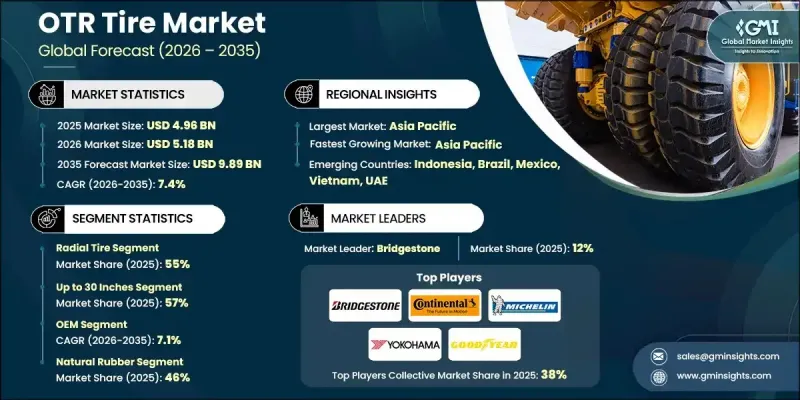
全球采矿和采石作业的持续扩张,带动了重型机械(如运输卡车、装载机和推土机)使用量的增加,从而推动了市场成长。全球对矿物和金属开采的需求不断增长,也带动了对坚固耐用的非公路(OTR)轮胎的需求,这类轮胎需要能够承受高负载、适应恶劣环境并长时间连续运行。对包括道路、桥樑、能源项目、工业区和城市发展在内的基础设施项目的投资,进一步提升了对工程机械的需求,而工程机械又依赖耐用的非公路轮胎。农业现代化以及拖拉机、收割机和先进机械的普及,推动了对专用农业非公路轮胎的需求,这类轮胎具有卓越的牵引力、减少土壤压实并延长使用寿命,从而支持新兴市场和发达市场高效的大规模农业生产。
| 市场范围 | |
|---|---|
| 起始年份 | 2025 |
| 预测年份 | 2026-2035 |
| 起始值 | 49.6亿美元 |
| 预测值 | 98.9亿美元 |
| 复合年增长率 | 7.4% |
2025年,子午线轮胎市占率达到55%,预计2026年至2035年将以7%的复合年增长率成长。子午线轮胎因其胎面寿命长、行驶平稳等优点,在越野和乘用车领域备受青睐。其独特的钢丝带束层设计,帘线方向垂直于行驶方向,确保了轮胎拥有更佳的牵引力、稳定性、燃油效率和散热性能。
2025 年, OEM部门的市占率为 44%,预计到 2034 年将以 7.1% 的复合年增长率成长。 OEMOEM使製造商能够直接了解新机械的轮胎需求,反映建筑、采矿和农业的趋势,并提供有关新车产量和技术整合的见解。
预计到2025年,美国非公路轮胎市场规模将达到12.2亿美元。采矿和建筑业是非公路轮胎的主要需求方,车队营运商倾向于选择耐用且燃油效率高的子午线轮胎和混合配方轮胎。基础设施建设,包括高速公路和城市项目,以及轮胎翻新、再生轮胎材料和节能设计等永续发展倡议,都推动了市场成长,这些倡议提高了营运效率并符合环保标准。
目录
第一章:方法论
第二章:执行概要
第三章:行业洞察
- 产业生态系分析
- 供应商格局
- 利润率
- 成本结构
- 每个阶段的价值增加
- 影响价值链的因素
- 中断
- 产业影响因素
- 成长驱动因素
- 采矿和采石活动的扩张
- 基础建设发展和建设成长
- 农业机械化
- 转向采用子午线轮胎
- 产业陷阱与挑战
- 原物料价格波动
- 过热和过载导致的高故障率
- 市场机会
- 新兴矿业市场的成长
- 采矿和建筑设备的自动化
- 港口和物料搬运业务的扩张
- 售后市场更换需求成长
- 成长驱动因素
- 成长潜力分析
- 监管环境
- 全球的
- 安全与性能标准
- 环境与永续发展法规
- 进出口法规及关税
- 采矿和建筑工地规章
- 北美洲
- 欧洲
- 亚太地区
- 拉丁美洲
- 中东和非洲
- 全球的
- 波特的分析
- PESTEL 分析
- 技术与创新格局
- 当前技术趋势
- 专有技术(MASTERCORE、V.PLY、LSW、NRF)
- 数位轮胎监测系统(TPMS)
- 智慧轮胎技术
- 先进材料与化合物
- 新兴技术
- 无气自主
- 人工智慧、区块链、3D列印、自愈
- 电动和混合动力设备轮胎技术
- 当前技术趋势
- 定价分析
- 按轮胎结构类型定价
- 价格以轮胎尺寸和轮圈直径计算
- 按应用领域定价
- OEM价格与售后市场价格对比
- 区域定价分析
- 生产统计
- 生产中心
- 消费中心
- 进出口
- 成本細項分析
- 製造成本结构
- 原料成本分析
- 製造和生产成本
- 物流和配送成本
- 研发投资分配
- 专利分析
- 永续性和环境方面
- 永续实践
- 减少废弃物策略
- 生产中的能源效率
- 环保倡议
- 碳足迹考量
- 最终使用者行为与消费分析
- 最终用户细分框架
- 采矿业使用者行为
- 建筑业使用者行为
- 农业部门使用者行为
- 港口和物料搬运用户行为
- 购买影响者和决策者
- 风险评估与缓解框架
- 供应链风险
- 金融和经济风险
- 监理与合规风险
- 营运风险
- 技术与创新风险
- OTR 生命週期分析
- 生命週期分析框架
- 原料提取阶段
- 製造阶段生命週期影响
- 配送与物流阶段
- 生命週期成本分析(LCCA)
- 生命週期绩效指标
第四章:竞争格局
- 介绍
- 公司市占率分析
- 北美洲
- 欧洲
- 亚太地区
- 拉丁美洲
- MEA
- 主要市场参与者的竞争分析
- 竞争定位矩阵
- 战略展望矩阵
- 关键进展
- 併购
- 合作伙伴关係与合作
- 新产品发布
- 扩张计划和资金
第五章:市场估价与预测:依轮胎类型划分,2022-2035年
- 子午线轮胎
- 斜交轮胎
- 实心轮胎
第六章:市场估算与预测:以轮圈尺寸划分,2022-2035年
- 最大可达 30 英寸
- 31-50英寸
- 超过 51 英寸
第七章:市场估算与预测:依设备类型划分,2022-2035年
- 自卸卡车
- 铰接式自卸车
- 刚性自卸卡车
- 装载机
- 挖掘装载机
- 履带式装载机
- 滑移装载机
- 挖土机
- 履带式挖土机
- 小型挖土机
- 轮式挖土机
- 沥青摊舖工
- 履带式推土机
- 平地机
- RTLT-伸缩式
- 农业拖拉机
- 其他的
第八章:市场估算与预测:依产业划分,2022-2035年
- 建造
- 矿业
- 农业
- 林业
- 工业的
- 港口与物流
- 其他的
第九章:市场估算与预测:依材料划分,2022-2035年
- 天然橡胶
- 合成橡胶
- 混合/复合轮胎
第十章:市场估价与预测:依配销通路划分,2022-2035年
- OEM
- 售后市场
第十一章:市场估计与预测:按地区划分,2022-2035年
- 北美洲
- 我们
- 加拿大
- 欧洲
- 德国
- 英国
- 法国
- 义大利
- 西班牙
- 北欧
- 俄罗斯
- 波兰
- 罗马尼亚
- 亚太地区
- 中国
- 印度
- 日本
- 韩国
- 澳新银行
- 越南
- 印尼
- 拉丁美洲
- 巴西
- 墨西哥
- 阿根廷
- MEA
- 南非
- 沙乌地阿拉伯
- 阿联酋
第十二章:公司简介
- 全球公司
- Balkrishna Industries
- Bridgestone
- Continental
- Double Coin
- Goodyear Tire & Rubber Company
- Linglong Tire
- Michelin
- Pirelli
- Sumitomo Rubber Industries
- Titan International
- Triangle Tyre
- Yokohama Rubber Company
- Zhongce Rubber
- 区域玩家
- Aeolus Tyre
- Apollo Tyres
- CEAT
- Guizhou Tyre
- JK Tyre & Industries
- Magna Tyres
- MRF
- Sailun
- Techking Tires
- Vipal Rubber
- 新兴玩家
- Kal Tire Mining Tire
- OTR Engineered Solutions
- Revvo Technologies
- RubberJet
- The SMART Tire
The Global OTR Tire Market was valued at USD 4.96 billion in 2025 and is estimated to grow at a CAGR of 7.4% to reach USD 9.89 billion by 2035.
Market growth is driven by the rising use of heavy-duty machinery, such as haul trucks, loaders, and dozers, due to the ongoing expansion of mining and quarrying operations worldwide. Increasing global demand for mineral and metal extraction has fueled the need for robust off-the-road (OTR) tires capable of handling high load capacities, enduring abrasive conditions, and operating continuously for long hours. Investments in infrastructure projects, including roads, bridges, energy initiatives, industrial zones, and urban developments, have further boosted the demand for construction equipment, which in turn relies on durable OTR tires. The modernization of agriculture and adoption of tractors, harvesters, and advanced machinery are driving demand for specialized agricultural OTR tires that provide excellent traction, reduce soil compaction, and offer extended wear life, supporting efficient large-scale farming across both emerging and developed markets.
| Market Scope | |
|---|---|
| Start Year | 2025 |
| Forecast Year | 2026-2035 |
| Start Value | $4.96 Billion |
| Forecast Value | $9.89 Billion |
| CAGR | 7.4% |
The radial tire segment held a 55% share in 2025 and is projected to grow at a CAGR of 7% from 2026 to 2035. Radial tires are preferred in off-road and automotive applications for their long tread life and smoother ride. The design, featuring steel belts with cords oriented perpendicular to the travel direction, ensures improved traction, stability, fuel efficiency, and heat dissipation.
The OEM segment held a 44% share in 2025 and is expected to grow at a CAGR of 7.1% through 2034. OEM channels provide manufacturers with direct access to tire requirements for new machinery, reflecting trends in construction, mining, and agriculture, and offering insights into production volumes and technological integration in new vehicles.
U.S. OTR Tire Market reached USD 1.22 billion in 2025. Mining and construction sectors dominate demand for off-the-road tires, with fleet operators favoring radial and mixed-compound designs for durability and fuel efficiency. Growth is supported by infrastructure development, including highways and urban projects, and sustainability initiatives such as retreading, recycled tire materials, and energy-efficient designs that enhance operational efficiency and compliance with environmental standards.
Leading players operating in the OTR Tire Market include Titan International, The Goodyear Tire & Rubber Company, Bridgestone, Sumitomo Rubber, Yokohama Rubber Company, Michelin, Triangle, Pirelli, Continental, and Balkrishna Industries. Companies in the OTR Tire Market are adopting several strategies to strengthen their market position. They are investing in research and development to create longer-lasting, high-performance tires suitable for extreme conditions. Strategic partnerships with construction, mining, and agricultural equipment manufacturers help ensure OEM adoption. Geographic expansion into emerging markets increases sales opportunities, while sustainability initiatives, such as energy-efficient tire designs and retreading programs, meet regulatory requirements and environmental demands.
Table of Contents
Chapter 1 Methodology
- 1.1 Market scope and definition
- 1.2 Research design
- 1.2.1 Research approach
- 1.2.2 Data collection methods
- 1.3 Data mining sources
- 1.3.1 Global
- 1.3.2 Regional/Country
- 1.4 Base estimates and calculations
- 1.4.1 Base year calculation
- 1.4.2 Key trends for market estimation
- 1.5 Primary research and validation
- 1.5.1 Primary sources
- 1.6 Forecast model
- 1.7 Research assumptions and limitations
Chapter 2 Executive Summary
- 2.1 Industry 360° synopsis
- 2.2 Key market trends
- 2.2.1 Regional
- 2.2.2 Tire
- 2.2.3 Equipment
- 2.2.4 Rim size
- 2.2.5 Industry
- 2.2.6 Material
- 2.2.7 Distribution channel
- 2.3 TAM analysis, 2026-2035
- 2.4 CXO perspectives: Strategic imperatives
- 2.4.1 Executive decision points
- 2.4.2 Critical success factors
- 2.5 Future outlook
- 2.6 Strategic recommendations
Chapter 3 Industry Insights
- 3.1 Industry ecosystem analysis
- 3.1.1 Supplier landscape
- 3.1.2 Profit margin
- 3.1.3 Cost structure
- 3.1.4 Value addition at each stage
- 3.1.5 Factor affecting the value chain
- 3.1.6 Disruptions
- 3.2 Industry impact forces
- 3.2.1 Growth drivers
- 3.2.1.1 Expansion of mining and quarrying activities
- 3.2.1.2 Infrastructure development and construction growth
- 3.2.1.3 Agricultural mechanization
- 3.2.1.4 Shift toward radial tire adoption
- 3.2.2 Industry pitfalls and challenges
- 3.2.2.1 Raw material price volatility
- 3.2.2.2 High failure rates from heat and overloading
- 3.2.3 Market opportunities
- 3.2.3.1 Growth in emerging mining markets
- 3.2.3.2 Automation in mining and construction equipment
- 3.2.3.3 Expansion in port and material handling operations
- 3.2.3.4 Aftermarket replacement demand growth
- 3.2.1 Growth drivers
- 3.3 Growth potential analysis
- 3.4 Regulatory landscape
- 3.4.1 Global
- 3.4.1.1 Safety & performance standards
- 3.4.1.2 Environmental & sustainability regulations
- 3.4.1.3 Import/export regulations & tariffs
- 3.4.1.4 Mining & construction site regulations
- 3.4.2 North America
- 3.4.3 Europe
- 3.4.4 Asia Pacific
- 3.4.5 Latin America
- 3.4.6 Middle East & Africa
- 3.4.1 Global
- 3.5 Porter's analysis
- 3.6 PESTEL analysis
- 3.7 Technology and innovation landscape
- 3.7.1 Current technological trends
- 3.7.1.1 Proprietary technologies (MASTERCORE, V.PLY, LSW, NRF)
- 3.7.1.2 Digital tire monitoring systems (TPMS)
- 3.7.1.3 Intelligent tire technologies
- 3.7.1.4 Advanced materials & compounds
- 3.7.2 Emerging technologies
- 3.7.2.1 Airless autonomous
- 3.7.2.2 AI, Blockchain, 3D Printing, self-healing
- 3.7.2.3 Electric & hybrid equipment tire technologies
- 3.7.1 Current technological trends
- 3.8 Pricing analysis
- 3.8.1.1 Pricing by tire construction type
- 3.8.1.2 Pricing by tire size & rim diameter
- 3.8.1.3 Pricing by application segment
- 3.8.1.4 OEM vs aftermarket pricing
- 3.8.1.5 Regional pricing analysis
- 3.9 Production statistics
- 3.9.1 Production hubs
- 3.9.2 Consumption hubs
- 3.9.3 Export and import
- 3.10 Cost breakdown analysis
- 3.10.1 Manufacturing cost structure
- 3.10.2 Raw material cost analysis
- 3.10.3 Manufacturing & production costs
- 3.10.4 Logistics & distribution costs
- 3.10.5 R&D investment allocation
- 3.11 Patent analysis
- 3.12 Sustainability and environmental aspects
- 3.12.1 Sustainable practices
- 3.12.2 Waste reduction strategies
- 3.12.3 Energy efficiency in production
- 3.12.4 Eco-friendly initiatives
- 3.12.5 Carbon footprint considerations
- 3.13 End use behavior & consumption analysis
- 3.13.1 End use segmentation framework
- 3.13.2 Mining sector user behavior
- 3.13.3 Construction sector user behavior
- 3.13.4 Agriculture sector user behavior
- 3.13.5 Port & material handling user behavior
- 3.13.6 Purchase influencers & decision makers
- 3.14 Risk assessment & mitigation framework
- 3.14.1 Supply chain risks
- 3.14.2 Financial & economic risks
- 3.14.3 Regulatory & compliance risks
- 3.14.4 Operational risks
- 3.14.5 Technology & innovation risks
- 3.15 OTR lifecycle analysis
- 3.15.1 Lifecycle analysis framework
- 3.15.2 Raw material extraction phase
- 3.15.3 Manufacturing phase lifecycle impact
- 3.15.4 Distribution & logistics phase
- 3.15.5 Lifecycle cost analysis (LCCA)
- 3.15.6 Lifecycle performance metrics
Chapter 4 Competitive Landscape, 2025
- 4.1 Introduction
- 4.2 Company market share analysis
- 4.2.1 North America
- 4.2.2 Europe
- 4.2.3 Asia Pacific
- 4.2.4 LATAM
- 4.2.5 MEA
- 4.3 Competitive analysis of major market players
- 4.4 Competitive positioning matrix
- 4.5 Strategic outlook matrix
- 4.6 Key developments
- 4.6.1 Mergers & acquisitions
- 4.6.2 Partnerships & collaborations
- 4.6.3 New product launches
- 4.6.4 Expansion plans and funding
Chapter 5 Market Estimates & Forecast, By Tire, 2022 - 2035 ($Mn, Units)
- 5.1 Key trends
- 5.2 Radial tire
- 5.3 Bias tire
- 5.4 Solid tire
Chapter 6 Market Estimates & Forecast, By Rim Size, 2022 - 2035 ($Mn, Units)
- 6.1 Key trends
- 6.2 Up to 30 inches
- 6.3 31-50 inches
- 6.4 Above 51 inches
Chapter 7 Market Estimates & Forecast, By Equipment, 2022 - 2035 ($Mn, Units)
- 7.1 Key trends
- 7.2 Dump trucks
- 7.2.1 Articulated dump trucks
- 7.2.2 Rigid dump trucks
- 7.3 Loaders
- 7.3.1 Backhoe loaders
- 7.3.2 Crawler loaders
- 7.3.3 Skid-steer loaders
- 7.4 Excavators
- 7.4.1 Crawler excavators
- 7.4.2 Mini excavators
- 7.4.3 Wheeled excavators
- 7.5 Asphalt finishers
- 7.6 Crawler dozer
- 7.7 Motor graders
- 7.8 RTLT-telescopic
- 7.9 Agriculture tractors
- 7.10 Others
Chapter 8 Market Estimates & Forecast, By Industry, 2022 - 2035 ($Mn, Units)
- 8.1 Key trends
- 8.2 Construction
- 8.3 Mining
- 8.4 Agriculture
- 8.5 Forestry
- 8.6 Industrial
- 8.7 Ports & logistics
- 8.8 Others
Chapter 9 Market Estimates & Forecast, By Material, 2022 - 2035 ($Mn, Units)
- 9.1 Key trends
- 9.2 Natural rubber
- 9.3 Synthetic rubber
- 9.4 Mixed/compound tires
Chapter 10 Market Estimates & Forecast, By Distribution Channel, 2022 - 2035 ($Mn, Units)
- 10.1 Key trends
- 10.2 OEM
- 10.3 Aftermarket
Chapter 11 Market Estimates & Forecast, By Region, 2022 - 2035 ($Mn, Units)
- 11.1 Key trends
- 11.2 North America
- 11.2.1 US
- 11.2.2 Canada
- 11.3 Europe
- 11.3.1 Germany
- 11.3.2 UK
- 11.3.3 France
- 11.3.4 Italy
- 11.3.5 Spain
- 11.3.6 Nordics
- 11.3.7 Russia
- 11.3.8 Poland
- 11.3.9 Romania
- 11.4 Asia Pacific
- 11.4.1 China
- 11.4.2 India
- 11.4.3 Japan
- 11.4.4 South Korea
- 11.4.5 ANZ
- 11.4.6 Vietnam
- 11.4.7 Indonesia
- 11.5 Latin America
- 11.5.1 Brazil
- 11.5.2 Mexico
- 11.5.3 Argentina
- 11.6 MEA
- 11.6.1 South Africa
- 11.6.2 Saudi Arabia
- 11.6.3 UAE
Chapter 12 Company Profiles
- 12.1 Global companies
- 12.1.1 Balkrishna Industries
- 12.1.2 Bridgestone
- 12.1.3 Continental
- 12.1.4 Double Coin
- 12.1.5 Goodyear Tire & Rubber Company
- 12.1.6 Linglong Tire
- 12.1.7 Michelin
- 12.1.8 Pirelli
- 12.1.9 Sumitomo Rubber Industries
- 12.1.10 Titan International
- 12.1.11 Triangle Tyre
- 12.1.12 Yokohama Rubber Company
- 12.1.13 Zhongce Rubber
- 12.2 Regional players
- 12.2.1 Aeolus Tyre
- 12.2.2 Apollo Tyres
- 12.2.3 CEAT
- 12.2.4 Guizhou Tyre
- 12.2.5 JK Tyre & Industries
- 12.2.6 Magna Tyres
- 12.2.7 MRF
- 12.2.8 Sailun
- 12.2.9 Techking Tires
- 12.2.10 Vipal Rubber
- 12.3 Emerging players
- 12.3.1 Kal Tire Mining Tire
- 12.3.2 OTR Engineered Solutions
- 12.3.3 Revvo Technologies
- 12.3.4 RubberJet
- 12.3.5 The SMART Tire

 OTR轮胎市场:2026-2032年全球市场预测(按产品类型、轮胎尺寸、载重能力、车辆类型、应用和销售管道)
 越野轮胎市场分析及预测(至2035年):依类型、产品类型、服务、技术、应用、材质、最终用户、功能、安装方式划分
 全球工程机械轮胎市场规模、份额、趋势和成长分析报告(2026-2034)
 日本越野轮胎市场规模、份额、趋势和预测:按车辆类型、轮胎类型、分销管道、轮圈尺寸、应用和地区划分,2026-2034年
 越野高性能车辆市场规模、份额和成长分析(按车辆类型、应用、燃料类型、分销管道和地区划分)-2026-2033年产业预测
 全钢子午线工程机械轮胎:全球市场份额和排名、总销售量和需求预测(2025-2031年)工程机械轮胎:全球市场份额和排名、总销售量和需求预测(2025-2031年)
 2032 年工程车轮胎市场预测:按轮胎类型、轮圈尺寸、轮胎状况、通路、应用、最终用户和地区进行的全球分析2025 年至 2033 年非公路轮胎市场报告(按车辆类型、轮胎类型、最终用途、配销通路、轮圈尺寸和地区划分)
 全球非公路用轮胎市场