


 |
市场调查报告书
商品编码
1913313
冻干水果及蔬菜市场机会、成长要素、产业趋势分析及2026年至2035年预测Freeze Dried Fruits and Vegetables Market Opportunity, Growth Drivers, Industry Trend Analysis, and Forecast 2026 - 2035 |
||||||

全球冻干水果和蔬菜市场预计到 2025 年将达到 55 亿美元,到 2035 年将达到 107 亿美元,年复合成长率为 6.9%。
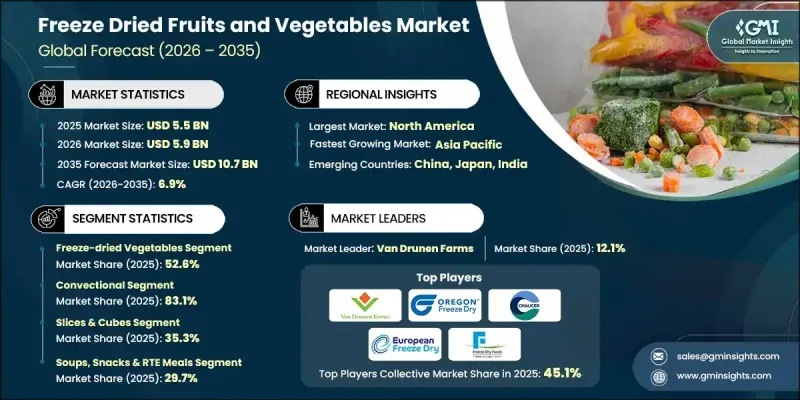
市场成长主要受以下因素驱动:消费者生活方式向更健康的生活方式转变,对便捷食品的偏好日益增长,以及对成分洁净标示干净的产品的需求不断增加。消费者越来越倾向于选择既能维持营养价值又能兼顾保存期限和易用性的食品。冷冻干燥技术无需添加人工添加剂即可保留蔬果的天然特性,满足了消费者的这项偏好。随着人们对健康饮食和食材来源的意识不断增强,食品生产商和零售商正在拓展其高端产品线,尤其是在有机和非基因改造食品领域。快节奏的生活方式也影响消费者的购买行为,导致保存期限长、易于烹调的食品消费量增加。因此,冷冻干燥原料在包装食品和饮料领域中得到更广泛的应用,促进了大众市场和特色食品领域的创新和产品多元化。
| 市场覆盖范围 | |
|---|---|
| 开始年份 | 2025 |
| 预测年份 | 2026-2035 |
| 起始值 | 55亿美元 |
| 预测金额 | 107亿美元 |
| 复合年增长率 | 6.9% |
预计到2034年,冷冻干燥蔬菜市场将以5.6%的复合年增长率成长,这主要得益于包装食品製造和餐饮服务业的持续需求。冷冻干燥蔬菜具有保质期长、重量轻、易于復水等功能优势,这些优势使其作为保鲜食品配料的应用日益广泛。此外,便利食品品类的不断拓展以及消费者对产品耐久性提升的需求,也将持续成为推动成长要素。
预计到 2025 年,切碎和切丝的冷冻干燥水果和蔬菜市场规模将达到 12 亿美元。这一成长主要得益于商用厨房和工业食品生产对这类产品的强劲需求,因为与其他形式相比,这类产品烹饪时间更短,处理效率更高。
预计到2025年,北美冻干蔬果市场规模将达15亿美元。该地区的成长得益于即食食品的高消费量、先进的加工技术以及成熟的食品製造生态系统。消费者对健康和洁净标示产品的日益关注也持续推动该地区的需求。
目录
第一章调查方法和范围
第二章执行摘要
第三章业界考察
- 生态系分析
- 供应商情况
- 利润率
- 每个阶段的附加价值
- 影响价值链的因素
- 中断
- 产业影响因素
- 司机
- 对方便食品的需求不断增长
- 人们越来越关注健康和营养
- 食品加工业的扩张
- 产业潜在风险与挑战
- 高昂的生产和设备成本
- 发展中地区消费者意识较低
- 復水后的质地变化
- 市场机会
- 对有机和天然食品的需求日益增长
- 拓展户外与太空食品应用
- 包装和加工技术的创新
- 司机
- 成长潜力分析
- 监管环境
- 北美洲
- 欧洲
- 亚太地区
- 拉丁美洲
- 中东和非洲
- 波特五力分析
- PESTEL 分析
- 价格趋势
- 按地区
- 依产品类型
- 未来市场趋势
- 科技与创新趋势
- 当前技术趋势
- 新兴技术
- 专利状态
- 贸易统计(HS编码)(註:仅提供主要国家的贸易统计)
- 主要进口国
- 主要出口国
- 永续性和环境方面
- 永续努力
- 减少废弃物策略
- 生产中的能源效率
- 环保倡议
- 考虑到碳足迹
第四章 竞争情势
- 介绍
- 公司市占率分析
- 按地区
- 北美洲
- 欧洲
- 亚太地区
- 拉丁美洲
- 中东和非洲
- 按地区
- 企业矩阵分析
- 主要市场公司的竞争分析
- 竞争定位矩阵
- 重大进展
- 併购
- 伙伴关係与合作
- 新产品发布
- 业务拓展计划
第五章 依产品类型分類的市场估算与预测,2022-2035年
- 冻干水果
- 冷冻干燥蔬菜
第六章 2022-2035年依天然来源分類的市场估计与预测
- 传统的
- 有机耕作
第七章 按类型分類的市场估计与预测,2022-2035年
- 所有的
- 切片和切丁
- 切菜和剁菜
- 粉末/颗粒
第八章 按应用领域分類的市场估算与预测,2022-2035年
- 汤、点心和蒸馏餐
- 谷物
- 饮料和冰沙
- 麵包糖果甜点
- 冰淇淋甜点
- 酱汁、沾酱、调味汁
- 其他的
第九章 2022-2035年各地区市场估算与预测
- 北美洲
- 美国
- 加拿大
- 欧洲
- 德国
- 英国
- 法国
- 西班牙
- 义大利
- 其他欧洲地区
- 亚太地区
- 中国
- 印度
- 日本
- 澳洲
- 韩国
- 亚太其他地区
- 拉丁美洲
- 巴西
- 墨西哥
- 阿根廷
- 其他拉丁美洲地区
- 中东和非洲
- 沙乌地阿拉伯
- 南非
- 阿拉伯聯合大公国
- 其他中东和非洲地区
第十章:公司简介
- Chaucer Foods Ltd.
- Crispy Green, Inc.
- 欧洲冷冻干燥有限公司
- Expedition Foods Limited
- Freeze-Dry Foods GmbH
- Harmony House Foods
- Natierra(Sunridge Farms)
- OFD Foods(Oregon Freeze Dry)
- Thrive Freeze Dry/Thrive Life
- Van Drunen Farms
The Global Freeze Dried Fruits and Vegetables Market was valued at USD 5.5 billion in 2025 and is estimated to grow at a CAGR of 6.9% to reach USD 10.7 billion by 2035.
Market momentum is being driven by a strong shift toward healthier lifestyles, increased preference for convenient food options, and growing demand for products with clean labels and transparent ingredient profiles. Consumers are increasingly favoring food products that preserve nutritional value while offering extended shelf stability and ease of use. Freeze drying technology supports these preferences by maintaining the natural characteristics of fruits and vegetables without the need for artificial additives. Rising awareness around wellness-oriented diets and ingredient sourcing is encouraging food manufacturers and retailers to expand premium offerings, particularly within organic and non-GMO categories. Busy lifestyles are also influencing purchasing behavior, leading to higher consumption of shelf-stable and easy-to-prepare foods. As a result, freeze dried ingredients are gaining wider adoption across packaged food and beverage categories, supporting innovation and product diversification across both mass-market and specialized food segments.
| Market Scope | |
|---|---|
| Start Year | 2025 |
| Forecast Year | 2026-2035 |
| Start Value | $5.5 Billion |
| Forecast Value | $10.7 Billion |
| CAGR | 6.9% |
The freeze dried vegetables segment is expected to grow at a CAGR of 5.6% through 2034, supported by sustained demand from processed food manufacturing and foodservice operations. Their functional benefits, including long storage life, low weight, and rehydration efficiency, continue to support adoption as ingredients in shelf-stable food formulations. The ongoing expansion of convenience-focused food categories and the need for extended product durability remain key growth contributors.
The minced and chopped freeze dried fruits and vegetables segment reached USD 1.2 billion in 2025. This growth is supported by strong demand from commercial kitchens and industrial food production due to reduced preparation time and improved handling efficiency compared to other formats.
North America Freeze Dried Fruits and Vegetables Market generated USD 1.5 billion in 2025. Regional growth is supported by high consumption of ready-to-eat foods, advanced processing capabilities, and a well-developed food manufacturing ecosystem. Growing interest in health-focused and clean-label products continues to reinforce regional demand.
Key companies operating in the Global Freeze Dried Fruits and Vegetables Market include Van Drunen Farms, OFD Foods (Oregon Freeze Dry), Chaucer Foods Ltd., Natierra (Sunridge Farms), European Freeze Dry Ltd., Harmony House Foods, Crispy Green, Inc., Thrive Freeze Dry / Thrive Life, Freeze-Dry Foods GmbH, and Expedition Foods Limited. Companies in the Global Freeze Dried Fruits and Vegetables Market are strengthening their market position through product innovation and portfolio expansion focused on organic and clean-label offerings. Many players are investing in advanced freeze-drying technologies to improve nutrient retention, texture, and flavor consistency. Strategic sourcing of raw materials and long-term supplier partnerships are being used to ensure quality and supply stability. Firms are also expanding private-label and foodservice-focused product lines to reach diverse customer segments.
Table of Contents
Chapter 1 Methodology & Scope
- 1.1 Market scope and definition
- 1.2 Research design
- 1.2.1 Research approach
- 1.2.2 Data collection methods
- 1.3 Data mining sources
- 1.3.1 Global
- 1.3.2 Regional/Country
- 1.4 Base estimates and calculations
- 1.4.1 Base year calculation
- 1.4.2 Key trends for market estimation
- 1.5 Primary research and validation
- 1.5.1 Primary sources
- 1.6 Forecast model
- 1.7 Research assumptions and limitations
Chapter 2 Executive Summary
- 2.1 Industry 360° synopsis
- 2.2 Key market trends
- 2.2.1 Regional
- 2.2.2 Product type
- 2.2.3 Nature
- 2.2.4 Form
- 2.2.5 Application
- 2.3 TAM Analysis, 2025-2034
- 2.4 CXO perspectives: Strategic imperatives
- 2.4.1 Executive decision points
- 2.4.2 Critical success factors
- 2.5 Future Outlook and strategic recommendations
Chapter 3 Industry Insights
- 3.1 Industry ecosystem analysis
- 3.1.1 Supplier landscape
- 3.1.2 Profit margin
- 3.1.3 Value addition at each stage
- 3.1.4 Factor affecting the value chain
- 3.1.5 Disruptions
- 3.2 Industry impact forces
- 3.2.1 Growth drivers
- 3.2.1.1 Rising demand for convenience foods
- 3.2.1.2 Growing health and nutrition awareness
- 3.2.1.3 Expansion of food processing industry
- 3.2.2 Industry pitfalls and challenges
- 3.2.2.1 High production and equipment costs
- 3.2.2.2 Limited consumer awareness in developing regions
- 3.2.2.3 Texture changes after rehydration
- 3.2.3 Market opportunities
- 3.2.3.1 Growing demand for organic and natural foods
- 3.2.3.2 Increasing outdoor and space food applications
- 3.2.3.3 Innovation in packaging and processing technology
- 3.2.1 Growth drivers
- 3.3 Growth potential analysis
- 3.4 Regulatory landscape
- 3.4.1 North America
- 3.4.2 Europe
- 3.4.3 Asia Pacific
- 3.4.4 Latin America
- 3.4.5 Middle East & Africa
- 3.5 Porter's analysis
- 3.6 PESTEL analysis
- 3.7 Price trends
- 3.7.1 By region
- 3.7.2 By product type
- 3.8 Future market trends
- 3.9 Technology and innovation landscape
- 3.9.1 Current technological trends
- 3.9.2 Emerging technologies
- 3.10 Patent Landscape
- 3.11 Trade statistics (HS code)( Note: The trade statistics will be provided for key countries only)
- 3.11.1 Major importing countries
- 3.11.2 Major exporting countries
- 3.12 Sustainability and environmental aspects
- 3.12.1 Sustainable practices
- 3.12.2 Waste reduction strategies
- 3.12.3 Energy efficiency in production
- 3.12.4 Eco-friendly initiatives
- 3.13 Carbon footprint consideration
Chapter 4 Competitive Landscape, 2025
- 4.1 Introduction
- 4.2 Company market share analysis
- 4.2.1 By region
- 4.2.1.1 North America
- 4.2.1.2 Europe
- 4.2.1.3 Asia Pacific
- 4.2.1.4 LATAM
- 4.2.1.5 MEA
- 4.2.1 By region
- 4.3 Company matrix analysis
- 4.4 Competitive analysis of major market players
- 4.5 Competitive positioning matrix
- 4.6 Key developments
- 4.6.1 Mergers & acquisitions
- 4.6.2 Partnerships & collaborations
- 4.6.3 New Product Launches
- 4.6.4 Expansion Plans
Chapter 5 Market Estimates and Forecast, By Product Type, 2022-2035 (USD Billion) (Kilo Tons)
- 5.1 Key trends
- 5.2 Freeze-dried fruits
- 5.3 Freeze-dried vegetables
Chapter 6 Market Estimates and Forecast, By Nature, 2022-2035 (USD Billion) (Kilo Tons)
- 6.1 Key trends
- 6.2 Conventional
- 6.3 Organic
Chapter 7 Market Estimates and Forecast, By Form, 2022-2035 (USD Billion) (Kilo Tons)
- 7.1 Key trends
- 7.2 Whole
- 7.3 Slices & cubes
- 7.4 Minced & chopped
- 7.5 Powder & granules
Chapter 8 Market Estimates and Forecast, By Application, 2022-2035 (USD Billion) (Kilo Tons)
- 8.1 Key trends
- 8.2 Soups, snacks & RTE meals
- 8.3 Breakfast cereals
- 8.4 Beverages & smoothies
- 8.5 Bakery & confectionery
- 8.6 Ice cream & desserts
- 8.7 Sauces, dips & dressings
- 8.8 Others
Chapter 9 Market Estimates and Forecast, By Region, 2022-2035 (USD Billion) (Kilo Tons)
- 9.1 Key trends
- 9.2 North America
- 9.2.1 U.S.
- 9.2.2 Canada
- 9.3 Europe
- 9.3.1 Germany
- 9.3.2 UK
- 9.3.3 France
- 9.3.4 Spain
- 9.3.5 Italy
- 9.3.6 Rest of Europe
- 9.4 Asia Pacific
- 9.4.1 China
- 9.4.2 India
- 9.4.3 Japan
- 9.4.4 Australia
- 9.4.5 South Korea
- 9.4.6 Rest of Asia Pacific
- 9.5 Latin America
- 9.5.1 Brazil
- 9.5.2 Mexico
- 9.5.3 Argentina
- 9.5.4 Rest of Latin America
- 9.6 Middle East and Africa
- 9.6.1 Saudi Arabia
- 9.6.2 South Africa
- 9.6.3 UAE
- 9.6.4 Rest of Middle East and Africa
Chapter 10 Company Profiles
- 10.1 Chaucer Foods Ltd.
- 10.2 Crispy Green, Inc.
- 10.3 European Freeze Dry Ltd.
- 10.4 Expedition Foods Limited
- 10.5 Freeze-Dry Foods GmbH
- 10.6 Harmony House Foods
- 10.7 Natierra (Sunridge Farms)
- 10.8 OFD Foods (Oregon Freeze Dry)
- 10.9 Thrive Freeze Dry / Thrive Life
- 10.10 Van Drunen Farms


