


 |
市场调查报告书
商品编码
1913333
车队管理市场机会、成长驱动因素、产业趋势分析及预测(2026-2035年)Fleet Management Market Opportunity, Growth Drivers, Industry Trend Analysis, and Forecast 2026 - 2035 |
||||||

全球车队管理市场预计到 2025 年将达到 270 亿美元,到 2035 年将达到 1,223 亿美元,年复合成长率为 16.9%。
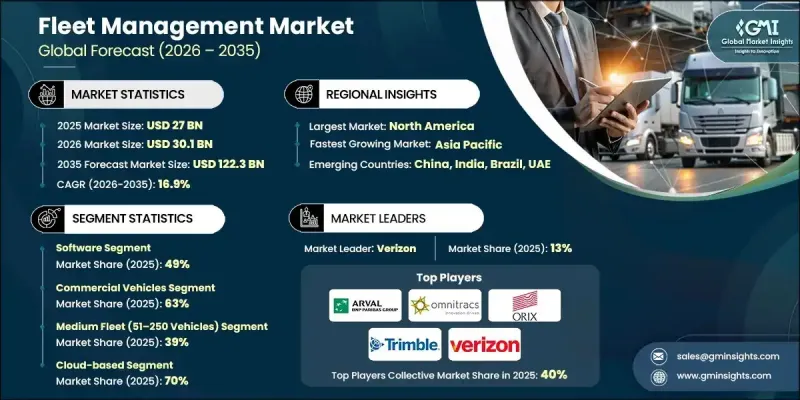
强劲的市场成长主要得益于持续的数位转型、车辆电气化程度的提高、严格的监管合规性以及快速发展的电子商务产业。该市场涵盖广泛的硬体产品,包括GPS/GNSS追踪器、远端资讯处理控制单元、行车记录器和物联网感测器,以及用于车队追踪、维护、燃油监控和分析的软体平台。专业的服务,例如安装、咨询、託管服务和培训,进一步强化了市场生态系统。云端解决方案发挥关键作用,与传统的本地部署系统相比,它能够实现扩充性、远端存取、自动更新并降低基础设施成本。特别是中小企业正在利用SaaS模式,无需大量IT投资即可获得先进的车队管理功能。北美市场处于领先地位,其中美国凭藉其高商用车活跃度、严格的电子记录设备(ELD)强制令、先进的远端资讯处理整合以及主要解决方案供应商的集中,推动了区域市场的扩张。
| 市场覆盖范围 | |
|---|---|
| 开始年份 | 2025 |
| 预测年份 | 2026-2035 |
| 起始值 | 270亿美元 |
| 预测金额 | 1223亿美元 |
| 复合年增长率 | 16.9% |
预计到2025年,软体产业将占据49%的市场份额,并在2026年至2035年间以17.1%的复合年增长率成长。儘管技术不断进步,但硬体仍逐渐趋于同质化,因此该产业正迅速向以软体为中心、采用经常性收入模式的解决方案转型。目前,软体平台凭藉其全面的功能占据市场主导地位,这些功能远不止于简单的数据收集,还能提供数据聚合、分析、可视化和可执行的洞察。该领域的成长动力来自以下几个方面:能够支撑高价的先进功能、带来高利润经常性收入的SaaS订阅模式,以及能够带来可衡量的营运投资回报率的智慧决策工具的日益普及。
预计到2025年,商用车市占率将达到63%,2026年至2035年期间的复合年增长率(CAGR)将达到17%。该细分市场包括轻型商用货车、中型卡车和重型牵引车。这些车辆的年行驶里程在3万英里到10万英里以上,年燃油消耗量在5000加仑到2万加仑之间,油价根据地区和燃油类型的不同,每加仑在3.00美元到4.50美元之间。轻型商用车,例如小型送货卡车和服务货车,广泛用于本地配送和服务,受益于路线优化、生产力监控和营运效率的提升。
美国车队管理市场预计到2025年将达到121亿美元,并在2026年至2035年间以14.6%的复合年增长率成长。成熟的远端资讯处理生态系统、强大的数位基础设施以及联网汽车技术的快速普及推动了这一成长。物流、运输、公共产业和公共服务产业的车队营运商正在加速采用先进的车队解决方案。软体开发商、远端资讯处理供应商和云端平台公司也进一步推动了这一趋势,他们致力于提高营运效率、安全性和合规性。
目录
第一章调查方法
第二章执行摘要
第三章业界考察
- 生态系分析
- 供应商情况
- 利润率分析
- 成本结构
- 每个阶段的附加价值
- 影响价值链的因素
- 中断
- 产业影响因素
- 司机
- 对效率和成本节约的需求
- 日益严格的汽车保养法规
- 电子商务和最后一公里配送的兴起
- 将先进技术整合到远端资讯处理、物联网 (IoT) 和人工智慧中
- 日益重视永续性
- 产业潜在风险与挑战
- 数据过载和管理问题
- 驾驶员管理与安全问题
- 市场机会
- 整合人工智慧、物联网和高阶分析技术,实现更智慧的车队运营
- 部署配备专用监控工具的电动和混合动力汽车队
- 自动驾驶车辆车队管理解决方案
- 拓展新兴市场与区域市场
- 联网汽车和5G车队管理系统
- 成长潜力分析
- 监管环境
- 波特五力分析
- PESTEL 分析
- 科技与创新趋势
- 当前技术趋势
- 新兴技术
- 成本細項分析
- 专利分析
- 用例和成功案例
- 永续性和环境方面
- 永续努力
- 减少废弃物策略
- 生产中的能源效率
- 环保倡议
- 碳足迹考量
- 未来前景与机会
第四章 竞争情势
- 介绍
- 公司市占率分析
- 北美洲
- 欧洲
- 亚太地区
- 拉丁美洲
- 中东和非洲
- 主要市场公司的竞争分析
- 竞争定位矩阵
- 战略展望矩阵
- 重大进展
- 併购
- 伙伴关係与合作
- 新产品发布
- 企业扩张计画和资金筹措
第五章 按组件分類的市场估算与预测,2022-2035年
- 硬体
- 车辆追踪设备
- 车载诊断系统(OBD)
- 车载资讯设备
- 感应器
- 软体
- 车队管理软体(FMS)
- 车载资讯服务平台
- 路线优化和调度软体
- 驾驶员行为监控软体
- 维护管理软体
- 服务
- 安装与集成
- 数据分析与报告
- 维护和支援服务
第六章 依车辆类型分類的市场估计与预测,2022-2035年
- 搭乘用车
- SUV
- 掀背车
- 轿车
- 商用车辆
- 轻型
- 中型
- 重负
- 电动车
- 特种车辆车队
- 建筑和采矿设备
- 紧急车辆
- 公用事业服务车辆
7. 按车队规模分類的市场估算与预测,2022-2035 年
- 小规模车队(1-50车)
- 中型车队(51-250车)
- 大型车队(超过250辆车)
第八章 连结技术市场估算与预测,2022-2035年
- GPS/GNSS
- 4G/LTE
- 5G
- Bluetooth/Wi-Fi
- 卫星通讯
- 物联网感测器和CAN总线集成
第九章 依部署方式分類的市场估算与预测,2022-2035年
- 本地部署
- 基于云端的
第十章 依最终用途分類的市场估计与预测,2022-2035年
- 运输
- 营运管理
- 驾驶员管理
- 车辆追踪系统
- 合规管理
- 维护管理
- 燃料管理
- 资产追踪
- 其他的
- 建造
- 营运管理
- 驾驶员管理
- 车辆追踪系统
- 合规管理
- 维护管理
- 燃料管理
- 资产追踪
- 其他的
- 製造业
- 营运管理
- 驾驶员管理
- 车辆追踪系统
- 合规管理
- 维护管理
- 燃料管理
- 资产追踪
- 其他的
- 公共产业
- 营运管理
- 驾驶员管理
- 车辆追踪系统
- 合规管理
- 维护管理
- 燃料管理
- 资产追踪
- 其他的
- 医疗和药品
- 营运管理
- 驾驶员管理
- 车辆追踪系统
- 合规管理
- 维护管理
- 燃料管理
- 资产追踪
- 其他的
- 零售与电子商务
- 营运管理
- 驾驶员管理
- 车辆追踪系统
- 合规管理
- 维护管理
- 燃料管理
- 资产追踪
- 其他的
- 食品饮料/低温运输
- 营运管理
- 驾驶员管理
- 车辆追踪系统
- 合规管理
- 维护管理
- 燃料管理
- 资产追踪
- 其他的
- 其他的
- 营运管理
- 驾驶员管理
- 车辆追踪系统
- 合规管理
- 维护管理
- 燃料管理
- 资产追踪
- 其他的
第十一章 2022-2035年各地区市场估计与预测
- 北美洲
- 美国
- 加拿大
- 欧洲
- 德国
- 英国
- 法国
- 义大利
- 西班牙
- 俄罗斯
- 北欧国家
- 比荷卢经济联盟
- 亚太地区
- 中国
- 印度
- 日本
- 澳洲
- 韩国
- 新加坡
- 泰国
- 印尼
- 越南
- 拉丁美洲
- 巴西
- 墨西哥
- 阿根廷
- 哥伦比亚
- 中东和非洲
- 南非
- 沙乌地阿拉伯
- 阿拉伯聯合大公国
第十二章:公司简介
- 世界公司
- ARI Fleet Management
- Donlen
- Element Fleet Management
- Geotab
- LeasePlan
- Omnitracs
- Orix
- Trimble
- Verizon Connect
- Wheels
- 当地公司
- Azuga
- Bestmile
- ClearPath GPS
- GPS Insights
- Inseego
- NexTraq
- Onfleet
- Teletrac Navman
- ThingTech
- TomTom Telematics
- 新兴科技创新者
- Automile
- Fleet Complete
- KeepTruckin(Motive)
- Lytx
- Samsara
The Global Fleet Management Market was valued at USD 27 billion in 2025 and is estimated to grow at a CAGR of 16.9% to reach USD 122.3 billion by 2035.
The market's strong growth is fueled by ongoing digital transformation, the rise of vehicle electrification, stringent regulatory compliance, and the booming e-commerce sector. This market spans a wide range of hardware, including GPS/GNSS trackers, telematics control units, dashcams, and IoT sensors, while also encompassing software platforms for fleet tracking, maintenance, fuel monitoring, and analytics. Professional services such as installation, consulting, managed services, and training further enhance the market ecosystem. Cloud-based solutions play a pivotal role, offering scalability, remote accessibility, automatic updates, and lower infrastructure costs compared to traditional on-premises systems. Small and medium-sized enterprises are particularly leveraging SaaS models to access advanced fleet management functionalities without heavy IT investment. North America leads this market, with the U.S. driving regional expansion due to high commercial vehicle activity, strict ELD mandates, advanced telematics integration, and a concentration of key solution providers.
| Market Scope | |
|---|---|
| Start Year | 2025 |
| Forecast Year | 2026-2035 |
| Start Value | $27 Billion |
| Forecast Value | $122.3 Billion |
| CAGR | 16.9% |
The software segment accounted for a 49% share in 2025 and is forecasted to grow at a CAGR of 17.1% from 2026 to 2035. The industry is increasingly shifting toward software-centric solutions with recurring revenue models, while hardware is becoming commoditized despite technological advancements. Software platforms now dominate by offering comprehensive capabilities for data aggregation, analytics, visualization, and actionable insights, which go far beyond simple data collection. The segment's growth is driven by advanced features that justify premium pricing, SaaS subscription models with high-margin recurring revenues, and the rising adoption of intelligent decision-making tools that deliver measurable operational ROI.
The commercial vehicles segment held a 63% share in 2025 and is expected to grow at a CAGR of 17% between 2026 and 2035. This segment includes light-duty vans, medium-duty trucks, and heavy-duty tractors, which travel between 30,000 and over 100,000 miles annually, consuming 5,000 to 20,000 gallons of fuel per year, with prices ranging from USD 3.00 to USD 4.50 per gallon depending on the region and fuel type. Light-duty commercial vehicles, such as small delivery trucks and service vans, are widely used in local deliveries and service fleets, benefiting from route optimization, productivity monitoring, and operational efficiency improvements.
U.S. Fleet Management Market generated USD 12.1 billion in 2025 and is expected to grow at a CAGR of 14.6% from 2026 to 2035. The growth is supported by a mature telematics ecosystem, strong digital infrastructure, and rapid adoption of connected vehicle technologies. Fleet operators across logistics, transportation, utilities, and public services are increasingly implementing advanced fleet solutions. This adoption is reinforced by software developers, telematics providers, and cloud platform companies aiming to improve operational efficiency, safety, and regulatory compliance.
Major players operating in the Global Fleet Management Industry include Geotab, Samsara, Omnitracs, Trimble, ARI Fleet Management, Wheels, Verizon Connect, Arval-Element, Donlen, and Teletrac Navman. Key strategies adopted by companies in the Global Fleet Management Market include expanding both hardware and software offerings to provide end-to-end solutions, developing cloud-based platforms for scalable and remote fleet management, and implementing SaaS subscription models that generate high-margin recurring revenues. Providers are integrating AI, predictive analytics, and real-time reporting features to enhance decision-making and operational efficiency. Partnerships with vehicle manufacturers, telematics vendors, and cloud service providers enable companies to broaden market reach and strengthen global presence.
Table of Contents
Chapter 1 Methodology
- 1.1 Market scope and definition
- 1.2 Research design
- 1.2.1 Research approach
- 1.2.2 Data collection methods
- 1.3 Data mining sources
- 1.3.1 Global
- 1.3.2 Regional/Country
- 1.4 Base estimates and calculations
- 1.4.1 Base year calculation
- 1.4.2 Key trends for market estimation
- 1.5 Primary research and validation
- 1.5.1 Primary sources
- 1.6 Forecast model
- 1.7 Research assumptions and limitations
Chapter 2 Executive Summary
- 2.1 Industry 3600 synopsis, 2022 - 2035
- 2.2 Key market trends
- 2.2.1 Regional
- 2.2.2 Component
- 2.2.3 Vehicle
- 2.2.4 Fleet Size
- 2.2.5 Connectivity Technology
- 2.2.6 Deployment Mode
- 2.2.7 End Use
- 2.3 TAM Analysis, 2026-2035
- 2.4 CXO perspectives: Strategic imperatives
- 2.4.1 Executive decision points
- 2.4.2 Critical success factors
- 2.5 Future outlook and strategic recommendations
Chapter 3 Industry Insights
- 3.1 Industry ecosystem analysis
- 3.1.1 Supplier landscape
- 3.1.2 Profit margin analysis
- 3.1.3 Cost structure
- 3.1.4 Value addition at each stage
- 3.1.5 Factor affecting the value chain
- 3.1.6 Disruptions
- 3.2 Industry impact forces
- 3.2.1.1 Growth drivers
- 3.2.1.2 Demand for efficiency and cost reduction
- 3.2.1.3 A growing number of regulations in vehicle maintenance
- 3.2.1.4 Rise of e-commerce and last-mile delivery
- 3.2.1.5 Integration of advanced technologies in telematics, the Internet of Things (IoT), and artificial intelligence
- 3.2.1.6 Increasing focus on sustainability
- 3.2.2 Industry pitfalls and challenges
- 3.2.2.1 Data overload and management concerns
- 3.2.2.2 Driver management and safety issues
- 3.2.3 Market opportunities
- 3.2.3.1 Integration of AI, IoT, and advanced analytics for smarter fleet operations.
- 3.2.3.2 Adoption of electric and hybrid vehicle fleets with specialized monitoring tools.
- 3.2.3.3 Autonomous vehicle fleet management solutions.
- 3.2.3.4 Expansion in emerging and regional markets.
- 3.2.3.5 Connected vehicles and 5G-enabled fleet management systems.
- 3.3 Growth potential analysis
- 3.4 Regulatory landscape
- 3.5 Porter's analysis
- 3.6 PESTEL analysis
- 3.7 Technology and innovation landscape
- 3.7.1 Current technological trends
- 3.7.2 Emerging technologies
- 3.8 Cost breakdown analysis
- 3.9 Patent analysis
- 3.10 Use cases & success stories
- 3.11 Sustainability and environmental aspects
- 3.11.1 Sustainable practices
- 3.11.2 Waste reduction strategies
- 3.11.3 Energy efficiency in production
- 3.11.4 Eco-friendly Initiatives
- 3.11.5 Carbon footprint considerations
- 3.12 Future outlook and opportunities
Chapter 4 Competitive Landscape, 2025
- 4.1 Introduction
- 4.2 Company market share analysis
- 4.2.1 North America
- 4.2.2 Europe
- 4.2.3 Asia Pacific
- 4.2.4 LATAM
- 4.2.5 MEA
- 4.3 Competitive analysis of major market players
- 4.4 Competitive positioning matrix
- 4.5 Strategic outlook matrix
- 4.6 Key developments
- 4.6.1 Mergers & acquisitions
- 4.6.2 Partnerships & collaborations
- 4.6.3 New product launches
- 4.6.4 Expansion plans and funding
Chapter 5 Market Estimates & Forecast, By Component, 2022 - 2035 ($Bn)
- 5.1 Key trends
- 5.2 Hardware
- 5.2.1 Vehicle tracking devices
- 5.2.2 Onboard diagnostics (OBD) devices
- 5.2.3 Telematics devices
- 5.2.4 Sensors
- 5.3 Software
- 5.3.1 Fleet management software (FMS)
- 5.3.2 Telematics platforms
- 5.3.3 Route optimization & scheduling software
- 5.3.4 Driver behavior monitoring software
- 5.3.5 Maintenance management software
- 5.4 Services
- 5.4.1 Installation & integration
- 5.4.2 Data analytics & reporting
- 5.4.3 Maintenance & support services
Chapter 6 Market Estimates & Forecast, By Vehicle, 2022 - 2035 ($Bn)
- 6.1 Key trends
- 6.2 Passenger vehicles
- 6.2.1 SUVs
- 6.2.2 Hatchback
- 6.2.3 Sedan
- 6.3 Commercial vehicles
- 6.3.1 Light duty
- 6.3.2 Medium-duty
- 6.3.3 Heavy-duty
- 6.4 Electric Vehicle
- 6.5 Specialty Fleets
- 6.5.1 Construction & mining equipment
- 6.5.2 Emergency vehicles
- 6.5.3 Utility service vehicles
Chapter 7 Market Estimates & Forecast, By Fleet Size, 2022 - 2035 ($Bn)
- 7.1 Key trends
- 7.2 Small fleet (1-50 vehicles)
- 7.3 Medium fleet (51-250 vehicles)
- 7.4 Large fleet (250+ vehicles)
Chapter 8 Market Estimates & Forecast, By Connectivity Technology, 2022 - 2035 ($Bn)
- 8.1 Key trends
- 8.2 GPS / GNSS
- 8.3 4G / LTE
- 8.4 5G
- 8.5 Bluetooth / Wi-Fi
- 8.6 Satellite communication
- 8.7 IoT sensors & CAN bus integration
Chapter 9 Market Estimates & Forecast, By Deployment Mode, 2022 - 2035 ($Bn)
- 9.1 Key trends
- 9.2 On-premises
- 9.3 Cloud-based
Chapter 10 Market Estimates & Forecast, By End Use, 2022 - 2035 ($Bn)
- 10.1 Key trends
- 10.2 Transportation
- 10.2.1 Operation management
- 10.2.2 Driver management
- 10.2.3 Vehicle tracking system
- 10.2.4 Compliance management
- 10.2.5 Maintenance management
- 10.2.6 Fuel management
- 10.2.7 Asset tracking
- 10.2.8 Others
- 10.3 Construction
- 10.3.1 Operation management
- 10.3.2 Driver management
- 10.3.3 Vehicle tracking system
- 10.3.4 Compliance management
- 10.3.5 Maintenance management
- 10.3.6 Fuel management
- 10.3.7 Asset tracking
- 10.3.8 Others
- 10.4 Manufacturing
- 10.4.1 Operation management
- 10.4.2 Driver management
- 10.4.3 Vehicle tracking system
- 10.4.4 Compliance management
- 10.4.5 Maintenance management
- 10.4.6 Fuel management
- 10.4.7 Asset tracking
- 10.4.8 Other
- 10.5 Utility
- 10.5.1 Operation management
- 10.5.2 Driver management
- 10.5.3 Vehicle tracking system
- 10.5.4 Compliance management
- 10.5.5 Maintenance management
- 10.5.6 Fuel management
- 10.5.7 Asset tracking
- 10.5.8 Others
- 10.6 Healthcare & pharmaceuticals
- 10.6.1 Operation management
- 10.6.2 Driver management
- 10.6.3 Vehicle tracking system
- 10.6.4 Compliance management
- 10.6.5 Maintenance management
- 10.6.6 Fuel management
- 10.6.7 Asset tracking
- 10.6.8 Others
- 10.7 Retail & E-commerce
- 10.7.1 Operation management
- 10.7.2 Driver management
- 10.7.3 Vehicle tracking system
- 10.7.4 Compliance management
- 10.7.5 Maintenance management
- 10.7.6 Fuel management
- 10.7.7 Asset tracking
- 10.7.8 Others
- 10.8 Food & beverage / cold Chain
- 10.8.1 Operation management
- 10.8.2 Driver management
- 10.8.3 Vehicle tracking system
- 10.8.4 Compliance management
- 10.8.5 Maintenance management
- 10.8.6 Fuel management
- 10.8.7 Asset tracking
- 10.8.8 Others
- 10.9 Others
- 10.9.1 Operation management
- 10.9.2 Driver management
- 10.9.3 Vehicle tracking system
- 10.9.4 Compliance management
- 10.9.5 Maintenance management
- 10.9.6 Fuel management
- 10.9.7 Asset tracking
- 10.9.8 Others
Chapter 11 Market Estimates & Forecast, By Region, 2022 - 2035 ($Bn)
- 11.1 Key trends
- 11.2 North America
- 11.2.1 US
- 11.2.2 Canada
- 11.3 Europe
- 11.3.1 Germany
- 11.3.2 UK
- 11.3.3 France
- 11.3.4 Italy
- 11.3.5 Spain
- 11.3.6 Russia
- 11.3.7 Nordics
- 11.3.8 Benelux
- 11.4 Asia Pacific
- 11.4.1 China
- 11.4.2 India
- 11.4.3 Japan
- 11.4.4 Australia
- 11.4.5 South Korea
- 11.4.6 Singapore
- 11.4.7 Thailand
- 11.4.8 Indonesia
- 11.4.9 Vietnam
- 11.5 Latin America
- 11.5.1 Brazil
- 11.5.2 Mexico
- 11.5.3 Argentina
- 11.5.4 Colombia
- 11.6 MEA
- 11.6.1 South Africa
- 11.6.2 Saudi Arabia
- 11.6.3 UAE
Chapter 12 Company Profiles
- 12.1 Global Players
- 12.1.1 ARI Fleet Management
- 12.1.2 Donlen
- 12.1.3 Element Fleet Management
- 12.1.4 Geotab
- 12.1.5 LeasePlan
- 12.1.6 Omnitracs
- 12.1.7 Orix
- 12.1.8 Trimble
- 12.1.9 Verizon Connect
- 12.1.10 Wheels
- 12.2 Regional Players
- 12.2.1 Azuga
- 12.2.2 Bestmile
- 12.2.3 ClearPath GPS
- 12.2.4 GPS Insights
- 12.2.5 Inseego
- 12.2.6 NexTraq
- 12.2.7 Onfleet
- 12.2.8 Teletrac Navman
- 12.2.9 ThingTech
- 12.2.10 TomTom Telematics
- 12.3 Emerging Technology Innovators
- 12.3.1 Automile
- 12.3.2 Fleet Complete
- 12.3.3 KeepTruckin (Motive)
- 12.3.4 Lytx
- 12.3.5 Samsara

 东南亚车队管理市场报告 - 第二版
 车队行车记录器市场规模、份额和成长分析(按产品类型、车辆类型、功能、最终用户和地区划分)-2026-2033年产业预测
 车队管理市场分析及预测(至2035年):依类型、产品类型、服务、技术、组件、应用、设备、部署类型及最终用户划分
 2026年全球电动车队管理市场报告
 车队管理市场-全球产业规模、份额、趋势、机会及预测(按车辆类型、组件、通讯技术、产业垂直领域、地区及竞争格局划分,2021-2031年)
 车队管理能力和解决方案市场:全球预测(2026-2032 年),按解决方案类型、部署模式、车队类型、车辆类型和最终用户行业划分
 欧洲车队管理:市场占有率分析、产业趋势与统计、成长预测(2026-2031 年)
 日本车队管理市场报告:按组件、车辆类型、最终用户产业、技术、部署类型和地区划分(2026-2034 年)
 学校交通解决方案市场规模、份额和成长分析(按关键特性、部署模式、平台、应用、客户规模、最终用户和地区划分)-2026-2033年产业预测
 车队管理市场规模、份额和成长分析(按组件、车队类型、垂直行业和地区划分)-2026-2033年产业预测