


 |
市场调查报告书
商品编码
1913359
海洋能源市场机会、成长要素、产业趋势分析及2026年至2035年预测Marine Energy Market Opportunity, Growth Drivers, Industry Trend Analysis, and Forecast 2026 - 2035 |
||||||

全球海洋能源市场预计到 2025 年价值 21.1 亿美元,到 2035 年达到 49.4 亿美元,年复合成长率为 9.7%。
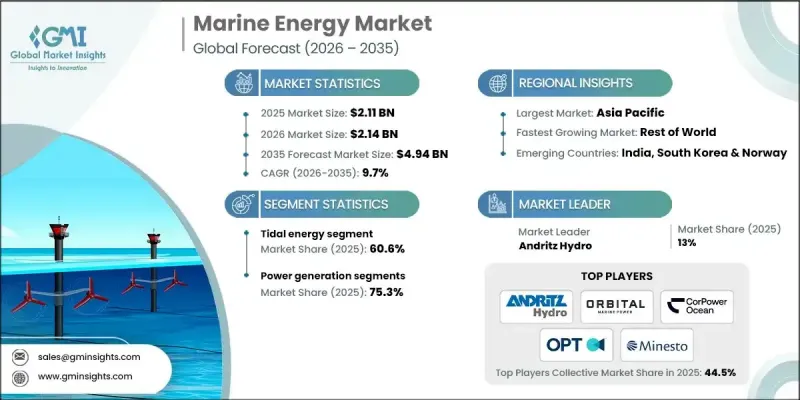
越来越多的公共部门资金筹措机制鼓励对海洋可再生能源系统进行探索、试点部署和早期商业化,从而推动了市场成长。海洋能源是指利用海洋资源(例如潮汐运动、波浪运动、洋流和温差)发电,为传统能源来源提供了永续的替代方案。这些系统将海水的动能和热能转化为可用电力,排放极低。海洋能源因其可预测性、较长的运作寿命以及对实现脱碳目标的贡献而日益受到重视。人们对绿色可再生能源解决方案日益增长的兴趣持续推动市场需求。对能够提供稳定输出并具有应对气候变迁能力的能源来源的需求也是推动市场发展的重要因素。将海洋能源计划与现有的海上可再生能源基础设施结合,可以提高成本效益和电网连接性。混合可再生能源配置进一步提高了运转率利用率,并支持不间断供电,从而巩固了海洋能源在多元化清洁能源组合中的长期地位。
| 市场覆盖范围 | |
|---|---|
| 开始年份 | 2025 |
| 预测年份 | 2026-2035 |
| 起始值 | 21.1亿美元 |
| 预测金额 | 49.4亿美元 |
| 复合年增长率 | 9.7% |
预计到 2035 年,盐度梯度发电领域市场规模将达到 5 亿美元。增加对先进膜技术研发的投资,将提高能量转换效率,同时降低系统成本,促进商业化进程,并支持在水资源充足的地区进行更广泛的部署。
预计到 2035 年,海洋动力海水淡化应用领域将以 10.7% 的复合年增长率成长。沿海和岛屿地区对淡水的需求不断增长,推动了人们对绿能解决方案的兴趣,这些解决方案可以降低营运成本、提高能源效率并支持长期的水安全。
预计到 2025 年,美国海洋能源市场将占全球市场份额的 89.9%,到 2035 年将成长至 2,000 亿美元。强劲的可再生能源目标、日益增长的机构投资者兴趣以及不断增加的私人投资,持续巩固该地区的主导地位和长期市场潜力。
目录
第一章调查方法和范围
第二章执行摘要
第三章业界考察
- 产业生态系统
- 原物料供应及采购分析
- 製造能力评估
- 供应链韧性与风险因素
- 配电网路分析
- 监管环境
- 产业影响因素
- 司机
- 产业潜在风险与挑战
- 成长潜力分析
- 成本结构分析
- 波特五力分析
- PESTEL 分析
- 新的机会与趋势
- 数位化和物联网集成
- 拓展新兴市场
- 投资分析及未来展望
第四章 竞争情势
- 介绍
- 按地区分類的公司市占率分析
- 北美洲
- 欧洲
- 亚太地区
- 世界其他地区
- 战略仪錶板
- 策略倡议
- 企业标竿管理
- 创新与科技趋势
第五章 依类型分類的市场规模及预测(2022-2035年)
- 波能
- 潮汐能
- 海洋温差发电(OTEC)
- 盐度梯度发电(SGP)
第六章 依应用领域分類的市场规模及预测(2022-2035年)
- 发电
- 海水淡化
- 其他的
第七章 2022-2035年各地区市场规模及预测
- 北美洲
- 美国
- 加拿大
- 欧洲
- 法国
- 西班牙
- 英国
- 挪威
- 亚太地区
- 中国
- 印度
- 韩国
- 世界其他地区
第八章:公司简介
- Andritz Hydro
- AWS Ocean Energy
- BioPower Systems
- Carnegie Clean Energy
- CorPower Ocean
- Eco Wave Power
- Havkraft AS
- Marine Energy Group
- Minesto
- Mocean Energy
- Nova Innovations
- Ocean Power Technologies(OPT)
- Ocean Renewable Power Company
- Orbital Marine Power
- Oscilla Power
- Sabella SAS
- Seabased AB
- SINN Power
- SSE Renewables
- Verdant Power
The Global Marine Energy Market was valued at USD 2.11 billion in 2025 and is estimated to grow at a CAGR of 9.7% to reach USD 4.94 billion by 2035.
Market growth is supported by rising public-sector funding mechanisms that encourage research, pilot deployment, and early commercialization of ocean-based renewable power systems. Marine energy represents electricity generated from ocean resources such as tidal movements, wave motion, water currents, and thermal differences, offering a sustainable alternative to conventional energy sources. These systems convert the kinetic and thermal potential of seawater into usable power with minimal emissions. Marine energy is increasingly valued for its predictability, long operating life, and contribution to decarbonization goals. Growing interest in renewable solutions with lower environmental impact continues to strengthen demand. The market also benefits from the need for energy sources that provide stable output and resilience against climate variability. Integration of marine energy projects with existing offshore renewable infrastructure improves cost efficiency and grid connectivity. Hybrid renewable configurations further enhance utilization rates and support uninterrupted electricity generation, reinforcing the long-term role of marine energy within diversified clean power portfolios.
| Market Scope | |
|---|---|
| Start Year | 2025 |
| Forecast Year | 2026-2035 |
| Start Value | $2.11 Billion |
| Forecast Value | $4.94 Billion |
| CAGR | 9.7% |
The salinity gradient power segment is projected to reach USD 500 million by 2035. Increased investment in advanced membrane development improves energy conversion efficiency while reducing system costs, which enhances commercial readiness and supports wider deployment in regions with suitable water resources.
The marine energy-powered desalination applications segment will grow at a CAGR of 10.7% through 2035. Rising freshwater demand in coastal and island regions accelerates interest in clean power solutions that reduce operating costs, improve energy efficiency, and support long-term water security.
U.S. Marine Energy Market held 89.9% share in 2025 and is expected to generate USD 200 million by 2035. Strong renewable energy targets, growing institutional interest, and increasing private investment continue to reinforce regional leadership and long-term market potential.
Key companies active in the Global Marine Energy Market include Orbital Marine Power, Ocean Power Technologies, Carnegie Clean Energy, Verdant Power, Andritz Hydro, Minesto, SSE Renewables, CorPower Ocean, SINN Power, Mocean Energy, Nova Innovations, Sabella SAS, Seabased AB, Oscilla Power, Havkraft AS, BioPower Systems, Eco Wave Power, Marine Energy Group, AWS Ocean Energy, and Ocean Renewable Power Company. Companies strengthen their position by prioritizing technology optimization, cost reduction, and scalable project development. Many players focus on improving device durability and energy efficiency to enhance long-term performance in harsh marine environments. Strategic partnerships with utilities, infrastructure developers, and research institutions support faster commercialization and risk sharing. Firms also emphasize modular designs and standardized components to simplify deployment and maintenance.
Table of Contents
Chapter 1 Methodology & Scope
- 1.1 Research design
- 1.1.1 Research approach
- 1.1.2 Data collection methods
- 1.2 Base estimates and calculations
- 1.2.1 Base year calculation
- 1.2.2 Market estimates & forecast parameters
- 1.3 Forecast
- 1.3.1 Key trends for market estimates
- 1.3.1.1 Quantified market impact analysis
- 1.3.2 Mathematical impact of growth parameters on forecast
- 1.3.3 Scenario analysis framework
- 1.3.1 Key trends for market estimates
- 1.4 Primary research and validation
- 1.4.1 Some of the primary sources (but not limited to)
- 1.5 Data mining sources
- 1.5.1 Paid Sources
- 1.5.2 Sources, by region
- 1.6 Research trail & scoring components
- 1.6.1 Research trail components
- 1.6.2 Scoring components
- 1.7 Research transparency addendum
- 1.7.1 Source attribution framework
- 1.7.2 Quality assurance metrics
- 1.7.3 Our commitment to trust
- 1.8 Market definitions
Chapter 2 Executive Summary
- 2.1 Industry synopsis, 2022 - 2035
- 2.2 Business trends
- 2.3 Type trends
- 2.4 Application trends
- 2.5 Regional trends
Chapter 3 Industry Insights
- 3.1 Industry ecosystem
- 3.1.1 Raw material availability & sourcing analysis
- 3.1.2 Manufacturing capacity assessment
- 3.1.3 Supply chain resilience & risk factors
- 3.1.4 Distribution network analysis
- 3.2 Regulatory landscape
- 3.3 Industry impact forces
- 3.3.1 Growth drivers
- 3.3.2 Industry pitfalls & challenges
- 3.4 Growth potential analysis
- 3.5 Cost structure analysis
- 3.6 Porter's analysis
- 3.6.1 Bargaining power of suppliers
- 3.6.2 Bargaining power of buyers
- 3.6.3 Threat of new entrants
- 3.6.4 Threat of substitutes
- 3.7 PESTEL analysis
- 3.7.1 Political factors
- 3.7.2 Economic factors
- 3.7.3 Social factors
- 3.7.4 Technological factors
- 3.7.5 Legal factors
- 3.7.6 Environmental factors
- 3.8 Emerging opportunities & trends
- 3.8.1 Digitalization & IoT integration
- 3.8.2 Emerging market penetration
- 3.9 Investment analysis and future outlook
Chapter 4 Competitive landscape, 2025
- 4.1 Introduction
- 4.2 Company market share analysis, by region, 2025
- 4.2.1 North America
- 4.2.2 Europe
- 4.2.3 Asia Pacific
- 4.2.4 Rest of World
- 4.3 Strategic dashboard
- 4.4 Strategic initiatives
- 4.5 Company benchmarking
- 4.6 Innovation & technology landscape
Chapter 5 Market Size and Forecast, By Type, 2022 - 2035 (USD Million & MW)
- 5.1 Key trends
- 5.2 Wave energy
- 5.3 Tidal energy
- 5.4 Ocean thermal energy conversion (OTEC)
- 5.5 Salinity gradient power (SGP)
Chapter 6 Market Size and Forecast, By Application, 2022 - 2035 (USD Million & MW)
- 6.1 Key trends
- 6.2 Power generation
- 6.3 Desalination
- 6.4 Others
Chapter 7 Market Size and Forecast, By Region, 2022 - 2035 (USD Million & MW)
- 7.1 Key trends
- 7.2 North America
- 7.2.1 U.S.
- 7.2.2 Canada
- 7.3 Europe
- 7.3.1 France
- 7.3.2 Spain
- 7.3.3 UK
- 7.3.4 Norway
- 7.4 Asia Pacific
- 7.4.1 China
- 7.4.2 India
- 7.4.3 South Korea
- 7.5 Rest of World
Chapter 8 Company Profiles
- 8.1 Andritz Hydro
- 8.2 AWS Ocean Energy
- 8.3 BioPower Systems
- 8.4 Carnegie Clean Energy
- 8.5 CorPower Ocean
- 8.6 Eco Wave Power
- 8.7 Havkraft AS
- 8.8 Marine Energy Group
- 8.9 Minesto
- 8.10 Mocean Energy
- 8.11 Nova Innovations
- 8.12 Ocean Power Technologies (OPT)
- 8.13 Ocean Renewable Power Company
- 8.14 Orbital Marine Power
- 8.15 Oscilla Power
- 8.16 Sabella SAS
- 8.17 Seabased AB
- 8.18 SINN Power
- 8.19 SSE Renewables
- 8.20 Verdant Power

 船舶能源效率市场规模、份额及成长分析(按类型、应用和地区划分)-2026-2033年产业预测
 按船舶类型、营运模式、载重吨位、系统、解决方案和地区分類的航运市场规模、份额和成长分析 - 产业预测(2026-2033 年)
 航运市场规模、份额和趋势分析报告:按船舶类型、载重吨位、营运、地区和细分市场预测,2025 年至 2033 年
 2025年全球航运市场报告
 船舶市场机会、成长动力、产业趋势分析及 2025 - 2034 年预测
 2034 年海洋市场分析与预测:类型、产品、服务、技术、组件、应用、材料类型、最终用户
 海洋武器系统市场按武器类型、平台、射程、导引系统和应用划分 - 2025-2030 年全球预测2025年海洋能源效率全球市场报告