


 |
市场调查报告书
商品编码
1913377
蛋白A树脂市场:市场机会、成长驱动因素、产业趋势分析及预测(2026-2035)Protein A Resins Market Opportunity, Growth Drivers, Industry Trend Analysis, and Forecast 2026 - 2035 |
||||||

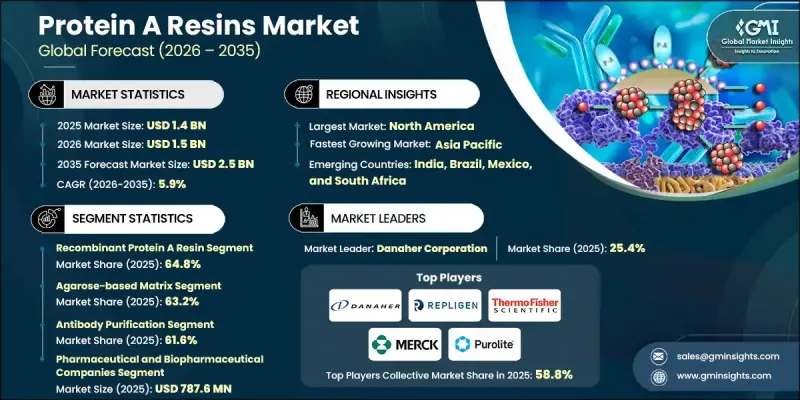
全球蛋白A树脂市场预计到2025年将达到14亿美元,到2035年将达到25亿美元,年复合成长率为5.9%。
市场成长与生物製药行业的快速扩张和生物製药产量的不断提高密切相关。 Protein A 树脂作为一种高亲和性层析法介质,可高效纯化生产过程中的单株抗体和免疫球蛋白。对生物疗法的持续增长的需求正推动生产商扩大产能,这直接增加了他们对高性能纯化解决方案的依赖。重点地区人口老化导致需要先进生物疗法和疫苗的长期健康问题发生率上升,进一步强化了对 Protein A 树脂的需求。对生命科学研究的持续投入、生物製药生产基础设施的不断完善以及对产品品质和均一性的严格监管要求,都在推动市场稳步扩张。这些因素共同促成了 Protein A 树脂成为现代生物製药生产流程中不可或缺的一部分。
| 市场覆盖范围 | |
|---|---|
| 开始年份 | 2025 |
| 预测期 | 2026-2035 |
| 初始市场规模 | 14亿美元 |
| 市场规模预测 | 25亿美元 |
| 复合年增长率 | 5.9% |
重组蛋白A树脂预计在2025年将占据64.8%的市场份额,这主要得益于其卓越的结合效率、更高的稳定性以及在大规模生物製药生产环境中的稳定性能。技术进步提高了树脂的耐久性和运作,从而帮助生产商优化成本。
由于琼脂糖基质具有优异的机械性能、良好的流动性和适用于工业规模层析法系统的特性,预计到 2025 年,琼脂糖基材产品市场份额将达到 63.2%。
受强劲的生物製药研究活动和抗体疗法的持续开发推动,美国蛋白 A 树脂市场预计将从 2025 年的 5.421 亿美元增长到 2035 年的 9.524 亿美元。
目录
第一章:分析方法和范围
第二章执行摘要
第三章业界考察
- 产业生态系分析
- 产业影响因素
- 司机
- 疫苗和治疗性抗体的需求不断增长
- 慢性病发生率呈上升趋势
- 扩大药物发现与研发活动
- 蛋白质A树脂技术进展
- 产业潜在风险与挑战
- 单株抗体纯化替代方法的兴起
- 基体树脂高成本
- 市场机会
- 新兴市场的地域扩张
- 永续性和成本效益
- 司机
- 成长潜力分析
- 监管环境
- 北美洲
- 欧洲
- 亚太地区
- 科技趋势
- 当前技术趋势
- 新兴技术
- 专利分析
- 未来市场趋势
- 定价分析
- 波特五力分析
- PESTEL 分析
第四章 竞争情势
- 介绍
- 公司市占率分析
- 按地区
- 世界
- 北美洲
- 欧洲
- 亚太地区
- 按地区
- 企业矩阵分析
- 主要企业的竞争分析
- 竞争定位矩阵
- 主要趋势
- 企业合併(M&A)
- 伙伴关係与合作
- 新产品发布
- 扩张计划
第五章 按产品分類的市场估算与预测(2022-2035 年)
- 天然蛋白A树脂
- 重组蛋白A树脂
6. 依基材类型分類的市场估算与预测(2022-2035 年)
- 琼脂糖基材
- 玻璃/硅胶基材
- 有机聚合物基材
第七章 按应用领域分類的市场估算与预测(2022-2035 年)
- 免疫沉淀分析法
- 抗体纯化
第八章 依最终用途分類的市场估算与预测(2022-2035 年)
- 製药和生物製药公司
- CRO/CDMO
- 学术和研究机构
- 其他最终用户
第九章 各地区市场估算与预测(2022-2035 年)
- 北美洲
- 美国
- 加拿大
- 欧洲
- 德国
- 英国
- 法国
- 义大利
- 西班牙
- 荷兰
- 亚太地区
- 中国
- 印度
- 日本
- 澳洲
- 韩国
- 拉丁美洲
- 巴西
- 墨西哥
- 阿根廷
- 中东和非洲
- 沙乌地阿拉伯
- 南非
- 阿拉伯聯合大公国
第十章:公司简介
- Agarose Beads Technologies
- Agilent Technologies
- Bio-Rad Laboratories
- Danaher Corporation
- GenScript
- Merck
- Purolite
- Repligen Corporation
- Takara Bio
- Thermo Fisher Scientific
- Tosoh Bioscience
The Global Protein A Resins Market was valued at USD 1.4 billion in 2025 and is estimated to grow at a CAGR of 5.9% to reach USD 2.5 billion by 2035.
Market growth is linked to the rapid expansion of the biopharmaceutical industry and the rising production of biologic drugs. Protein A resins serve as high-affinity chromatography media that enable efficient purification of monoclonal antibodies and immunoglobulins during manufacturing. As demand for biologic therapies continues to rise, manufacturers are scaling up production capacities, which directly increases reliance on high-performance purification solutions. Aging populations across major regions are contributing to higher incidence rates of long-term health conditions that require advanced biologic treatments and vaccines, further strengthening demand for protein A resins. Continued investment in life sciences research, expansion of biopharmaceutical manufacturing infrastructure, and strict regulatory requirements for product quality and consistency are reinforcing steady market expansion. Together, these factors position protein A resins as an essential component within modern biologics manufacturing workflows.
| Market Scope | |
|---|---|
| Start Year | 2025 |
| Forecast Year | 2026-2035 |
| Start Value | $1.4 Billion |
| Forecast Value | $2.5 Billion |
| CAGR | 5.9% |
The recombinant protein A resins segment accounted 64.8% share in 2025, supported by their superior binding efficiency, improved stability, and consistent performance in large-scale biologics production environments. Technological progress has enhanced resin durability and operational lifespan, helping manufacturers optimize costs.
The agarose-based matrix products segment held 63.2% share in 2025, driven by their strong mechanical properties, favorable flow behavior, and suitability for industrial-scale chromatography systems.
U.S. Protein A Resins Market is expected to grow from USD 542.1 million in 2025 to USD 952.4 million by 2035, supported by strong biopharmaceutical research activity and rising development of antibody-based therapeutics.
Key companies operating in the Global Protein A Resins Market include Merck, Repligen Corporation, Thermo Fisher Scientific, Danaher Corporation, Tosoh Bioscience, Bio-Rad Laboratories, Agilent Technologies, Purolite, GenScript, Takara Bio, and Agarose Beads Technologies. Companies in the Global Protein A Resins Market are strengthening their market position through continuous investment in resin innovation to improve binding capacity, durability, and chemical resistance. Strategic collaborations with biopharmaceutical manufacturers help align product development with evolving production needs. Firms are expanding manufacturing capabilities to support large-scale biologics production and ensure reliable supply chains. Focusing on regulatory compliance, quality consistency, and cost optimization enables suppliers to meet stringent industry standards.
Table of Contents
Chapter 1 Methodology and Scope
- 1.1 Market scope and definitions
- 1.2 Research design
- 1.2.1 Research approach
- 1.2.2 Data collection methods
- 1.3 Data mining sources
- 1.3.1 Global
- 1.3.2 Regional/country
- 1.4 Base estimates and calculations
- 1.4.1 Base year calculation
- 1.4.2 Key trends for market estimation
- 1.5 Primary research and validation
- 1.5.1 Primary sources
- 1.6 Forecast model
- 1.7 Research assumptions and limitations
Chapter 2 Executive Summary
- 2.1 Industry 360º synopsis
- 2.2 Key market trends
- 2.2.1 Regional trends
- 2.2.2 Product trends
- 2.2.3 Matrix type trends
- 2.2.4 Application trends
- 2.2.5 End use trends
- 2.3 CXO perspectives: Strategic imperatives
- 2.3.1 Key decision points for industry executives
- 2.3.2 Critical success factors for market players
- 2.4 Future outlook and strategic recommendations
Chapter 3 Industry Insights
- 3.1 Industry ecosystem analysis
- 3.2 Industry impact forces
- 3.2.1 Growth drivers
- 3.2.1.1 Rising demand for vaccine and therapeutic antibodies
- 3.2.1.2 Increasing prevalence of chronic diseases
- 3.2.1.3 Growing drug discovery and research and development activity
- 3.2.1.4 Technology advancements in protein A resins
- 3.2.2 Industry pitfalls and challenges
- 3.2.2.1 Rise in alternative methods for the purification of monoclonal antibodies
- 3.2.2.2 High cost of the matrix resins
- 3.2.3 Market opportunities
- 3.2.3.1 Regional expansion in emerging markets
- 3.2.3.2 Sustainability and cost-effectiveness
- 3.2.1 Growth drivers
- 3.3 Growth potential analysis
- 3.4 Regulatory landscape
- 3.4.1 North America
- 3.4.2 Europe
- 3.4.3 Asia Pacific
- 3.5 Technology landscape
- 3.5.1 Current technological trends
- 3.5.2 Emerging technologies
- 3.6 Patent analysis
- 3.7 Future market trends
- 3.8 Pricing analysis
- 3.9 Porter's analysis
- 3.10 PESTEL analysis
Chapter 4 Competitive Landscape, 2025
- 4.1 Introduction
- 4.2 Company market share analysis
- 4.2.1 Global
- 4.2.2 North America
- 4.2.3 Europe
- 4.2.4 Asia Pacific
- 4.3 Company matrix analysis
- 4.4 Competitive analysis of major market players
- 4.5 Competitive positioning matrix
- 4.6 Key development
- 4.6.1 Mergers and acquisitions
- 4.6.2 Partnerships and collaborations
- 4.6.3 New product launches
- 4.6.4 Expansion plans
Chapter 5 Market Estimates and Forecast, By Product, 2022 - 2035 ($ Mn)
- 5.1 Key trends
- 5.2 Natural protein A resin
- 5.3 Recombinant protein A resin
Chapter 6 Market Estimates and Forecast, By Matrix Type, 2022 - 2035 ($ Mn)
- 6.1 Key trends
- 6.2 Agarose-based matrix
- 6.3 Glass or silica gel-based matrix
- 6.4 Organic polymer-based matrix
Chapter 7 Market Estimates and Forecast, By Application, 2022 - 2035 ($ Mn)
- 7.1 Key trends
- 7.2 Immunoprecipitation
- 7.3 Antibody purification
Chapter 8 Market Estimates and Forecast, By End Use, 2022 - 2035 ($ Mn)
- 8.1 Key trends
- 8.2 Pharmaceutical and biopharmaceutical companies
- 8.3 CROs and CDMOs
- 8.4 Academic and research institutes
- 8.5 Other end users
Chapter 9 Market Estimates and Forecast, By Region, 2022 - 2035 ($ Mn)
- 9.1 Key trends
- 9.2 North America
- 9.2.1 U.S.
- 9.2.2 Canada
- 9.3 Europe
- 9.3.1 Germany
- 9.3.2 UK
- 9.3.3 France
- 9.3.4 Italy
- 9.3.5 Spain
- 9.3.6 Netherlands
- 9.4 Asia Pacific
- 9.4.1 China
- 9.4.2 India
- 9.4.3 Japan
- 9.4.4 Australia
- 9.4.5 South Korea
- 9.5 Latin America
- 9.5.1 Brazil
- 9.5.2 Mexico
- 9.5.3 Argentina
- 9.6 Middle East and Africa
- 9.6.1 Saudi Arabia
- 9.6.2 South Africa
- 9.6.3 UAE
Chapter 10 Company Profiles
- 10.1 Agarose Beads Technologies
- 10.2 Agilent Technologies
- 10.3 Bio-Rad Laboratories
- 10.4 Danaher Corporation
- 10.5 GenScript
- 10.6 Merck
- 10.7 Purolite
- 10.8 Repligen Corporation
- 10.9 Takara Bio
- 10.10 Thermo Fisher Scientific
- 10.11 Tosoh Bioscience

 2026年全球蛋白A树脂市场报告
 蛋白A树脂市场规模、份额及成长分析(依产品类型、蛋白A类型、应用、最终用户及地区划分)-2026-2033年产业预测
 蛋白A树脂市场-全球产业规模、份额、趋势、机会和预测,按产品、基质类型、应用(免疫沉淀、抗体纯化)、最终用户、地区和竞争格局划分,2020-2030年预测
 全球蛋白A树脂市场(按产品、产地、基质类型、应用和最终用户划分)- 预测至2030年
 蛋白质 A、G 和 L 树脂的全球市场蛋白质A树脂的全球市场
 全球蛋白A树脂市场:市场规模、占有率、趋势、产业分析:依类型、产品、应用、最终用户、地区、未来预测(2025-2034)
 蛋白 A 树脂市场:依产品类型、依基质类型、依应用、依最终使用者、按地区蛋白质A,G,L,树脂市场,规模,占有率,趋势,产业分析报告:各类型,各用途,各地区 - 市场预测,2024年~2032年
 Protein A树脂全球市场2024-2028