


 |
市场调查报告书
商品编码
1913402
精油市场机会、成长驱动因素、产业趋势分析及预测(2026-2035)Essential Oils Market Opportunity, Growth Drivers, Industry Trend Analysis, and Forecast 2026 - 2035 |
||||||

全球精油市场预计到 2025 年将达到 283 亿美元,到 2035 年将达到 604 亿美元,年复合成长率为 7.9%。
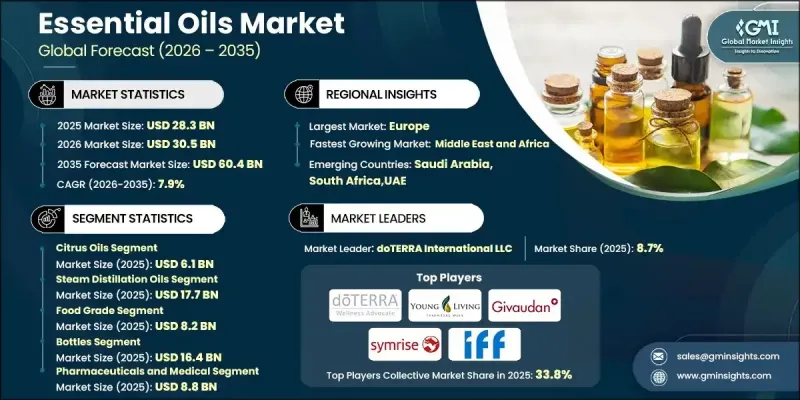
市场成长的驱动力在于消费者对有益于身心健康的植物来源产品的偏好日益增强。精油是从各种植物成分中提取的高浓度芳香液体,因其香气、功能特性和治疗潜力而备受推崇。历史上,精油一直被用于药品、化妆品配方和食品添加剂中,随着消费者转向天然解决方案,其重要性也与日俱增。萃取技术的不断进步提高了产量稳定性、纯度和敏感成分的保留率,从而促进了更广泛的商业性应用。现代加工技术增强了扩充性、品质保证和标准化,使精油在整个行业中更容易获得。人们对天然疗法的认识不断提高,以及天然疗法越来越多地被融入消费品中,并持续推动着全球市场的发展势头。
| 市场覆盖范围 | |
|---|---|
| 开始年份 | 2025 |
| 预测年份 | 2026-2035 |
| 起始金额 | 283亿美元 |
| 预测金额 | 604亿美元 |
| 复合年增长率 | 7.9% |
2025年,柑橘油市场价值将达到61亿美元。该市场受益于其在保健、家居和消费品配方中的广泛应用,而其他植物油类别则继续支持治疗、个人护理和卫生应用方面的多样化需求。
预计到2025年,蒸汽蒸馏法萃取精油的市场规模将达到177亿美元,成为最大的萃取方法细分市场。该技术因其能够保留精油的活性成分而持续受到青睐。其他萃取方法也因其满足特定植物成分需求和高端应用领域而不断获得认可。
预计到2025年,美国精油市场规模将达55亿美元。北美市场的成长得益于天然保健品日益普及、健康和化妆品製造商的强大影响力,以及消费者对符合道德规范且经过认证的精油需求不断增长。法律规范也为产品的安全性和品质稳定性提供了保障。
目录
第一章调查方法和范围
第二章执行摘要
第三章业界考察
- 生态系分析
- 供应商情况
- 利润率
- 每个阶段的附加价值
- 影响价值链的因素
- 中断
- 产业影响因素
- 成长驱动因素
- 对天然和有机产品的需求不断增长
- 健康与保健趋势
- 美容和个人护理行业的扩张
- 产业潜在风险与挑战
- 过敏反应或皮肤敏感
- 高昂的生产成本
- 市场机会
- 永续且环保的包装
- 拓展新市场
- 技术进步
- 成长驱动因素
- 成长潜力分析
- 监管环境
- 北美洲
- 欧洲
- 亚太地区
- 拉丁美洲
- 中东和非洲
- 波特分析
- PESTEL 分析
- 科技与创新趋势
- 当前技术趋势
- 新兴技术
- 价格趋势
- 按地区
- 依产品类型
- 未来市场趋势
- 科技与创新趋势
- 当前技术趋势
- 新兴技术
- 专利趋势
- 贸易统计(HS编码)(註:仅提供主要国家的贸易统计)
- 主要进口国
- 主要出口国
- 永续性和环境方面
- 永续努力
- 减少废弃物策略
- 生产中的能源效率
- 环保倡议
- 考虑到碳足迹
第四章 竞争情势
- 介绍
- 公司市占率分析
- 按地区
- 北美洲
- 欧洲
- 亚太地区
- 拉丁美洲
- 中东和非洲
- 按地区
- 企业矩阵分析
- 主要市场公司的竞争分析
- 竞争定位矩阵
- 重大进展
- 併购
- 伙伴关係与合作
- 新产品发布
- 业务拓展计划
第五章 依产品类型分類的市场估算与预测(2022-2035 年)
- 柑橘类精油
- 薄荷油
- 熏衣草花油
- 尤加利茶树油
- 香辛料油
- 木材和树脂精油
- 花香净油和珍贵精油
- 草本植物和草本精油
- 针叶树和松树油
- 其他的
第六章 依撷取法分類的市场估算与预测(2022-2035 年)
- 蒸汽蒸馏
- 冷压
- 溶剂萃取
- 二氧化碳萃取(超临界和亚临界)
- 其他的
第七章 市场估算与预测:依等级划分(2022-2035 年)
- 治疗级
- 食品级
- 化妆品和香水级
- 工业级
- 医药级
第八章 市场估算与预测:依包装类型划分(2022-2035 年)
- 瓶子
- 散装容器
- 罐
- 其他的
第九章 按分销管道分類的市场估计和预测(2022-2035 年)
- 超级市场/大卖场
- 专卖店
- 专业沙龙
- 线上/电子商务
- 药局
- 其他的
第十章 按应用领域分類的市场估算与预测(2022-2035 年)
- 製药和医疗领域
- 食品/饮料
- 化妆品和个人护理
- 芳香疗法与健康
- 香水及香氛
- 宠物护理
- 动物饲料
- 其他的
第十一章 各地区市场估计与预测(2022-2035 年)
- 北美洲
- 美国
- 加拿大
- 墨西哥
- 欧洲
- 德国
- 英国
- 法国
- 西班牙
- 义大利
- 其他欧洲
- 亚太地区
- 中国
- 印度
- 日本
- 澳洲
- 韩国
- 亚太其他地区
- 拉丁美洲
- 巴西
- 墨西哥
- 阿根廷
- 其他拉丁美洲
- 中东和非洲
- 沙乌地阿拉伯
- 南非
- 阿拉伯聯合大公国
- 其他中东和非洲地区
第十二章:公司简介
- AOS Products Private Limited(Aromatic and Allied Chemicals)
- doTERRA International LLC
- Eden Botanicals
- Floracopeia Inc.
- Givaudan SA
- DSM-Firmenich
- Kush Aroma Exports Private Limited
- Mane SA
- Mountain Rose Herbs
- Plant Therapy Essential Oils
- Pranarom International
- Robertet Group
- Symrise AG
- Takasago International Corporation
- Young Living Essential Oils LC
- International Flavors and Fragrances Inc.(IFF)
The Global Essential Oils Market was valued at USD 28.3 billion in 2025 and is estimated to grow at a CAGR of 7.9% to reach USD 60.4 billion by 2035.
Market growth is driven by rising consumer preference for plant-derived products that support physical and emotional well-being. Essential oils are defined as highly concentrated aromatic liquids obtained from different botanical components and valued for their fragrance, functional properties, and therapeutic potential. These oils have been used historically across healthcare, cosmetic formulation, and food enhancement, and continue to gain relevance as consumers shift toward natural solutions. Ongoing progress in extraction technologies has improved yield consistency, purity levels, and preservation of sensitive compounds, enabling broader commercial adoption. Modern processing techniques have enhanced scalability, quality assurance, and standardization, making essential oils more accessible across industries. Expanding awareness of natural wellness practices and increased integration into consumer products continue to reinforce global market momentum.
| Market Scope | |
|---|---|
| Start Year | 2025 |
| Forecast Year | 2026-2035 |
| Start Value | $28.3 Billion |
| Forecast Value | $60.4 Billion |
| CAGR | 7.9% |
The citrus-based oils segment reached USD 6.1 billion in 2025. This segment benefits from wide application across wellness, household, and consumable formulations, while other botanical oil categories continue to support diversified demand across therapeutic, personal care, and hygiene uses.
The steam-distilled oils segment accounted for USD 17.7 billion in 2025, making this the leading extraction method segment. This technique remains widely used due to its ability to preserve functional integrity. Other extraction approaches continue to gain traction for specific botanical requirements and premium applications.
U.S. Essential Oils Market generated USD 5.5 billion in 2025. Growth across North America is supported by increasing adoption of natural health products, strong presence of wellness and cosmetic manufacturers, and rising demand for ethically sourced and certified oils. Regulatory oversight continues to support safety and quality consistency.
Key companies operating in the Global Essential Oils Market include Givaudan SA, International Flavors and Fragrances Inc., DSM-Firmenich, Symrise AG, Robertet Group, Mane SA, Takasago International Corporation, doTERRA International LLC, Young Living Essential Oils LC, Pranarom International, Plant Therapy Essential Oils, Mountain Rose Herbs, Eden Botanicals, Floracopeia Inc., AOS Products Private Limited, and Kush Aroma Exports Private Limited. Companies in the Essential Oils Market are strengthening their market position through investment in sustainable sourcing, advanced extraction technologies, and product diversification. Leading players are focusing on vertical integration to secure raw material supply and maintain quality control. Strategic partnerships with wellness, cosmetic, and food manufacturers are expanding application reach. Firms are emphasizing certification, traceability, and transparency to meet evolving consumer expectations.
Table of Contents
Chapter 1 Methodology & Scope
- 1.1 Market scope and definition
- 1.2 Research design
- 1.2.1 Research approach
- 1.2.2 Data collection methods
- 1.3 Data mining sources
- 1.3.1 Global
- 1.3.2 Regional/Country
- 1.4 Base estimates and calculations
- 1.4.1 Base year calculation
- 1.4.2 Key trends for market estimation
- 1.5 Primary research and validation
- 1.5.1 Primary sources
- 1.6 Forecast model
- 1.7 Research assumptions and limitations
Chapter 2 Executive Summary
- 2.1 Industry 3600 synopsis
- 2.2 Key market trends
- 2.2.1 Product Type
- 2.2.2 Extraction Method
- 2.2.3 Grade
- 2.2.4 Packaging Type
- 2.2.5 Distribution Channel
- 2.2.6 Application
- 2.2.7 Regional
- 2.3 TAM Analysis, 2025-2035
- 2.4 CXO perspectives: Strategic imperatives
- 2.4.1 Executive decision points
- 2.4.2 Critical success factors
- 2.5 Future outlook and strategic recommendations
Chapter 3 Industry Insights
- 3.1 Industry ecosystem analysis
- 3.1.1 Supplier landscape
- 3.1.2 Profit margin
- 3.1.3 Value addition at each stage
- 3.1.4 Factor affecting the value chain
- 3.1.5 Disruptions
- 3.2 Industry impact forces
- 3.2.1 Growth drivers
- 3.2.1.1 Rising demand for natural and organic products
- 3.2.1.2 Health and wellness trends
- 3.2.1.3 Expansion of the beauty and personal care industry
- 3.2.2 Industry pitfalls and challenges
- 3.2.2.1 Allergic reactions or skin sensitivity
- 3.2.2.2 High production costs
- 3.2.3 Market opportunities
- 3.2.3.1 Sustainable and eco-friendly packaging
- 3.2.3.2 Expansion into new markets
- 3.2.3.3 Technological advancements
- 3.2.1 Growth drivers
- 3.3 Growth potential analysis
- 3.4 Regulatory landscape
- 3.4.1 North America
- 3.4.2 Europe
- 3.4.3 Asia Pacific
- 3.4.4 Latin America
- 3.4.5 Middle East & Africa
- 3.5 Porter's analysis
- 3.6 PESTEL analysis
- 3.7 Technology and innovation landscape
- 3.7.1 Current technological trends
- 3.7.2 Emerging technologies
- 3.8 Price trends
- 3.8.1 By region
- 3.8.2 By product type
- 3.9 Future market trends
- 3.10 Technology and innovation landscape
- 3.10.1 Current technological trends
- 3.10.2 Emerging technologies
- 3.11 Patent landscape
- 3.12 Trade statistics (HS code) ( Note: the trade statistics will be provided for key countries only)
- 3.12.1 Major importing countries
- 3.12.2 Major exporting countries
- 3.13 Sustainability and environmental aspects
- 3.13.1 Sustainable practices
- 3.13.2 Waste reduction strategies
- 3.13.3 Energy efficiency in production
- 3.13.4 Eco-friendly initiatives
- 3.14 Carbon footprint consideration
Chapter 4 Competitive Landscape, 2025
- 4.1 Introduction
- 4.2 Company market share analysis
- 4.2.1 By region
- 4.2.1.1 North America
- 4.2.1.2 Europe
- 4.2.1.3 Asia Pacific
- 4.2.1.4 LATAM
- 4.2.1.5 MEA
- 4.2.1 By region
- 4.3 Company matrix analysis
- 4.4 Competitive analysis of major market players
- 4.5 Competitive positioning matrix
- 4.6 Key developments
- 4.6.1 Mergers & acquisitions
- 4.6.2 Partnerships & collaborations
- 4.6.3 New product launches
- 4.6.4 Expansion plans
Chapter 5 Market Estimates and Forecast, By Product Type, 2022-2035 (USD Billion) (Kilo Tons)
- 5.1 Key trends
- 5.2 Citrus oils
- 5.3 Mint oils
- 5.4 Lavender and floral oils
- 5.5 Eucalyptus and tea tree oils
- 5.6 Spice oils
- 5.7 Wood and resin oils
- 5.8 Floral absolutes and precious oils
- 5.9 Grass and herb oils
- 5.10 Conifer and pine oils
- 5.11 Others
Chapter 6 Market Estimates and Forecast, By Extraction Method, 2022-2035 (USD Billion) (Kilo Tons)
- 6.1 Key trends
- 6.2 Steam distillation
- 6.3 Cold pressing (expression)
- 6.4 Solvent extraction
- 6.5 CO2 extraction (supercritical and subcritical)
- 6.6 Others
Chapter 7 Market Estimates and Forecast, By Grade, 2022-2035 (USD Billion) (Kilo Tons)
- 7.1 Key trends
- 7.2 Therapeutic grade
- 7.3 Food grade
- 7.4 Cosmetic and perfume grade
- 7.5 Industrial grade
- 7.6 Pharmaceutical grade
Chapter 8 Market Estimates and Forecast, By Packaging Type, 2022-2035 (USD Billion) (Kilo Tons)
- 8.1 Key trends
- 8.2 Bottles
- 8.3 Bulk Containers
- 8.4 Canisters
- 8.5 Others
Chapter 9 Market Estimates and Forecast, By Distribution Channel, 2022-2035 (USD Billion) (Kilo Tons)
- 9.1 Key trends
- 9.2 Supermarkets/ Hypermarkets
- 9.3 Specialty stores
- 9.4 Professional salon
- 9.5 Online/e-commerce
- 9.6 Pharmacy stores
- 9.7 Others
Chapter 10 Market Estimates and Forecast, By Application, 2022-2035 (USD Billion) (Kilo Tons)
- 10.1 Key trends
- 10.2 Pharmaceuticals and medical
- 10.3 Food and beverages
- 10.4 Cosmetics and personal care
- 10.5 Aromatherapy and wellness
- 10.6 Fragrances and perfumery
- 10.7 Pet care
- 10.8 Animal feed
- 10.9 Others
Chapter 11 Market Estimates and Forecast, By Region, 2022-2035 (USD Billion) (Kilo Tons)
- 11.1 Key trends
- 11.2 North America
- 11.2.1 U.S.
- 11.2.2 Canada
- 11.2.3 Mexico
- 11.3 Europe
- 11.3.1 Germany
- 11.3.2 UK
- 11.3.3 France
- 11.3.4 Spain
- 11.3.5 Italy
- 11.3.6 Rest of Europe
- 11.4 Asia Pacific
- 11.4.1 China
- 11.4.2 India
- 11.4.3 Japan
- 11.4.4 Australia
- 11.4.5 South Korea
- 11.4.6 Rest of Asia Pacific
- 11.5 Latin America
- 11.5.1 Brazil
- 11.5.2 Mexico
- 11.5.3 Argentina
- 11.5.4 Rest of Latin America
- 11.6 Middle East and Africa
- 11.6.1 Saudi Arabia
- 11.6.2 South Africa
- 11.6.3 UAE
- 11.6.4 Rest of Middle East and Africa
Chapter 12 Company Profiles
- 12.1 AOS Products Private Limited (Aromatic and Allied Chemicals)
- 12.2 doTERRA International LLC
- 12.3 Eden Botanicals
- 12.4 Floracopeia Inc.
- 12.5 Givaudan SA
- 12.6 DSM-Firmenich
- 12.7 Kush Aroma Exports Private Limited
- 12.8 Mane SA
- 12.9 Mountain Rose Herbs
- 12.10 Plant Therapy Essential Oils
- 12.11 Pranarom International
- 12.12 Robertet Group
- 12.13 Symrise AG
- 12.14 Takasago International Corporation
- 12.15 Young Living Essential Oils LC
- 12.16 International Flavors and Fragrances Inc. (IFF)

 全球精油市场规模、份额、趋势和成长分析报告(2026-2034年)
 2026-2030年全球有机精油市场
 2026-2032年全球睡眠精油市场预测(依产品类型、形态、应用、最终用户和销售管道)佛木精油市场按产品类型、萃取方法、品质等级、应用、通路和最终用户划分,全球预测(2026-2032年)按产品类型、应用和分销管道分類的阿米香树精油市场,全球预测(2026-2032年)榄香脂精油市场依等级、萃取方法、用途及通路划分,全球预测(2026-2032年)熏衣草肥料市场:按肥料类型、配方、种植方法、应用和分销管道划分-2026-2032年全球预测黄花籽油市场按形态、用途、分销管道和最终用户划分,全球预测(2026-2032)
 α-红没药醇市场规模、份额和成长分析(按纯度、应用、通路和地区划分)—2026-2033年产业预测
 广藿香油市场规模、份额和成长分析(按产品类型、特性、萃取製程、分销通路、功能、最终用途和地区划分)-2026-2033年产业预测