


 |
市场调查报告书
商品编码
1913406
体育场照明市场机会、成长要素、产业趋势分析及2026年至2035年预测Stadium Lighting Market Opportunity, Growth Drivers, Industry Trend Analysis, and Forecast 2026 - 2035 |
||||||

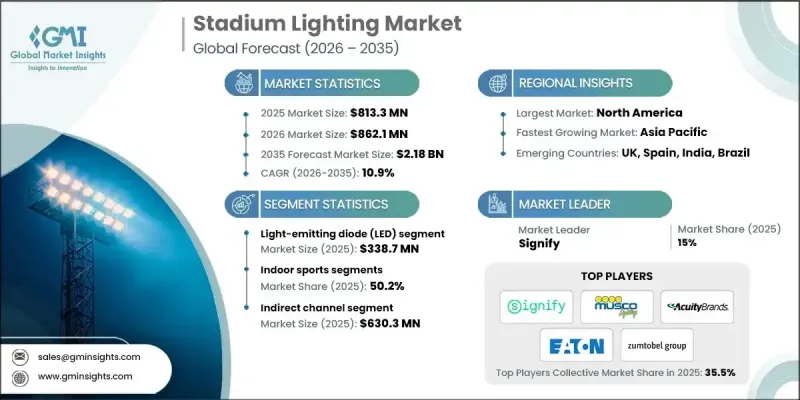
全球体育场照明市场预计到 2025 年价值 8.133 亿美元,到 2035 年达到 21.8 亿美元,年复合成长率为 10.9%。
政府以提高能源效率为重点的法规正在重塑照明系统设计,并加速老旧基础设施的更新换代。现代广播技术,包括先进的超高清格式,对照明品质、均匀性和视觉清晰度提出了更高的要求,推动了大规模体育场馆的升级改造。许多老旧的照明装置已无法满足目前的性能和效率标准,因此对替换设备的需求十分旺盛。强制规定最低能源性能目标的法规结构进一步推动了市场扩张,合规期限将持续到下一个十年。数位照明技术也正在透过实现即时系统监控、预测性维护和生命週期优化,改变体育场馆的运作方式。利用互联感测器和虚拟建模的先进控制平台,透过自动效能调整,平均可降低20%的能耗。全球范围内减少排放和节约能源的努力,持续推动智慧照明解决方案在公共和私人体育场馆的应用。
| 市场覆盖范围 | |
|---|---|
| 开始年份 | 2025 |
| 预测年份 | 2026-2035 |
| 起始值 | 8.133亿美元 |
| 预测金额 | 21.8亿美元 |
| 复合年增长率 | 10.9% |
预计到2025年,发光二极体)技术市场规模将达到3.387亿美元。由于LED的消费量远低于传统照明系统,节能效果可达70%至80%,因此广泛采用。预计到2030年,LED技术的广泛应用每年将节省348兆瓦时的电力。这些系统不仅能提升视觉效果,也有助于降低长期营运成本。
到 2025 年,室内体育设施领域将占 50.2% 的市场份额。可控的室内环境全年提供稳定的照明、可预测的维护週期和可靠的照明性能,这促成了该领域的高普及率。
预计到2025年,美国体育场馆照明市场将占据80.2%的市场。体育赛事的持续扩张和场馆的现代化改造正在推动强劲的需求。联邦政府意识到LED系统比传统照明节能高达75%,加上政府推出的节能维修奖励计划,进一步促进了LED照明系统的普及。
目录
第一章调查方法和范围
第二章执行摘要
第三章业界考察
- 生态系分析
- 供应商情况
- 利润率
- 每个阶段的附加价值
- 影响价值链的因素
- 产业影响因素
- 司机
- 扩大运动基础设施
- 关注永续性和能源效率
- 政府措施和资金筹措
- 产业潜在风险与挑战
- 环境问题
- 维护保养不足
- 机会
- 智慧互联照明系统普及状况
- 向节能型LED解决方案过渡
- 司机
- 成长潜力分析
- 未来市场趋势
- 科技与创新趋势
- 当前技术趋势
- 新兴技术
- 价格趋势
- 按地区
- 透过光源
- 监管环境
- 标准和合规要求
- 区域法规结构
- 认证标准
- 贸易统计(HS编码940540)
- 主要进口国
- 主要出口国
- 差距分析
- 风险评估与缓解
- 波特五力分析
- PESTEL 分析
- 消费行为分析
- 购买模式
- 偏好分析
- 消费行为的区域差异
- 电子商务对购买决策的影响
第四章 竞争情势
- 介绍
- 公司市占率分析
- 按地区
- 企业矩阵分析
- 主要市场公司的竞争分析
- 竞争定位矩阵
- 重大进展
- 併购
- 伙伴关係与合作
- 新产品发布
- 扩张计划
第五章 2022-2035年按光源分類的市场估算与预测
- 发光二极体(LED)
- 高强度放电
- 高压钠灯
- 导光灯
第六章 依运动项目分類的市场估计与预测,2022-2035年
- 室内的
- 户外的
7. 按安装类型分類的市场估算与预测,2022-2035 年
- 新安装
- 维修
第八章 按分销管道分類的市场估算与预测,2022-2035年
- 直销
- 间接
第九章 2022-2035年各地区市场估算与预测
- 北美洲
- 美国
- 加拿大
- 欧洲
- 德国
- 法国
- 英国
- 义大利
- 西班牙
- 亚太地区
- 中国
- 印度
- 日本
- 韩国
- 澳洲
- 拉丁美洲
- 巴西
- 墨西哥
- 阿根廷
- 中东和非洲
- 南非
- 沙乌地阿拉伯
- 阿拉伯聯合大公国
第十章:公司简介
- Acuity Brands
- Aeon LED
- Ams Osram
- Bajaj Illumination
- Cree Lighting
- Current
- Eaton
- Ledil
- LG Electronics
- Musco Lighting
- Schreder
- Signify
- Thorn Lighting
- Transrail Lighting
- Zumtobel Group
The Global Stadium Lighting Market was valued at USD 813.3 million in 2025 and is estimated to grow at a CAGR of 10.9% to reach USD 2.18 billion by 2035.
Government mandates focused on energy efficiency are reshaping lighting system design and accelerating the replacement of outdated infrastructure. Modern broadcast requirements, including advanced ultra-high-definition formats, demand higher illumination quality, uniformity, and visual clarity, prompting large-scale stadium upgrades. Many legacy lighting installations no longer comply with current performance or efficiency benchmarks, creating strong replacement demand. Regulatory frameworks enforcing minimum energy performance targets, with phased compliance timelines extending into the next decade, further support market expansion. Digital lighting technologies are also transforming stadium operations by enabling real-time system monitoring, predictive maintenance, and lifecycle optimization. Advanced control platforms using connected sensors and virtual modeling help reduce energy consumption by an average of 20% through automated performance adjustments. Global commitments to emissions reduction and energy conservation continue to encourage the adoption of intelligent lighting solutions across public and private sports infrastructure.
| Market Scope | |
|---|---|
| Start Year | 2025 |
| Forecast Year | 2026-2035 |
| Start Value | $813.3 Million |
| Forecast Value | $2.18 billion |
| CAGR | 10.9% |
The light-emitting diode technology generated USD 338.7 million in 2025. LEDs are widely adopted due to their significantly lower energy consumption compared to conventional systems, delivering energy savings of approximately 70-80%. Broad adoption of LED technology is projected to result in annual electricity savings of 348 terawatt-hours by 2030. These systems also enhance visual performance while reducing long-term operational expenses.
The indoor sports facilities segment held a 50.2% share in 2025. Controlled indoor environments support consistent illumination, predictable maintenance cycles, and reliable lighting performance throughout the year, contributing to higher adoption rates within this segment.
United States Stadium Lighting Market held an 80.2% share in 2025. Continuous expansion of sports events and ongoing modernization of venues drive strong demand. Federal assessments highlighting that LED systems consume up to 75% less energy than traditional lighting, along with incentive programs supporting energy-efficient upgrades, further reinforce adoption.
Key companies operating in the Global Stadium Lighting Market include Signify, Eaton, Zumtobel Group, Acuity Brands, LG Electronics, Schreder, Musco Lighting, Cree Lighting, Ams Osram, Bajaj Illumination, Aeon LED, Ledil, Thorn Lighting, Transrail Lighting, and Current. Companies in the Global Stadium Lighting Market strengthen their competitive position through technology-driven innovation, energy-efficiency optimization, and digital system integration. Manufacturers focus on developing high-performance LED solutions that meet stringent broadcast and regulatory standards. Investment in smart lighting controls, connected sensors, and predictive maintenance platforms enhances system reliability and reduces operating costs. Strategic partnerships with infrastructure developers and sports authorities support large-scale project deployment.
Table of Contents
Chapter 1 Methodology & Scope
- 1.1 Market scope and definition
- 1.2 Research design
- 1.2.1 Research approach
- 1.2.2 Data collection methods
- 1.3 Data mining sources
- 1.3.1 Global
- 1.3.2 Regional/Country
- 1.4 Base estimates and calculations
- 1.4.1 Base year calculation
- 1.4.2 Key trends for market estimation
- 1.5 Primary research and validation
- 1.5.1 Primary sources
- 1.6 Forecast model
- 1.7 Research assumptions and limitations
Chapter 2 Executive Summary
- 2.1 Industry 3600 synopsis
- 2.2 Key market trends
- 2.2.1 Regional
- 2.2.2 Light source
- 2.2.3 Sports type
- 2.2.4 Installation type
- 2.2.5 Distribution channel
- 2.3 CXO perspectives: Strategic imperatives
- 2.3.1 Key decision points for industry executives
- 2.3.2 Critical success factors for market players
- 2.4 Future outlook and strategic recommendations
Chapter 3 Industry Insights
- 3.1 Industry ecosystem analysis
- 3.1.1 Supplier landscape
- 3.1.2 Profit margin
- 3.1.3 Value addition at each stage
- 3.1.4 Factor affecting the value chain
- 3.2 Industry impact forces
- 3.2.1 Growth drivers
- 3.2.1.1 Growing sports infrastructure
- 3.2.1.2 Emphasis on sustainability and energy efficiency
- 3.2.1.3 Government initiatives and funding
- 3.2.2 Industry pitfalls & challenges
- 3.2.2.1 Environmental concerns
- 3.2.2.2 Inadequate maintenance and upkeep
- 3.2.3 Opportunities
- 3.2.3.1 Adoption of smart and connected lighting systems
- 3.2.3.2 Shift toward energy-efficient LED solutions
- 3.2.1 Growth drivers
- 3.3 Growth potential analysis
- 3.4 Future market trends
- 3.5 Technology and innovation landscape
- 3.5.1 Current technological trends
- 3.5.2 Emerging technologies
- 3.6 Price trends
- 3.6.1 By region
- 3.6.2 By Light source
- 3.7 Regulatory landscape
- 3.7.1 Standards and compliance requirements
- 3.7.2 Regional regulatory frameworks
- 3.7.3 Certification standards
- 3.8 Trade statistics (HS code 940540)
- 3.8.1 Major importing countries
- 3.8.2 Major exporting countries
- 3.9 Gap analysis
- 3.10 Risk assessment and mitigation
- 3.11 Porter's analysis
- 3.12 PESTEL analysis
- 3.13 Consumer behaviour analysis
- 3.13.1 Purchasing patterns
- 3.13.2 Preference analysis
- 3.13.3 Regional variations in consumer behaviour
- 3.13.4 Impact of e-commerce on buying decisions
Chapter 4 Competitive Landscape, 2025
- 4.1 Introduction
- 4.2 Company market share analysis
- 4.2.1 By region
- 4.2.1.1 North America
- 4.2.1.2 Europe
- 4.2.1.3 Asia Pacific
- 4.2.1.4 Latin America
- 4.2.1.5 Middle East and Africa
- 4.2.1 By region
- 4.3 Company matrix analysis
- 4.4 Competitive analysis of major market players
- 4.5 Competitive positioning matrix
- 4.6 Key developments
- 4.6.1 Mergers & acquisitions
- 4.6.2 Partnerships & collaborations
- 4.6.3 New product launches
- 4.6.4 Expansion plans
Chapter 5 Market Estimates & Forecast, By Light Source, 2022 - 2035 (USD Million) (Thousand Units)
- 5.1 Key trends
- 5.2 Light-emitting diode (LED)
- 5.3 High-intensity discharge
- 5.4 High-pressure sodium
- 5.5 Induction lights
Chapter 6 Market Estimates & Forecast, By Sports Type, 2022 - 2035 (USD Million) (Thousand Units)
- 6.1 Key trends
- 6.2 Indoor
- 6.3 Outdoor
Chapter 7 Market Estimates & Forecast, By Installation Type, 2022 - 2035 (USD Million) (Thousand Units)
- 7.1 Key trends
- 7.2 New installation
- 7.3 Retrofit
Chapter 8 Market Estimates & Forecast, By Distribution Channel, 2022 - 2035 (USD Million) (Thousand Units)
- 8.1 Key trends
- 8.2 Direct
- 8.3 Indirect
Chapter 9 Market Estimates & Forecast, By Region, 2022 - 2035 (USD Million) (Thousand Units)
- 9.1 Key trends
- 9.2 North America
- 9.2.1 U.S.
- 9.2.2 Canada
- 9.3 Europe
- 9.3.1 Germany
- 9.3.2 France
- 9.3.3 UK
- 9.3.4 Italy
- 9.3.5 Spain
- 9.4 Asia Pacific
- 9.4.1 China
- 9.4.2 India
- 9.4.3 Japan
- 9.4.4 South Korea
- 9.4.5 Australia
- 9.5 Latin America
- 9.5.1 Brazil
- 9.5.2 Mexico
- 9.5.3 Argentina
- 9.6 MEA
- 9.6.1 South Africa
- 9.6.2 Saudi Arabia
- 9.6.3 UAE
Chapter 10 Company Profiles
- 10.1 Acuity Brands
- 10.2 Aeon LED
- 10.3 Ams Osram
- 10.4 Bajaj Illumination
- 10.5 Cree Lighting
- 10.6 Current
- 10.7 Eaton
- 10.8 Ledil
- 10.9 LG Electronics
- 10.10 Musco Lighting
- 10.11 Schreder
- 10.12 Signify
- 10.13 Thorn Lighting
- 10.14 Transrail Lighting
- 10.15 Zumtobel Group


