


 |
市场调查报告书
商品编码
1936482
运动照明市场机会、成长要素、产业趋势分析及2026年至2035年预测Sports Lighting Market Opportunity, Growth Drivers, Industry Trend Analysis, and Forecast 2026 - 2035 |
||||||

全球体育照明市场预计到 2025 年将达到 8.831 亿美元,到 2035 年将达到 18.7 亿美元,年复合成长率为 7.9%。
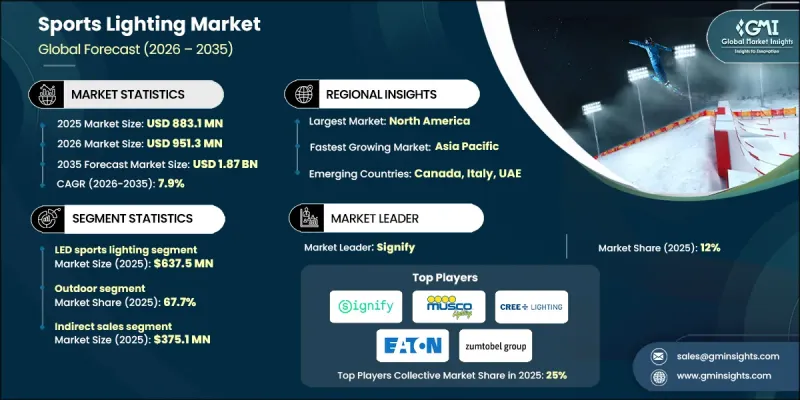
市场成长主要得益于体育场馆照明系统从传统技术向先进LED系统的大规模转型。现代体育场馆越来越重视能源效率、长寿命和卓越的照明质量,加速了LED照明在全球的普及。与传统照明相比,LED解决方案显着降低了电力消耗量和维护需求,使营运商能够在保持稳定照明品质的同时降低长期营运成本。更长的使用寿命(通常超过50,000小时)减少了停机时间和更换成本,尤其在大型场馆中,具有显着的价值。更高的色彩精度和更均匀的亮度提升了运动员和观众的可见度,并满足了更高的性能标准和转播要求。此外,更低的发热量也有助于降低冷却需求,从而实现整体节能,使照明昇级与永续性和碳减排目标相契合。
| 市场覆盖范围 | |
|---|---|
| 开始年份 | 2025 |
| 预测年份 | 2026-2035 |
| 起始值 | 8.831亿美元 |
| 预测金额 | 18.7亿美元 |
| 复合年增长率 | 7.9% |
LED 体育照明领域反映了其主导的市场地位,预计到 2025 年将达到 6.375 亿美元。这些系统具有高效、即时启动和出色的视觉效果,使其成为寻求可靠和柔软性照明解决方案的体育场、竞技场和休閒场所的完美选择。
到 2025 年,户外应用领域将占 67.7% 的市场份额。由于 LED 系统在恶劣环境条件下的耐用性、较长的使用寿命以及改进的光控制(可确保均匀照明并最大限度地减少设施周界外的光线洩漏),市场需求将保持强劲。
预计到 2025 年,美国体育照明市场将占据 79.7% 的市场份额,价值 2.438 亿美元。推动市场成长的因素包括体育设施的持续维修、严格的能源效率要求、永续性目标,以及对能够满足现代广播技术和数位互动需求的先进照明系统日益增长的需求。
目录
第一章调查方法和范围
第二章执行摘要
第三章业界考察
- 生态系分析
- 供应商情况
- 利润率
- 每个阶段的附加价值
- 影响价值链的因素
- 产业影响因素
- 司机
- LED穿透力和能源效率
- 高清广播要求
- 节能法规
- 产业潜在风险与挑战
- 前期成本高
- 供应链风险
- 机会
- 智慧照明集成
- 永续性和ESG相容性
- 司机
- 成长潜力分析
- 未来市场趋势
- 科技与创新趋势
- 当前技术趋势
- 新兴技术
- 价格趋势
- 按地区
- 按类型
- 监管环境
- 标准和合规要求
- 区域法规结构
- 认证标准
- 波特五力分析
- PESTEL 分析
第四章 竞争情势
- 介绍
- 公司市占率分析
- 按地区
- 企业矩阵分析
- 主要市场公司的竞争分析
- 竞争定位矩阵
- 重大进展
- 併购
- 伙伴关係与合作
- 新产品发布
- 扩张计划
第五章 按类型分類的市场估算与预测,2022-2035年
- LED运动照明
- 传统照明系统
- 太阳能运动照明
6. 2022-2035年按家电类型分類的市场估算与预测
- 泛光灯
- 工矿灯
第七章 按类别分類的市场估计与预测,2022-2035年
- 户外
- 室内的
第八章 2022-2035年按价格分類的市场估算与预测
- 低价位
- 中价位
- 高的
第九章 按功率类型分類的市场估算与预测,2022-2035年
- 50瓦或以下
- 50-100W
- 100-200W
- 150-200W
- 超过200瓦
第十章 依应用领域分類的市场估计与预测,2022-2035年
- 篮球
- 排球
- 网球和球拍运动
- 足球
- 蟋蟀
- 羽毛球
- 其他(橄榄球、棒球、冰上曲棍球等)
第十一章 依最终用户分類的市场估算与预测,2022-2035年
- 专业体育场馆
- 教育机构
- 市政/休閒设施
- 体育中心
- 培训学院
第十二章 按分销管道分類的市场估算与预测,2022-2035年
- 直销
- 间接销售
第十三章 2022-2035年各地区市场估算与预测
- 北美洲
- 我们
- 加拿大
- 欧洲
- 德国
- 英国
- 法国
- 义大利
- 西班牙
- 亚太地区
- 中国
- 日本
- 印度
- 澳洲
- 韩国
- 拉丁美洲
- 巴西
- 墨西哥
- 阿根廷
- 中东和非洲
- 南非
- 沙乌地阿拉伯
- 阿拉伯聯合大公国
第十四章:公司简介
- Acuity Brands
- AEON LED
- Bajaj Illumination
- Cooper Lighting Solutions
- Cree Lighting
- Eaton
- GE
- Havells India Limited
- Musco Lighting
- Schreder
- Signify NV
- SITECO
- Thorn Lighting
- Transrail
- Zumtobel Group
The Global Sports Lighting Market was valued at USD 883.1 million in 2025 and is estimated to grow at a CAGR of 7.9% to reach USD 1.87 billion by 2035.
Market growth is driven by a large-scale transition from conventional lighting technologies to advanced LED systems across sports infrastructure. Modern sports facilities are increasingly prioritizing energy efficiency, long operational life, and superior lighting quality, which has accelerated LED adoption worldwide. Compared to traditional lighting, LED solutions significantly reduce electricity consumption and maintenance requirements, allowing operators to lower long-term operating costs while maintaining consistent illumination quality. Extended service life, often exceeding 50,000 hours, reduces downtime and replacement expenses, which is especially valuable for large venues. Improved color accuracy and uniform brightness enhance visibility for athletes and audiences, supporting higher performance standards and broadcast requirements. Reduced heat generation also contributes to overall energy savings by lowering cooling needs, aligning lighting upgrades with sustainability and carbon reduction targets.
| Market Scope | |
|---|---|
| Start Year | 2025 |
| Forecast Year | 2026-2035 |
| Start Value | $883.1 Million |
| Forecast Value | $1.87 Billion |
| CAGR | 7.9% |
The LED sports lighting segment generated USD 637.5 million in 2025, reflecting its leadership position in the market. These systems deliver high efficiency, instant operation, and superior visual performance, making them the preferred choice for stadiums, arenas, and recreational facilities seeking reliable and flexible lighting solutions.
The outdoor applications segment accounted for 67.7% share in 2025. Demand remains strong due to the durability of LED systems in harsh environmental conditions, longer operational life, and improved light control that ensures even coverage while minimizing spillover beyond facility boundaries.
United States Sports Lighting Market held a 79.7% share and generated USD 243.8 million in 2025. Growth is supported by ongoing upgrades of sports venues, stricter energy efficiency requirements, sustainability targets, and increasing demand for advanced lighting systems capable of supporting modern broadcast and digital engagement needs.
Key players in the Global Sports Lighting Market include Signify N.V., Musco Lighting, Acuity Brands, Eaton, Cree Lighting, GE, Cooper Lighting Solutions, Zumtobel Group, Schreder, Thorn Lighting, SITECO, AEON LED, Bajaj Illumination, Havells India Limited, and Transrail. Companies in the sports lighting market are strengthening their position by investing in high-efficiency LED technologies, smart lighting controls, and connected systems that enable remote management and dynamic lighting effects. Manufacturers are expanding portfolios with modular and customizable solutions to address varied facility sizes and performance requirements. Strategic partnerships with stadium developers and sports organizations help secure long-term contracts, while continued R&D improves optical performance, durability, and energy savings. Sustainability-focused product development and compliance with evolving energy regulations further enhance competitiveness, while global expansion into emerging sports infrastructure markets supports long-term growth.
Table of Contents
Chapter 1 Methodology and Scope
- 1.1 Market scope and definition
- 1.2 Research design
- 1.2.1 Research approach
- 1.2.2 Data collection methods
- 1.3 Data mining sources
- 1.3.1 Global
- 1.3.2 Regional/Country
- 1.4 Base estimates and calculations
- 1.4.1 Base year calculation
- 1.4.2 Key trends for market estimation
- 1.5 Primary research and validation
- 1.5.1 Primary sources
- 1.6 Forecast model
- 1.7 Research assumptions and limitations
Chapter 2 Executive Summary
- 2.1 Industry 360° synopsis
- 2.2 Key market trends
- 2.2.1 Regional
- 2.2.2 Product type
- 2.2.3 Technology type
- 2.2.4 End user
- 2.2.5 Distribution channel
- 2.3 CXO perspectives: Strategic imperatives
- 2.3.1 Key decision points for industry executives
- 2.3.2 Critical success factors for market players
- 2.4 Future outlook and strategic recommendations
Chapter 3 Industry Insights
- 3.1 Industry ecosystem analysis
- 3.1.1 Supplier landscape
- 3.1.2 Profit margin
- 3.1.3 Value addition at each stage
- 3.1.4 Factor affecting the value chain
- 3.2 Industry impact forces
- 3.2.1 Growth drivers
- 3.2.1.1 LED adoption & energy efficiency
- 3.2.1.2 High-definition broadcast requirements
- 3.2.1.3 Energy efficiency mandates
- 3.2.2 Industry pitfalls & challenges
- 3.2.2.1 High initial cost
- 3.2.2.2 Supply chain risks
- 3.2.3 Opportunities
- 3.2.3.1 Smart lighting integration
- 3.2.3.2 Sustainability & ESG alignment
- 3.2.1 Growth drivers
- 3.3 Growth potential analysis
- 3.4 Future market trends
- 3.5 Technology and innovation landscape
- 3.5.1 Current technological trends
- 3.5.2 Emerging technologies
- 3.6 Price trends
- 3.6.1 By region
- 3.6.2 By type
- 3.7 Regulatory landscape
- 3.7.1 Standards and compliance requirements
- 3.7.2 Regional regulatory frameworks
- 3.7.3 Certification standards
- 3.8 Porter's analysis
- 3.9 PESTEL analysis
Chapter 4 Competitive Landscape, 2025
- 4.1 Introduction
- 4.2 Company market share analysis
- 4.2.1 By region
- 4.2.1.1 North America
- 4.2.1.2 Europe
- 4.2.1.3 Asia Pacific
- 4.2.1.4 Latin America
- 4.2.1.5 Middle East and Africa
- 4.2.1 By region
- 4.3 Company matrix analysis
- 4.4 Competitive analysis of major market players
- 4.5 Competitive positioning matrix
- 4.6 Key developments
- 4.6.1 Mergers & acquisitions
- 4.6.2 Partnerships & collaborations
- 4.6.3 New product launches
- 4.6.4 Expansion plans
Chapter 5 Market Estimates and Forecast, By Type, 2022 - 2035 (USD Million) (Thousand Units)
- 5.1 Key trends
- 5.2 LED sports lighting
- 5.3 Traditional lighting systems
- 5.4 Solar sports lighting
Chapter 6 Market Estimates and Forecast, By Fixture Type, 2022 - 2035 (USD Million) (Thousand Units)
- 6.1 Key trends
- 6.2 Floodlights
- 6.3 High-bay lights
Chapter 7 Market Estimates and Forecast, By Category, 2022 - 2035 (USD Million) (Thousand Units)
- 7.1 Key trends
- 7.2 Outdoor
- 7.3 Indoor
Chapter 8 Market Estimates and Forecast, By Price, 2022 - 2035 (USD Million) (Thousand Units)
- 8.1 Key trends
- 8.2 Low
- 8.3 Medium
- 8.4 High
Chapter 9 Market Estimates and Forecast, By Power Type, 2022 - 2035 (USD Million) (Thousand Units)
- 9.1 Key trends
- 9.2 Upto 50W
- 9.3 50-100W
- 9.4 100-200W
- 9.5 150-200W
- 9.6 Above 200W
Chapter 10 Market Estimates and Forecast, By Application, 2022 - 2035 (USD Million) (Thousand Units)
- 10.1 Key trends
- 10.2 Basketball
- 10.3 Volleyball
- 10.4 Tennis & Racquet Sports
- 10.5 Football/Soccer
- 10.6 Cricket
- 10.7 Badminton
- 10.8 Others (Rugby, baseball, ice hockey, etc.)
Chapter 11 Market Estimates and Forecast, By End User, 2022 - 2035 (USD Million) (Thousand Units)
- 11.1 Key trends
- 11.2 Professional sports arenas
- 11.3 Educational institutions
- 11.4 Municipalities/recreational facilities
- 11.5 Sports complex
- 11.6 Training academies
Chapter 12 Market Estimates and Forecast, By Distribution Channel, 2022 - 2035 (USD Million) (Thousand Units)
- 12.1 Key trends
- 12.2 Direct sales
- 12.3 Indirect Sales
Chapter 13 Market Estimates and Forecast, By Region, 2022 - 2035 (USD Million) (Thousand Units)
- 13.1 Key trends
- 13.2 North America
- 13.2.1 U.S.
- 13.2.2 Canada
- 13.3 Europe
- 13.3.1 Germany
- 13.3.2 UK
- 13.3.3 France
- 13.3.4 Italy
- 13.3.5 Spain
- 13.4 Asia Pacific
- 13.4.1 China
- 13.4.2 Japan
- 13.4.3 India
- 13.4.4 Australia
- 13.4.5 South Korea
- 13.5 Latin America
- 13.5.1 Brazil
- 13.5.2 Mexico
- 13.5.3 Argentina
- 13.6 Middle East and Africa
- 13.6.1 South Africa
- 13.6.2 Saudi Arabia
- 13.6.3 UAE
Chapter 14 Company Profiles
- 14.1 Acuity Brands
- 14.2 AEON LED
- 14.3 Bajaj Illumination
- 14.4 Cooper Lighting Solutions
- 14.5 Cree Lighting
- 14.6 Eaton
- 14.7 GE
- 14.8 Havells India Limited
- 14.9 Musco Lighting
- 14.10 Schreder
- 14.11 Signify N.V.
- 14.12 SITECO
- 14.13 Thorn Lighting
- 14.14 Transrail
- 14.15 Zumtobel Group


