


 |
市场调查报告书
商品编码
1913413
抗菌纺织品市场机会、成长要素、产业趋势分析及2026年至2035年预测Antimicrobial Textile Market Opportunity, Growth Drivers, Industry Trend Analysis, and Forecast 2026 - 2035 |
||||||

全球抗菌纺织品市场预计到 2025 年将达到 141 亿美元,到 2035 年将达到 436 亿美元,年复合成长率为 12%。
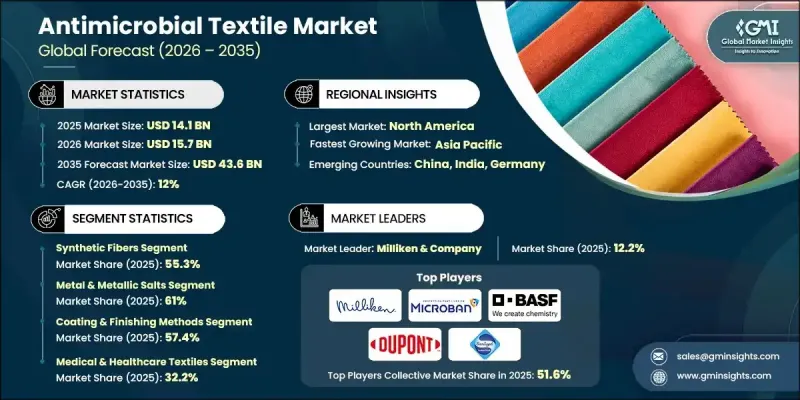
市场成长主要受个人卫生和感染预防意识的提高以及消费者对安全耐用布料的需求所驱动。製造商正越来越多地在纺织品中添加抗菌剂,以提高耐用性、抑制微生物滋生并减少异味。合成纤维因其优异的耐用性、吸湿排汗性能以及易于涂覆先进抗菌涂层而占据市场主导地位。天然纤维因其舒适性、透气性和可生物降解性而迅速受到关注,预计2035年将占据超过30%的市场。虽然许多技术纺织品使用季铵化合物和三氯生等合成化合物,但对永续性的重视正在推动对生物基抗菌剂的需求激增。医疗保健应用是最大的细分市场,其次是服装、家居和商业以及特殊纺织品。北美凭藉其先进的医疗保健系统引领着抗菌剂的应用,而欧洲则专注于卫生和永续性。同时,亚太地区由于其强大的纺织製造业基础和不断提高的医疗保健标准,成长速度最快。
| 市场覆盖范围 | |
|---|---|
| 开始年份 | 2025 |
| 预测年份 | 2026-2035 |
| 起始值 | 141亿美元 |
| 预测金额 | 436亿美元 |
| 复合年增长率 | 12% |
预计到 2025 年,合成纤维市占率将达到 55.3%,到 2035 年将以 13.2% 的复合年增长率成长。其耐用性、吸湿排汗性和与先进抗菌涂层的兼容性等性能增强特性,使其成为运动服、医用纺织品和技术面料的理想选择。
预计到2025年,涂层和整理製程领域将占据57.4%的市场份额,并在2035年之前以11%的复合年增长率成长。这些后处理后处理可将抗菌剂均匀分布在织物表面,以防止细菌滋生。它们对天然纤维、合成纤维和混纺纤维均有效,并广泛应用于医疗保健、服装和家居用品等领域。
预计到2025年,北美抗菌纺织品市场规模将达45亿美元。先进的医疗基础设施、严格的卫生法规以及消费者日益增强的感染预防意识正在推动抗菌纺织品的普及。医院、实验室和运动服装製造商是抗菌纺织品的主要消费群体,这促使功能性纺织品和后整理技术不断创新,以保持市场动态。
目录
第一章调查方法和范围
第二章执行摘要
第三章业界考察
- 生态系分析
- 供应商情况
- 利润率
- 每个阶段的附加价值
- 影响价值链的因素
- 中断
- 产业影响因素
- 司机
- 全球对卫生管理和感染控制的关注度日益提高
- 医疗和医院感染预防
- 产业潜在风险与挑战
- 高昂的生产和加工成本
- 监管和环境安全问题
- 市场机会
- 环保天然抗菌剂
- 运动服、休閒服和家用纺织品市场成长
- 司机
- 成长潜力分析
- 监管环境
- 北美洲
- 欧洲
- 亚太地区
- 拉丁美洲
- 中东和非洲
- 波特五力分析
- PESTEL 分析
- 价格趋势
- 按地区
- 依纤维类型
- 未来市场趋势
- 科技与创新趋势
- 当前技术趋势
- 新兴技术
- 专利状态
- 贸易统计(HS编码)(註:仅提供主要国家的贸易统计)
- 主要进口国
- 主要出口国
- 永续性和环境方面
- 永续努力
- 减少废弃物策略
- 生产中的能源效率
- 环保倡议
- 考虑到碳足迹
第四章 竞争情势
- 介绍
- 公司市占率分析
- 按地区
- 北美洲
- 欧洲
- 亚太地区
- 拉丁美洲
- 中东和非洲
- 按地区
- 企业矩阵分析
- 主要市场公司的竞争分析
- 竞争定位矩阵
- 重大进展
- 併购
- 伙伴关係与合作
- 新产品发布
- 业务拓展计划
第五章 按布料类型分類的市场估算与预测,2022-2035年
- 天然纤维
- 棉布
- 羊毛
- 丝绸
- 其他天然纤维
- 合成纤维
- 聚酯纤维
- 聚酰胺(尼龙)
- 聚丙烯
- 其他合成纤维
- 混纺布料
第六章 抗菌剂市场估算与预测(2022-2035年)
- 金属和金属盐
- 银和银奈米粒子
- 铜和氧化铜
- 氧化锌
- 二氧化钛
- 其他金属杀菌剂
- 合成有机化合物
- 季铵化合物(QACs)
- 三氯生
- 聚六亚甲基双胍(PHMB)
- N-卤胺
- 氯己定
- 其他合成化合物
- 生物基製剂
- 几丁聚醣
- 植物萃取物
- 精油
- 木质素
- 其他天然系药物
7. 按表面处理技术分類的市场估算与预测,2022-2035 年
- 涂层和表面处理方法
- 垫干固化
- 喷涂
- 浸涂
- 其他的
- 融入纺织品製造过程
- 熔融纺丝
- 静电纺丝
- 其他的
- 表面改质技术
- 化学接枝
- 电浆治疗
- 溶胶-凝胶法
- 逐层堆迭法
- 其他的
第八章 依最终用途分類的市场估算与预测,2022-2035年
- 医疗和保健纺织品
- 服装与时尚
- 家用纺织品
- 商业和工业纺织品
- 技术和特殊应用
第九章 2022-2035年各地区市场估算与预测
- 北美洲
- 美国
- 加拿大
- 欧洲
- 德国
- 英国
- 法国
- 西班牙
- 义大利
- 其他欧洲地区
- 亚太地区
- 中国
- 印度
- 日本
- 澳洲
- 韩国
- 亚太其他地区
- 拉丁美洲
- 巴西
- 墨西哥
- 阿根廷
- 其他拉丁美洲地区
- 中东和非洲
- 沙乌地阿拉伯
- 南非
- 阿拉伯聯合大公国
- 其他中东和非洲地区
第十章:公司简介
- BASF SE
- Clariant AG
- DuPont de Nemours Inc.
- Fuji Chemical Industries, Ltd.
- Indorama Ventures Public Company Limited
- Milliken &Company
- Microban International
- Polygiene AB
- Sanitized AG
- The Dow Chemical Company
The Global Antimicrobial Textile Market was valued at USD 14.1 billion in 2025 and is estimated to grow at a CAGR of 12% to reach USD 43.6 billion by 2035.
The market growth is fueled by rising awareness of hygiene, infection control, and consumer demand for safe, long-lasting fabrics. Manufacturers are increasingly embedding antimicrobial agents into textiles to enhance durability, prevent microbial growth, and reduce odor. Synthetics dominate the market due to their superior durability, moisture management, and adaptability to advanced antimicrobial coatings. Natural fibers are rapidly gaining traction for their comfort, breathability, and biodegradability, and are expected to capture over 30% of the market by 2035. While many technical textiles utilize synthetic compounds such as Quaternary Ammonium Compounds and Triclosan, demand for bio-based antimicrobial agents is surging with the emphasis on sustainability. Medical and healthcare applications remain the largest segment, followed by apparel, home, commercial, and specialty textiles. North America leads adoption due to advanced healthcare systems, Europe focuses on hygiene and sustainability, while Asia-Pacific grows fastest because of strong textile manufacturing and rising healthcare standards.
| Market Scope | |
|---|---|
| Start Year | 2025 |
| Forecast Year | 2026-2035 |
| Start Value | $14.1 Billion |
| Forecast Value | $43.6 Billion |
| CAGR | 12% |
The synthetic fibers segment held a 55.3% share in 2025 and is projected to grow at a CAGR of 13.2% through 2035. Their performance-enhancing features, including durability, moisture control, and compatibility with advanced antimicrobial coatings, make them ideal for sportswear, hospital textiles, and technical fabrics.
The coatings and finishing methods segment held 57.4% share in 2025 and is expected to grow at a CAGR of 11% by 2035. These post-manufacturing treatments distribute antimicrobial agents evenly across fabric surfaces, protecting against bacterial growth and working effectively with natural, synthetic, and blended textiles for applications spanning healthcare, clothing, and home products.
North America Antimicrobial Textile Market generated USD 4.5 billion in 2025. Adoption is driven by advanced healthcare infrastructure, stringent hygiene regulations, and growing consumer awareness about infection prevention. Hospitals, laboratories, and sportswear manufacturers are primary consumers, prompting continued innovation in functional fibers and finishing technologies to sustain market dynamics.
Major players operating in the Global Antimicrobial Textile Market include BASF SE, Clariant AG, DuPont de Nemours Inc., Fuji Chemical Industries, Ltd., Indorama Ventures Public Company Limited, Milliken & Company, Microban International, Polygiene AB, Sanitized AG, and The Dow Chemical Company. To strengthen their presence, companies in the Antimicrobial Textile Market are focusing on strategic R&D investments to develop sustainable, high-performance fibers and coatings, expanding their product portfolios to cover diverse end-use applications, and forging collaborations with textile manufacturers and healthcare institutions. They are also prioritizing geographic expansion into emerging regions, adopting digital marketing and e-commerce channels to reach broader audiences, and implementing advanced manufacturing technologies to enhance production efficiency and cost-effectiveness.
Table of Contents
Chapter 1 Methodology & Scope
- 1.1 Market scope and definition
- 1.2 Research design
- 1.2.1 Research approach
- 1.2.2 Data collection methods
- 1.3 Data mining sources
- 1.3.1 Global
- 1.3.2 Regional/Country
- 1.4 Base estimates and calculations
- 1.4.1 Base year calculation
- 1.4.2 Key trends for market estimation
- 1.5 Primary research and validation
- 1.5.1 Primary sources
- 1.6 Forecast model
- 1.7 Research assumptions and limitations
Chapter 2 Executive Summary
- 2.1 Industry 3600 synopsis
- 2.2 Key market trends
- 2.2.1 Regional
- 2.2.2 Fabric Type
- 2.2.3 Antimicrobial Agent
- 2.2.4 Finishing Technique
- 2.2.5 End Use
- 2.3 TAM Analysis, 2025-2034
- 2.4 CXO perspectives: Strategic imperatives
- 2.4.1 Executive decision points
- 2.4.2 Critical success factors
- 2.5 Future Outlook and Strategic Recommendations
Chapter 3 Industry Insights
- 3.1 Industry ecosystem analysis
- 3.1.1 Supplier landscape
- 3.1.2 Profit margin
- 3.1.3 Value addition at each stage
- 3.1.4 Factor affecting the value chain
- 3.1.5 Disruptions
- 3.2 Industry impact forces
- 3.2.1 Growth drivers
- 3.2.1.1 Rising global focus on hygiene and infection control
- 3.2.1.2 Healthcare and hospital-acquired infection prevention
- 3.2.2 Industry pitfalls and challenges
- 3.2.2.1 High production and treatment costs
- 3.2.2.2 Regulatory and environmental safety concerns
- 3.2.3 Market opportunities
- 3.2.3.1 Eco-friendly and natural antimicrobial agents
- 3.2.3.2 Growth in activewear, sportswear, home-textiles
- 3.2.1 Growth drivers
- 3.3 Growth potential analysis
- 3.4 Regulatory landscape
- 3.4.1 North America
- 3.4.2 Europe
- 3.4.3 Asia Pacific
- 3.4.4 Latin America
- 3.4.5 Middle East & Africa
- 3.5 Porter's analysis
- 3.6 PESTEL analysis
- 3.7 Price trends
- 3.7.1 By region
- 3.7.2 By fiber type
- 3.8 Future market trends
- 3.9 Technology and Innovation landscape
- 3.9.1 Current technological trends
- 3.9.2 Emerging technologies
- 3.10 Patent Landscape
- 3.11 Trade statistics (HS code) ( Note: the trade statistics will be provided for key countries only)
- 3.11.1 Major importing countries
- 3.11.2 Major exporting countries
- 3.12 Sustainability and environmental aspects
- 3.12.1 Sustainable practices
- 3.12.2 Waste reduction strategies
- 3.12.3 Energy efficiency in production
- 3.12.4 Eco-friendly initiatives
- 3.13 Carbon footprint consideration
Chapter 4 Competitive Landscape, 2025
- 4.1 Introduction
- 4.2 Company market share analysis
- 4.2.1 By region
- 4.2.1.1 North America
- 4.2.1.2 Europe
- 4.2.1.3 Asia Pacific
- 4.2.1.4 LATAM
- 4.2.1.5 MEA
- 4.2.1 By region
- 4.3 Company matrix analysis
- 4.4 Competitive analysis of major market players
- 4.5 Competitive positioning matrix
- 4.6 Key developments
- 4.6.1 Mergers & acquisitions
- 4.6.2 Partnerships & collaborations
- 4.6.3 New Product Launches
- 4.6.4 Expansion Plans
Chapter 5 Market Estimates and Forecast, By Fabric Type, 2022-2035 (USD Billion) (Kilo Tons)
- 5.1 Key trends
- 5.2 Natural Fibers
- 5.2.1 Cotton
- 5.2.2 Wool
- 5.2.3 Silk
- 5.2.4 Other Natural Fibers
- 5.3 Synthetic Fibers
- 5.3.1 Polyester
- 5.3.2 Polyamide (Nylon)
- 5.3.3 Polypropylene
- 5.3.4 Other Synthetic Fibers
- 5.4 Blended Fabrics
Chapter 6 Market Estimates and Forecast, By Antimicrobial Agent, 2022-2035 (USD Billion) (Kilo Tons)
- 6.1 Key trends
- 6.2 Metal & Metallic Salts
- 6.2.1 Silver & Silver Nanoparticles
- 6.2.2 Copper & Copper Oxide
- 6.2.3 Zinc Oxide
- 6.2.4 Titanium Dioxide
- 6.2.5 Other Metallic Agents
- 6.3 Synthetic Organic Compounds
- 6.3.1 Quaternary Ammonium Compounds (QACs)
- 6.3.2 Triclosan
- 6.3.3 Polyhexamethylene Biguanide (PHMB)
- 6.3.4 N-Halamines
- 6.3.5 Chlorhexidine
- 6.3.6 Other Synthetic Compounds
- 6.4 Bio-Based Agents
- 6.4.1 Chitosan
- 6.4.2 Plant Extracts
- 6.4.3 Essential Oils
- 6.4.4 Lignin
- 6.4.5 Other Natural Agents
Chapter 7 Market Estimates and Forecast, By Finishing Technique, 2022-2035 (USD Billion) (Kilo Tons)
- 7.1 Key trends
- 7.2 Coating & Finishing Methods
- 7.2.1 Pad-Dry-Cure
- 7.2.2 Spray Coating
- 7.2.3 Dip Coating
- 7.2.4 Others
- 7.3 Incorporation during Fiber Production
- 7.3.1 Melt Spinning
- 7.3.2 Electrospinning
- 7.3.3 Others
- 7.4 Surface Modification Techniques
- 7.4.1 Chemical Grafting
- 7.4.2 Plasma Treatment
- 7.4.3 Sol-Gel Process
- 7.4.4 Layer-by-Layer Assembly
- 7.4.5 Others
Chapter 8 Market Estimates and Forecast, By End Use, 2022-2035 (USD Billion) (Kilo Tons)
- 8.1 Key trends
- 8.2 Medical & Healthcare Textiles
- 8.3 Apparel & Fashion
- 8.4 Home Textiles
- 8.5 Commercial & Industrial Textiles
- 8.6 Technical & Specialty End uses
Chapter 9 Market Estimates and Forecast, By Region, 2022-2035 (USD Billion) (Kilo Tons)
- 9.1 Key trends
- 9.2 North America
- 9.2.1 U.S.
- 9.2.2 Canada
- 9.3 Europe
- 9.3.1 Germany
- 9.3.2 UK
- 9.3.3 France
- 9.3.4 Spain
- 9.3.5 Italy
- 9.3.6 Rest of Europe
- 9.4 Asia Pacific
- 9.4.1 China
- 9.4.2 India
- 9.4.3 Japan
- 9.4.4 Australia
- 9.4.5 South Korea
- 9.4.6 Rest of Asia Pacific
- 9.5 Latin America
- 9.5.1 Brazil
- 9.5.2 Mexico
- 9.5.3 Argentina
- 9.5.4 Rest of Latin America
- 9.6 Middle East and Africa
- 9.6.1 Saudi Arabia
- 9.6.2 South Africa
- 9.6.3 UAE
- 9.6.4 Rest of Middle East and Africa
Chapter 10 Company Profiles
- 10.1 BASF SE
- 10.2 Clariant AG
- 10.3 DuPont de Nemours Inc.
- 10.4 Fuji Chemical Industries, Ltd.
- 10.5 Indorama Ventures Public Company Limited
- 10.6 Milliken & Company
- 10.7 Microban International
- 10.8 Polygiene AB
- 10.9 Sanitized AG
- 10.10 The Dow Chemical Company

 日本抗菌纤维市场规模、份额、趋势和预测:按活性成分、应用和地区划分,2026-2034年
 2026年全球抗菌服饰市场报告2026年全球抗菌纺织品市场报告
 除臭功能纤维市场:2026-2032年全球预测(按材料类型、技术、价格范围、应用和通路)抗菌纺织品市场:依活性成分、材料类型、功能、通路和最终用户划分-2025-2032年全球预测2025-2033年抗菌纺织品市场报告(布料、活性剂、应用和地区)
 2032年抗菌纺织品市场预测:按织物类型、活性成分、整理技术、应用和地区进行的全球分析
 抗菌纤维市场规模、份额、成长分析,按活性剂、按织物、按应用、按地区 - 按行业预测,2024-2031 年