


 |
市场调查报告书
商品编码
1913439
工业地坪涂料市场机会、成长要素、产业趋势分析及预测(2026年至2035年)Industrial Floor Coatings Market Opportunity, Growth Drivers, Industry Trend Analysis, and Forecast 2026 - 2035 |
||||||

全球工业地板涂料市场预计到 2025 年将达到 61 亿美元,到 2035 年将达到 123 亿美元,年复合成长率为 7.2%。
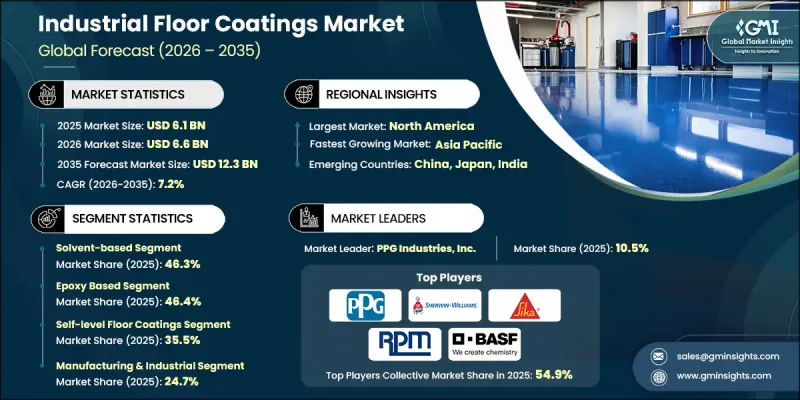
市场成长的驱动力来自各行业对高性能、耐用地板材料日益增长的需求,以及对永续涂料解决方案的转变。各行业越来越多地采用水性、低VOC、生物基树脂涂料,以减少对环境的影响,改善室内空气质量,并维持耐久性和耐化学性标准。由于其零VOC、优异的耐化学性和在重负荷应用中更长的使用寿命,100%固含量配方,尤其是在环氧树脂和聚脲系统中,正成为日益流行的趋势。
| 市场覆盖范围 | |
|---|---|
| 开始年份 | 2025 |
| 预测年份 | 2026-2035 |
| 起始值 | 61亿美元 |
| 预测金额 | 123亿美元 |
| 复合年增长率 | 7.2% |
由于其成本效益和优异的耐化学性,环氧基涂料预计到2025年将占据46.4%的市场份额。同时,整个产业部门都在优先考虑高性能且符合环保要求的解决方案,以满足营运和监管要求。
预计到2025年,溶剂型涂料将占据46.3%的市场份额,并在2035年之前以6.8%的复合年增长率成长。虽然这类涂料具有优异的附着力和耐久性,但日益严格的法规和高挥发性有机化合物(VOC)含量正逐渐促使市场需求转向更环保的替代品。环氧基涂料仍然是最大的市场份额,这反映出它们在重工业生产和仓储领域的持续应用。同时,聚氨酯基涂料体系在需要柔软性、抗紫外线和抗热衝击性的应用领域,尤其是在户外和高温环境下,正日益受到认可。
预计2025年,北美工业地板涂料市场规模将达23亿美元。该地区拥有成熟的工业基础、先进的基础设施以及严格的环境和职业安全法规,这些都是推动市场成长的因素。低VOC和环保涂料的普及,以及老旧工业设施、仓库和生产车间的维修和现代化改造,持续推动市场扩张。此外,监管机构对卫生、安全和永续性的日益重视,也进一步刺激了该地区对先进涂料解决方案的需求。
目录
第一章调查方法和范围
第二章执行摘要
第三章业界考察
- 生态系分析
- 供应商情况
- 利润率
- 每个阶段的附加价值
- 影响价值链的因素
- 中断
- 产业影响因素
- 司机
- 製造和仓储设施的需求不断增长
- 扩大卫生地板材料在食品和製药行业的应用
- 产业潜在风险与挑战
- 先进涂层技术的前期投资和安装成本较高
- 在极端温度和重负载应用中的效能限制
- 市场机会
- 工业设施自动化程度的提高将推动对地板材料的需求。
- 随着基础设施现代化,新兴经济体实现成长。
- 司机
- 成长潜力分析
- 监管环境
- 北美洲
- 欧洲
- 亚太地区
- 拉丁美洲
- 中东和非洲
- 波特五力分析
- PESTEL 分析
- 价格趋势
- 按地区
- 依树脂类型
- 未来市场趋势
- 科技与创新趋势
- 当前技术趋势
- 新兴技术
- 专利状态
- 贸易统计(HS编码)(註:仅提供主要国家的贸易统计)
- 主要进口国
- 主要出口国
- 永续性和环境方面
- 永续努力
- 减少废弃物策略
- 生产中的能源效率
- 环保倡议
- 考虑到碳足迹
第四章 竞争情势
- 介绍
- 公司市占率分析
- 按地区
- 北美洲
- 欧洲
- 亚太地区
- 拉丁美洲
- 中东和非洲
- 按地区
- 企业矩阵分析
- 主要市场公司的竞争分析
- 竞争定位矩阵
- 重大进展
- 併购
- 伙伴关係与合作
- 新产品发布
- 业务拓展计划
第五章 依製剂类型分類的市场估算与预测,2022-2035年
- 溶剂型
- 水溶液
- 100%固体
第六章 依树脂类型分類的市场估算与预测,2022-2035年
- 环氧树脂基
- 聚氨酯基
- MMA
- 聚天门冬胺酸和聚脲
- 其他的
第七章 按技术分類的市场估计与预测,2022-2035年
- 自流平
- 高填充/抹刀流量
- 薄膜
- 广播/骨材
第八章 依最终用途分類的市场估算与预测,2022-2035年
- 製造业和工业领域
- 一般製造业
- 金属加工
- 其他的
- 仓储/物流
- 食品/饮料
- 加工厂
- 生产设施
- 其他的
- 製药和生物技术
- 医疗设施
- 医院
- 研究所
- 汽车製造
- 航太航太
- 电子和半导体
- 商业和零售
- 其他(教育机构和政府/军事设施)
第九章 2022-2035年各地区市场估算与预测
- 北美洲
- 美国
- 加拿大
- 欧洲
- 德国
- 英国
- 法国
- 西班牙
- 义大利
- 其他欧洲地区
- 亚太地区
- 中国
- 印度
- 日本
- 澳洲
- 韩国
- 亚太其他地区
- 拉丁美洲
- 巴西
- 墨西哥
- 阿根廷
- 其他拉丁美洲地区
- 中东和非洲
- 沙乌地阿拉伯
- 南非
- 阿拉伯聯合大公国
- 其他中东和非洲地区
第十章:公司简介
- Akzo Nobel NV
- Axalta Coating Systems, LLC
- BASF SE
- Hempel A/S
- Jotun A/S
- MAPEI SpA
- PPG Industries, Inc.
- RPM International Inc.
- Sika AG
- The Sherwin-Williams Company
The Global Industrial Floor Coatings Market was valued at USD 6.1 billion in 2025 and is estimated to grow at a CAGR of 7.2% to reach USD 12.3 billion by 2035.
Market growth is driven by the rising demand for high-performance, durable flooring across industrial sectors and the shift toward sustainable coating solutions. Industries are increasingly adopting water-based, low-VOC, and bio-based resin coatings to reduce environmental impact, improve indoor air quality, and maintain durability and chemical resistance standards. The trend toward 100% solids formulations, especially in epoxy and polyurea systems, is gaining traction due to their zero-VOC benefits, superior chemical resistance, and extended service life in heavy-duty applications.
| Market Scope | |
|---|---|
| Start Year | 2025 |
| Forecast Year | 2026-2035 |
| Start Value | $6.1 Billion |
| Forecast Value | $12.3 Billion |
| CAGR | 7.2% |
The epoxy-based coatings segment accounted for a 46.4% share in 2025 owing to their cost-effectiveness and strong chemical resistance, while the overall industrial sector is prioritizing high-performance, environmentally compliant solutions to meet both operational and regulatory requirements.
The solvent-based coatings captured 46.3% share in 2025 and are anticipated to grow at a CAGR of 6.8% by 2035. While these coatings offer excellent adhesion and durability, demand is gradually shifting toward environmentally friendly alternatives due to stricter regulations and higher VOC content. Epoxy-based coatings remain the largest segment, reflecting their continued use in heavy-production and storage areas, whereas polyurethane-based systems are gaining traction for applications requiring flexibility, UV resistance, and thermal shock tolerance, especially in outdoor or high-temperature environments.
North America Industrial Floor Coatings Market generated USD 2.3 billion in 2025. The region benefits from a well-established industrial base, advanced infrastructure, and strict environmental and worker safety regulations. Adoption of low-VOC, environmentally compliant coatings, coupled with refurbishment and modernization of aging industrial facilities, warehouses, and production plants, continues to support market expansion. Regulatory emphasis on hygiene, safety, and sustainability is further driving demand for advanced coating solutions in the region.
Key players operating in the Global Industrial Floor Coatings Market include Akzo Nobel N.V., Axalta Coating Systems, LLC, BASF SE, Hempel A/S, Jotun A/S, MAPEI S.p.A., PPG Industries, Inc., RPM International Inc., Sika AG, and The Sherwin-Williams Company. Companies in the Global Industrial Floor Coatings Market are adopting multiple strategies to reinforce their market presence and growth. These include developing eco-friendly and low-VOC formulations, enhancing product performance with advanced chemical resistance, and expanding geographic reach to emerging industrial hubs. Firms focus on innovation in water-based, 100% solids, and polyurethane systems to meet diverse industrial needs. Collaborations with construction and industrial service providers improve market access, while refurbishment projects in existing industrial facilities boost adoption.
Table of Contents
Chapter 1 Methodology & Scope
- 1.1 Market scope and definition
- 1.2 Research design
- 1.2.1 Research approach
- 1.2.2 Data collection methods
- 1.3 Data mining sources
- 1.3.1 Global
- 1.3.2 Regional/Country
- 1.4 Base estimates and calculations
- 1.4.1 Base year calculation
- 1.4.2 Key trends for market estimation
- 1.5 Primary research and validation
- 1.5.1 Primary sources
- 1.6 Forecast model
- 1.7 Research assumptions and limitations
Chapter 2 Executive Summary
- 2.1 Industry 3600 synopsis
- 2.2 Key market trends
- 2.2.1 Regional
- 2.2.2 Formulation Type
- 2.2.3 Resin Type
- 2.2.4 Technology
- 2.2.5 End Use
- 2.3 TAM Analysis, 2025-2034
- 2.4 CXO perspectives: Strategic imperatives
- 2.4.1 Executive decision points
- 2.4.2 Critical success factors
- 2.5 Future Outlook and Strategic Recommendations
Chapter 3 Industry Insights
- 3.1 Industry ecosystem analysis
- 3.1.1 Supplier landscape
- 3.1.2 Profit margin
- 3.1.3 Value addition at each stage
- 3.1.4 Factor affecting the value chain
- 3.1.5 Disruptions
- 3.2 Industry impact forces
- 3.2.1 Growth drivers
- 3.2.1.1 Growing demand from manufacturing and warehouse facilities
- 3.2.1.2 Rising adoption of hygienic floors in food and pharma sectors
- 3.2.2 Industry pitfalls and challenges
- 3.2.2.1 High initial investment and installation costs for advanced coatings
- 3.2.2.2 Limited performance in extreme temperatures or heavy-load applications
- 3.2.3 Market opportunities
- 3.2.3.1 Adoption of automation in industrial facilities enhances flooring demand
- 3.2.3.2 Growth in emerging economies with infrastructure modernization
- 3.2.1 Growth drivers
- 3.3 Growth potential analysis
- 3.4 Regulatory landscape
- 3.4.1 North America
- 3.4.2 Europe
- 3.4.3 Asia Pacific
- 3.4.4 Latin America
- 3.4.5 Middle East & Africa
- 3.5 Porter's analysis
- 3.6 PESTEL analysis
- 3.7 Price trends
- 3.7.1 By region
- 3.7.2 By resin type
- 3.8 Future market trends
- 3.9 Technology and Innovation landscape
- 3.9.1 Current technological trends
- 3.9.2 Emerging technologies
- 3.10 Patent Landscape
- 3.11 Trade statistics (HS code) (Note: the trade statistics will be provided for key countries only)
- 3.11.1 Major importing countries
- 3.11.2 Major exporting countries
- 3.12 Sustainability and environmental aspects
- 3.12.1 Sustainable practices
- 3.12.2 Waste reduction strategies
- 3.12.3 Energy efficiency in production
- 3.12.4 Eco-friendly initiatives
- 3.13 Carbon footprint consideration
Chapter 4 Competitive Landscape, 2025
- 4.1 Introduction
- 4.2 Company market share analysis
- 4.2.1 By region
- 4.2.1.1 North America
- 4.2.1.2 Europe
- 4.2.1.3 Asia Pacific
- 4.2.1.4 LATAM
- 4.2.1.5 MEA
- 4.2.1 By region
- 4.3 Company matrix analysis
- 4.4 Competitive analysis of major market players
- 4.5 Competitive positioning matrix
- 4.6 Key developments
- 4.6.1 Mergers & acquisitions
- 4.6.2 Partnerships & collaborations
- 4.6.3 New Product Launches
- 4.6.4 Expansion Plans
Chapter 5 Market Estimates and Forecast, By Formulation type, 2022-2035 (USD Billion) (Kilo Tons)
- 5.1 Key trends
- 5.2 Solvent-Based
- 5.3 Water-Based
- 5.4 100% Solids
Chapter 6 Market Estimates and Forecast, By Resin type, 2022-2035 (USD Billion) (Kilo Tons)
- 6.1 Key trends
- 6.2 Epoxy-Based
- 6.3 Polyurethane-Based
- 6.4 MMA
- 6.5 Polyaspartic & Polyurea
- 6.6 Others
Chapter 7 Market Estimates and Forecast, By Technology, 2022-2035 (USD Billion) (Kilo Tons)
- 7.1 Key trends
- 7.2 Self-Leveling
- 7.3 High-Build/Trowel
- 7.4 Thin-Film
- 7.5 Broadcast/Aggregate
Chapter 8 Market Estimates and Forecast, By End Use, 2022-2035 (USD Billion) (Kilo Tons)
- 8.1 Key trends
- 8.2 Manufacturing & Industrial
- 8.2.1 General Manufacturing
- 8.2.2 Metal Working
- 8.2.3 Others
- 8.3 Warehousing & Logistics
- 8.4 Food & Beverage
- 8.4.1 Processing Plants
- 8.4.2 Production Facilities
- 8.4.3 Others
- 8.5 Pharmaceutical & Biotech
- 8.6 Healthcare Facilities
- 8.6.1 Hospitals
- 8.6.2 Laboratories
- 8.7 Automotive Manufacturing
- 8.8 Aerospace & Aviation
- 8.9 Electronics & Semiconductor
- 8.10 Commercial & Retail
- 8.11 Others (educational institutes and government & military facilities)
Chapter 9 Market Estimates and Forecast, By Region, 2022-2035 (USD Billion) (Kilo Tons)
- 9.1 Key trends
- 9.2 North America
- 9.2.1 U.S.
- 9.2.2 Canada
- 9.3 Europe
- 9.3.1 Germany
- 9.3.2 UK
- 9.3.3 France
- 9.3.4 Spain
- 9.3.5 Italy
- 9.3.6 Rest of Europe
- 9.4 Asia Pacific
- 9.4.1 China
- 9.4.2 India
- 9.4.3 Japan
- 9.4.4 Australia
- 9.4.5 South Korea
- 9.4.6 Rest of Asia Pacific
- 9.5 Latin America
- 9.5.1 Brazil
- 9.5.2 Mexico
- 9.5.3 Argentina
- 9.5.4 Rest of Latin America
- 9.6 Middle East and Africa
- 9.6.1 Saudi Arabia
- 9.6.2 South Africa
- 9.6.3 UAE
- 9.6.4 Rest of Middle East and Africa
Chapter 10 Company Profiles
- 10.1 Akzo Nobel N.V.
- 10.2 Axalta Coating Systems, LLC
- 10.3 BASF SE
- 10.4 Hempel A/S
- 10.5 Jotun A/S
- 10.6 MAPEI S.p.A.
- 10.7 PPG Industries, Inc.
- 10.8 RPM International Inc.
- 10.9 Sika AG
- 10.10 The Sherwin-Williams Company

 地板涂料市场:2026-2032年全球市场预测(依树脂类型、类别、应用方法及用途划分)
 全球工业地坪涂料市场规模、份额、趋势及成长分析报告:2026-2034年
 2026年全球工业地板涂料市场报告
 工业地坪涂料市场规模、份额及成长分析(按类型、成分、地板材料、应用及地区划分)-2026-2033年产业预测
 地板涂料市场规模、份额和成长分析(按黏合剂类型、涂料成分、地板结构、配方、最终用户和地区划分)—2026-2033年产业预测
 地板配件:全球市场份额和排名、总收入和需求预测(2025-2031年)
 2025-2033年地板涂料市场报告,按黏合剂类型、涂料组成(单组分、双组分、三组分)、地板结构、配方、最终用户和地区划分
 地板配件市场按产品类型、材料、最终用户、分销管道和地区划分
 地板化学品市场机会、成长动力、产业趋势分析及 2025 - 2034 年预测
 地板涂料的全球市场:类别,地板类别,各终端用户业界,各地区,机会,预测,2018年~2032年